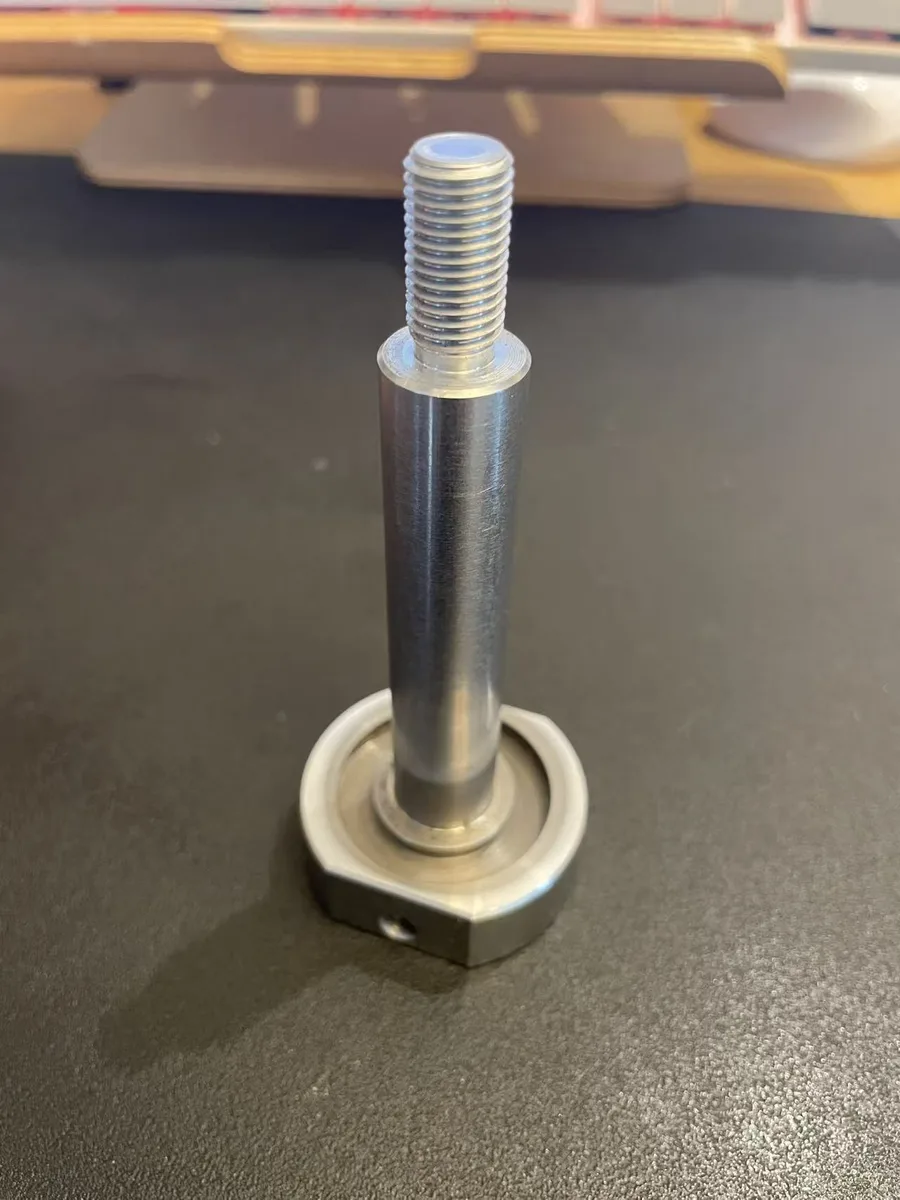
What the Part Is
It is a shoulder bolt with a special head. Read from the top down: an M8 thread; a face where the thread meets the shoulder; a plain Ø10 shoulder that makes up most of the length; a narrow step at the root of the shoulder; and a round base turned from the same piece, with an annular recess in its top face, a flat on its side and a tapped hole through that flat. The material is 304 stainless (1.4301), left in its machined finish. The customer did not say what machine it goes into, and we do not publish that.
| Feature | This part | ISO 7379 shoulder bolt |
|---|---|---|
| Thread | M8 | M8 for a Ø10 shoulder, the same |
| Shoulder | Ø10, plain | Ø10, tolerance f9 |
| Head | Round base, recessed top face, one flat, tapped cross hole | Hexagon socket head; no flat, no side hole |
| Construction | One piece | One piece |
| Material / finish | 304 stainless, natural | Usually alloy steel 12.9, black oxide; stainless in fewer sizes |
The table shows where the part stops being standard: the top two rows match the catalogue, the head row does not. The six names below come from people reading one row or the other.
Why Machinists Gave It Six Names
Each guess named the part after the feature that stood out to the person making it. That is why the guesses disagree, and why most of them are partly right.
| Name | Feature it reads | Where it fits | Where it does not |
|---|---|---|---|
| Shoulder bolt (shoulder screw, stripper bolt) | A plain shank ending in a face, thread smaller than the shank | M8 on Ø10 is the exact ISO 7379 pairing | ISO 7379 has a socket head; this part has a base |
| Upside-down shoulder bolt | The wide part at the bottom, the thread at the top | Describes the layout | Not a trade name; no supplier lists it |
| Axle bolt | A long plain shank something could turn on | The Ø10 shoulder can carry a roller or lever | Only if something runs on it in service, which the customer did not say |
| Shank-fit bolt (fitted bolt, DIN 609) | A shank closely fitted in its hole | The shank is the precise feature | DIN 609 puts a Ø9 shank on M8 with a hex head; this part has Ø10 and a base |
| Sealing shoulder screw (stem bolt) | The recess, read as an O-ring groove | There is an annular recess in the base | It is in the top face of the base; whether a seal sits in it depends on the assembly, which was not shared |
| Actuator shaft (or a pivot with a grease nipple) | The tapped side hole, read as a lube point or spring seat | A tapped cross hole is how a grease nipple or set screw is fitted | What goes into the hole belongs to the assembly, not the part |
It is not a stud: a stud is threaded at both ends. For a purchase order the name that works is “shoulder bolt with special head, to drawing”. The name gets the request to a supplier who makes shoulder bolts; the drawing defines the part.
The Top Half Is Standard. The Bottom Half Is Not.
Because M8 on a Ø10 shoulder is the ISO 7379 pairing, the thread and shoulder could come off a shelf. The base cannot: ISO 7379 fixes the head as a hexagon socket, and no catalogue offers a shoulder bolt with a recessed base, a flat and a tapped cross hole. That leaves three ways to get the part.
| Route | What it needs | Where it fails | Verdict |
|---|---|---|---|
| Stock ISO 7379 shoulder bolt, M8 × Ø10 | Nothing, ships from stock | Socket head; no base, no recess, no flat, no side hole | Does not fit |
| Stock shoulder bolt fastened into a separately machined base | A second part and a joint between them | The joint can loosen, and the shoulder is only as square to the base as the joint holds it | Only where the drawing allows two pieces |
| One piece turned from 304 bar, this case | Bar large enough for the base; thread, shoulder and base from the same bar | Nothing on the assembly changes | What the drawing asks for |
The drawing for this part shows one piece, so the second route was not open. Where a drawing does allow two pieces, it is worth asking which one is cheaper: the answer depends on the base diameter, covered in the next section.
What One Piece Means for the Cost
A one-piece part starts as a bar the size of its largest diameter. Here that is the base, not the Ø10 shoulder, so most of the bar along the shoulder is turned away. The wider the base and the longer the shoulder, the more material goes to chips, and in stainless that is a real part of the price.
- The bar is set by the base. A base twice the shoulder diameter means the shoulder section removes about three-quarters of the bar there.
- The flat and the cross hole are side features. A turned part needs either a lathe with driven tools or a second setup to put a flat and a tapped hole in its side.
- What it buys you: no joint between shoulder and base, so nothing to loosen and no stack-up between the two.
Why 304, and Why No Plating
The part is 304 stainless in its natural finish. Three points to know before ordering a similar part:
- No coating on the shoulder. A plated shoulder grows by the coating thickness, which matters on a locating diameter. Bare stainless keeps the shoulder at its machined size. The shine in the photo is bare 304, not chrome.
- Stainless on stainless galls. If the M8 thread goes into a stainless tapped hole or nut, use an anti-seize compound, or a different grade on the mating part.
- Other grades from the same drawing: 316L (1.4404) for chlorides or washdown; an alloy steel such as 42CrMo4 when the shoulder carries load and can be hardened or plated after machining.
When to Buy From a Catalogue Instead
Most shoulder bolts should be bought, not made. The line falls at the head, as this part shows.
| What you need | In the catalogue? | What happens |
|---|---|---|
| Socket-head shoulder bolt, Ø10 × a listed length, M8, alloy steel | Yes, stocked | Buy it from stock. A machined one-off will not match a catalogue price, and we say so in the quote. |
| The same in stainless A2 | In common sizes, from some suppliers | Check stock first. |
| A shoulder diameter or length between the catalogue steps | No | Turned to your size, see custom shoulder bolts. |
| A head the standard does not have: a base, a flange, flats, a cross hole | No | Turned in one piece to the drawing, this case. |
What to Send for a Part Like This
A shoulder bolt with a special head is quoted from these numbers. If one is missing we ask for it before quoting rather than guess it.
- Thread: size, pitch if fine, and thread length.
- Shoulder: diameter with its tolerance, and its length.
- Base: diameter, height, the recess (diameter and depth), and where the flat sits.
- Cross hole: thread size, depth, and its position relative to the flat and the base face.
- Material, finish and quantity. One piece is a normal order.
A drawing is best. A dimensioned sketch works for a part this simple, and so does an old part posted to us. The quote goes out within 12 hours with a drawing for you to confirm before anything is cut.