What Is a Clevis End?
A clevis end is the fork of a clevis joint. The slot takes a flat tab, a rod eye or a bracket, and a pin or screws through both prongs hold it in place. The shank at the other end joins the fork to whatever pushes or pulls it. Buyers use several names for the same family, and the names differ mainly by the shank:
| Name | Shank | Typical use |
|---|---|---|
| Clevis rod end | Threaded, male or female | Cylinder rods, linkages, turnbuckles |
| Tube clevis, tube clevis end | Plain spigot that goes into or over a tube, then is bonded, welded or pinned | Struts and push rods made from tube |
| Clevis fitting, clevis end fitting | Swaged or threaded onto wire rope or a rod | Rigging, turnbuckles, guy lines |
| Clevis pin | None. It is the pin, not the fork | Closes any of the above, see custom clevis pins |
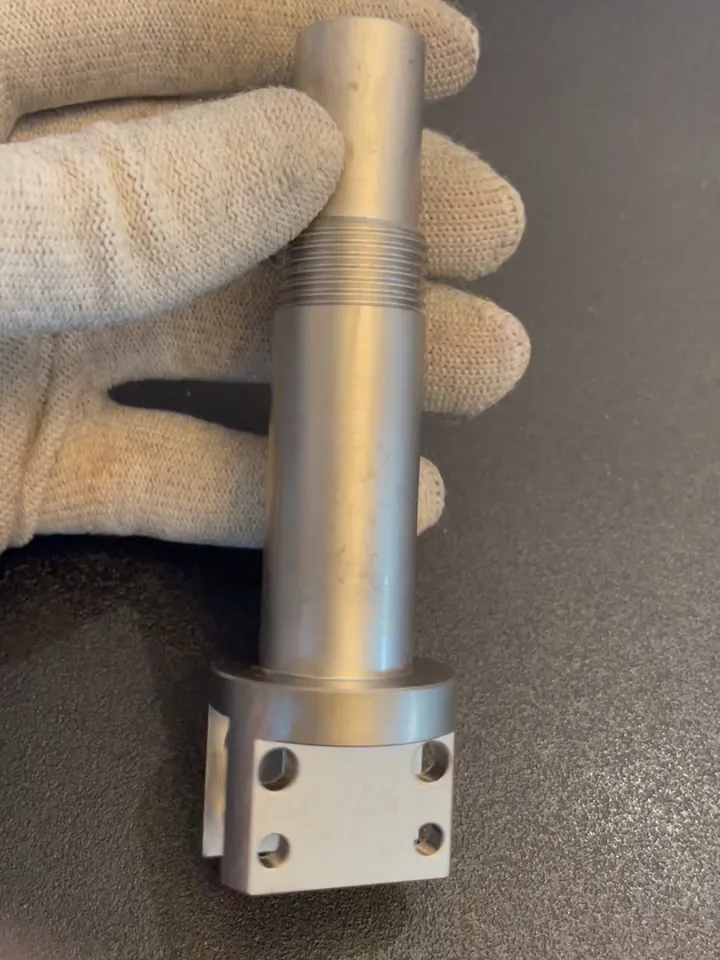
The part on this page has a plain hollow shank with no thread, so it belongs to the tube clevis type. On a purchase order, “titanium clevis end, hollow shank, to drawing” reaches the right supplier. The drawing defines the part.
This Titanium Clevis End
| Feature | This part |
|---|---|
| Material | Titanium, natural finish, no coating |
| Overall length | 115 mm |
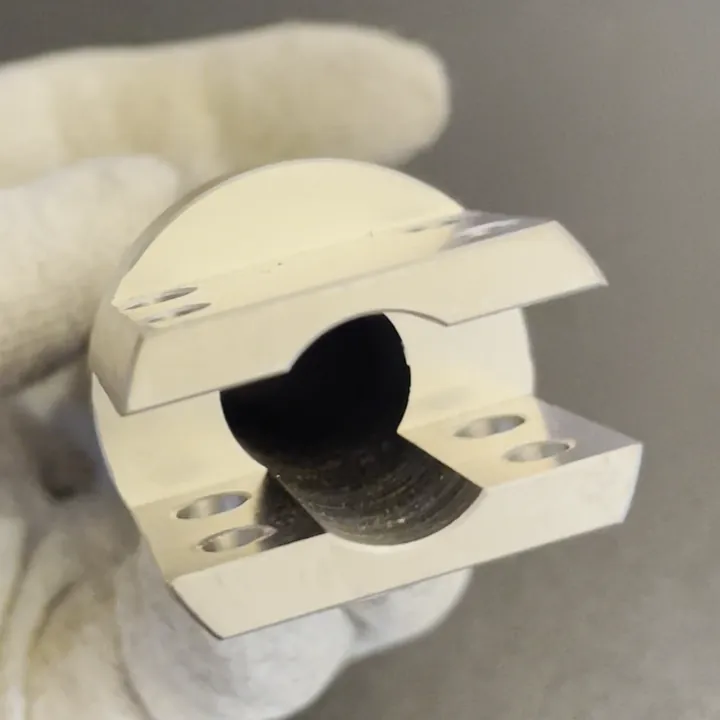
| Shank | Ø12 outside, hollow, Ø10 bore, so the wall is 1 mm |
| Grooves | A band of annular grooves near the open end. Rings, not a thread |
| Collar | Round collar where the shank meets the head |
| Clevis head | Two prongs with flat outer faces either side of a straight slot. The bore opens at the bottom of the slot |
| Holes | 4 plain holes in each prong, 8 in all, not tapped |
| Quantity | 10 pieces |
The rings near the open end are often taken for a thread. They are grooves: each ring closes on itself and nothing screws onto them. If your clevis end needs a thread instead, that is a separate line on the drawing.
Why Make a Clevis End in Titanium?
A clevis end sits at the end of a moving rod or strut, so its weight and its resistance to corrosion count. Compared with the usual catalogue materials:
| Material | Density (g/cm³) | Corrosion | When it is the right choice |
|---|---|---|---|
| Titanium, Grade 5 (Ti-6Al-4V) or Grade 2 | about 4.4 to 4.5 | Does not rust, resists seawater and chlorides | Weight matters, or the part sits outdoors or near salt water |
| Carbon or alloy steel, plated | about 7.85 | Rusts once the plating wears | Lowest cost, high load, dry location |
| Stainless 304 or 316 | about 7.9 to 8.0 | Good, 316 for chlorides | Corrosion matters, weight does not |
| Aluminium 6061 or 7075 | about 2.7 to 2.8 | Good when anodised | Lightest, lower strength and wear resistance |
For the same geometry, a titanium clevis end weighs a little over half as much as a steel one. Two things to settle before ordering.
The first is the grade. Grade 5 (Ti-6Al-4V) is the strong grade used for most machined fittings. Grade 2 is commercially pure titanium, softer and easier to form. Name the grade on the drawing, or tell us the load and we propose one.
The second is what the part touches. A titanium pin turning in titanium holes can gall, so where the joint moves under load, use a pin in another material or a bushing in the holes. A titanium shank fixed into an aluminium tube in a wet location causes galvanic corrosion of the aluminium. Seal the joint or keep the two metals apart.
What We Can Change on a Custom Clevis End
Every feature on this part is a dimension on the drawing, so each one can be set to your assembly. The shank can be solid or hollow, with any outside diameter, bore and length. Its end can be plain, grooved like this one, threaded male or female, or cross-drilled for a pin. The collar can be resized or left off. The slot width and depth follow your tab or rod eye, and the head can carry one cross hole for a clevis pin or a pattern of holes, plain or tapped.
Materials are titanium Grade 5 or Grade 2, 304 or 316 stainless, 6061 or 7075 aluminium and alloy steel. The minimum order is one piece. This batch was 10.
A hollow shank limits one thing: the thinner the wall, the less room there is for a thread. A thread cut into a 1 mm wall like this one leaves almost nothing under it. If the shank needs a thread, size the bore so the wall under the thread still carries the load.
Buy From a Catalogue or Have It Made?
| What you need | In the catalogue? | What to do |
|---|---|---|
| Steel or stainless clevis rod end, standard thread and pin size | Yes, stocked | Buy it from stock. A machined one-off will not match the catalogue price, and we say so in the quote. |
| A clevis end in titanium | Rarely | Made to order from 1 piece |
| A hollow shank, a tube spigot, or a shank size between catalogue steps | No | Made to your diameter and bore |
| Your own slot width or hole pattern | No | Made to the drawing, as in this case |
What to Send for a Clevis End Quote
- Shank diameter, the bore if it is hollow, overall length, and what is on the end of the shank.
- Slot width and depth, prong thickness, and the collar if there is one.
- Hole sizes and positions, and whether they are plain or tapped.
- Material and grade, finish and quantity.
- If you can share it, what goes in the slot and what the shank fits into.
A drawing is best. A dimensioned sketch or a sample posted to us also works for a part like this. The quote goes out within 12 hours, with a drawing for you to confirm before anything is cut. For titanium parts in general, see custom titanium CNC parts.