Need a trapezoidal lead screw nut in a form the catalogue does not carry, or a nut for a screw you already have? Catalogue Tr nuts are plain round or hex bronze in the single-start ISO sizes. We make lead screw nuts in five forms, round flange, two-flat flange, block, plain round and plastic anti-backlash, in bronze or plastic, to the lead and starts of any screw in our Ø4 to Ø24 range or of the screw you send, from one piece. No drawing needed: a photo with a rule, the measurements in a message, the old part or its part number is enough; we draw it, you approve, we machine. Get a quote →
Five nut forms, and where each one mounts
EKINSUN LTD is a custom parts manufacturer that makes trapezoidal lead screws and the nuts that run on them to the buyer's drawing, from one piece. The nut is the half of the pair that carries the load and wears, so it is the softer metal and the part that gets replaced. Its outside is dictated by the housing, which is why a catalogue nut so rarely fits: the flange has to match a hole circle, the block has to match a slot, the round body has to pilot in a bore.
| Nut form | Mounts | Typical use | In the photos |
|---|---|---|---|
| Round flange nut | Flange bolted to the housing on a hole circle, body piloted in the bore | Machine slides, lifting columns, presses | Photos 1 and 2 below |
| Two-flat flange nut | Same, with two flats on the flange where the housing is narrow | Compact slides, stacked axes | — |
| Block nut | Square or rectangular body in a slot, clamped or pinned | Carriages, cross-slides, vice-type mechanisms | Photo 4 |
| Plain round nut | Pressed, pinned or set-screwed into a bore | Handwheel feeds, adjusters, instrument slides | — |
| Plastic anti-backlash nut | Two halves with a spring, flange or body mounted | Positioning stages, measuring slides, small actuators | Photo 3 |
| Split half nut | Two halves that close on the screw | Lathe carriages | Lathe half nuts |
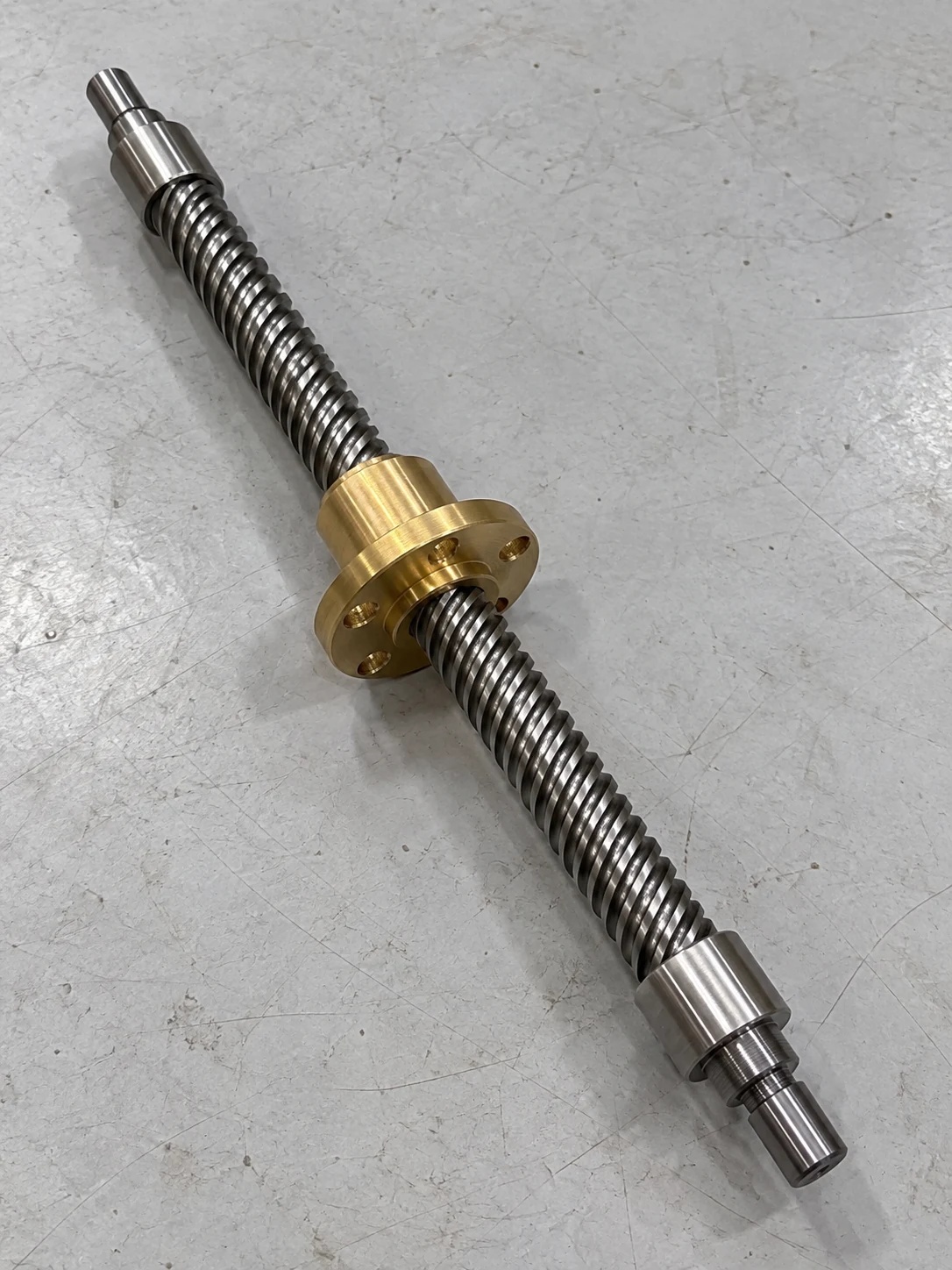
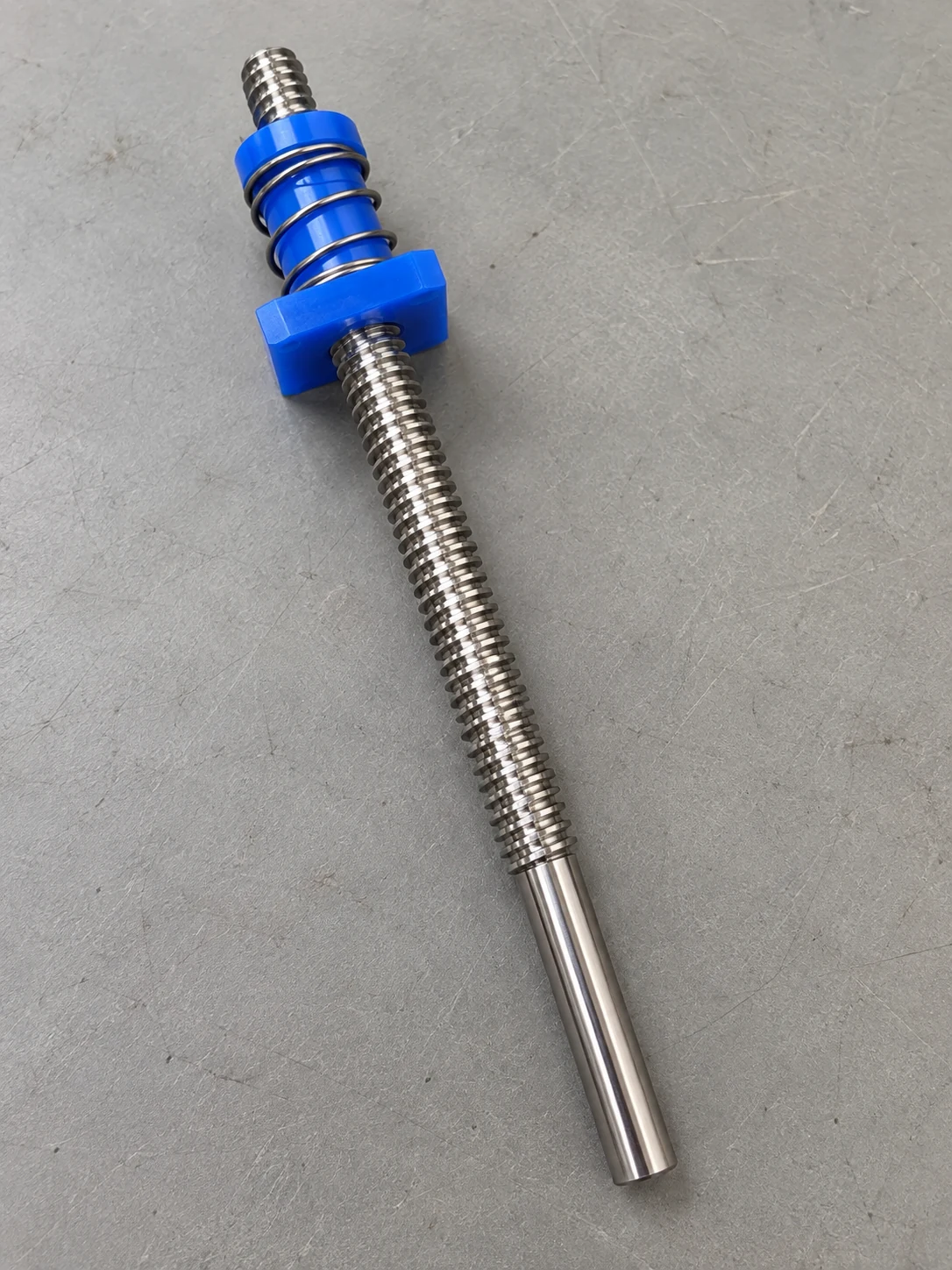
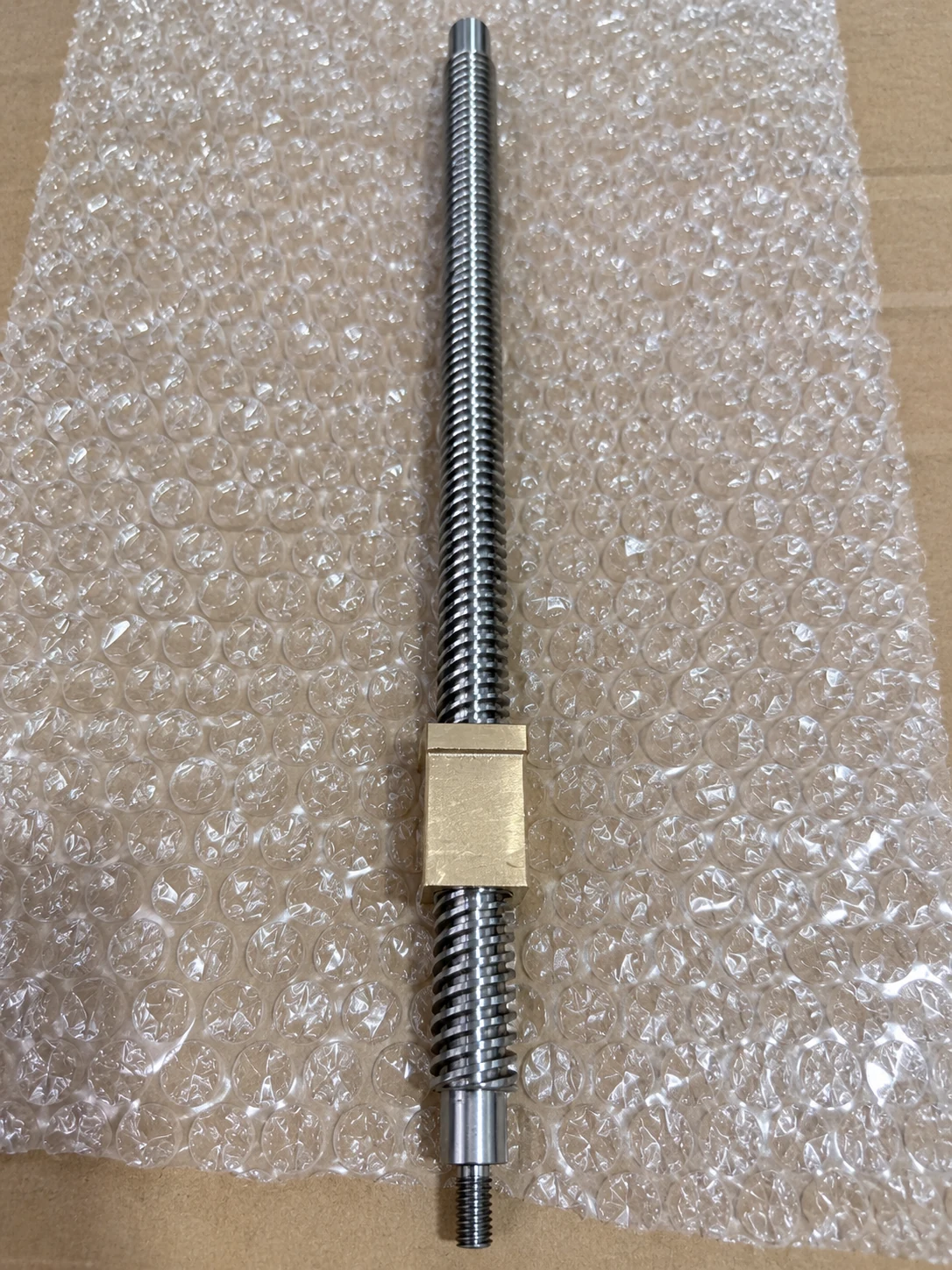
The flange nut drawing: what each letter is
Our flange nut drawing carries the thread bore, the body diameter D with an h8 fit so the body pilots in the housing bore, the flange diameter and thickness T, the overall length A, the hole circle P.C.D. with four holes spaced at 30° from the centreline, 0.5 mm chamfers on the edges and a 0.4 mm fillet under the flange. The two-flat version adds the width W across the flats. Send those figures, or send the housing, and the drawing comes back for approval before machining.
| Letter on the drawing | Means | You give us |
|---|---|---|
| d | Thread: outside Ø, lead, pitch, starts, hand of the screw | The screw callout, or the screw |
| D h8 | Body diameter, piloting in the housing bore | Bore diameter of the housing |
| Flange Ø and T | Flange diameter and thickness | Space on the housing face |
| A | Overall length of the nut | Space along the screw; longer nut, more thread in contact |
| P.C.D. | Hole circle for the mounting holes | Hole circle and hole size of the housing, number of holes |
| W | Width across the two flats of the flange | Width of the housing |
| C0.5, R0.4 | Chamfers and the fillet under the flange | As drawn unless you say otherwise |
Bronze or plastic: what the efficiency column says
The size chart gives the efficiency of every screw twice, with a bronze nut and with a plastic nut, and the plastic nut is about ten points higher on every row because it runs with less friction. That gain is also the reason to be careful: a plastic nut on a two-start Ø12 screw is over the 50 % line and will let a load turn the screw back, where the bronze nut on the same screw holds. Bronze takes load, heat and years of machine-tool duty; plastic is quiet, needs no oil and suits light loads at speed.
| Screw | Bronze nut | Plastic nut | Which holds a load |
|---|---|---|---|
| Ø8 × 1.5 (P1.5) | 24 % | 42 % | Both |
| Ø10 × 2 (P2) | 25 % | 36 % | Both |
| Ø12 × 3 (P3) | 30 % | 41 % | Both |
| Ø12 × 6 (P3, 2 starts) | 45 % | 58 % | Bronze only |
| Ø16 × 4 (P4) | 30 % | 41 % | Both |
| Ø16 × 8 (P4, 2 starts) | 45 % | 58 % | Bronze only |
| Ø20 × 4 (P4) LH | 25 % | 35 % | Both |
| Ø20 × 16 (P4, 4 starts) | 55 % | 67 % | Neither |
| Ø24 × 5 (P5) | 26 % | 36 % | Both |
The screw the nut runs on is bearing steel as standard, stainless or carbon steel on request; the table gives the pairings we make.
| Material | Where it is used | Note |
|---|---|---|
| Bearing steel 100Cr6 (GCr15, SAE 52100) | Standard screw material for every size in the Ø4 to Ø24 range | Machine tools, semiconductor equipment, instruments, conveyors |
| Stainless steel 304 (1.4301) | Screws in wet, washdown, food and lab equipment | On request; the screw with the plastic nut in the photos |
| Carbon steel C45 (1.0503) | General machinery and large screws to drawing | On request |
| Aluminium 6061 | Light hand-feed and instrument screws where weight matters more than wear | With a bronze or plastic nut |
| Bronze CuSn12 nut | Load, heat and long machine-tool duty | The bronze column of the chart |
| Plastic nut (POM) | Quiet, self-lubricating, light load, higher efficiency | The plastic column; anti-backlash version with a spring |
A nut for a screw you already have
Three measurements identify the screw: the outside diameter with a caliper, ten thread crests with a rule for the pitch, and the number of thread starts counted on the end face. Lead is pitch times starts. If the screw is worn, the unworn end gives the size the nut must be cut to, and the nut is made to that, not to the worn middle. Send the screw and the nut comes back run onto it; send photos and the callout comes back for you to confirm. Nuts for ACME screws with the 29° flank are made the same way, on the ACME page.
What to specify
| Item | Say | Example |
|---|---|---|
| Thread | Outside Ø, lead, pitch or starts, hand | Ø16 × 4, single start, RH |
| Form | Round flange, two-flat flange, block, plain round, anti-backlash | Round flange, 4 holes |
| Material | Bronze or plastic; brass on request | Bronze |
| Mounting | Bore, hole circle, hole size, slot width, or the housing drawing | Body Ø28 h8, P.C.D. 44, 4 × Ø5.5 |
| Length | Overall length of the nut | 40 mm |
| With the screw? | Yes or no; if yes, the screw length and ends | Yes, 500 long, journals Ø10 h6 |
Price, lead time, delivery
There is no list price for a lead screw made to your length and ends; a single piece starts from €25 and is quoted within 12 hours from the callout: outside diameter, lead, pitch, starts, hand, length, the ends, and whether a nut goes with it. One to a few dozen pieces ship in 5 working days, 50 to 500 in 15 working days, delivered DDP to your door with duties in the quote. The first piece is the sample; repeat orders run to the same drawing, and 500-piece and 1,000-piece runs are priced lower per piece. The screw is bearing steel unless the order says stainless 304 or carbon steel C45; the nut is bronze unless the order says plastic; the grades go on the drawing.
Where the nut catalogue stops
| What you need | In the catalogue? | What to do |
|---|---|---|
| Plain round or hex bronze nut, ISO single-start size | Yes | Buy it there, or ask us |
| Flange nut drilled to my hole circle | No | Made to the housing |
| Two-flat flange nut | No | Made to the housing width |
| Block nut for a slot | No | Made to the slot |
| Nut for a two-, four- or six-start screw | No | Cut to the lead and starts |
| Plastic anti-backlash nut for an existing screw | Rare | Made to the screw you send |
| Left-hand nut | Rare | Cut left-hand with or without the screw |
| Nut for a Ø60 to Ø300 screw | No | Made to drawing with the screw |
Related lead screw pages
Frequently asked
Which nut forms do you make for trapezoidal lead screws?
Round flange nuts with a hole circle for the housing, two-flat flange nuts for a narrow housing, block nuts with a square or rectangular outside for a slot, plain round nuts that are pressed or pinned into a bore, and plastic anti-backlash nuts with a spring between two halves. Split half nuts for lathes are on the half-nut page.
Can you make a nut for a lead screw I already have?
Yes. Send the screw, or a photo with a rule across ten thread crests and a photo of the end face to count the starts. We measure outside diameter, pitch and starts, cut the nut to that lead and run it on your screw before shipping. A worn screw is gauged at its unworn end.
Bronze or plastic?
Bronze for load, machine-tool duty and long life; plastic for quiet, self-lubricating, light-load travel and where the higher efficiency is wanted. On a Ø12 × 3 screw a bronze nut runs at 30 % efficiency and a plastic nut at 41 %; both hold a load. On a Ø12 × 9 three-start screw they are at 54 % and 66 % and both back-drive.
What is an anti-backlash nut?
Two nut halves on the same screw pushed apart by a spring, so each half bears on the opposite flank of the thread and the play between screw and nut is taken up; the nut in the photo is the plastic version with a coil spring. It is used where the carriage must not shift when the load reverses, on measuring slides and small positioning stages.
What goes on the drawing of a flange nut?
Thread callout with hand, body diameter and its fit, h8 where the body pilots in a bore, flange diameter and thickness, overall length, hole circle diameter with hole size and count, and chamfers. For the two-flat version the width across the flats. If you have only the housing, send its bore, the hole circle and the space, and we draw the nut to it.
Who makes lead screw nuts one at a time, and what do they cost?
EKINSUN, from one piece; a nut is quoted within 12 hours from the thread callout and the form, and a screw-and-nut pair from €25 for the screw plus the nut. Bronze and plastic are both stocked bar; the nut is machined to the lead of your screw.
Send the screw callout and the housing. "Ø16 × 4 RH, round flange, bronze, body Ø28 h8, P.C.D. 44 with 4 holes Ø5.5, 40 long, 2 pieces", or the old nut and a photo of the screw with a rule. Quote in 12 hours, MOQ 1. Get a quote →