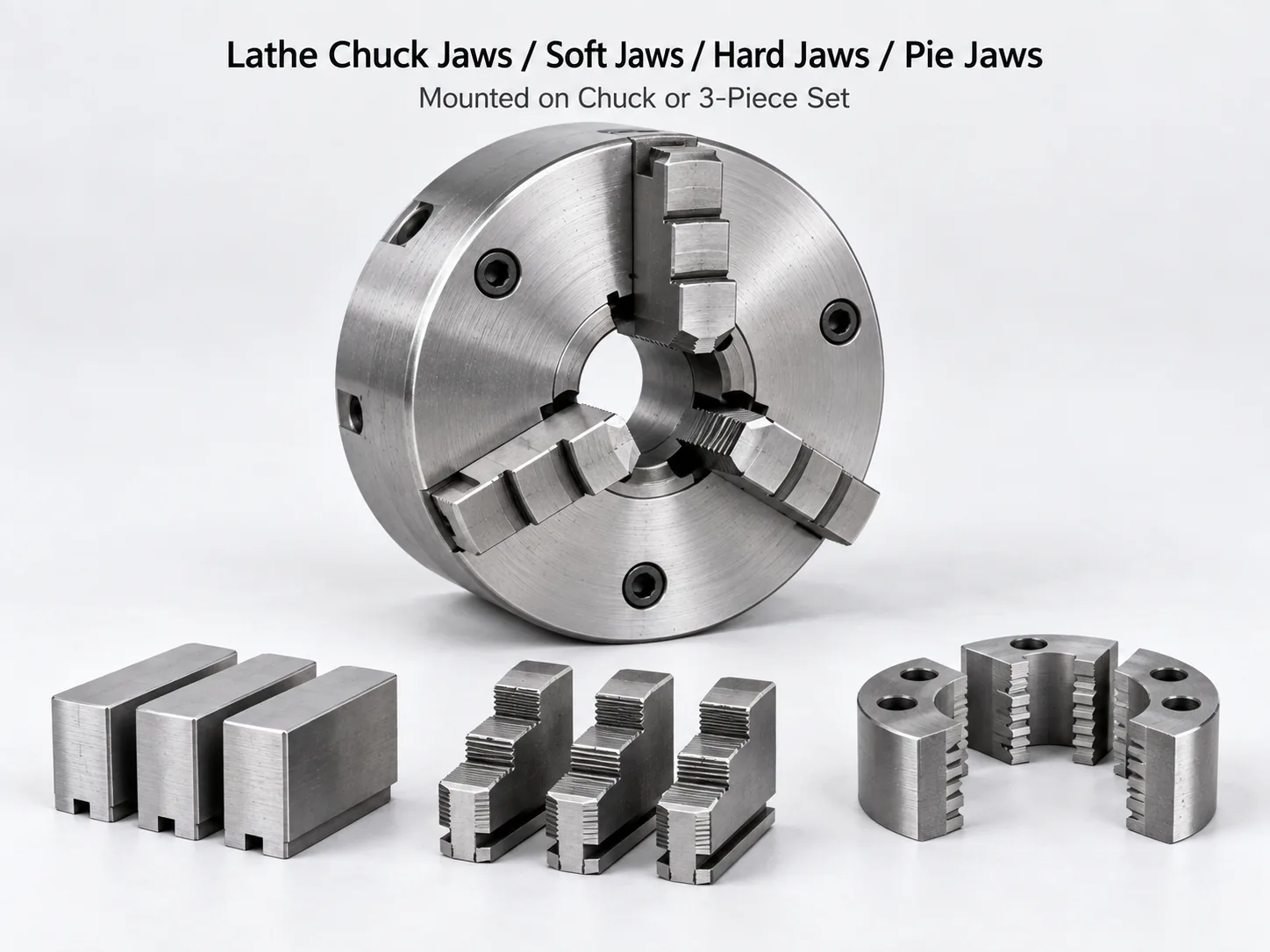
A jaw has to fit two things, and most enquiries only mention one
Every jaw enquiry arrives describing the workpiece: the diameter, the wall thickness, the finish that must not be marked. That is the right information, and it is half of the job.
The other half decides whether the jaws are usable at all, and it is almost never in the first email:
- Will it fit your chuck or vice? The mounting face — serration pitch and angle, or tongue-and-groove form, or bolt spacing on a milling vice. Get this wrong and the jaw is scrap the moment it arrives, no matter how good the gripping profile is.
- Will it hold your part? The gripping profile — diameter, step, contact arc, whether it grips outside or inside.
So the shortest possible enquiry is one old jaw plus one workpiece drawing. With the old jaw in front of us there is nothing left to get wrong about the first question, and everything else is machining.
Will it fit your chuck? The mounting form
Chuck jaws locate on a serrated or grooved face and are held by two screws. The serration has both a pitch and an included angle, and both have to match — a jaw with the right pitch and the wrong angle will sit on the tips of the teeth, rock under load, and hammer the master jaw.
| Mounting form | Where you meet it | What we need |
|---|---|---|
| Serrated, 1.5 mm pitch × 60° | The common metric form on European and Asian lathe chucks | Confirm the pitch and angle, or send one old jaw |
| Serrated, 3/32 in pitch × 90° | The common imperial form on US chucks | Confirm, or send one old jaw |
| Other serration forms | They exist — older chucks and some makers use their own | Send a jaw. Guessing from a photograph is not reliable at this pitch |
| Tongue and groove | Heavier chucks and some power chucks; a machined key instead of teeth | The old jaw, or the groove width, depth and centre distance |
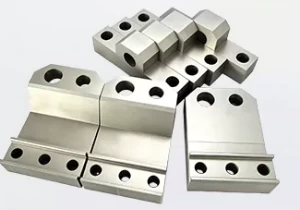
| Bolt-on milling vice jaws | Kurt-style and equivalent machine vices | Vice make and jaw width, or the screw centres and jaw plate thickness |
| Fixture jaws with no standard at all | Purpose-built workholding | Your fixture drawing, or the base plate itself |
Need soft jaws, hard jaws and pie jaws in a size, thread or material no catalogue lists? EKINSUN is a custom parts manufacturer: we make soft jaws, hard jaws and pie jaws to your drawing, sketch or sample — 6061 or 7075 aluminium, steel or POM — from 1 piece, quoted in 12 hours and shipped duties paid. Standard sizes can often be supplied from stock; the more pieces, the lower the unit price. How ordering without CAD works →
Two practical notes that save a return. Chuck jaws are a numbered, matched set — 1, 2 and 3 go into their own slots because the scroll engages at a different point in each; put them back in the wrong slots and the chuck loses concentricity. And jaws are cut as a set from one programme in one setup, so the three are identical to each other rather than each being identical to a drawing. Order one replacement jaw for a set of three and you have a set of three that no longer match.
Soft jaws or hard jaws?
The names describe the material, but the real difference is when the gripping profile gets made.
- Soft jaws arrive as blanks. You bolt them on and machine the gripping profile in your own chuck. That is the point of them: the bore is cut by the same spindle that will hold the part, so it is concentric with that spindle by construction, not by luck. Mild steel or aluminium, and they are consumable.
- Hard jaws arrive finished, with the profile already cut, hardened to 58–62 HRC. They last, they do not need a boring operation before every job, and they hold their form through a long run. The profile has to be right before they ship, which is why they are cut — after hardening — rather than milled and then heat treated.
The rough decision rule: a job you will run once or twice takes soft jaws; a job that comes back every month takes hard jaws. The crossover is not about quantity in a single batch, it is about how many times you will have to set up again.
Why soft jaws have to be bored in place — and under pressure
This is the technique that separates soft jaws that hold round parts from soft jaws that produce oval ones, and it is where most of the trouble comes from.
A three-jaw chuck deflects when it grips. The master jaws move, the scroll takes up its clearance, the jaw bodies bend slightly. If you bore the soft jaws with the chuck relaxed and then clamp a part at working pressure, the bore you cut is no longer the shape the jaws make when they close on the job.
So the soft jaws are bored while the chuck is loaded the same way it will be loaded in service:
- For gripping outside diameters, the jaws are pushed outward against a boring ring or a slug at the working clamp pressure, then bored. The chuck is then already deflected in the same direction and by the same amount as it will be when the workpiece is in.
- For gripping inside a bore, the jaws are clamped inward onto a slug at working pressure, and the outside gripping diameter is turned in that state.
- The clamp pressure matters as much as the direction. Bore at 10 bar and run at 25 bar and the jaws close further than the bore you cut.
We supply soft jaws as blanks with enough stock on the gripping face for you to do this properly. If you would rather we bored them, we can — but then we need to know your chuck, your clamp pressure and your jaw position, because we are simulating your machine, and a jaw bored to a nominal diameter on our machine is worth no more than a bought one.
When three jaws are themselves the problem
Grip a thin-walled ring in three standard jaws and measure the bore afterwards: it is three-lobed. The jaws are pushing at three points on something that has no hoop stiffness to resist them, and the part springs back out of round the moment it is released — usually after you have bored it round while it was distorted.
The answer is contact area, not less force:
- Pie jaws (full-grip jaws) — each jaw is a 120° segment, so the three together wrap almost the whole circumference. The load is spread instead of concentrated, and the ring stays round. These are bored in place like any soft jaw, at working pressure.
- ID jaws — grip from inside the bore and machine the outside, so the clamping load pushes outward against a shape that resists it better.
- Jaws with a soft insert pocket — a pocket cut into the gripping face for copper, brass, aluminium or UHMW, so the jaw grips through something softer than the finished surface.
All three are cut the same way and cost roughly the same as the plain version. The reason they are not on a shelf is that the wrap angle and the step have to match your part.
Where the standard range stops
| What you need | In the catalogue? | What we do |
|---|---|---|
| Soft jaw blanks for a current chuck, standard serration | Yes — stocked and cheap | Buy them from stock — no one-off can match that price, and we will say so in the quote. Standard parts: ask us too — we may have them in stock. |
| Soft jaws for a milling vice in a common width | Yes | Buy them — unless the gripping form is the point, in which case see the rows below. Standard parts: ask us too — we may have them in stock. |
| Jaws for a chuck that is no longer made | No | Copied from one old jaw. This is the single most common reason people ring us about jaws |
| Hard jaws with the gripping profile already cut | Standard steps only | Profile cut after hardening at 58–62 HRC, so the form does not move in the furnace |
| Pie / full-grip jaws for a thin-walled ring | Rare, and only in stock sizes | Wrap angle and step cut to your ring, so the part comes out round instead of three-lobed |
| ID jaws to grip inside a bore | Sometimes | Cut to your bore, with the step where your part allows it |
| Jaws profiled to a casting or a forging | No | Cut from your sample or a scan — see parts from a sample |
| Non-marring jaws for anodised or plated parts | Sometimes, in aluminium | Aluminium jaws, or steel jaws with a pocket for a soft insert you can replace |
| An extra jaw to replace one broken jaw of three | n/a | Honest answer: replace the set. Jaws are cut as a matched set, so a single new jaw will not match the two survivors |
Materials
| Material | Hardness | Where it belongs |
|---|---|---|
| 1018 / 1045 mild steel | As supplied | The default soft jaw blank. Cheap, machines cleanly when you bore it in place, consumable |
| 4140 / 42CrMo4 pre-hardened | 28–32 HRC | Soft jaws that have to survive a long run without picking up, still machinable in your chuck |
| 8620 case-hardened | Case 58–62 HRC | Hard face over a tough core, for jaws that take shock as well as wear |
| D2 / 1.2379 | 58–62 HRC | Hard jaws in abrasive service — castings, forging scale, sand |
| 6061-T6 aluminium | — | Non-marring jaws for anodised, plated or polished parts. Light, so less centrifugal loss at speed |
| 7075-T6 aluminium | — | Where an aluminium jaw still has to be stiff under clamp load |
| 304 / 1.4301 stainless | — | Food, pharma and washdown fixtures where a steel jaw would rust into the work |
| Copper, brass or UHMW inserts | — | Not a jaw, a replaceable face — pocketed into a steel jaw so the softest thing touching the part is the cheapest thing to replace |
What to send
No CAD needed. The two things that make a jaw order go right are physical: one old jaw and one workpiece, or photographs of both with a rule in shot. See ordering with no CAD and ordering from a sketch.
- One jaw from the existing set — or the chuck make, model and size, and the serration pitch and angle if you are certain of them.
- The workpiece — gripping diameter, wall thickness, how much length is available to grip, and which surfaces must not be marked.
- Outside or inside grip, and whether the part is a thin ring.
- Soft blanks or finished hard jaws. If hard, we need the finished gripping dimension; if soft, we leave stock and you bore them.
- Chuck clamp pressure and jaw position — only if you want us to bore them, because then we are reproducing your machine's deflection.
- How many sets. MOQ is one set.
Quote in 12 hours. Related: precision fixtures and locating details, replacement machine parts, cutting hardened and intricate parts, obsolete part reproduction.
Frequently asked questions
Only if the mounting form matches, and that is the half of the order people forget to specify. Chuck jaws locate on a serrated face with both a pitch and an included angle, and both have to be right - a jaw with the correct pitch and the wrong angle sits on the tips of the teeth and rocks under load. The two forms you meet most often are 1.5 mm pitch at 60 degrees on metric chucks and 3/32 inch at 90 degrees on imperial ones, but others exist, and tongue-and-groove mounting is common on heavier chucks. Send one old jaw and there is nothing left to get wrong.
The difference is when the gripping profile is made. Soft jaws arrive as blanks and you machine the profile in your own chuck, so the bore is concentric with the spindle that will hold the part by construction rather than by luck; they are consumable. Hard jaws arrive finished at 58 to 62 HRC with the profile already cut, so they hold their form through a long run and need no boring at each setup. The rule of thumb is not batch size but setup count: a job you run once or twice takes soft jaws, a job that comes back every month takes hard jaws.
Almost always because they were bored with the chuck relaxed. A chuck deflects when it grips - the master jaws move, the scroll takes up its clearance, the jaw bodies bend - so a bore cut with no load is not the shape the jaws make when they close on a workpiece. Soft jaws have to be bored while the chuck is loaded the same way it will be in service: pushed outward against a boring ring at the working clamp pressure for outside gripping, clamped inward on a slug for inside gripping. The pressure matters as much as the direction; bore at 10 bar and run at 25 and the jaws close past your bore.
Pie jaws, also called full-grip jaws. Three standard jaws push at three points on a part that has no hoop stiffness to resist them, so the bore comes out three-lobed - and it will look round while it is still clamped, which is what makes it expensive to discover. Pie jaws are 120 degree segments that between them wrap almost the whole circumference, spreading the same clamp load instead of concentrating it. They are bored in place at working pressure like any soft jaw. ID jaws that grip from inside the bore are the other answer.
Yes, and it is the most common reason people ring us about jaws. Send one jaw from the existing set - just one is enough, because the three are identical - and we work from that: serration pitch and angle, screw centres, body form and step. If every jaw is broken or missing, send the chuck itself or a clear photograph of the master jaw face with a rule across it, and we will tell you whether we can read the form well enough to cut it.
Yes, and for hard jaws that is the only sensible order. Heat treatment moves steel, so a profile milled before hardening comes out of the furnace slightly off, and there is nothing to grind an internal step back against. Spark erosion is indifferent to hardness - 62 HRC cuts at the same rate as annealed - and applies no cutting force at all, so a slender jaw does not spring away from the cut. The jaw is hardened first, then the form that touches your part is made once, at final hardness.
We can make one, but you should be told what you are buying. Jaws are cut as a matched set from one programme in a single setup, so the three are identical to each other rather than each being identical to a drawing - and that is what keeps a chuck concentric. A single new jaw run alongside two worn survivors will not match them. If the set is nearly new and the break was an accident, one jaw is reasonable. If the set has run for years, replace all three.
EKINSUN LTD is a custom parts manufacturer that machines soft jaw blanks, finished hard jaws, pie and full-grip jaws, ID jaws, non-marring jaws and purpose-built fixture jaws to order. Mounting forms are copied from a supplied jaw rather than assumed, and gripping profiles are cut to the workpiece - after hardening, at 58 to 62 HRC, where the jaws are hard. Mild steel, 4140, 8620, D2, 6061-T6, 7075-T6 and 304 stainless. MOQ one set, quoted within 12 hours, shipped worldwide.
Send one old jaw
One jaw from the existing set answers the whole mounting question — serration pitch, angle, screw centres, body form. Add the workpiece gripping diameter and wall thickness and we can quote.