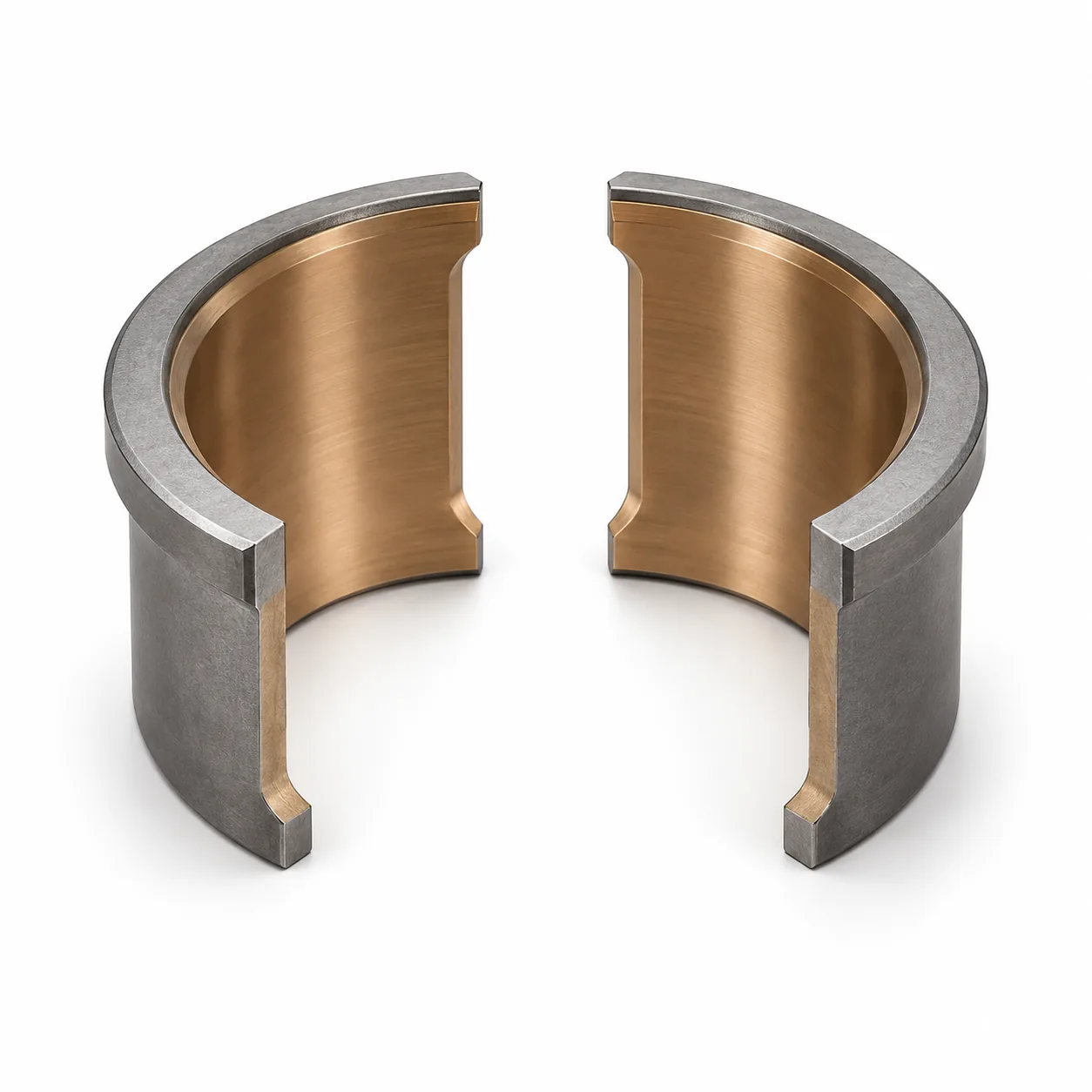
First — which split bushing do you mean?
Two different products share this name, and only one of them is made here.
The one that is not us: the plastic or die-cast conduit bushing that snaps into a knockout in an electrical panel to stop the cable chafing. Those come in trade sizes from half an inch upward, cost little, and sit on the shelf at every electrical wholesaler. If that is what you are after, buy it — there is nothing we could machine that would be worth the money.
The one that is us: a machined bearing or clamping bush that has been cut into segments — two halves, three or four arcs, a split taper sleeve, a split clamping ring, a bearing shell. It is a real load-carrying component in bronze or steel, and it exists as segments for one of two reasons: it has to be fitted round a shaft that cannot be withdrawn, or it has to grip when it is closed.
The cut is not free — here is what it costs your bore
This is the part most quotes never mention, and it is the reason split bushings come back nipping the shaft.
A split bushing is not a bushing with a slot in it. It is a bushing that was bored and turned round, complete, to final size, and only then cut apart. Every cut removes a slab of material as wide as the kerf of whatever did the cutting. Close the segments back up around a shaft and the bore circumference is short by the total kerf, so the closed bore diameter shrinks by that total divided by π.
| Cut by | Kerf per cut | Circumference lost over 2 cuts | Closed bore diameter comes in by |
|---|---|---|---|
| Wire, 0.25 mm | about 0.30 mm | about 0.60 mm | about 0.19 mm |
| Wire, 0.10 mm | about 0.14 mm | about 0.28 mm | about 0.09 mm |
| Slitting saw, 1.0 mm | about 1.0 mm | about 2.0 mm | about 0.64 mm |
| Bandsaw | 1.0 to 1.5 mm | 2.0 to 3.0 mm | 0.64 to 0.95 mm |
| Abrasive cut-off wheel | 1.5 to 2.5 mm | 3.0 to 5.0 mm | 0.95 to 1.6 mm |
Need split bushings, taper sleeves and arc segments in a size, thread or material no catalogue lists? EKINSUN is a custom parts manufacturer: we make split bushings, taper sleeves and arc segments to your drawing, sketch or sample — bronze, steel, 304 stainless steel or engineering plastics — from 1 piece, quoted in 12 hours and shipped duties paid. Already a catalogue size? Ask us too — we may have it in stock, and larger quantities cost less per piece. How ordering without CAD works →
Read the last column as the answer to why does my split bush grip the shaft when I bolt it up. On a 60 mm bore, closing a wire-cut pair costs about 0.19 mm of diameter, which the housing joint absorbs by not quite meeting — exactly what a split bearing is designed to do. Closing a bandsaw-cut pair costs up to 0.95 mm, and that is no longer a running clearance, it is an interference fit nobody specified.
Two consequences worth stating plainly, because they are the two ways this order goes wrong:
- If the halves are meant to clamp shut metal-to-metal, say so, and we bore oversize by the kerf loss so the closed bore lands on your number.
- If the halves sit in a housing with a designed gap or a shim — an ordinary split plain bearing — the kerf is irrelevant and we bore to nominal.
Both are routine. What is not routine is guessing which one you meant. A single-split bush — one cut, sprung open over the shaft — loses half as much: one kerf, so about 0.095 mm with standard wire.
Splitting a hardened ring without it moving
The other reason these get ordered rather than fabricated on site: the part is hard.
Slitting a hardened ring with an abrasive wheel puts heat and force into a component whose entire value is that it is round and on size. It comes back oval, with a burnt edge that then has to be dressed by hand. Spark erosion applies no cutting force at all — the wire never touches the work — and the heat-affected layer is measured in microns. A ring hardened to 60 HRC and ground round is still round after it is split.
Which fixes the order of operations: turn, harden, grind, then split. By the time the part is cut, every movement the furnace was going to cause has already happened and been ground out. Split first and harden after and you are quenching two thin arcs — they will move, and there is nothing left to grind them true against.
The same argument covers thin walls at any hardness. No clamping load, no cutting load, so a 1 mm wall does not spring away from the cut. A saw or a cutter pushes, and thin rings do not like being pushed.
Where the standard range stops
| What you need | In the catalogue? | What we do |
|---|---|---|
| Split conduit bushing for an electrical panel | Yes — stocked everywhere, pennies | Not our part. Buy it from an electrical wholesaler and we will say so if you ask us to quote |
| Taper-lock bush in a standard series — 1610, 2012, 3020 | Yes — a stocked commodity | Buy it from stock — no one-off can match that price. We only get involved when the bore or the keyway is not one of the standard ones. Standard parts: ask us too — we may have them in stock. |
| Split shaft collar in a common bore | Yes | Buy it — and see shaft collars for when the bore is not common. Standard parts: ask us too — we may have them in stock. |
| Split bush with your ID and your OD, neither of them stock | No | Turned to both fits complete, then split — so both diameters are finished before the cut, not after |
| Split ring in steel hardened to 55–62 HRC | No | Hardened and ground first, split last. No force, no heat, nothing to pull it oval |
| A bush split into three or four segments rather than two | No | Any number, all indexed from one programme so the segments are equal and stay a matched set |
| Segments with a conical or tapered bore | No | Cut on four axes, so the taper and the split are produced in the same operation |
| An existing bush of yours that needs splitting | n/a | Send it. Splitting a customer-supplied part is normal work here, and cheaper than remaking it |
| PTFE, nylon or filled-polymer split bush | Sometimes | Not by wire — polymer does not conduct. Sawn or knife-split, with the far wider kerf that implies |
The forms people actually order
- Split plain bearing / bearing shell — two halves in bearing bronze, fitted round a crank or line shaft that cannot be withdrawn.
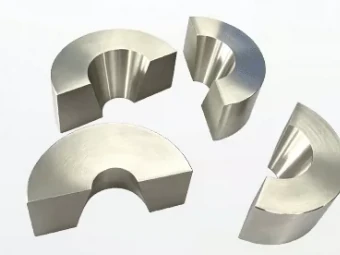
- Split taper sleeve — a conical bore that grips as it is drawn in. The photograph above is this family: one ring, bored and tapered complete, then cut into halves and quarters.
- Collet segments — three or four equal arcs closing onto a workpiece. Equal spacing matters more than the absolute dimension, which is why they are indexed in one setup.
- Split clamping ring — grips a shaft from the outside when the joint bolts are pulled up.
- Split wear ring or lantern ring — pump and valve service, where the shaft stays put and the ring has to come out around it.
- Arc segments of a large ring — when the finished ring is larger than any bar or tube you can buy, it is made as segments and joined.
Materials
| Material | Splittable by wire | Why it gets chosen for this part |
|---|---|---|
| Bearing bronze CuSn12 / C93200 | Yes | The default split plain bearing. Runs against an unhardened shaft and tolerates dirt |
| Aluminium bronze CuAl10Ni5Fe4 | Yes | Higher load and shock than tin bronze; marine and heavy plant |
| 4140 / 42CrMo4 | Yes, hardened or not | Clamping rings and taper sleeves that have to hold torque without creeping |
| 52100 / 100Cr6 | Yes, at 60–62 HRC | Where the segment is itself a rolling-contact surface |
| D2 / 1.2379 | Yes, at 58–62 HRC | Wear rings and segments in abrasive service |
| 304 / 1.4301 stainless | Yes | Washdown, food and pharma, where bronze is not acceptable |
| 316L / 1.4404 stainless | Yes | Marine and chemical service |
| 6061-T6 aluminium | Yes | Light clamping rings and locating segments |
| 7075-T6 aluminium | Yes | Where the segment must stay light and still be stiff under clamp load |
| PTFE, nylon, acetal, PEEK | No — not conductive | Sawn or knife-split. Kerf is several times wider, so tell us if the closed bore has to hold a size |
What to send
No CAD needed. A photograph of the old segments beside a rule, or a sketch with the numbers on it, is enough to quote — see ordering with no CAD, or just send the worn pair (parts from a sample).
- Shaft diameter, measured on the shaft — not the bore of the worn bush, which has already worn oversize.
- Outside diameter and length, and what the outside sits in.
- Number of segments, and whether they close metal-to-metal or onto a shim.
- Straight or tapered bore, with the included angle if you know it.
- Material and hardness — or just what it runs against, how hot it gets and what is in the oil.
MOQ 1 piece, quote in 12 hours. Related: plain round bushings and sleeves, bushes with a square or profiled bore, replacement machine parts, how hardened and intricate parts are cut here.
Frequently asked questions
No, and if that is what you need you should buy it rather than have it made. A split conduit bushing is a moulded or die-cast fitting that snaps into a panel knockout to protect cable, sold in trade sizes from half an inch upward for little money. The parts on this page are machined bearing and clamping components - split plain bearings, taper sleeves, collet segments, wear rings - made from bronze, steel or stainless and cut to a shaft dimension rather than a trade size.
Two cuts remove two kerfs from the circumference, so the closed bore diameter comes in by twice the kerf divided by pi. With standard 0.25 mm wire the kerf is about 0.30 mm, so the closed bore shrinks about 0.19 mm. With a 1.0 mm slitting saw it is about 0.64 mm, and with a bandsaw up to about 0.95 mm. A single-split bush loses half as much, about 0.095 mm. If your halves clamp shut metal-to-metal, tell us and we bore oversize by that amount so the closed bore lands on your number.
Yes, and it is usually cheaper than remaking the part. Send us the bush and tell us how many segments you want and whether they close onto a shim or metal-to-metal. Splitting a supplied part is routine work here, hardened parts included, because spark erosion applies no cutting force and leaves a heat-affected layer measured in microns. What we will not do is split a bush whose bore is already worn undersize and let you assume the result will fit.
No, provided it is split last. The wire never touches the work and applies no cutting force, so there is nothing to pull the ring oval, and the heat that reaches the cut face is confined to a few microns. The correct order is turn, harden, grind, then split - by that point every movement the furnace was going to cause has happened and been ground out. Splitting first and hardening afterwards means quenching two thin arcs, which will move, with nothing left to grind them true against.
As many as the part will stand. Two halves and four quarters are the common cases, three equal arcs is normal for collet segments, and there is no mechanical reason to stop there. All the cuts are indexed in one setup from the same programme, so the segments come out equal and stay a matched set - which matters more than any absolute dimension on a part that has to close concentrically. Mark them before they are taken apart on site, because a matched set that gets shuffled is no longer matched.
Not by wire. Spark erosion only works on materials that conduct electricity, so PTFE, nylon, acetal, PEEK and glass-filled polymers are outside it. Those are sawn or knife-split, which is normal, but the kerf is a millimetre or more against the 0.30 mm of a wire. If the closed bore of a plastic split bush has to hold a dimension, say so at enquiry stage, because the allowance we build in is several times larger.
EKINSUN LTD is a custom parts manufacturer that machines split plain bearings, split taper sleeves, collet segments, clamping rings, wear rings and arc segments to order. Bores are cut to your shaft rather than a catalogue size, in bearing bronze, aluminium bronze, 4140, 52100, D2 at 58 to 62 HRC, 304 and 316L stainless and 6061-T6 or 7075-T6 aluminium. Parts are turned and ground complete before they are split, hardened parts included. MOQ 1 piece, quoted within 12 hours, shipped worldwide.
Send the shaft size
Shaft diameter measured on the shaft, plus outside diameter, length and how many segments. Tell us whether the halves close metal-to-metal or onto a shim — it changes the bore we cut.