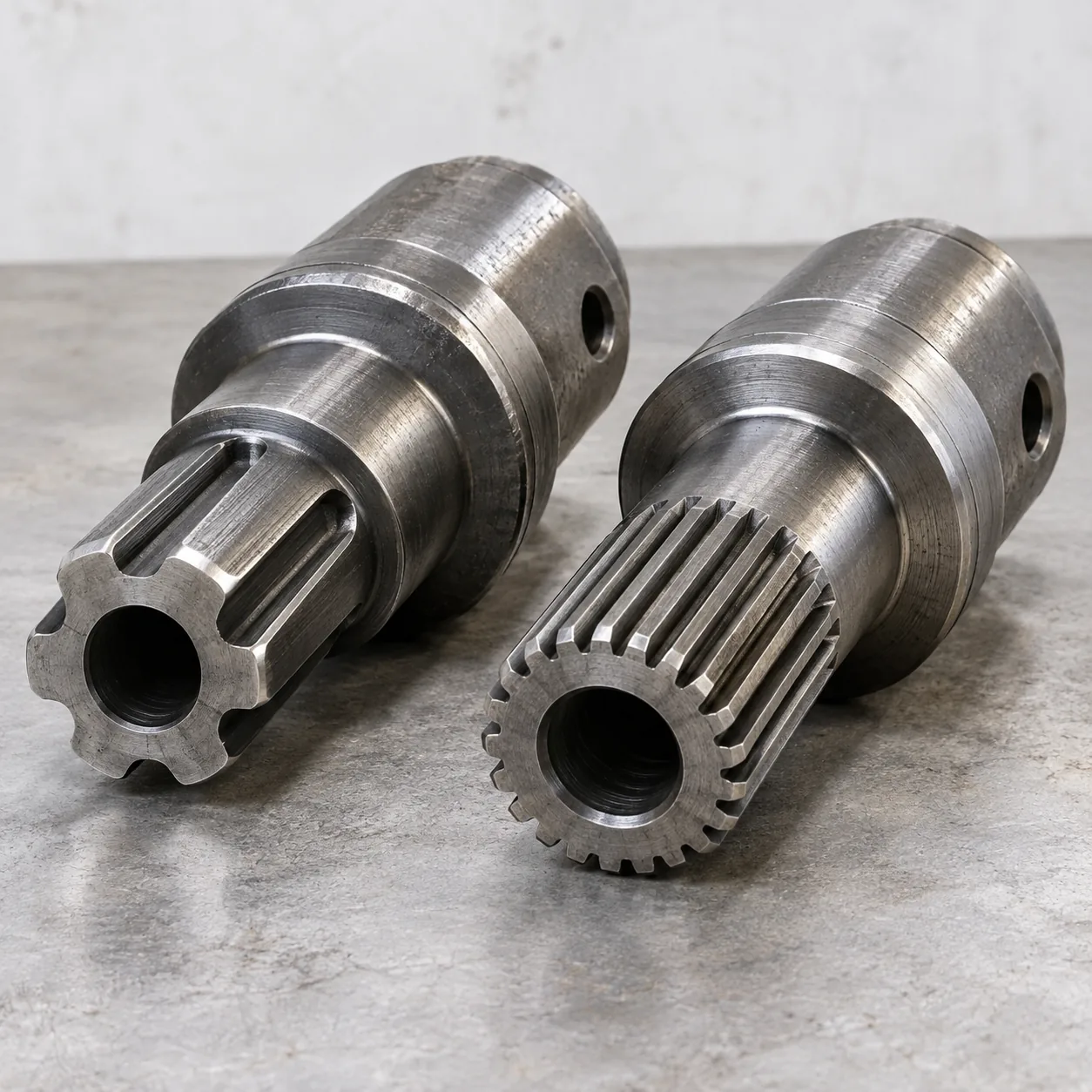
Most PTO adaptors are catalogue parts — start there, not here
Be clear about the boundary first, because the PTO world is better stocked than most people expect. Every pairing of the three standard splines — 1-3/8″ 6-spline, 1-3/8″ 21-spline, 1-3/4″ 20-spline — exists as a clamp-on adaptor from farm suppliers such as AgriSupply, Sparex and Bare-Co for roughly $40–75, with the horsepower class stamped on the listing. Spline-to-round is catalogue too: a 1-3/8″ 6-spline to a 1″, 1-1/8″, 1-1/4″ or even 30 mm keyed bore is about $50 off the shelf. If your combination is in that list, buy it there, or ask us — we may have it in stock. A catalogue part is cheaper, faster, and rated by people who rate driveline parts for a living.
Our lane opens where those listings stop, and the owners' forums mark the spot precisely: the 15-spline shaft someone researched for weeks and called an odd duck, the adapter that used to be available for a garden tractor whose maker moved on decades ago, the grey-import compact whose mid-PTO stub measures in millimetres and appears on no chart. That end of the driveline — measured from your shaft, splined, induction hardened, one piece — is what this page is for.
Reading the end you have — count, measure, class
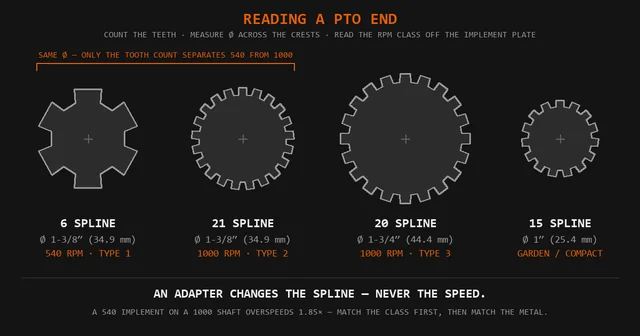
Three numbers identify any PTO end: the tooth count, the diameter across the spline crests (calipers), and the rpm class from the implement plate or manual. The sizes are standardised under ISO 500 and the old ASAE designations, which is why the same four patterns cover almost every tractor built since the fifties — and why the odd ones stand out so sharply.
| End | Diameter over crests | Class | Adaptors off the shelf? |
|---|---|---|---|
| 6-spline | 1-3/8″ (34.9 mm) | 540 rpm · Type 1 | Yes — to 21-spline, to 20-spline, and to common round bores. Buy them |
| 21-spline | 1-3/8″ (34.9 mm) | 1000 rpm · Type 2 | Yes — the same catalogue families cover it |
| 20-spline | 1-3/4″ (44.4 mm) | 1000 rpm · Type 3 | Yes — stocked, with HP class on the listing |
| 15-spline | 1″ (25.4 mm) | Garden & compact tractors | Loose clamp yokes exist; complete adapters in the configuration you need are patchy — this is our first regular customer |
| Metric splines | e.g. 25 mm · 10-spline | Mid-PTO on Japanese compacts | No — measured from the shaft and machined to order |
| The end no chart names | Whatever you measure | Pre-1960s and orphaned machines | No — the made-to-order case, from your measurements or the worn part |
Need PTO shaft adapters in a size, thread or material no catalogue lists? EKINSUN is a custom parts manufacturer: we make PTO shaft adapters to your drawing, sketch or sample — steel, 42CrMo4 or 304 stainless steel — from 1 piece, quoted in 12 hours and shipped duties paid. If the size is standard, ask anyway — it may be in stock, and the unit price drops as the quantity rises. All custom adapters and fittings →
The trap sits in the first two rows: 540 and 1000 share the same 1-3/8″ diameter. A caliper cannot tell them apart — only the tooth count can, 6 against 21. It is the same identification logic as inch-versus-metric threads that differ by a twentieth of a millimetre: measure what can be measured, count what can be counted, and never assume from the diameter alone.
What you can ask for that no catalogue stocks
| What you need | In the catalogue? | What we machine |
|---|---|---|
| Any pairing of the three standard splines | Yes — $40–75, HP-rated | Buy it from the farm supplier; it is the better part for that job. Standard parts: ask us too — we may have them in stock. |
| Spline to a common round bore (1″, 1-1/8″, 1-1/4″, 30 mm keyed) | Yes — about $50 | Buy that too — custom starts beyond this list |
| 1″×15-spline in the configuration you need | Yokes as loose parts; complete adapters patchy | The 15-spline end machined into one body with whatever the other side needs |
| Spline to an odd bore, taper or keyway | No | Bore, keyway or taper cut to your pump, generator or gearbox shaft — measured from the shaft itself |
| Metric mid-PTO stubs on grey-import compacts (25 mm 10-spline and kin) | No | Measured from the shaft, splined and hardened — the same machines whose front spindles we remake |
| The discontinued adapter for a vintage machine | No — “used to be available” is the forum phrase | Copied from your worn one to the catalogue nominal dimensions, or from three numbers per end |
| A worn or damaged PTO stub shaft | No | Remade as a turned, splined, induction-hardened part — the worn one is a pattern, not a drawing |
| Two odd ends in one short body | — | One piece instead of two stacked adaptors and their 360 mm of overhang — see below |
“The deck came off one machine and the tractor is another; the shaft measures an inch across with fifteen little teeth and everything the store sells is 1-3/8 six-spline. I've been searching for weeks.”
— the shape of the enquiry this page exists for. Tooth count, diameter, rpm class, one photo beside a ruler: that is the whole intake.
An adapter changes the spline — never the speed
This is the honest paragraph, and the reason we ask for the rpm class before quoting. The two 1000-rpm splines exist so that high-power drivelines cannot be plugged into 540-class implements by accident — the incompatibility is the safety feature. An adapter defeats that interlock. Put a 540-rated implement behind a shaft turning 1000 and its gearbox overspeeds 1.85×; the adapter fit and the implement still failed. So: match the class first, from the implement plate, then match the metal. If your enquiry crosses speed classes, we will ask why before we quote — and sometimes the right answer is the tractor's own dual-speed stub, not an adapter at all.
Two more boundaries we hold. The shear bolt or slip clutch stays in the driveline — an adapter must never replace the torque fuse, and we do not machine “solid” bypasses for guards or overload devices. And certified driveline assemblies — complete shafts, u-joints, wide-angle joints, overrunning clutches — are bought parts from the driveline makers; our work is the machined adapter and stub geometry, with material and hardening stated on the quote, not horsepower ratings we have no business issuing.
One machined body against two stacked adaptors
A typical clamp-type adaptor is about 180 mm (7″) long. Where your combination needs two of them — odd end to standard, standard to odd again — the implement yoke ends up riding roughly 360 mm further out on the tractor stub, with two sets of spline clearance adding up to visible driveline slop. Overhang and backlash are physics, not workmanship; no catalogue part removes them. A one-piece body machined with your two ends collapses the stack to one short part with one set of clearances — the same argument, on the same lathe, as our one-off machined coupling that ran $180 including shipping. And when a single catalogue adaptor covers your combination, we say so instead of quoting: one bought part beats one machined part that didn't need to exist.
Materials — what a PTO adapter should be, honestly
| Material | When it is the right call | Note |
|---|---|---|
| C45 (1045) induction hardened | The default — what stock adaptors and stubs are made of | Hard spline flanks on a tough core; blackened or lightly oiled |
| 42CrMo4 (4140) QT | Shock-loaded drives — flail mowers, chippers, post drivers | Quenched and tempered before the splines are finished |
| 304 / 316 stainless | Washdown and sprayer chemistry only | Rust-free but softer than QT steel and the splines gall — pay for it only when corrosion governs |
| 6061 aluminium | Never for the driveline | Aluminium has no place in a PTO shaft path — an honest no rather than a quote |
| 7075 aluminium | Never for the driveline | Strength on paper does not fix aluminium splines under shock torque; use steel |
| Brass | No | Too soft for splined torque transfer — we will not quote it |
How to order
Send three numbers per end — tooth count, diameter across the crests, rpm class — or simply photos of both ends beside a ruler, plus the overall length you have room for. A keyway spec helps when the bore side drives a keyed shaft; a hand sketch is enough, same intake as any of our custom thread adapters. Worn original in hand? Send it — parts from a physical sample is normal work here, and we machine to the standard's nominal dimensions, not to the wear. Quote in 12 hours, one piece minimum (MOQ 1).
Will it fit? PTO spline checks before you order
Two PTO shafts can share a diameter and still not fit: the 1-3/8″ 6-spline (540 rpm) and the 1-3/8″ 21-spline (1000 rpm) are both 34.9 mm across, and a 6-spline yoke goes onto a 21-spline shaft only far enough to strip it. The 1-3/4″ 20-spline is 44.4 mm and fits neither. Count the splines and measure across the outside; that is the whole identification. An adapter changes the spline form, never the speed — a 540 rpm implement on a 1000 rpm shaft still needs the tractor set to 540.
What do I need to run a 1-3/8″ 6-spline implement from a 1-3/8″ 21-spline tractor?
An adapter with a 21-spline female bore and a 6-spline male end, retained on the tractor stub by its groove, with a shear bolt or a locking collar to suit the implement yoke — and the tractor PTO switched to 540 rpm, because the adapter does nothing to the speed.
Same adapter, but 1″ 15-spline, longer, or with a shear bolt
A 1″ 15-spline end for a garden tractor, a longer body to clear a hitch, a shear-bolt hub for an implement that can jam, a metric spline no chart lists, or a spline-to-round-bore stub — each is a variant of the same drawing, one piece and up, quoted in 12 hours.
Frequently asked questions
Three numbers: count the teeth, measure the diameter across the spline crests with calipers, and read the rpm class off the implement plate or manual. The trap is that the 540 and 1000 rpm shafts share the same 1-3/8″ (34.9 mm) diameter — only the tooth count separates them: 6 splines is 540, 21 splines is 1000. A photo of the shaft end beside a ruler is enough for us to confirm it.
No — an adapter changes the spline, never the speed. If you put a 540-rated implement on a shaft turning 1000, its gearbox overspeeds 1.85 times, and the adapter that made the splines fit is what let it happen. Match the speed class first, from the implement plate; only then match the metal. Where a tractor offers both speeds on one shaft or by swapping stubs, use the correct stub rather than adapting across classes.
Usually not — and we will say so. Farm suppliers stock 1-3/8″ 6-spline to round bores of 1″, 1-1/8″, 1-1/4″ and even 30 mm with a keyway, at around $50. Buy those. Custom starts when the bore, the keyway or the length is not on that short list — an odd metric bore, a taper, two set-screw flats, or a body short enough to clear a guard.
Yes. The 1″×15-spline end lives on many older garden and compact tractors; clamp yokes for it exist as loose parts, but complete adapters and drivelines in the configuration you need are patchy, and owners' forums have been chasing them for years. We machine the 15-spline end and put whatever the implement side needs on the other end, in one body.
Either the old adapter — worn is fine, we measure it and machine to the catalogue nominal dimensions, not to the wear — or three numbers per end: tooth count, diameter across the crests, and the rpm class, plus a phone photo beside a ruler. No CAD and no drawing needed.
Yes — implement input stubs and tractor PTO stubs are turned and splined parts, and a worn one is a pattern, not a drawing. We take the spline data from the standard and the sound geometry, not from the worn surfaces, machine in C45 or 42CrMo4, and induction harden the spline. Send photos of both ends and the overall length.
Where a single catalogue part exists, use it. But each clamp-type adaptor adds about 180 mm (7″) of length, so stacking two to bridge an odd combination pushes the implement yoke roughly 360 mm further out and doubles the spline clearances that show up as driveline slop. A one-piece body machined with your two ends collapses that to one short part with one set of clearances.
EKINSUN — a custom parts manufacturer — machines one-off PTO adapters and stub shafts from your measurements or your worn part: odd spline counts, metric mid-PTO ends, spline-to-round with non-standard bores, and vintage adapters no longer sold. MOQ 1 piece, worldwide DHL shipping, quote within 12 hours.
One piece — most PTO adapter jobs are one piece for one orphaned machine. Send the tooth counts, diameters and rpm class, or just photos of both ends beside a ruler, and a quote comes back within 12 hours. There is no price list because every combination is different: material, spline count, hardening and length set the cost, which is why we quote each part individually.
Send the two ends
Tooth count, diameter across the crests, rpm class — per end. Or just photos beside a ruler. No CAD. One piece minimum, quote within 12 hours.