EKINSUN LTD is a custom parts manufacturer, and the 2WD front spindle is the part that keeps old tractors parked: it takes every pothole and every overloaded bucket, it bends before anything else on the axle, and on machines past a certain age — or grey-market Japanese compacts that never had a Western parts network at all — nobody sells a new one. The forum answer is "find a good used axle." The problem with the donor axle is that its spindle lived the same life as yours.
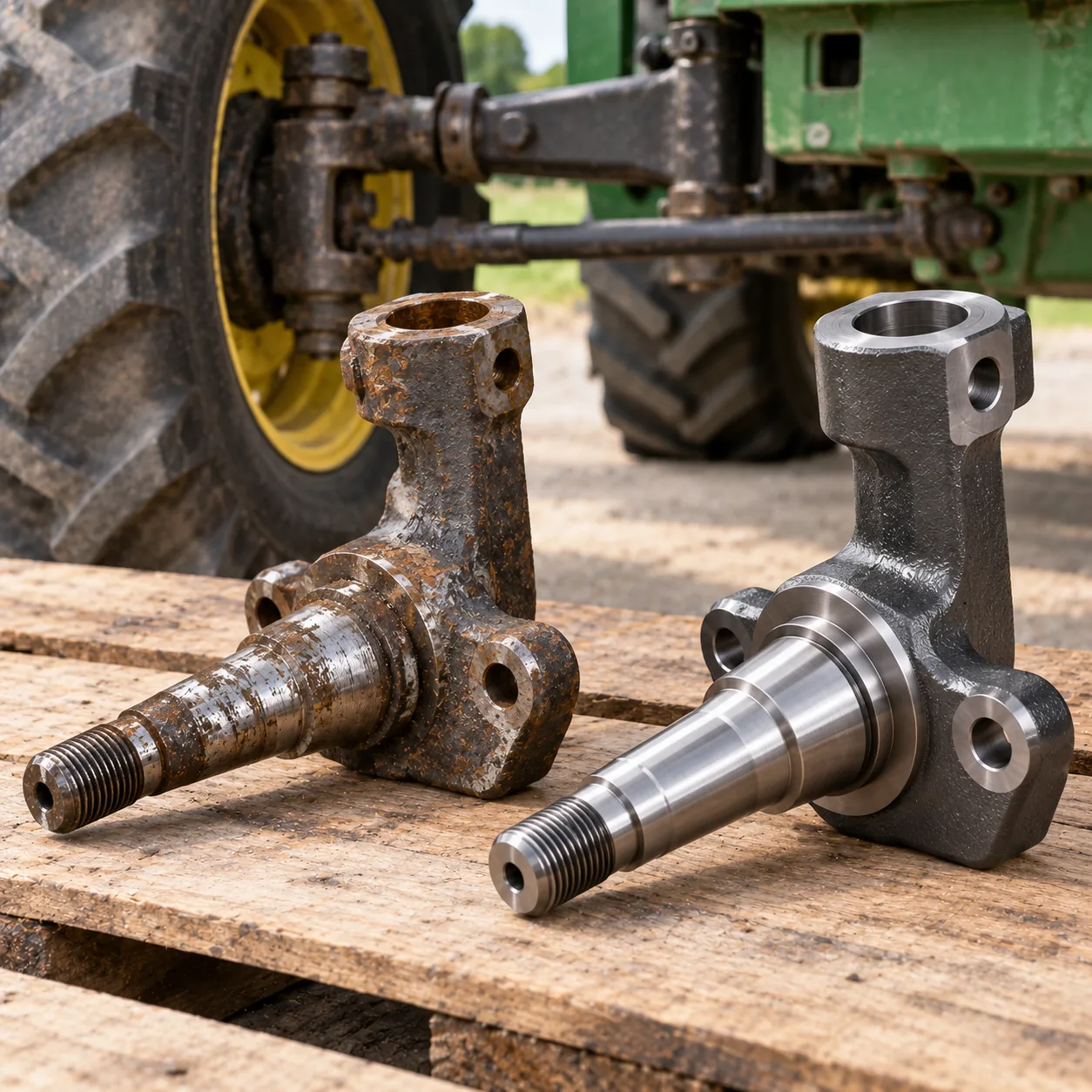
What Kills a Front Spindle
| The failure | How it happens | The remake answer |
|---|---|---|
| Bent vertical shaft | Loader work — the front axle carries loads the designer never met | New spindle in 4140 QT; straightening is refused, see below |
| Snapped at the stub root | The bend's final chapter: fatigue crack at the corner, then one pothole | New spindle, generous root radius machined, not ground in as an afterthought |
| Journals hammered oval | Bushings wore first, then the loose shaft peened its own journal | Journals at nominal + fresh bronze bushings, machined as a matched set |
| Bearing seats spun / worn | Wheel bearing ran loose or seized | Seats sized from the numbers on the old bearing cones — the bearing's bore is the truth |
| Threads wasted, keyway opened up | Decades of castle-nut cycles and a loose steering arm | Thread and keyway renewed at nominal on the new part |
| Axle eye itself wallowed | The last stage of running loose | Eye bored true and bushed back to size — the standard bore-and-bush fix |
Bent Once = Bends Again
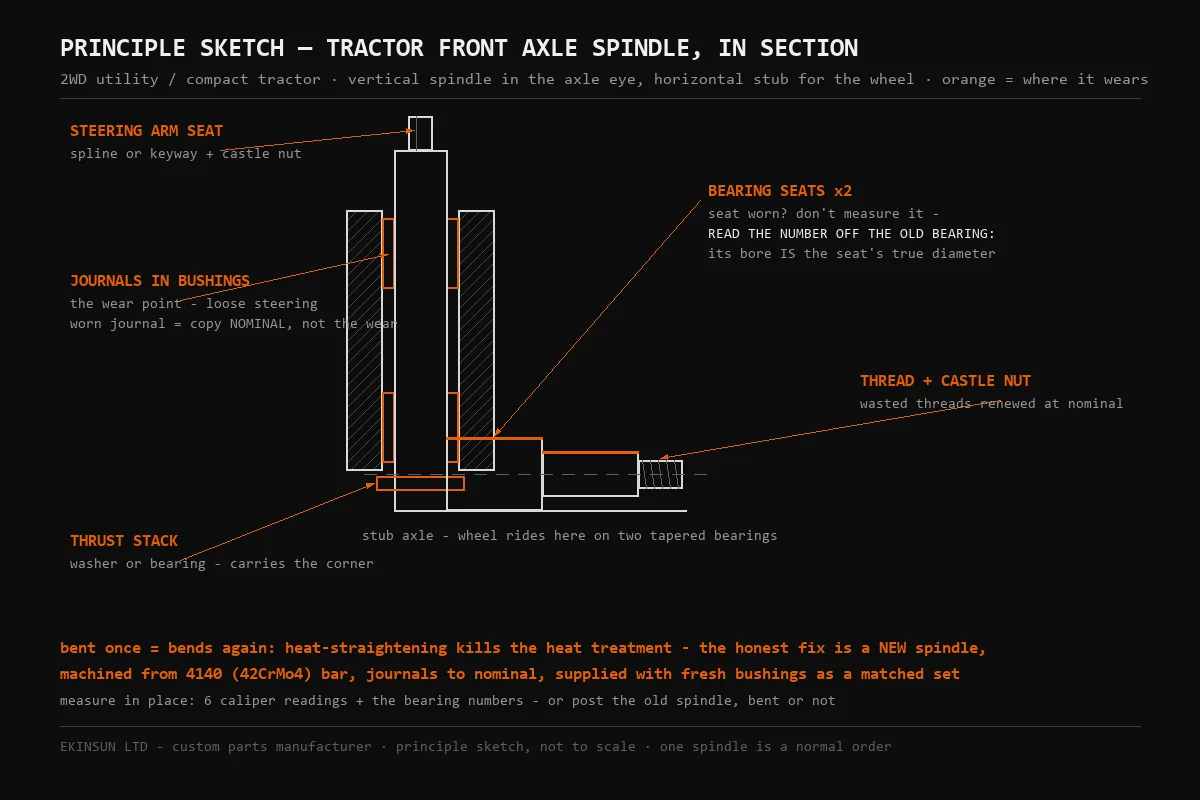
Straightening a bent spindle is the tempting quote, and we would rather lose the job than sell it quietly: heating a heat-treated spindle to straighten it destroys the temper exactly where the bend concentrated the stress, and the bend line keeps a fatigue-crack invitation for the rest of the part's life. On a loader tractor — which is how spindles get bent — that is a part with a countdown in it. The honest fix is a new spindle.
One more honesty, because it matters to how the remake is specified: factory spindles were forgings; a one-off remake is machined from bar. We do not pretend otherwise — we compensate with the grade. Quenched-and-tempered 4140 (42CrMo4) bar runs far stronger than the medium-carbon forging it replaces, the stub root gets a generous machined radius instead of a production fillet, and the bushing journals can be induction hardened where the original ran soft. The result is routinely stronger than what the factory fitted — which is the point, because your tractor already proved what the factory part could take.
Measured Around the Wear, Not Off It
A worn spindle must not be copied — the wear is the disease, the same rule as all our from-sample work. Journals hammered oval go back to nominal, recovered from the unworn ends where the bushings never ran. And for the stub axle there is a trick worth stating plainly, because half the forums half-know it:
Don't measure a worn bearing seat — read the number etched on the old bearing cone. The bearing's bore is the seat's true diameter, unworn by definition, and the two numbers identify both seats, the thrust arrangement and the castle-nut end in one line of email.
That is why the six-reading list below beats an hour with a micrometer on damaged surfaces: most of the truth about a spindle survives in its unworn shoulders and in the catalogue parts that ran on it.
Spindle and Bushings — a Matched Set
The bushings are bronze and softer by design: they are supposed to wear first and cost little. So every spindle here is quoted with fresh bushings machined to it as a set — a new shaft in old bushings is half a repair. If the wear went the full distance and the axle eye itself has wallowed, the eye is bored true and bushed back to size, and the steering geometry comes back to where the designer put it. Thrust washers and the odd hardened washer stack are turned to suit; seals and wheel bearings are catalogue consumables — buy them locally by the numbers you read off the old ones.
Materials — Stated, Not Assumed
| Material | Where it belongs on this page |
|---|---|
| 4140 / 42CrMo4, quenched & tempered | The spindle itself — journals optionally induction hardened; stronger than the forging it replaces |
| Bearing bronze | The bushings — sacrificial by design, supplied with every spindle as a matched set |
| 304 stainless | Rarely, and only where wash-down duty demands it — at a strength cost we state in the quote |
| 6061 / 7075 aluminium | Nowhere in a steering spindle, — those grades belong in pulleys and brackets elsewhere on the machine |
| C45 / medium-carbon steel | Thrust washers and non-critical spacers, where the original used the same |
What to Buy, and What to Have Machined
| What you need | Stocked? | The honest route |
|---|---|---|
| Spindle for a listed model — Ford 8N class, common Massey Ferguson | Yes — the tractor aftermarket stocks them | Buy it. A stocked spindle is cheaper than any one-off, no argument from us |
| Wheel bearings, seals, castle nuts | Yes — catalogue consumables | Buy locally, identified by the numbers on the old parts |
| A good used donor spindle | Sometimes — parted-out axles exist | Fair competition — except the part that bends on your tractor has usually bent on the donor too |
| Spindle for a grey-market Japanese compact — Yanmar, Hinomoto, Iseki, Mitsubishi, Satoh | No — never had a Western parts network | Machined from the old part or six readings, from 1 piece |
| Spindle for an orphaned or long-dead marque | No — the maker is gone | Same route; the drawing is archived for the next owner of the same machine |
| Spindle + bushings + bored axle eye as one repair | No listing pairs them | Machined to each other as a set — geometry back to the designer's numbers |
| Straightening a bent spindle | Any machine shop will quote it | We won't. Heat-straightening kills the temper and leaves a fatigue risk at the bend — the honest fix is a new spindle |
"Hinomoto E204 — front spindle bent when the loader was overloaded, and there's simply no dealer for these. Can you make one if I post you the bent spindle and the steering arm?"
That is a complete enquiry, and the bent part is enough: the unbent sections, the mating arm and the bearing numbers carry the whole geometry. The reply is a dimensioned approval drawing — spindle plus bushings — you check it against the axle, and machining starts after you approve. The wider family of this work lives at obsolete & discontinued parts; if the name of some linkage piece is the thing you're missing, the "part that connects" name table exists for exactly that. And the same orphaned machines lose their driveline ends too — a metric mid-PTO stub or an odd-spline shaft end follows the same measure-and-remake route at PTO shaft adapters.
How to Order
- Best input: the old spindle in a box — bent or snapped is fine; it comes back with the new one
- Or six caliper readings: vertical shaft Ø, both bearing seat Øs, overall length, drop to the stub, thread size — a caliper photo per figure is enough
- The bearing numbers off the old cones — they define the seats better than any worn surface can
- The steering arm connection: keyway, spline count, or taper — a photo of the arm's bore does it
- Say it carries a loader — it decides the induction-hardening question and the root radius
- Quantity: one is normal; both sides, or a spare for the sister tractor, get a price ladder
A dimensioned approval drawing comes back before machining. Quote within 12 hours; production typically 5 working days after approval.
Will it fit? Front spindle checks before you order
Three things on a remade spindle have to match parts you are keeping. The bearing seats match the numbers etched on the old cones, not the worn journals. The stub thread matches the castle nut you have — an M20×1.5 nut will not go onto a ¾″-16 UNF stub, though the two are 0.95 mm apart in diameter. And the steering-arm connection — keyway, spline count or taper — matches the arm, because a spindle with the wrong spline is a bar of 4140 with no steering. Send those three and the rest is measured around the wear.
What do I need when the spindle for my tractor is no longer sold?
The old spindle in a box, bent or snapped, or six caliper readings: vertical shaft diameter, both bearing-seat diameters, overall length, drop to the stub, and the stub thread — plus the bearing numbers and a photo of the arm's bore. Say if it carries a loader; that decides the hardening and the root radius.
Same spindle, but induction-hardened, a longer drop, or a keyed arm
4140 with induction-hardened journals for loader work, a longer drop to suit larger tyres, a keyed connection in place of a worn spline, or bushings supplied as a matched set — each is a variant of the same drawing, one piece and up, quoted in 12 hours.
Frequently Asked Questions
Yes. Post the old spindle — bent is fine, because the unbent sections and the mating parts still carry the geometry — or send six caliper readings: vertical shaft diameter, the two bearing seat diameters, overall length and drop, thread size, and the steering arm spline or keyway. Add the numbers off the old wheel bearings. A dimensioned approval drawing comes back before machining, and it is archived so the next spindle for the same axle is a repeat order.
It can be, and we would rather tell you the cost of that: heating a heat-treated spindle to straighten it destroys the temper where it matters most, and the bend line keeps a fatigue crack risk for the rest of its life. On a tractor that carries a loader — which is how most spindles get bent — bent once means bends again. The durable fix is a new spindle in quenched-and-tempered 4140, which typically leaves the part stronger than the worn original.
Factory spindles were usually forged medium-carbon steel. A one-off remake is machined from 4140 (42CrMo4) quenched-and-tempered bar instead — we say that difference out loud rather than pretending bar stock is a forging. The grade compensates: 4140 QT runs far stronger than the original mild forging, and the bushing journals can be induction hardened where the original ran soft. Stainless has no place here, and neither does aluminium — 6061 or 7075 belong in pulleys and brackets, never in a steering spindle.
Don't measure the worn seat — read the number etched on the old bearing cone instead. The bearing's bore is the seat's true diameter, unworn by definition, and the pair of numbers identifies both seats exactly. Measure the vertical journal at its unworn ends where the bushings did not run, and take the rest with a caliper. Wear is the disease; the remade spindle gets nominal dimensions, not a copy of the damage.
Usually both, in order: the bushings are bronze and softer by design, so they wear first; then the loose spindle hammers its own journal oval and starts on the axle eye. That is why a spindle is supplied with fresh bushings as a matched set, machined to each other. If the axle eye itself has wallowed, it is bored true and bushed back to size — the same bore-and-bush logic as any worn hole in a casting.
Yes — Yanmar, Hinomoto, Iseki, Mitsubishi and Satoh compacts are the strongest case for a machined spindle, because most were never officially imported and have no parts network in the West at all. The route is the same for every brand: the old spindle in a box, or the six readings and bearing numbers. No brand-specific listing is needed — the part in your hand is the drawing.
EKINSUN — a custom parts manufacturer machining one-off spindles, kingpins and bushings from the worn original or your measurements, MOQ 1, quote in 12 hours. Honest boundaries first: for listed models like the Ford 8N class and common Massey Fergusons, the tractor aftermarket sells spindles cheaper than any one-off — buy those; wheel bearings and seals are catalogue consumables; and a good used donor spindle is fair competition, except that the spindle that bends on your tractor has usually already bent on the donor.
Get a Quote
Post the spindle, or send six readings + the bearing numbers. Reply in 12 hours.
// In short
- →Listed model? Buy aftermarket
- →Grey-market or orphaned? We machine it
- →Bent spindle? New beats straightened
- →Spindle + bushings, matched set
- →Quote in 12 hours
or email: [email protected]