EKINSUN LTD is a custom parts manufacturer that reproduces fittings from a sample: the old part is measured, its threads identified from diameter, pitch and taper, the geometry that matters — threads, seats, lengths, bores — is drawn, and the fitting is machined in brass, 304 or 316L from 1 piece, with the drawing sent for approval first.
A typical request: an elbow that cracked at the flange on a pump whose maker went out of business in 2009, with the two halves and the pump still to hand.
Two halves and the pump are enough: the halves give the geometry, the pump gives the thread.
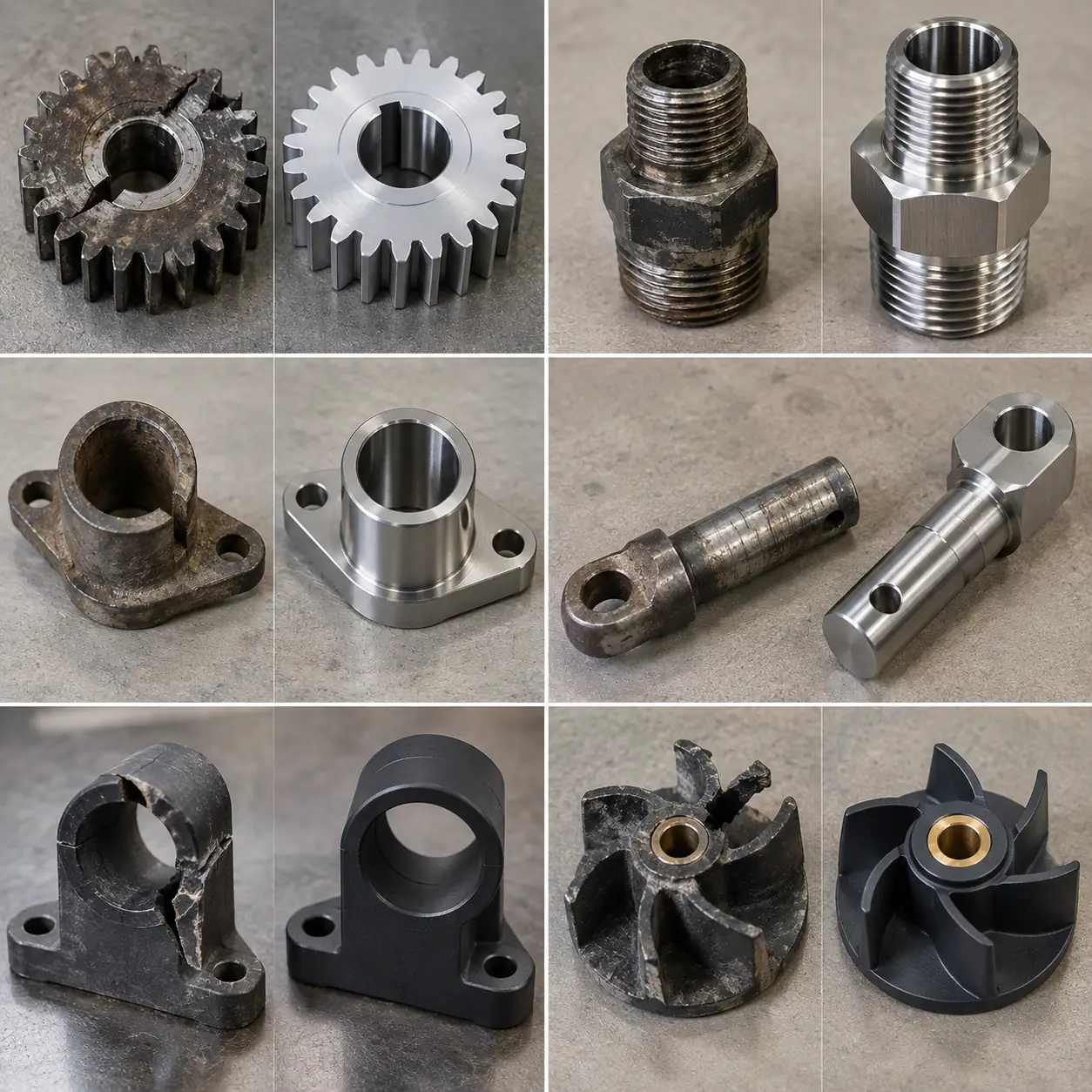
From sample to fitting
| Step | What happens | What you see |
|---|---|---|
| 1. Photo and caliper | you photograph the fitting from the side and the end, with a caliper across the thread, and photograph the port it fits | a reply within 12 hours saying what the thread is and what is missing |
| 2. Identification | outside diameter, pitch or threads per inch and taper name the thread: G, R, NPT, metric, UNF, or an odd one | the thread designation, in writing |
| 3. Sample in, if needed | the part is posted when a photo cannot settle a seat, a bore or a worn thread | a measurement report |
| 4. Drawing | threads, seats, lengths, hex, bore and seal are drawn; wear is measured out, not copied | a drawing for approval, with the changes marked |
| 5. Machining | brass, 304, 316L or steel from bar; threads gauged; seat and finish to the drawing | the fitting, from 1 piece, and the drawing stays on file |
| 6. Next time | the drawing is the part number | a reorder is one line |
An obsolete or broken fitting and no part number? EKINSUN is a custom parts manufacturer: we make a replacement fitting copied from your sample to your drawing, sketch or sample — brass, steel, 304 or 316L stainless steel — from 1 piece, quoted in 12 hours and shipped duties paid. Already a catalogue size? Ask us too — we may have it in stock, and larger quantities cost less per piece. All custom adapters and fittings →
Naming a thread from two measurements
| Measured outside diameter | Threads per inch or pitch | Taper | Thread |
|---|---|---|---|
| about 13.2 mm | 19 TPI | no | G1/4 (BSPP) |
| about 13.2 mm at the mouth, less further in | 19 TPI | yes | R1/4 (BSPT), sold as PT1/4 in Asia |
| about 13.7 mm | 18 TPI | yes | 1/4 NPT |
| 14.0 mm | 1.5 mm pitch | no | M14×1.5 |
| about 16.7 mm | 19 TPI | no | G3/8 |
| about 17.1 mm | 18 TPI | yes | 3/8 NPT |
| about 21.0 mm | 14 TPI | no | G1/2 |
| about 21.3 mm | 14 TPI | yes | 1/2 NPT |
| 11.1 mm (7/16 in) | 20 TPI | no, 37° cone | JIC -4 (7/16-20 UNF) |
| 14.3 mm (9/16 in) | 18 TPI | no, 37° cone | JIC -6 (9/16-18 UNF) |
The full list of every G, R, NPT, metric, JIC and ORFS size with diameter and pitch is on the fitting thread identification chart. A broken male thread is measured on the port it fits; a broken female thread on the fitting that fits it.
What is copied and what is improved
| Feature | Copied | Improved | Why |
|---|---|---|---|
| Threads | yes, to the standard identified | — | the mate is fixed; the thread must match it |
| Seat and sealing face | yes, form and angle | surface finish, and an O-ring groove if the original relied on tape | the seal is the job of the fitting |
| Lengths and hex | yes | hex added where the original had none | a spanner flat costs nothing on a machined part |
| Bore | yes | smoothed; a cast bore becomes a drilled one | flow does not suffer |
| Material | matched: brass for brass, stainless for stainless | 316L for a 304 part in a wet line; brass CW614N for a cast brass elbow | the replacement should outlast the original |
| Wear | no | measured out; the drawing shows the original dimension | a worn thread copied is a loose thread |
| Cast body shape | no; the geometry that mates is kept | machined from bar or hex | one-off castings are not economic; a machined body does the same job |
| Plastic fittings | form, yes | machined POM, PA or PEEK for a few; moulded for volume | the material follows the quantity |
What to send
- Two photos of the fitting: from the side with a rule or caliper across the thread, and from the end.
- A photo of the port or the mating part, with the caliper across it.
- What it connects, the medium, and whether it was leaking, cracked or worn.
- The quantity, and whether a spare set should be made with it.
- The part itself, posted, when a photo cannot settle a seat or a worn thread; it is returned with the replacement.
Identify the thread before you order the replacement fitting. Measure the outside diameter of a male thread, or the inside diameter at the mouth of a female one, with a caliper, and count the threads in 25 mm or in one inch. A G1/4 male measures about 13.2 mm across and has 19 threads per inch; a 1/4 NPT male measures about 13.7 mm and has 18; an M14×1.5 measures 14.0 mm with 1.5 mm between crests. Those three are the ones most often confused on a fitting, and only the metric one is not tapered. Then check whether the thread is parallel or tapered by measuring the diameter at the first and the fifth turn. The fitting thread identification chart lists every common pipe, port and tube thread with its diameter, pitch and seal, and the BSPP vs BSPT note explains the parallel and taper forms of the same BSP size.
What a sample can give, and what it cannot
| What you need | In the catalogue? | What we make |
|---|---|---|
| A fitting that turns out to be a standard part still in a catalogue | Yes | Buy it from stock; identification is free and we say so within 12 hours. Standard parts: ask us too — we may have them in stock. |
| An obsolete threaded fitting with the threads and seats intact, or with its port available to measure | No | Measured, drawn and machined in brass, 304, 316L or steel from 1 piece. |
| A broken fitting where the mating part exists | No | The mating part supplies the thread; the halves supply the rest. |
| A fitting with an odd or unknown thread | No | Identified from diameter, pitch and taper; if it matches no standard it is cut to the measured numbers. |
| A cast elbow, tee or manifold body | No | Reproduced as a machined body from bar, hex or block with the same ports and lengths; casting is not economic for a few pieces. |
| A plastic fitting | No | Machined in POM, PA or PEEK for a few pieces; moulded for volume. |
| A fitting whose critical dimension is worn away on both the part and its mate | Partly | The standard supplies the missing number where the thread is standard; otherwise we ask for a third reference — see reverse engineering. |
| A fitting with a pressure rating, approval or certificate carried over from the original | No | Not claimed: the replacement is made to the measured geometry in the alloy named; ratings and approvals belong to the original maker. |
Materials for replacement fittings
| Material | Designation | Where it fits here |
|---|---|---|
| Brass | CW614N / C36000; CW602N DZR for aggressive water | replacements for brass and cast brass fittings |
| Stainless 304 | 1.4301 | replacements for stainless fittings on general duty |
| Stainless 316L | 1.4404 | the usual upgrade for a 304 fitting in a wet or chemical line |
| Free-machining stainless | 303 / 1.4305 | where corrosion duty allows |
| Carbon and alloy steel | S235; 42CrMo4 | hydraulic fittings; zinc or phosphate finish |
| Aluminium 6061 | AlMg1SiCu | vacuum and air fittings from aluminium originals |
| Aluminium 7075 | AlZn5.5MgCu | machined manifold bodies |
| POM, PA, PEEK | engineering plastics | plastic fitting replacements |
A real job of this kind: 8 Brass Fitting Variants with Non-Standard Thread — eight brass fitting variants with non-standard threads, machined from sample parts for a US distributor in 18 days.
Related pages
- Reverse engineering — obsolete and worn parts beyond fittings
- Thread adapters from a sketch — when there is a sketch and no sample
- Replacement bolts from a sample — the same service for fasteners
- G, R, NPT and metric by diameter and pitch — every thread by diameter and pitch
- the fittings on a pump outlet — obsolete pump connectors
- adapters for valve ports — adapters for discontinued valves
- every fitting by port combination — every fitting form by ports and standard
- Replacement parts buyer guide — how replacement parts are ordered
Frequently asked questions
Yes. Send a photo with a caliper across the thread and, if possible, a photo of the port it fits; the outside diameter, the pitch or threads per inch and whether it tapers name the thread as G, R, NPT, metric or UNF. If it matches no standard it is cut to the measured numbers.
Usually. The halves give the lengths, seats and bores, and the port it fits gives the thread. When the break has taken a critical surface with it, the standard supplies the missing number for a standard thread, or a third reference is asked for.
No. A photo, a caliper reading or the part itself is enough; the drawing is made here and sent for approval before machining, and it stays on file as the part number for reorders.
The geometry that mates is kept exactly: threads, seats, lengths, bores. Wear is measured out rather than copied, a cast body is machined from bar, and the material is matched or upgraded, so the replacement fits like the original and usually outlasts it.
EKINSUN LTD is a custom parts manufacturer that identifies, draws and machines replacement fittings for pumps, valves, pneumatic and hydraulic equipment from a photo, a caliper reading or the old part, in brass, 304 / 316L stainless, steel, aluminium and engineering plastics, from 1 piece, with a quote within 12 hours.
No list price; the drivers are material, the number of threads and features, and quantity. Identification is free. A brass elbow from a sample is a short lathe and mill job; a 316L manifold body reproduced from a casting is priced as the machined block it is. The quote states the drivers, and where the part turns out to be a catalogue part, says so.
Send two photos and a caliper reading
Side and end photos with a caliper across the thread, a photo of the port it fits, what it connects, the medium, quantity. Post the part if a photo cannot settle it. From 1 piece, quote within 12 hours.
Not sure of the thread? Tell us four things: what the fitting connects to (pump, valve, gauge, cylinder, tube or hose); whether the port is the inlet or the outlet; which way the flow must go; and the tube outside diameter, not the hose bore, unless it is a barb. A photo with a caliper across the thread answers most of it.