Article Contents
The Tooling Trap
Plastic parts are made in steel injection moulds, and those moulds cost thousands of dollars and weeks of lead time. That maths works for a factory making 100,000 units. It's absurd for a restorer, a repair shop, or an engineer who needs one, five, or fifty of a discontinued part. So people assume the part is simply unobtainable.
It isn't. Two well-established processes reproduce plastic parts with no injection tooling at all — you just pick the one that matches your quantity.
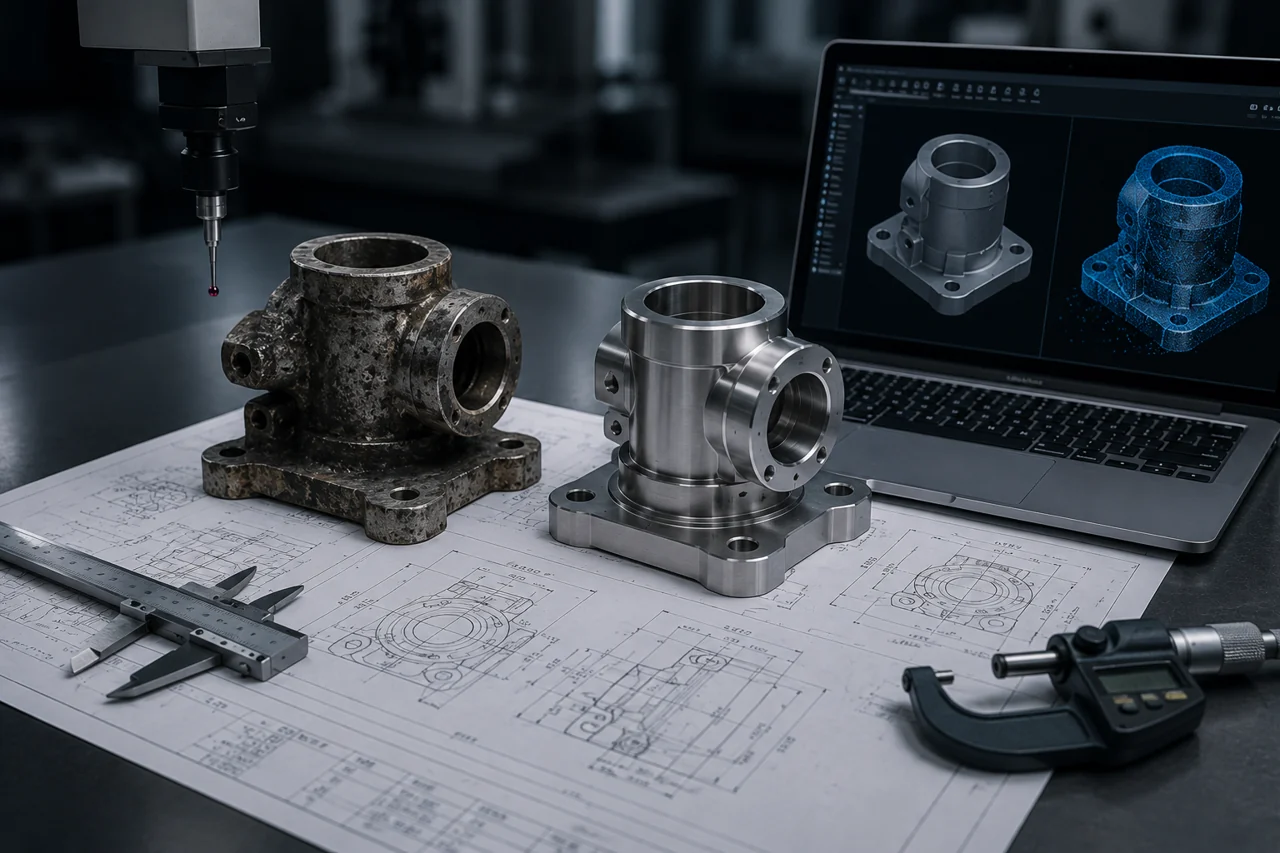
Two No-Tooling Routes
| CNC machining | Vacuum casting | |
|---|---|---|
| Best quantity | 1–10 pieces | ~10–100 pieces |
| How | Cut from solid plastic stock | Silicone mould from your master, cast resin |
| Materials | ABS, POM, nylon, PC, PEEK, PTFE… | PU resins mimicking ABS/PC/PP/rubber |
| Lead time | Days | ~1 week |
| Tooling cost | None | Soft mould only — a fraction of steel tooling |
For a handful of parts, CNC machining from a solid block gives a fully dense part in the real engineering plastic. For a small batch, vacuum casting copies your sample 1:1 in a silicone mould and casts resin parts that look and behave like the moulded original — smooth finish, fine detail, even clear or coloured.
Why Not Just 3D Print It?
3D printing is great for a quick visual check, but printed parts are usually layered, weaker, and not in the production material. Vacuum casting and CNC give fully dense parts in real plastics with proper surface finish — far closer to the part that broke. We use printing as a step (to make a master), not as the finished part. The full quantity math between the processes is on our CNC vs 3D printing vs injection molding decision chart.
From a Broken Sample to New Parts
A broken part is still a usable master: we reconstruct the missing areas, build a clean master model, then machine or cast from it. This is the same reverse-engineering method we apply to metal — see how reverse engineering works. For discontinued car interior pieces specifically, see replacement plastic trim for a discontinued car.
Tell us the quantity first. It's the single biggest factor in which route is cheapest. Send the sample (broken is fine) or photos with one reference dimension — no drawing needed via no-CAD ordering.
The metal equivalent is copying a cast part without drawings, where the draft angles disappear, the thinnest wall is taken as the true section and a machining allowance replaces the casting skin.
Plastic Parts Recreated Without Injection Moulding
Parts where we used CNC machining or vacuum casting to reproduce a plastic component without a mould:
Frequently Asked Questions
Two no-tooling routes: CNC machining from solid stock for 1–10 pieces, or vacuum casting (a silicone mould from your sample) for ~10–100. Neither needs a steel injection mould or its four-figure cost.
Yes. We reconstruct nominal geometry from the broken pieces, build a clean master, then machine or cast new parts. No drawing required.
When you need strength, finish and real material behaviour. Vacuum casting gives smooth, fully dense parts in resins that mimic production plastics — much closer to the original than a layered print.
By CNC: ABS, POM/Delrin, nylon, PC, PMMA, PEEK, PTFE and more. By vacuum casting: PU resins mimicking ABS, PC, PP, rubber and glass-filled nylon, in various hardnesses and colours including clear.
Quote a Plastic Part
Send the sample (broken OK) + quantity needed. Engineers reply within 12 hours.
// Qty & price
1 pc
Sample price
Confirm fit before a run
10–50
Unit price drops
Setup cost shared
100+
Best price
All tiers quoted upfront
- →No distributor — you pay the maker directly
- →CAD saved after first order — reorder anytime at lower unit price
No tooling cost · Files kept confidential