The Problem
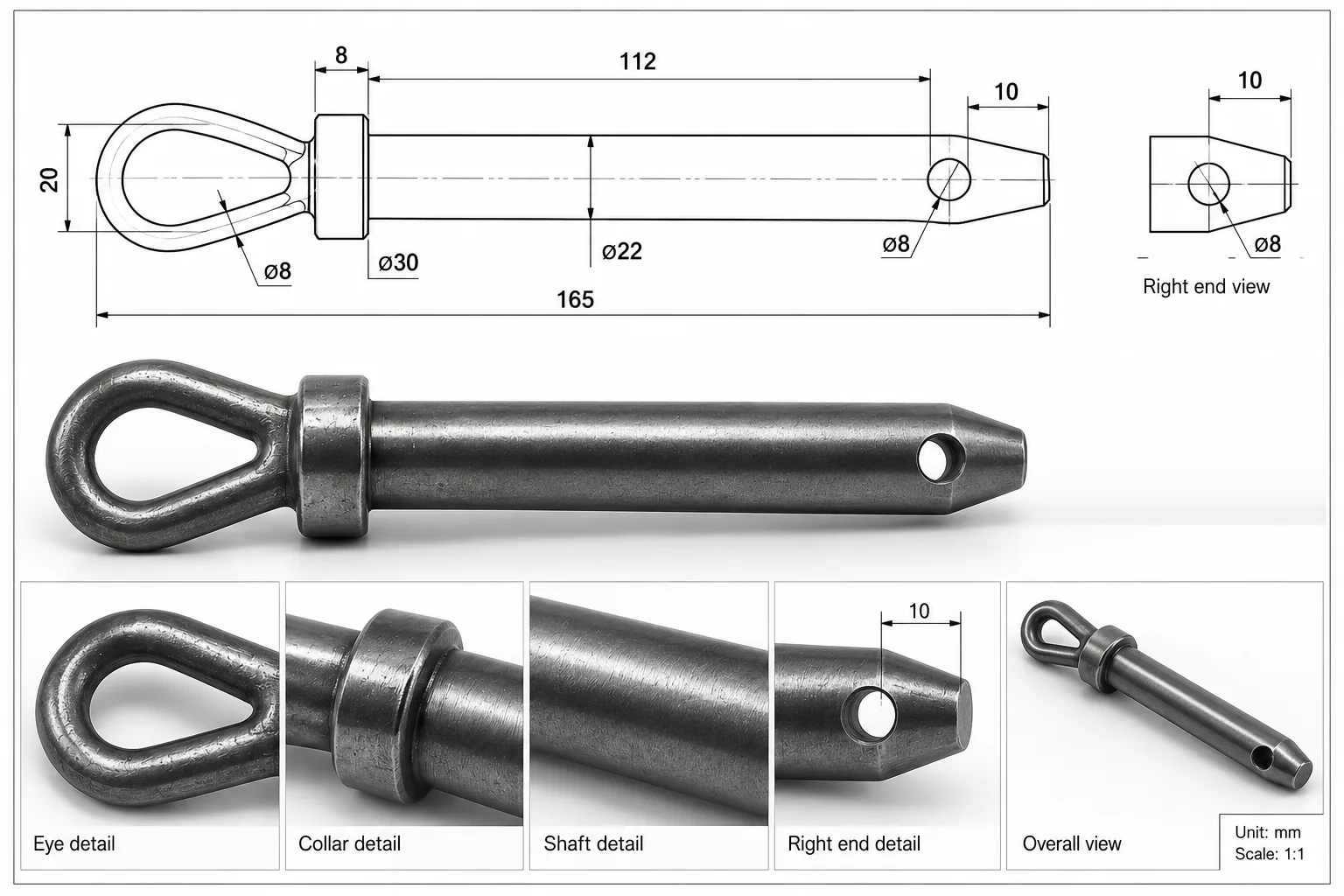
A pin, 165 mm overall: a Ø22 shaft 112 mm long, a Ø30 collar 8 mm wide that seats it in the bore, an eye of Ø8 round section standing 20 mm across, and a Ø8 cross hole 10 mm from a tapered tip — where a linch pin or R-clip normally goes. Material 45# steel, the Chinese designation for a 0.42–0.50 % carbon steel, the same class as C45 (EN 1.0503) and AISI 1045; poured, the same carbon class is the cast grade ZG310-570. Finish self-colour (plain) or black oxide.
The enquiry, paraphrased: “A steel pin with an eye, Ø22, 165 long, no tight tolerance — machining costs too much for a pin like this.”
The drawing carries no tolerance tighter than the shape itself. The pin sits in a clearance bore; nothing on it runs at speed, nothing is ground. Cut from bar on a CNC lathe it would be a fine pin and an expensive one. The buyer did not need a fine pin.
Why It Is Cast, Not CNC Machined
EKINSUN supplies pins like this from one piece — machined from bar when a drawing asks for a fit, cast when it does not and the quantity carries a pattern. The route follows the tolerance, and on this drawing the tolerance says casting.
- Machining starts from the biggest diameter. The collar is Ø30, so the bar is at least Ø30, and along the 112 mm shaft 46 % of a Ø30 bar's cross-section is turned into swarf before anything else happens.
- The eye is the expensive part. A closed loop of Ø8 section, 20 mm across, is not a lathe feature. From bar it is milled out of the full diameter — in a second setup, or with live tooling on a mill-turn centre; in volume production the eye is upset-forged on the end of the bar and the shank is left as bar, chamfered and cross-drilled, which is the route catalogue pins take and the reason their dies exist. From bar the eye costs more than the shaft; in a forging its cost moves into a die that only a run can pay for.
- A casting pours all of it at once. Eye, collar, shaft, cross hole and taper come out of the mould as one piece. Any surface that must mate — the shaft in its bore, if the bore were tight — gets one finishing cut. Here none does.
- The tolerance was never a reason to machine. A turned shaft holds a few hundredths of a millimetre; an investment casting holds a few tenths on a Ø22 shaft; a sand casting more than a millimetre. This drawing lives inside the middle number: it does not pay for a turned shaft, and a sand casting's surface and its scatter of more than a millimetre are too rough for a Ø22 shaft in a bore and a Ø8 cross hole.
The price of a machined pin is the price of removing metal. The price of a cast pin is the price of a pattern, spread over the run. When the drawing asks for no fit and the run carries the pattern, the second number is the smaller one.
Three Routes for the Same Pin
The same geometry is made three ways, and the drawing's tolerance plus the quantity picks between them.
| Route | Tooling | Tolerance it holds | Where it wins |
|---|---|---|---|
| CNC machined from Ø30 bar | None | Hundredths of a millimetre; hardened and ground where the drawing says so | One to a few dozen pieces; any pin with a running fit or a hardened wear surface |
| Cast (investment casting), finishing cut only where a face mates — this pin | A pattern or wax die, paid once | A few tenths of a millimetre as cast | Eye-head and collared pins with open tolerances, at a quantity that carries the pattern |
| Eye upset-forged on a bar shank | A forging die | As forged on the eye; bar tolerance on the shank, machined where it matters | Catalogue hitch and linch pins, thousands a year; the strongest of the three, because the eye keeps its grain flow |
Is a Cast Pin Strong Enough?
A cast medium-carbon steel gives up two things a wrought bar has: the rolled grain flow, and some ductility with it. For a pin that sits in a clearance bore and is loaded in shear at low cycle counts, neither matters. For a pin that is hardened, ground, loaded in fatigue or sits in a safety-critical joint, the same casting is the wrong part — that pin is machined from bar, C45 induction-hardened or 42CrMo4 / 4140 hardened and tempered, or forged, and we say which before quoting.
The same test runs the other way on brackets: a cast original replaced by a machined bracket is a conservative substitution; a machined original replaced by a casting is not — unless the drawing shows the fit was never there and the duty is the one above: shear in a clearance bore at low cycle counts.
What You Need, and Where It Comes From
| What you need | In the catalogue? | What happens |
|---|---|---|
| A standard linch pin (DIN 11023) or clevis pin (ISO 2341) in a listed size | Yes — every agricultural and trailer supplier stocks them | Buy it from stock. No one-off can match a catalogue pin on price |
| A hitch pin with an eye, catalogue diameter and length | Yes, in the common sizes | Buy the listed one; come to us when the collar position, the length or the hole does not match |
| Your own length, collar and hole pattern, open tolerance, a run of them | No | Cast, with a pattern made to your drawing — this case |
| One or two pins, urgently, to a worn original | No | Machined from bar — a pattern makes no sense for two pieces. See pivot pins from a worn sample |
| A running fit or a hardened wear surface | No | Machined from bar — C45 induction-hardened where the bore runs on it, or 42CrMo4 / 4140 hardened and tempered; stainless 304 / 316 for corrosion duty — not cast. See custom clevis pins |
Materials for a Pin Like This
| Material | Route | Where it belongs |
|---|---|---|
| C45 / 45# steel (EN 1.0503, AISI 1045) | Bar | The default for connecting pins when they are turned |
| C45-class cast steel (GB ZG310-570, the 45# cast grade) | Cast | The same 0.42–0.50 % carbon class poured instead of rolled — this pin |
| 42CrMo4 / 4140 | Bar, hardened and tempered | Pins with a running fit or a wear surface; induction-hardened where the bore runs on it |
| Stainless 304 / 316 (1.4301 / 1.4401) | Bar | Marine, washdown and outdoor joints where rust is the failure mode |
| Aluminium 6061 / 7075 | Not offered | No place in a connecting pin — an aluminium shaft in a steel bore wears and deforms. A pin like this is a steel part |
Black oxide, where the drawing asks for it, is a conversion coating about 1 µm thick: it changes no dimension and protects only with an oil film on top. It is a look and a light corrosion barrier, not a wear surface.
C45 is 1045 in the US, S45C in Japan and grade 45 in China, one steel under four names; the medium-carbon steel equivalents chart crosses them and says what changes with the delivery condition.
How the Job Runs
The route is settled — cast in C45-class steel, black oxide or self-colour as the drawing says, no machining beyond what a mating face needs. Casting generally takes about 2 weeks.
Enquiry received
A drawing, or the pin itself to measure from. For the cast route the pattern needs the whole geometry — eye, collar, taper and holes — so a photo with two numbers prices the job but does not define it.
Route check
Tolerance and quantity against the cost of a pattern, with a machined price alongside so the comparison is on paper. The route answer comes back within 12 hours.
Pattern and first castings
The pattern is made to the drawing and the first castings are checked against it before the run.
Finishing where a face mates
None on this drawing; black oxide if specified.
Inspection and dispatch
Shaft diameter, overall length and hole positions checked on the run before the pins ship.