The Crosswalk — 6 Grades Across AISI, EN, Old DIN / AFNOR, BS, JIS and GB
All 6 rows are direct equivalents: a plain carbon steel is defined by its carbon band, and every system draws the bands in the same places (0.32–0.39, 0.37–0.44, 0.42–0.50, 0.47–0.55, 0.52–0.60 % C). The family’s confusion is not in the names but in what comes after them — the delivery condition, the P / S cap that separates C45 from C45E, and the section size — so the chart spends its space there. The old-name column carries XC48, F-114, Ck45, EN8 and 080M46, which are still on a good share of the drawings we receive.
EKINSUN LTD machines shafts, pins, studs, gear blanks, racks, flanges and spacers in every grade in the chart from one piece, normalised or quenched and tempered to the drawing and induction hardened where drawn — from a drawing written in AISI, EN, JIS or GB names, a sketch or the worn part. This page is part of the material grade equivalents series.
| AISI / SAE | UNS | EN 10083-2 name (number) | Old DIN / AFNOR / UNE | BS 970 | JIS G4051 | GB/T 699 | Equivalence |
|---|---|---|---|---|---|---|---|
| 0.45 % carbon — the shaft and pin steel | |||||||
| 1045 | G10450 | C45 (C45E) (1.0503 (1.1191)) | Ck45 / C45 (AFNOR XC48, UNE F-114) | 080M46 (080M40 nearest) | S45C | 45 | direct: the most-machined steel on earth under five names: 1045 (C 0. |
| 1045 (fine-grain, std) | G10450 | C45E (1.1191) | Ck45 | 080M46 | S45C | 45 (high-quality: 45A, std) | direct: same bands as C45, with P and S each capped at 0. |
| 0.40 % carbon — the general-purpose grade | |||||||
| 1040 | G10400 | C40 (C40E) (1.0511 (1.1186)) | Ck40 (AFNOR XC42) | 080M40 (EN8) | S40C | 40 | direct: identical carbon band in SAE and EN; BS 080M40 (the old EN8) is the UK's default engineering bar and is routinely used where a drawing says 1045 or C45, with a little less carbon (0. |
| 0.35 % carbon — bolts, forgings, lightly loaded shafts | |||||||
| 1035 | G10350 | C35 (C35E) (1.0501 (1.1181)) | Ck35 (AFNOR XC38) | 080M36 (EN8 lower band) | S35C | 35 | direct: the lower end of the family, chosen where a part is welded or cold-formed; C35E / 1. |
| 0.50-0.55 % carbon — springs, blades, wear parts | |||||||
| 1050 | G10500 | C50 (C50E) (1.0540 (1.1206)) | Ck50 (AFNOR XC50) | 080M50 | S50C | 50 | direct: C50 / 1. |
| 1055 | G10550 | C55 (C55E) (1.0535 (1.1203)) | Ck55 (AFNOR XC55) | 070M55 | S55C | 55 | direct: the top of the plain-carbon Q&T range; C55 / 1. |
JIS G4051 and GB/T 699 bands quoted in the equivalence text are taken from the standards’ tables (S45C C 0.42–0.48 %, GB 45 C 0.42–0.50 %) and marked ‘std’; the 1035, 1050 and 1055 SAE bands come from SAE J403 in the same way. Old names: XC38 / XC42 / XC48 / XC50 / XC55 (AFNOR NF A35-552, withdrawn), F-114 (UNE 36011), Ck35–Ck55 (DIN 17200), EN8 / EN9 (BS 970:1955).
Need a part machined in C45 / 1045 or its equivalent medium-carbon steel? EKINSUN is a custom parts manufacturer: we machine parts in C45 / 1045 or its equivalent medium-carbon steel to your drawing, sketch or sample, from 1 piece, with a material certificate on request and a quote in 12 hours. If the size is standard, ask anyway — it may be in stock, and the unit price drops as the quantity rises. How ordering without CAD works →
Composition Bands — US and EN Side by Side (mass %)
Each cell shows the SAE J403 band first and the EN 10083-2 band under it. The only systematic difference across the family is manganese — SAE 0.60–0.90 % against EN 0.50–0.80 % for the 0.45 % grade — and the sulphur cap, ≤ 0.050 % in SAE against 0.045 % in EN and 0.035 % in the E grades. SAE J403 does not specify silicon for these grades; JIS G4051 does (0.15–0.35 %) and GB/T 699 does (0.17–0.37 %).
| Grade | C | Mn | Si | S max |
|---|---|---|---|---|
| 1045 C45 | US 0.43–0.50 EN 0.42–0.50 | US 0.60–0.90 EN 0.50–0.80 | US — (not specified) EN ≤ 0.40 | US ≤ 0.050 EN ≤ 0.045 (C45E: ≤ 0.035) |
| 1045 C45E | US 0.43–0.50 EN 0.42–0.50 | US 0.60–0.90 EN 0.50–0.80 | US — EN ≤ 0.40 | US ≤ 0.050 EN ≤ 0.035 (P ≤ 0.035) |
| 1040 C40 | US 0.37–0.44 EN 0.37–0.44 | US 0.60–0.90 EN 0.50–0.80 | US — EN ≤ 0.40 | US ≤ 0.050 EN ≤ 0.045 |
| 1035 C35 | US 0.32–0.38 (std) EN 0.32–0.39 | US 0.60–0.90 (std) EN 0.50–0.80 | US — EN ≤ 0.40 | US ≤ 0.050 EN ≤ 0.045 (C35E: ≤ 0.035) |
| 1050 C50 | US 0.48–0.55 (std) EN 0.47–0.55 | US 0.60–0.90 (std) EN 0.60–0.90 | US — EN ≤ 0.40 | US ≤ 0.050 EN ≤ 0.045 |
| 1055 C55 | US 0.50–0.60 (std) EN 0.52–0.60 | US 0.60–0.90 (std) EN 0.60–0.90 | US — EN ≤ 0.40 | US ≤ 0.050 EN ≤ 0.045 |
The Drawing Says… — What We Make the Part In
This is the column no stockholder chart has. A drawing arrives in one country’s names and the part is machined where a different name is on the bar; the table says, grade by grade, what the part is made in and what — if anything — changes. The rule behind every row: the grade and delivery condition actually used are written on the quote before machining and on the EN 10204 3.1 certificate after it.
| The drawing says | What we make it in — and what changes |
|---|---|
| 1045, S45C, 45 steel, XC48, F-114 or 080M46 | made in C45 / C45E bar (+N or +QT to the drawing); induction-hardened surfaces to 55 HRC where drawn. No change to the part. |
| 1040, S40C, 40, XC42 or EN8 / 080M40 | made in C40 / 1.0511; a UK EN8 drawing is made in C40 or C45 with the grade named on the quote. |
| 1035, S35C, 35 or XC38 | made in C35E / 1.1181; no change. |
| 1050, S50C or 50 | made in C50 / 1.0540, hardened and tempered or surface-hardened as drawn; no change. |
| 1055, S55C or 55 | made in C55 / 1.0535; no change. |
| C45E, Ck45 or 1.1191 | made in C45E; where only 1045 or GB 45 is in stock, the certificate's P and S are checked against 0.035 % before the bar is cut. |
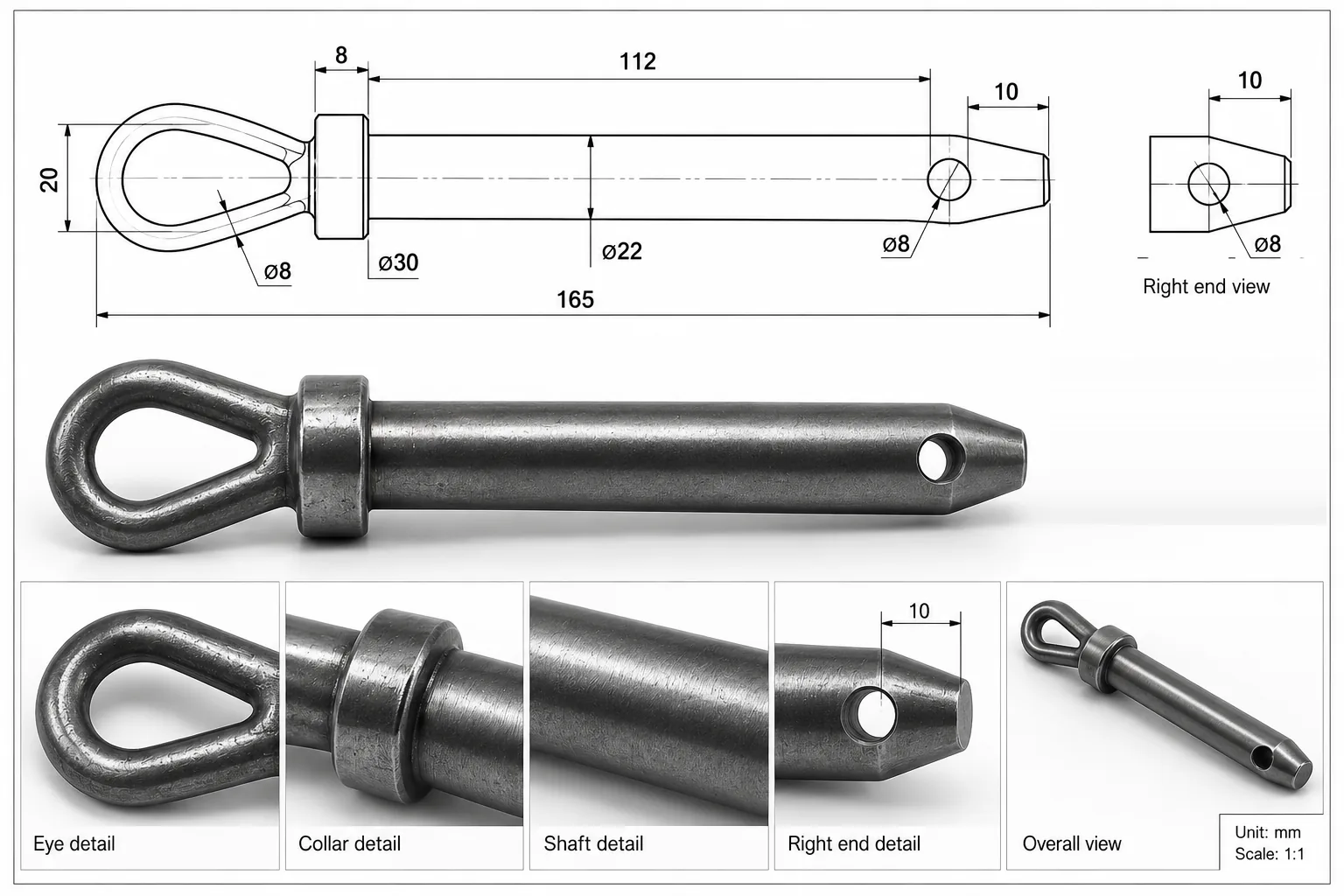
Two requests from the inbox show the two directions. A Norwegian buyer: “eye pin Ø22 × 165 mm, C45, cast head, no fit on the drawing” — the pin is C45 in every system, so the question was never the grade but the fit and the casting route (see the cast C45 eye pin case). A US buyer with a Chinese drawing: “material says 45#, is that 1045 or something special?” — it is 1045, GB/T 699 grade 45, and the part is made in C45E with the certificate naming the grade. Custom shafts, gears, spacers and large nuts in C45 follow the same route; a hand sketch with the main dimensions is enough to start.
Four Traps — Where a Name Match Is Not a Material Match
Trap 1 — the name says nothing about the condition. C45 +N is Rm 560–650 MPa; C45 +QT is 700–850 MPa with Re 490 MPa up to 16 mm. 1045 ‘hot rolled’ and 1045 ‘heat treated’ differ the same way. Order the bar by the condition on the drawing, not by the name.
Trap 2 — plain carbon does not harden through. C45 +QT is guaranteed to 16 mm; at 40–100 mm Re falls to 370 MPa. A shaft above about 40 mm that needs a hard core is a 42CrMo4 / 4140 part, whatever name system the drawing uses.
Trap 3 — 45 steel is not 42CrMo, and 1045 is not 1018. GB 45 is C45; GB 42CrMo is 42CrMo4 (adds Cr and Mo). 1018 / C15E / S15C / GB 15 are 0.15–0.20 % C mild and case-hardening steels that never through-harden; A36 / S235 / Q235 are structural steels sold to strength, not carbon.
Trap 4 — C45 and C45E are not interchangeable on a hardened part. C45E / 1.1191 (old Ck45) caps P and S at 0.035 % and guarantees the hardening response; a drawing for an induction-hardened pin should name it, and a 1045 or GB 45 heat is checked against that cap before it is used.
Conditions, Section Sizes and the Numbers Behind the Names
| Fact | Value | Standard / source |
|---|---|---|
| Composition of the anchor grade in four systems | C45 (EN 10083-2): C 0.42–0.50, Si ≤ 0.40, Mn 0.50–0.80, P ≤ 0.045, S ≤ 0.045. 1045 (SAE J403): C 0.43–0.50, Mn 0.60–0.90, P ≤ 0.040, S ≤ 0.050. S45C (JIS G4051): C 0.42–0.48, Si 0.15–0.35, Mn 0.60–0.90. 45 (GB/T 699): C 0.42–0.50, Si 0.17–0.37, Mn 0.50–0.80. | MakeItFrom C45 and 1045; JIS G4051; GB/T 699 |
| Two conditions, two parts | C45 normalised (+N): Rm 560-650 MPa, Re about 300-340 MPa, machines easily, about 190 HB. C45 quenched and tempered (+QT, ≤ 16 mm): Rm 700-850 MPa, Re 490 MPa, about 210-250 HB. The name is the same; the drawing's condition note decides which bar is ordered and how the part behaves. | EN 10083-2 |
| Induction hardening | C45 / 1045 / S45C / 45 surface-harden by induction or flame to 55-58 HRC on a case of 1-3 mm over a tough core, the reason the grade carries most shafts, pins and rack teeth; alloy steels are not needed for that. The drawing has to state the hardened zone, the depth and the hardness. | EN 10083-2; shop practice |
| Section-size limit | Plain carbon steel hardens through only in small sections: C45 +QT is guaranteed to 16 mm at Re 490 MPa, falls to Re 430 MPa at 16-40 mm and Re 370 MPa at 40-100 mm. A shaft above about 40 mm that needs a hard core is a 42CrMo4 / 4140 part, not a C45 part. | EN 10083-2 |
| C45 vs 42CrMo4 — the question behind half the quotes | Same carbon; 42CrMo4 adds Cr 0.90–1.20 % and Mo 0.15–0.30 % for hardenability and strength in section (+QT Re 900 MPa at ≤ 16 mm against 490 MPa for C45). C45 is cheaper, welds and machines more easily and surface-hardens just as well; the alloy steel is bought for the core, not the surface. | EN 10083-2 / EN 10083-3 |
| Old names still on drawings | XC48 and XC42 (France, AFNOR), F-114 (Spain, UNE), Ck45 (Germany, DIN 17200), EN8 (UK, ≈ 080M40) and EN9 (≈ 070M55) map to the rows above; 'C45' itself is also the ISO 683-1 name, so it is the safest single name to write on an international drawing. | AFNOR NF A35-552; UNE 36011; DIN 17200; BS 970:1955 |
| Weldability | Weldable with preheat (about 150-250 °C for C45, more for C50 / C55) and post-weld stress relief; C35 / 1035 welds without preheat in thin sections. Cracking on cooling is the usual failure when a 1045 part is welded like mild steel. | EN 1011-2 guidance |
| Not the same as mild steel | 1018 / C15E / S15C / GB 15 (C about 0.15–0.20 %) are case-hardening and general mild steels; they do not through-harden and belong on the case-hardening steel crosswalk. A36 / S235 / Q235 are structural steels sold to strength, not carbon, and are not equivalents of 1045 either. | SAE J403; EN 10025 |
Native datasheets for the grade exist in French (C45 / XC48) and Spanish (F-114); the general carbon-steel machining page is carbon steel machining (1018, 1045, 4130); the property classes C45 sits behind (class 8.8 nuts and bolts) are on the bolt grade chart; the sequence for hardened parts on heat treatment and machining.
Where the Chart Stops — Bar From Stock, Parts From a Drawing
Bar in every grade above is a stock item at any stockholder, and the chart is how you order the right one in another country; a shaft, pin, stud, gear or flange in that grade, in the drawing’s condition, is not on any shelf. The table is plain about which is which.
| What you need | In the catalogue? | What we machine |
|---|---|---|
| Round bar or plate in C45, 1045, S45C or 45 for your own shop | Yes — every stockholder | Buy it from stock, +N for machining or +QT pre-hard; the cheapest engineering bar there is. A stockholder cuts to length for less than any machined blank, and we say so in the quote. Standard parts: ask us too — we may have them in stock. |
| A pin, axle or eye pin drawn in C45 by a European buyer, Ø10–80 mm, induction hardened or not | No | Machined in C45E / 1.0503, normalised or +QT to the drawing, induction hardened on the bearing length to 55–58 HRC where drawn; a pin with a cast head goes the casting route — see the cast C45 eye pin Ø22 × 165. |
| A shaft or spindle drawn in 1045 or S45C by a US or Japanese customer, delivered in Europe | No | Machined in C45 / C45E in the drawing's condition, keyways and threads to the drawing's standard; see custom shafts and the deep-hole precision shafts. |
| A shaft above Ø40 mm drawn in C45 +QT with a core hardness the plain steel cannot reach | No | We say so and quote 42CrMo4 / 4140 +QT instead, with the section-size row on the quote — see the 4140 / 42CrMo4 equivalents. |
| A Chinese drawing in 45 or 45# steel, or a European drawing in XC48 / F-114 / Ck45 | No | All the same steel: machined in C45 / C45E (or GB 45 in China) and the certificate names the grade used; native datasheets in French (C45 / XC48) and Spanish (F-114). |
| A gear blank, rack or sprocket in C45 / 1045, flame or induction hardened on the teeth | No | Machined in C45E, teeth cut, hardened to the drawn depth and hardness; see custom spur gears and gearbox parts. For carburised gears the grade changes family — see the case-hardening steel chart. |
Quick Answers
What is 1045 in EN?
C45 / 1.0503 (C 0.42–0.50 %, Mn 0.50–0.80 %), or C45E / 1.1191 with P and S ≤ 0.035 %; JIS S45C; GB 45; BS 080M46; AFNOR XC48; UNE F-114. Direct equivalent; add the condition (+N or +QT).
What is C45 in AISI?
1045 (C 0.43–0.50 %, Mn 0.60–0.90 %), UNS G10450.
What is 45 steel in EN and AISI?
GB/T 699 grade 45 = C45 / 1.0503 = 1045 = S45C (C 0.42–0.50 %, Si 0.17–0.37 %, Mn 0.50–0.80 %).
What is S45C in EN?
C45 / 1.0503 — direct; S40C is C40 / 1.0511, S50C is C50 / 1.0540, S55C is C55 / 1.0535, S35C is C35E / 1.1181.
What is XC48 or F-114?
Old French (AFNOR) and Spanish (UNE) names for C45 / 1045; XC42 is C40 / 1040, XC38 is C35 / 1035.
What is EN8 steel equivalent to?
BS 080M40 (C 0.36–0.44 %), between C40 / 1040 and C45 / 1045; EN8 drawings are made in C40 or C45 with the grade named. EN9 is 070M55 ≈ C55 / 1055.
What is Ck45?
The old DIN 17200 name of C45E / 1.1191: C45 with P and S capped at 0.035 %, the grade for induction-hardened parts.
Other families in the series: quenched-and-tempered alloy steels (4140 / 42CrMo4, 4340, 40Cr), case-hardening steels (8620, 16MnCr5), stainless steels (304 / 1.4301, 316L / 1.4404), aluminium alloys (6061, 6082, 7075), free-machining steels (12L14 / 11SMnPb30), plastic trade names (Delrin, Teflon); the index is the material grade equivalents hub.
1045 / C45 Equivalents FAQ
1045 is C45, material number 1.0503, in EN 10083-2 (C45E / 1.1191, the old Ck45, when P and S are capped at 0.035 %); the same steel is JIS S45C, GB/T 699 grade 45, BS 080M46, AFNOR XC48 and UNE F-114. The bands overlap: 1045 has C 0.43–0.50 % and Mn 0.60–0.90 %, C45 has C 0.42–0.50 % and Mn 0.50–0.80 %, S45C C 0.42–0.48 %, GB 45 C 0.42–0.50 %. What differs by drawing is the delivery condition — normalised or quenched and tempered — which decides the strength.
Yes: direct equivalents, and the bar is sold under both names. The only paper difference is the manganese band (C45 0.50–0.80 %, 1045 0.60–0.90 %) and the sulphur cap (C45 0.045 %, 1045 0.050 %), neither of which changes a machined part. C45E / 1.1191 tightens P and S to 0.035 % and is the grade to write when the part will be induction hardened.
GB/T 699 grade 45 — the Chinese 1045 / C45 / S45C, C 0.42–0.50 %, Si 0.17–0.37 %, Mn 0.50–0.80 %. It is the default shaft, pin and gear-blank steel in China exactly as C45 is in Europe; 45A and 45E are the same steel with tighter P / S caps. It is not 42CrMo (the Chinese 42CrMo4), which adds chromium and molybdenum.
Same carbon, different hardenability. 42CrMo4 adds Cr 0.90–1.20 % and Mo 0.15–0.30 %, so it hardens through in thick sections (+QT Re 900 MPa up to 16 mm, 750 MPa at 16–40 mm) where C45 +QT gives Re 490 MPa up to 16 mm and 430 MPa at 16–40 mm. C45 is cheaper, welds and machines more easily and surface-hardens just as well by induction, so it carries most shafts and pins; the alloy steel is bought for a hard core in large sections, not for a hard surface.
JIS S45C (C 0.42–0.48 %, Si 0.15–0.35 %, Mn 0.60–0.90 %) is C45 / 1.0503 in EN and 1045 in AISI — direct. S35C is C35 / 1035, S40C is C40 / 1040, S50C is C50 / 1050, S55C is C55 / 1055; the JIS number is the carbon × 100, like the SAE number.
The EN 10083-2 delivery condition. +N is normalised: Rm 560–650 MPa, about 190 HB, the machining condition. +QT is quenched and tempered: Rm 700–850 MPa and Re 490 MPa up to 16 mm, falling to Re 430 MPa at 16–40 mm and 370 MPa at 40–100 mm. A drawing that says C45 without a condition has specified the chemistry, not the strength; for a shaft above about 40 mm that needs a hard core, the answer is 42CrMo4, not C45 +QT.
EKINSUN LTD is a custom parts manufacturer that machines shafts, pins, studs, gear blanks, racks, flanges and spacers in C45 / C45E / 1045 / S45C / 45 from one piece, normalised or quenched and tempered to the drawing and induction hardened to 55–58 HRC where drawn, from a drawing written in AISI, EN, JIS or GB names, a sketch or the worn part. The quote states the grade and condition the part is made in; the EN 10204 3.1 certificate names the grade actually used. Quote in 12 hours.