EKINSUN is a manufacturer of turned parts to drawing, sketch or sample. This page is one enquiry written out in full, because the reasoning in it repeats on every press-fit bushing that comes in.
The enquiry, as it arrived
„Pilot bearing. Jeg trenger en lager ring med 32.025mm ytterdim, 17mm innerdim, 20mm dyp. Jeg har blitt anbefalt materiale RG7. Men er åpen for forslag.“
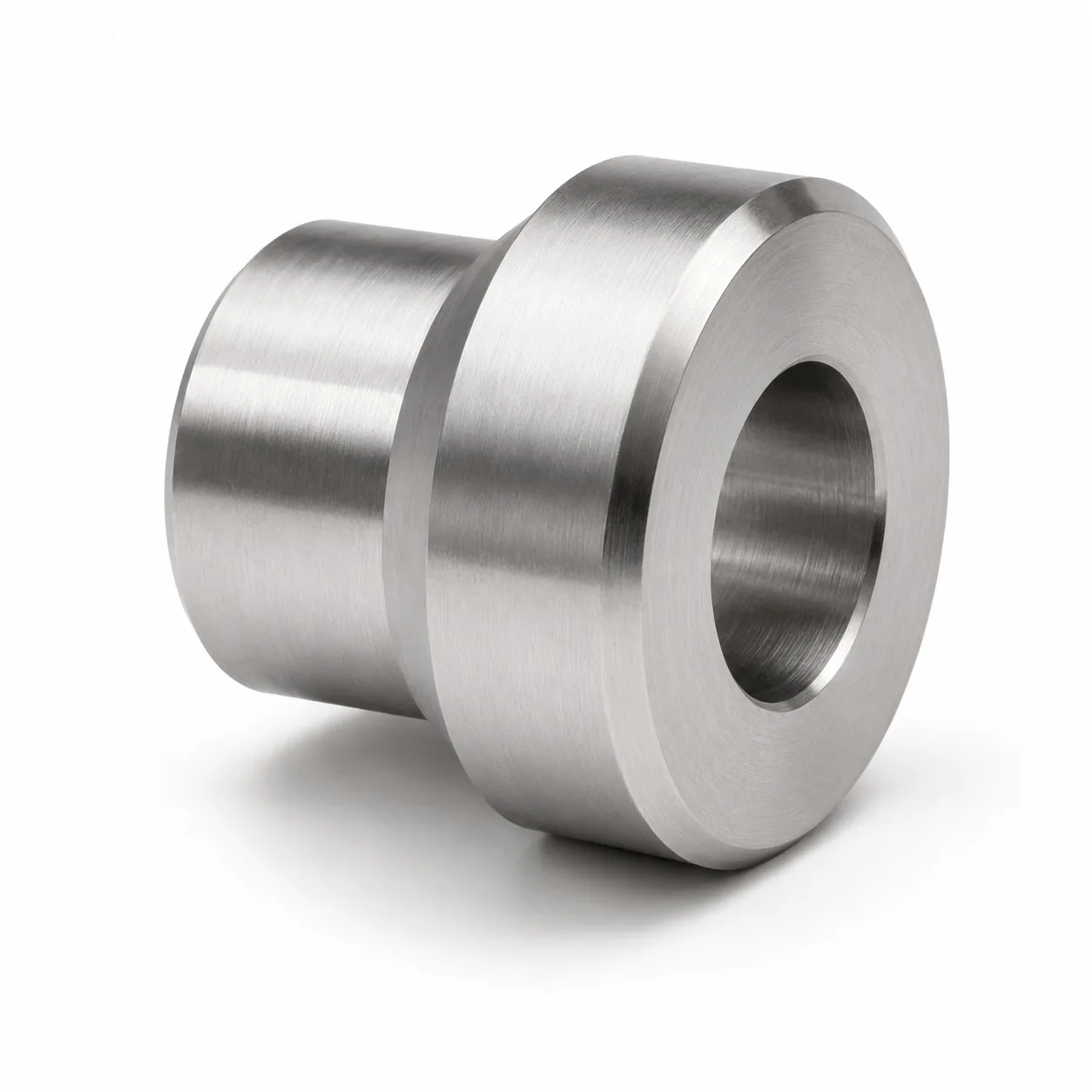
In English: a bearing ring, 32,025 mm outside, 17 mm inside, 20 mm deep; RG7 was recommended to him, but he is open to suggestions. The part is a pilot bushing — it sits in the end of the crankshaft or the flywheel and carries the nose of the gearbox input shaft. Four things in that sentence set the whole job, and the first is the one most likely to be read as a typo.
32,025 is not a rounding error
A buyer who wanted a nominal 32 mm bushing would have written 32. The third decimal says the number came off a bore gauge in the crankshaft, and that the bushing is meant to be pressed in rather than slipped in. That changes how the outside diameter is cut:
| Outside diameter cut at | What happens on assembly |
|---|---|
| 32,03 – 32,04 mm | Correct. Light interference against a 32,025 bore: the bushing is pressed in and stays put |
| Exactly 32,025 mm | A line-to-line fit that a lathe cannot hold reliably on bronze, and which becomes a slip fit as soon as the bore is a micron generous |
| Under 32,00 mm | Fails. The bushing turns in its housing instead of the shaft turning in the bushing, and it wears the crankshaft bore — the expensive part |
The rule that falls out of it: on a press fit, err upward. A bushing 0,015 mm too large goes in under the press. A bushing 0,03 mm too small is scrap, and it can take the housing with it.
The bore closes when the part goes in
This is the step that catches people who turn their own. Press a bushing into an interference fit and the wall is squeezed: the outside diameter is forced down to the housing bore, and the inside diameter follows it inward by roughly the same amount. With 0,025 mm of interference, a bore finished at 17,00 mm closes to about 16,98 mm — and the gearbox input shaft that measured 17 mm no longer enters.
Two ways out, and the choice belongs to whoever is doing the fitting:
- Cut the bore oversize, 17,05 – 17,08 mm. It closes to roughly the size you wanted. Simplest when the bushing is pressed in once and left alone.
- Cut the bore undersize and ream after pressing. More accurate, because the final size is cut with the bushing already squeezed, but it needs a reamer and access to the fitted part.
Which one we cut is a question we ask before machining rather than a decision we make quietly. It is also the reason a bushing bought from a catalogue sometimes needs reaming out of the box: the catalogue bore is a nominal figure, not a fitted one.
It runs almost dry
A pilot bushing is stationary most of its life. Clutch engaged, gearbox shaft and crankshaft turn together and nothing moves inside the bushing. Only when the clutch is disengaged does the shaft turn relative to it — at the difference between engine and gearbox speed, with no oil feed and whatever grease was put in at assembly. That duty cycle is why bronze is the traditional answer, and why the bore is worth treating as a bearing surface rather than a hole:
- An oil groove or a few blind oil pockets in the bore hold grease where it is needed, instead of letting it all squeeze out at the first engagement.
- A lead-in chamfer at the shaft end keeps the shaft nose from shaving the bore on reassembly — the gearbox is usually being fitted blind, at arm's length.
- Bore surface finish matters more than the tolerance band. A ground or reamed bore holds its film; a roughly turned one polishes itself by wearing.
The material question he actually asked
„RG7 was recommended to me, but I am open to suggestions“ is a request for a decision, not a purchase order. RG7 is a leaded tin bronze — the lead is what makes it forgiving when the film breaks down, which for a dry-running bushing is the whole point.
| Material | For a pilot bushing | Note |
|---|---|---|
| Tin bronze, bearing grade | Yes — this is the family | Same field of use as RG7. We state it that way rather than as an equivalent: without a material certificate on the bar, claiming equivalence to a specific grade is not something we will put in writing |
| RG7 with certificate | Yes, if the specification names it | Certified bar is a separate line on a quote. Ask for it if a workshop manual or an insurer requires the grade by name |
| Sintered bronze bush | Buy it, if the size exists | Catalogue sizes to ISO 3547 are stock and better and cheaper than anything turned. They are porous and oil-filled, which a turned bush is not. Check the catalogue before asking anyone to cut metal |
| Stainless 1.4301 or 1.4404 | No | Runs badly against a steel shaft without a matching counterface — it galls rather than wears |
| Aluminium 6061 or 7075 | No | Not a sliding partner for a steel shaft. It belongs in the housing, not in the running surface |
| A needle roller pilot bearing | Often the better answer | If a rolling pilot bearing exists in your size, it handles misalignment better than any bushing. The bushing route is for sizes that are not made |
Why this size is not on a shelf
Pilot bushings are a catalogue item in the sizes the volume engines used. This one is not one of those sizes, which is the usual reason a part like it reaches a machine shop at all: a gearbox swap, a rebuilt crank, an engine in a chassis it did not leave the factory in, or simply a make that stopped being supported. The housing bore is whatever it is, and the input shaft is whatever the other gearbox brought with it — the two ends come from different parts bins and no catalogue bushing spans them.
If your size is a catalogue size, buy it. A stock bushing costs less than the setup to turn one, and we will say so. What we make is the one in between: an odd outside diameter, an odd bore, a flange where the standard part has none, or a depth that no listed part matches.
What we ask before cutting
Three questions settle a bushing like this, and they are the same three every time:
- What does the housing bore measure? Not the nominal figure — the reading off the crankshaft or flywheel, taken in two directions in case it has gone oval. The bushing OD is cut from this number, not from a table.
- What does the shaft nose measure? The bore is cut to the shaft, with clearance chosen for the material pairing, then adjusted for what the press fit will take out of it.
- Are you reaming after fitting, or not? This decides whether we cut the bore oversize or undersize, and it is the one question that cannot be answered from here.
None of that needs a drawing. Three measured numbers and an answer to the third question are enough to cut the part. How to take the readings on a worn housing is on which surface to measure on a worn part, and the wider bushing family is under custom bushings.
Frequently Asked Questions
Because the fit has to be an interference fit, and a lathe cannot reliably hold a line-to-line size on bronze. Cutting 0,005 to 0,015 mm over the measured bore guarantees the bushing is pressed rather than dropped in. Cutting under the bore size is the failure case: the bushing then turns in its housing and wears the crankshaft bore, which costs far more than the bushing.
Nothing, probably — the bore closed. An interference fit squeezes the wall, and the inside diameter moves inward by roughly the interference amount. With 0,025 mm of press fit a 17,00 mm bore ends up near 16,98 mm. Either the bore should have been cut 17,05 to 17,08 mm before fitting, or it needs reaming to size now that the bushing is in place.
Yes, from certified bar, and that is quoted as its own line because certified material is bought for the job. Without the certificate we describe what we use as a bearing-grade tin bronze with the same field of use, which is accurate, rather than calling it equivalent to a named grade, which would not be.
If one exists in your size, often yes: a rolling pilot bearing tolerates slight misalignment between engine and gearbox better than a plain bushing, and it does not depend on a grease film that has to survive years of standing still. The bushing route exists for the sizes nobody makes a bearing for, which is what brought this enquiry in.
No. Three measurements and one decision: housing bore, shaft diameter, depth available, and whether you will ream after fitting. Send the old bushing as well if it came out in one piece — it confirms the depth and shows whether the previous one was turning in its housing, which changes what we cut.
MOQ is 1. Worth knowing on a part this size: most of the cost of a single turned bushing is setup rather than metal, so a few spares alongside the one you need cost much less each than the first. If the machine is in service and the part is not catalogue stock, that is usually the sensible order.
A bushing size that is not on any shelf?
Send the two measurements and the depth, or send the old bushing. We come back with what we would cut and why, in 12 hours.
Send the pitch, not a guess
Thread designation or a pitch-gauge reading over ten threads, the across-flats and height it must fit, quantity, material. Posting the shaft end or the old nut works too. One piece minimum, quote within 12 hours.