The Problem
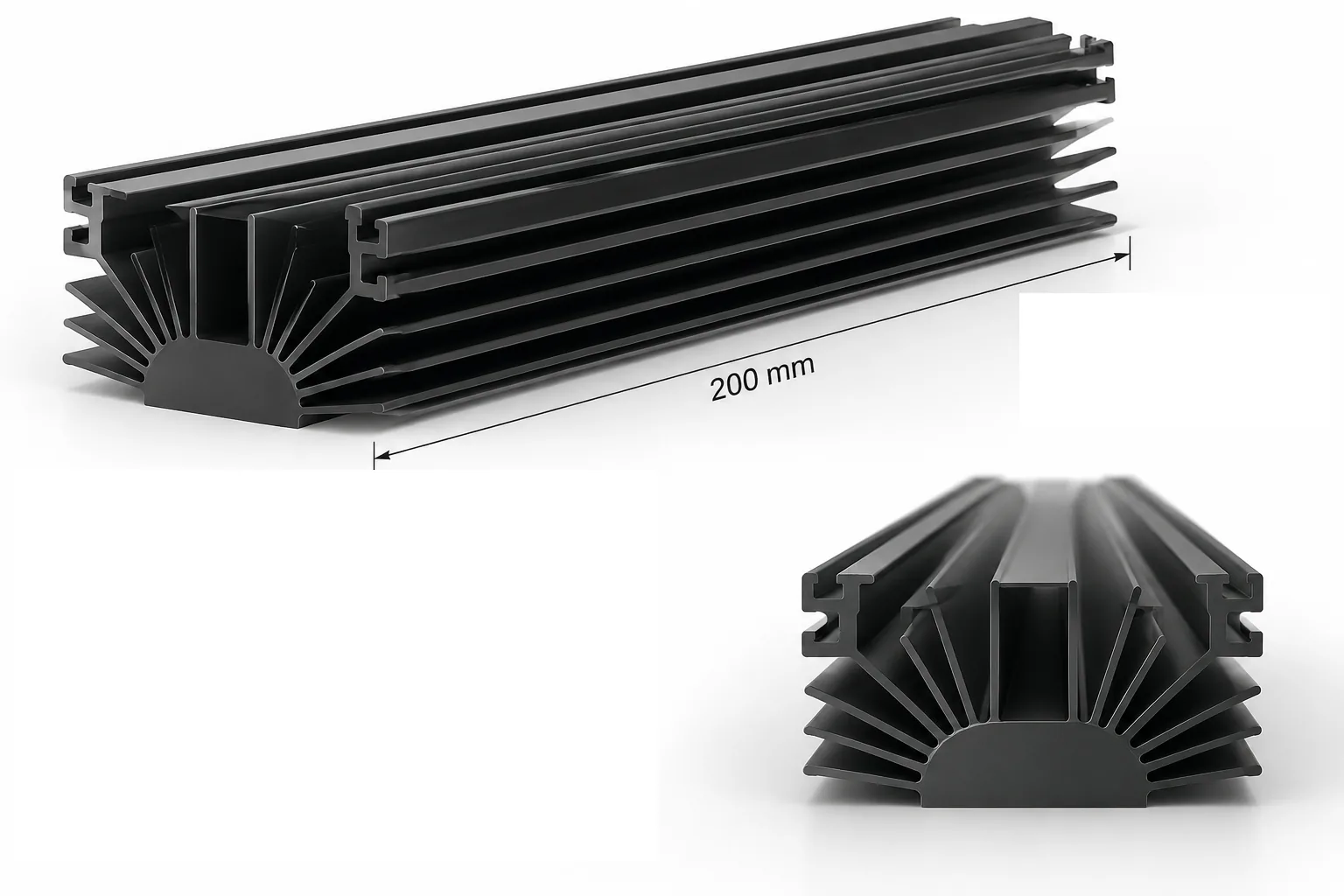
A heat sink with a section of its own: a half-round base with fins radiating out of it, a flat top carrying two T-slots for mounting, and the same cross-section for 200 mm. The buyer wants it in aluminium 6061, and wants only a few of them.
The enquiry, paraphrased: “A few pieces of this profile in 6061 — the die quote is more than the parts are worth. Can you make them without one?”
Every catalogue profile of this kind is an extrusion, and an extrusion needs a die cut for that exact section. The die is what makes an extruded heat sink cheap per metre — and what rules it out at this quantity, because the die quote alone comes to more than the parts are worth. The question was never whether the shape can be made. It was which route gets there without paying for tooling that a handful of parts cannot carry.
Why Wire EDM, Not an Extrusion Die
EKINSUN makes custom heat sinks to drawing from one piece, and picks the route by quantity and section rather than by habit — milled, skived, bonded, wire-cut, or extruded through a die when the volume is there. For this profile the arithmetic is short.
- An extrusion die is paid once and amortised over metres. At hundreds of metres it disappears into the piece price. At a few pieces of 200 mm it is the price.
- Wire EDM has no tooling at all. A travelling brass wire — Ø0.25 mm for a block this thick — cuts the profile all the way through, leaving a kerf of about 0.3 mm: the wire plus a spark gap on each side. The programme is the only setup, and it costs the same whether it cuts one part or twenty.
- The wire cuts what the die would have cut. Both produce one constant cross-section along the length — the wire simply does it from a 6061-T6 block instead of forcing hot 6063 through a steel opening.
- The length fits. Wire EDM cuts through up to about 300 mm of material, so the whole 200 mm profile goes through in one pass and the section is the same at both ends, within the wire's tolerance at that height.
Extrusion and wire EDM make the same kind of shape — one constant section. The difference is who pays for the die. At a handful of pieces, nobody should.
Why Not Just Mill It
Milling is the usual answer for a one-off heat sink, and for most fin fields it is the right one. This section defeats it in three places.
- Fin gaps. The radial fins converge toward the half-round base, so the gap between them narrows exactly where it is deepest. A milling cutter has to be thinner than the gap and long enough to reach the root, and at that reach both the cutter and the thin fin it leaves standing deflect — milled fin fields stop at about 8:1 fin height to fin thickness. A wire has no cutting force, so that limit disappears; what remains is the kerf, so the gap has to stay wider than about 0.3 mm at the root, and a fin thick enough to survive handling and anodising.
- T-slots. A T-slot is an undercut. Milling it means a T-slot cutter matched to each slot width and a separate operation per slot; the wire cuts the undercut as part of the same contour, in the same pass.
- Corners. A milled inside corner carries the radius of the cutter. A wire-cut corner carries half the kerf — wire radius plus spark gap, about 0.15 mm with the 0.25 mm wire — so the fin roots come out close to as drawn.
Same Profile, Three Quantities
The route changes with the quantity and nothing else. The crossover between the last two rows is set by the die quote for that particular section, not by a rule.
| Quantity | Route | Tooling paid | What you give up |
|---|---|---|---|
| 1 – 20 | Wire EDM through a 6061-T6 block — this enquiry | None. The programme only | A matte spark-eroded surface on the fins; anything that varies along the length is a second milling operation |
| 20 – 200 | Wire EDM, or milling where the fin gap allows it — the crossover to a die sits somewhere in this band | None, until the die quote beats the wire time | Wire time is paid on every piece, so the piece price barely falls with quantity; the die usually wins earlier than buyers expect |
| Hundreds and up | Extrusion die, profile cut to length and machined | The die, once | The extruder will want 6063 (about 201 W/m·K against 6061-T6 at about 167 W/m·K), the section is fixed to what a die can push, and there are weeks before first parts |
The first row is the one that surprises buyers: a route with no tooling that still produces the extruded-looking part, in the alloy they specified rather than the one the extruder prefers.
What You Have, and Where It Goes
Most heat sink enquiries do not need a special route, and it saves everyone a week to say which ones do.
| What you need | In the catalogue? | What happens |
|---|---|---|
| Standard extruded profile, standard footprint | Yes — heat sink makers and electronics distributors stock it deep | Buy it from stock. No one-off can match its price, and for that you don't need us |
| Catalogue profile in the wrong length, or with holes missing | Half — the profile exists, your length does not | We cut it to length and machine the pattern into it — see extruded heat sinks |
| A section of your own, hundreds of pieces a year | No | We quote a die and the pieces together, from your drawing and annual volume |
| A section of your own, a few pieces | No | Wire EDM through a 6061-T6 block, no tooling — this case |
| Fins deeper and thinner than a milling cutter reaches | No | Wire EDM for a constant section; for a flat-topped field, bonded fin from one piece — or skived fin in 1050 / 6063 / copper, never in 6061-T6 |
| Anything that changes along the length — pockets, bosses, stepped fins | No | Wire EDM for the section, then milling as a second operation; or milled from solid where the fins allow |
Which Aluminium, and Why 6061 Is Right Here
Wire EDM cuts whatever block is on the table, so the alloy is the buyer's choice rather than the process's. The choice still matters, because the alloys are not thermally equal.
| Alloy | Conductivity | Fits this route? | Note |
|---|---|---|---|
| 6061-T6 | ≈167 W/m·K | Yes — the drawing's alloy | The standard plate and block alloy, so it is what a wire-cut profile is normally made from; takes anodising well |
| 6063 | ≈201 W/m·K | Not this drawing's alloy | The extrusion alloy: better conductivity, and it can be milled or skived from solid, but thick 6063 stock is far rarer than 6061 plate and the buyer named 6061 |
| 1050 | ≈229 W/m·K | Not for this section | Soft and best for skived fins; too soft for T-slots that carry T-slot nuts |
| 7075-T6 | ≈130 W/m·K | No | Gives up a fifth of 6061's conductivity for strength this part does not need |
| Stainless 304 | ≈16 W/m·K | No | At 16 W/m·K it is an insulator by heat sink standards |
The one row that matters for this enquiry is the first: the buyer asked for 6061, the wire cuts 6061 block, and nothing in the route pushes the part toward a different alloy.
What the Drawing Needs to Say
For a wire-cut profile the drawing is the section and the length, plus three things that are usually left off.
- The alloy and temper — 6061-T6 here. The wire does not care, but the anodiser and the thermal calculation do.
- Which surfaces are thermal contact faces. The base gets skim passes or a milled finish after cutting; the fins can stay as cut.
- What the T-slots are for. If they take T-slot nuts (hammer-head nuts), say which system or standard — the slot's mouth, undercut and depth are taken from it.
How the Job Runs
The route is settled — wire EDM from 6061-T6, no die — and a small run of a special profile like this one takes about 15–20 working days after drawing approval.
Enquiry received
A section drawing or a sample profile, the alloy, the length and the quantity.
Route check
Die cost against quantity; fin gap and depth against a milling cutter; anything that varies along the length. Answered within 12 hours.
Programme
The 2D contour — fins, base, T-slots — as one closed path. The length of the part is the thickness the wire travels through.
Cut
The wire goes through the full 200 mm in one pass. Skim passes only where a surface is a contact face.
Second operations and finish
Mounting holes, the base face, anodising if the drawing calls for it.
Inspection and dispatch
The section is checked against the drawing at both ends of the length before the parts ship.