When Off-the-Shelf Stainless Won't Do
Distributors stock A2 and A4 stainless to DIN 931 and DIN 933 across a wide range — M5 upwards, with long lengths available on request. If your bolt is in that range, buy it. No machined bolt competes with a stocked one on price or lead time, and we will tell you so rather than quote.
The problem people bring here is a different one, and it is almost always the same problem: the size exists as a special, but not in the quantity you need.
The Real Wall Is Quantity, Not Size
Bolts are normally cold-formed. The shape is punched into the blank by a die, which is why a stocked bolt costs what it costs — and why a special bolt costs what it costs. A die has to be cut before the first piece exists, and that tooling is charged whether you order one bolt or ten thousand.
That is what puts the floor under custom fastener orders. Tooling for a special typically runs several hundred to several thousand dollars and has to be spread across the run, so quoted minimums for cold-formed specials commonly sit in the hundreds to several thousand pieces. Suppliers will often go lower for a prototype batch, but the unit price climbs steeply when it happens, because the same tooling is being divided among far fewer parts.
Machining from bar removes that step. There is no die, so there is nothing to amortise — which is why one piece is a normal order here. The trade-off is honest and worth stating plainly:
| Your situation | Cold-formed special | Machined from bar |
|---|---|---|
| You need 1–20 pieces — a repair, a prototype, a rig that takes four bolts | Tooling cost lands on a handful of parts | This is the case machining exists for. MOQ 1, no tooling charge |
| You need 50–500 | Possible, unit price rises sharply at the low end | Usually still competitive — worth quoting both ways |
| You need 5,000+ of one size | Go to a cold-former. Tooling disappears into the volume and they will beat us comfortably | We would be more expensive per piece and slower |
| You have one corroded original and no drawing | Needs a drawing before anything can be tooled | Measured from the sample, drawing rebuilt at no charge |
| Head, shoulder or drilling that no die exists for — wired heads, non-standard shoulders, cross-drilled shanks | New tooling for each variant | Geometry is a program change, not a new die |
Say the quantity in your first message. It changes the answer more than the material or the thread does. If your volume belongs with a cold-former we will say so — a quote we know to be uncompetitive is not worth either side's time.
For marine hardware, food processing equipment and chemical plant, the material grade matters as much as the dimensions. We machine 316L (low-carbon 316) to the exact specification your application requires, and passivate the finished parts to restore the passive layer after machining.
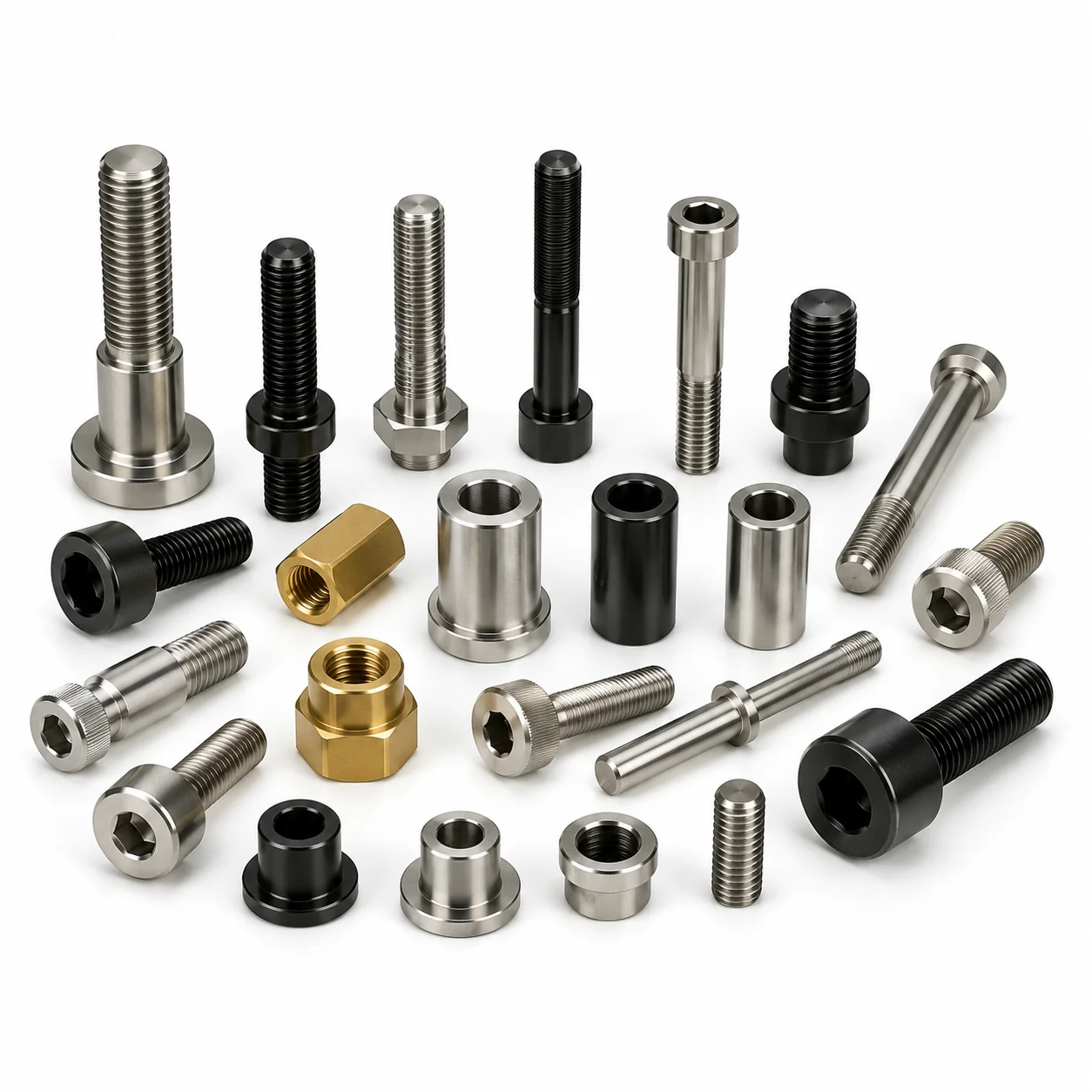
304 vs 316L — Which Grade for Your Application
| Environment | Recommended grade | Reason |
|---|---|---|
| Indoor / general | 304 | Good corrosion resistance, lower cost |
| Outdoor / coastal | 316L | Salt air resistance, no surface pitting |
| Marine / immersed | 316L | Chloride pitting resistance from molybdenum |
| Food processing | 316L | Resists acidic and chlorinated cleaning agents |
| Chemical plant | 316L | Chloride solution resistance |
| Swimming pools | 316L | Chlorinated water environment |
Have an existing stainless bolt to match? Send the sample — corroded or stripped threads are fine. We measure it, rebuild the drawing for free and machine a replacement in the correct grade. See replacement bolts from a sample or marine replacement parts for related services.
What We Make
| Specification | Options |
|---|---|
| Grade | 304, 316, 316L (low-carbon for welded assemblies) |
| Thread | Metric coarse and fine, UNC, UNF, BSP, custom pitch |
| Head types | Hex, socket cap, button, countersunk, cheese, flanged, eye bolt, stud |
| Length | Any — not limited to catalogue increments; long lengths welcome |
| Finish | As-machined, passivated (ASTM A967), electropolished on request |
| Quantity | Single piece to medium production runs |
Will it fit? Stainless in place of a zinc-plated bolt
An A2 or A4 stainless bolt has the same thread and head as the 8.8 zinc-plated one it replaces, and it fits the same hole and spanner. What it does not do is carry the same load: A2-70 and A4-70 are 700 MPa tensile against 800 MPa for 8.8 and 1,040 MPa for 10.9, so a 10.9 swapped for A2-70 gives up a third of its clamp. Stainless on stainless also galls dry — the nut seizes halfway down and has to be cut off — so a 316L bolt takes a lubricated 316 nut, or a nut in a different stainless grade.
What do I need for a bolt on a boat or a coastal structure?
A 316L bolt, a 316 nut with anti-seize, and a 316 washer under the nut; 304 pits in salt spray within a season. If the original was 8.8 and the joint is loaded, go up a size or add a bolt rather than trusting A4-70 at the old diameter.
Same stainless bolt, but 316L, 20 mm longer, or with a drilled head
316L instead of 304, a length between catalogue steps, a drilled head for lockwire, a reduced shank, or electropolish for a food-contact line — each is a variant of the same drawing, one piece and up, quoted in 12 hours.
The same cold-welding that seizes a stainless bolt in a stainless nut is worst on long nuts; the stainless coupling nut galling page gives the grade pairings and the assembly rules that stop it.
Frequently Asked Questions
304 is the standard general-purpose grade. 316 and 316L add molybdenum, which improves resistance to chloride pitting and crevice corrosion. For marine, food processing and chemical environments where salt or cleaning agents are present, 316L is the correct choice.
Yes. We machine 316L to any length, thread pitch, head type and drive that catalogues don't carry — including long lengths, partial threads, custom grip lengths and non-standard diameter combinations.
Yes, on request. Passivation removes free iron introduced during machining and restores the chromium oxide passive layer. For marine and food-contact applications we recommend it as standard.
Yes. Send the bolt in any condition and we measure the thread, head, drive and dimensions, rebuild the drawing for free, confirm with you, then machine in the correct stainless grade. No CAD file needed.
Marine and coastal environments, food processing equipment cleaned with chlorinated chemicals, chemical plant handling chloride solutions, outdoor coastal architecture, and swimming pools. Wherever prolonged chloride exposure would eventually pit 304.
Yes — a single replacement bolt is a normal order. The reason most custom fastener suppliers cannot do this is that bolts are usually cold-formed, and a special shape needs a die cut before the first piece exists. That tooling has to be paid for and spread across the run, which is what pushes quoted minimums for cold-formed specials into the hundreds or thousands of pieces. Machining from bar has no die, so there is nothing to amortise and no minimum to reach.
Somewhere in the low thousands of one identical size, cold forming wins and we will say so. Tooling that is painful to amortise over 50 pieces disappears into a run of 5,000, and a cold-former will then beat us on both price and throughput. Tell us the quantity in your first message — it changes the recommendation more than the grade or the thread does, and there is no point quoting you a job that someone else should have.
Hex head, socket cap, button and countersunk socket, shoulder bolts, studs and threaded bar, plus head forms that have no standard die at all — wired or drilled heads for lockwiring, non-standard shoulder diameters and lengths, cross-drilled shanks, and screwdriver slots cut into a head that is normally socket-drive only. Because the geometry is a program rather than a die, a one-off head form costs no more to set up than a standard one.
Get Stainless Bolts Quoted
Drawing or sample both accepted. Engineers reply in 12h.
// Qty & price
1 pc
Sample price
Confirm fit before a run
10–50
Unit price drops
Setup cost shared
100+
Best price
All tiers quoted upfront
- →No distributor — you pay the maker directly
- →CAD saved after first order — reorder anytime at lower unit price