You asked for 60 pieces and the quote came back with a line item you were not expecting: three molds. That is not padding. It is the single physical constraint that shapes every vacuum casting job.
The Honest Number
| Mold type | Realistic castings | What it suits |
|---|---|---|
| Standard RTV silicone | 20–25 | The normal case. One-off batches, discontinued parts, pre-production runs. |
| RTV, gentle geometry, careful handling | 30–40 | Shallow parts, generous draft, mild resin, no deep undercuts. |
| RTV, difficult geometry | 10–15 | Deep undercuts, thin fragile features, hot-curing or chemically aggressive resins. |
| High-temperature vulcanised silicone | 300–500 | Repeat programmes where the tooling investment amortises. Slower and far more expensive to make. |
Anyone quoting you "hundreds of parts from one silicone mold" without saying HTV is either counting a different process or has not run the batch yet.
What Kills a Mold Early
Mold life is not a fixed property of silicone. It is mostly a property of your part:
| Factor | Effect | What we do about it |
|---|---|---|
| Deep undercuts | The biggest one. The silicone has to stretch hard over the feature on every demold, and it tears from the inside out. | Split the mold differently, or make that feature a separate cast piece. |
| Thin, tall features | Narrow fins of silicone between ribs are the first thing to go soft. | Accept fewer parts per mold and budget an extra mold. |
| Aggressive resins | Clear and flame-retardant grades attack silicone chemically and shorten life. | Quote the mold count against the resin you need, not the cheapest one. |
| Hot cure cycles | Faster cycles cost mold life. Every degree is a trade. | Run cooler when finish matters more than speed. |
| Rough demolding | Cheapest way to lose a mold at casting 12. | Slower demold, correct release agent, one operator per mold. |
What This Means for Your Quantity
| You need | Typical molds | What to expect |
|---|---|---|
| 1–4 pieces | — | Usually cheaper to machine or print. You would be paying for a mold you barely touch. |
| 5–25 pieces | 1 | The sweet spot. One mold, one master, roughly a week. |
| 25–100 pieces | 2–5 | Molds run in parallel from one master. Lead time barely moves; cost rises stepwise, not smoothly. |
| 100–500 pieces | 5–20 | Still viable, and still faster than cutting a tool. This is where we start comparing against bridge tooling honestly. |
| 500+ pieces / year | — | Stop. Aluminium bridge tooling or a production tool will beat this on cost per part. |
Cost per part in vacuum casting does not fall smoothly with quantity — it steps up every time the batch crosses another mold. This is why 24 pieces and 26 pieces can be priced further apart than 20 and 24.
Piece 1 Against Piece 25
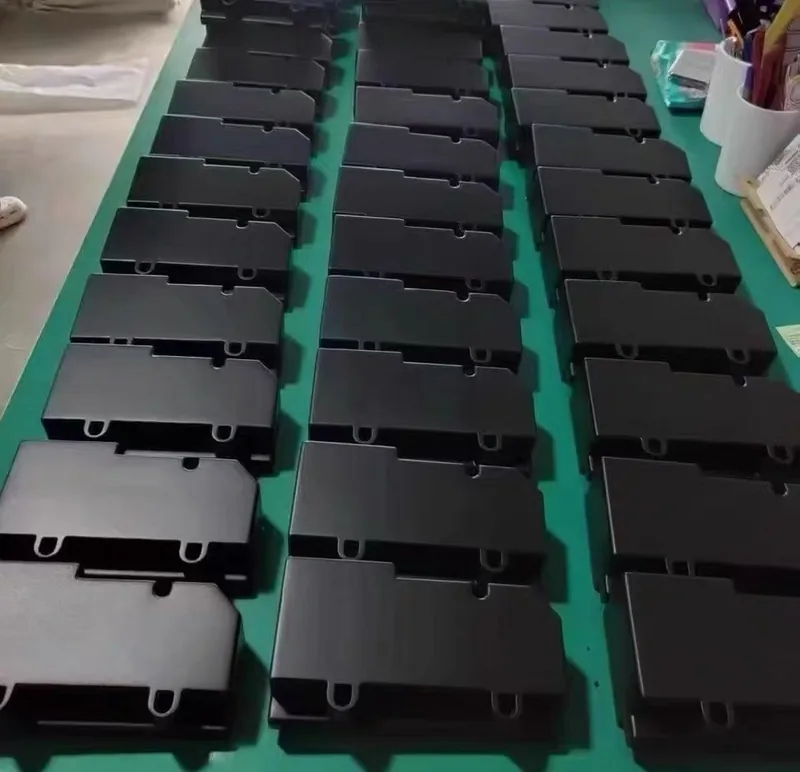
The batch below came off several molds built from one master. Consistency across a run is the whole reason for building multiple molds instead of pushing one past its life — parts from different molds match each other, because they all trace back to the same master.
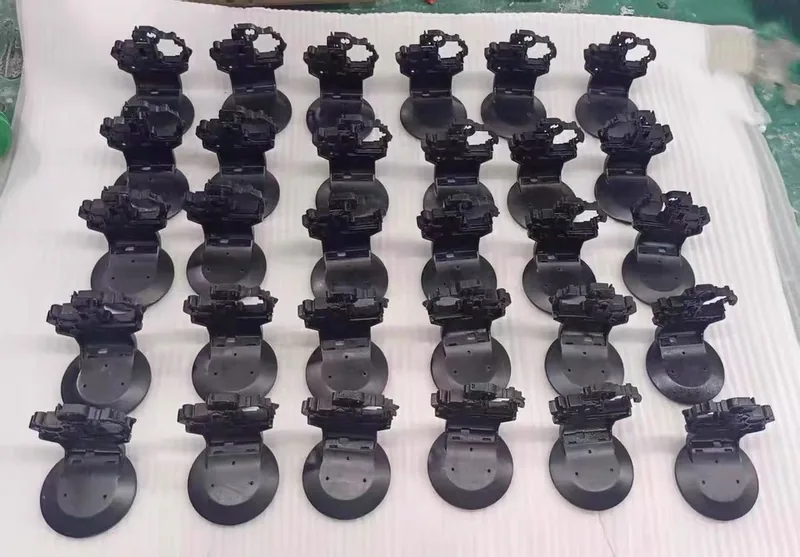
The parts below make the point differently: fine slats and small raised detail are the first features to go soft as a cavity ages. On a part like this, a tired mold is obvious immediately.
Why We Do Not Quietly Push a Mold Further
It is a real temptation on a fixed-price job: run the mold to 35 shots, absorb the margin, ship the batch. The customer receives parts 1 through 20 that look right and parts 28 through 35 that are a little softer at the edges, a little hazier where the light catches them.
Then they get assembled into the same product, sitting next to each other on a shelf. That is when it becomes visible — and by then the parts are paid for and shipped.
We quote the mold count up front instead. If the number of molds makes the job uneconomic, that is worth finding out before you order, not after.
Common Questions
About 20 to 25 good castings from a standard RTV silicone mold. With simple geometry, gentle demolding and a mild resin, 30 to 40 is achievable. Deep undercuts, aggressive resins or high cure temperatures can cut it to under 15.
Not a dramatic failure. The cavity loses definition gradually — sharp edges soften, small text goes shallow, thin ribs start to round off, and the surface picks up a slight haze that shows through gloss paint. On a matte textured part you may not notice until piece 30. On a gloss part you can see it by piece 20.
Multiple molds from the same master, run in parallel. Four or five molds for 100 pieces. Because they all come from the same master, parts from mold 1 and mold 5 match — which is not true of parts from casting 1 and casting 45 of a single overworked mold.
Less. The master already exists and the parting line is already worked out, so subsequent molds are mostly silicone and labour. The expensive part of a first mold is the engineering, not the rubber.
For high-temperature vulcanised silicone, yes — those can run into the hundreds. They are also far more expensive and slower to make, so they only pay off on repeat programmes. For a one-off batch of a few dozen parts, standard RTV is the right economics.
Keep the master alive. We store masters for repeat customers, so a reorder is a new mold from the existing master rather than starting over. Tell us at the time of the first order if a reorder is likely.