Why left-hand threads exist — and why the adapter follows
Nobody cuts a mirror-image thread for fun; there are exactly two engineering reasons — the ones that make a bicycle's left pedal 9/16-20 LH and carry the same convention onto R32 and R454B service connections — and each one generates adapter work.
Rotation. On a spinning or vibrating joint, a right-hand thread on the wrong side unscrews itself. That is why the left bicycle pedal is 9/16-20 LH, why outboard lathe spindle noses run left-hand, and why string trimmer and mower arbors are commonly LH. The moment one of those machines meets a modern right-hand accessory, someone needs a two-hand adapter.
Safety segregation. Fuel-gas fittings are left-hand on purpose: propane POL and acetylene cylinder connections thread the opposite way from oxygen so the wrong hose physically cannot be attached. The mildly flammable A2L refrigerants — R32 and R454B — inherit the same convention on some service connections, which is why “a2l left hand thread adapter” and “r32 left hand thread adapter” are live searches in HVAC right now.
Both reasons produce the same buying problem: the left-hand part is deliberate and necessary, the right-hand world is everywhere, and the bridge between them is not a stock item.
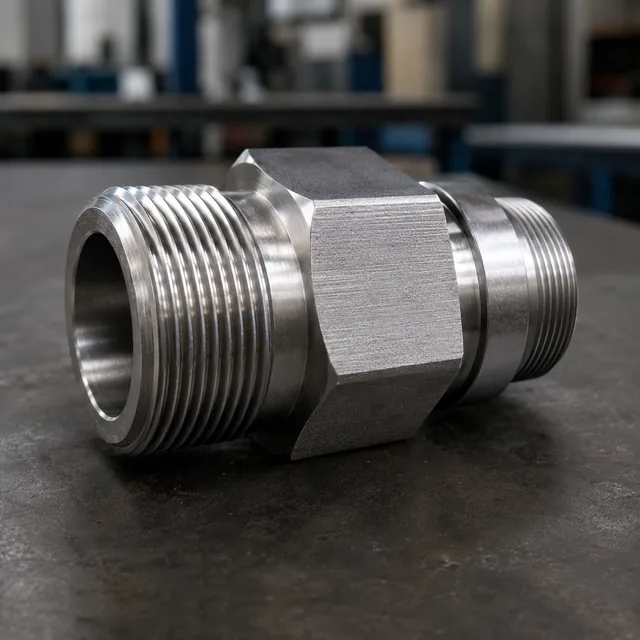
The four conversions — and the turnbuckle rule
Every LH job is one of four bodies. All four are machined here, plain or with a hexagon:
| Form | Typical job | Base geometry page |
|---|---|---|
| LH male × RH male (stud) | Turnbuckle logic — one body that tensions two fixed ends | male-to-male adapters |
| LH female × RH male | Puts a modern RH accessory onto an LH spindle or fitting | female-to-male adapters |
| LH male × RH female | Puts an LH component into RH equipment | same geometry, mirrored |
| LH female × RH female (coupler) | Joins an LH stud to an RH stud; also the classic turnbuckle body | female-to-female adapters |
The turnbuckle rule explains why LH keeps appearing in double-ended parts: if both ends were the same hand, turning the body would drive one joint in and the other out and the assembly would never tighten. Two fixed ends can only be drawn together when one thread is left-hand — which is why a genuine two-hand body cannot be improvised from two stock adapters.
Who is asking for this right now
“a2l left hand thread adapter”, “r32 left hand thread adapter”, “propane left hand thread adapter”, “14x1 left hand thread adapter” — these are not hypothetical applications; each row below is phrased the way buyers are typing it into search boxes today:
| The ask | Behind it | What we machine |
|---|---|---|
| a2l / r32 / r454b left hand thread adapter | A2L service connections carrying the fuel-gas LH convention | Service-port adapters to your thread spec and material; certified hoses and manifolds stay with listed HVAC equipment |
| propane left hand thread adapter | POL and fuel-gas fittings, LH by convention | Machined adapter bodies between LH fuel fittings and RH equipment threads |
| left hand thread thermocouple adapter | Instrument bosses on rotating or legacy plant | LH compression or port adapters cut to the boss you actually have |
| 14x1 left hand thread adapter | Automotive M14×1 LH — no shelf answer | Single-point cut, either hand either end |
| Outboard lathe nose, LH | Traditional lathes tighten against reversed rotation | Covered in depth on wood lathe spindle adapters |
| Old water heater, LH nipples | Legacy plumbing where parts desks come up empty | Measured from the part or a photo, machined complete |
| Left bicycle pedal, 9/16-20 LH | Crank precession | Honestly: a bike shop solves this with stock taps and inserts — you rarely need us |
Need left-hand thread adapters in a size, thread or material no catalogue lists? EKINSUN is a custom parts manufacturer: we make left-hand thread adapters to your drawing, sketch or sample — brass, steel, 304 or 316L stainless steel — from 1 piece, quoted in 12 hours and shipped duties paid. Standard sizes can often be supplied from stock; the more pieces, the lower the unit price. All custom adapters and fittings →
Where the shelf ends
To be fair to the catalogues before we make the case: a few LH–RH parts do exist as stock. Then it stops.
| What you need | In the catalogue? | What we machine |
|---|---|---|
| Small steel LH–RH stud or coupler, common metric size | Yes — a handful of SKUs at the big industrial suppliers | Buy it there, or ask us — we may have it in stock, and the more pieces, the lower the unit price; for one piece today, a local supplier is faster |
| The same part in 316 stainless or brass | No | Turned from bar in the material the environment demands |
| LH–RH in a female hex body | No | Hexagon cut to a standard or non-standard SW, hand stamped on the flats — see hex thread adapters |
| LH on one end, a different pitch or standard on the other | No | Each end single-point cut to its own gauge; mixed metric-inch included |
| Anything past roughly M12 | No | M3 to M64 and beyond — a mirrored helix carries no size premium |
| LH thread on a stud, nut or custom fastener | Rare | The fastener side lives on non-standard thread bolts and large custom nuts |
“The fitting on the old machine is left-hand — I finally worked that out after stripping it — and nobody, anywhere, lists the adapter to the right-hand line.”
— the shape of the enquiry this page exists for. Two threads and their hands: that is the whole specification.
Is my thread left-hand? Thirty seconds to be sure
It tightens anticlockwise — if the nut comes off when you turn it the normal loosening way, you have LH. Left-hand nuts customarily carry an identifying groove or notch on the flats; on anything we make, the hand is stamped on the body so it cannot be fitted backwards years later. Still unsure? A clear side-on photo shows the helix direction, and that is all we need to confirm it.
One warning worth its own sentence: a left-hand thread cannot be rescued with right-hand tooling. The helix is mirrored, so forcing RH taps or dies onto an LH part destroys it. For one part, machining complete is almost always cheaper than buying odd-size LH tooling you will use once.
Materials
| Material | When it is the right call | Note |
|---|---|---|
| Carbon / 4140 steel | Studs, turnbuckle bodies, machine joints | The default; zinc plated or oiled |
| 303 / 304 stainless | General corrosion resistance | 303 gives the cleanest single-point LH finish |
| 316L stainless | Refrigerant, marine, chemical service | The usual pick for HVAC and fuel-gas adapter bodies |
| Brass CuZn39Pb3 / CW614N (US ≈ C360) | Gas fittings, instruments | Traditional for fuel-gas hardware |
| 6061 aluminium | Light fixtures only | Not for torqued steel joints |
| 7075 aluminium | We will talk you out of it | No benefit on an adapter that steel doesn't deliver cheaper |
How to order
Write the hand into the callout — that is the one habit that prevents every mistake in this family. Send both thread designations with the hand of each end (“M20×1.5 LH one end, M20×1.5 RH the other”), the overall length, the body style (plain, flats or hex) and the material. A photo or hand sketch is enough — same intake as thread adapters from a sketch. Quote in 12 hours, one piece minimum (MOQ 1). If your part is right-hand after all, start at custom thread adapters.
See also the fitting thread identification chart and the fitting types chart.
Gas cylinders follow the same rule: a left-hand cylinder valve marks a fuel gas, and we do not make adapters that cross it to another gas. Right-hand inert-gas cylinders — argon, nitrogen and helium on CGA 580, W 21.8 or W 24.32 × 1/14 — are on argon and nitrogen cylinder adapters; CO₂ cylinders on CO₂ cylinder thread adapters.
Frequently asked questions
A machined body that connects a left-hand threaded part to right-hand equipment, or carries LH on one end and RH on the other on purpose. It exists because the two hands cannot mate: a left-hand thread is mirror geometry, and no amount of force threads it onto a right-hand part.
Two reasons. Rotation: on a spinning or vibrating joint a right-hand thread on the wrong side works itself loose, so the left side of a bicycle crank takes a 9/16-20 LH pedal and outboard lathe noses run LH. Safety: fuel-gas cylinder valves and fittings — propane POL, acetylene — are left-hand by convention so a fuel hose cannot be connected to an oxygen fitting. The mildly flammable A2L refrigerants (R32, R454B) inherit the same logic on some service connections.
No. A left-hand thread is not a right-hand thread run the other way — the helix itself is mirrored, so it needs LH tooling or single-point turning. LH taps and dies exist only in common sizes and get expensive fast in odd ones, which is why a one-off is usually cheaper to machine complete than to tool up for.
Yes — all four combinations: LH male to RH male, LH male to RH female, LH female to RH male and LH female to RH female, plain or with a hexagon body for the spanner. Left-hand female with a non-standard pitch is the same single-point work as any other thread here.
We machine the mechanical adapter — the two threads, the hand, the material — to your specification, including LH service-port geometries for R32 and R454B equipment. The honest boundary: certified charging manifolds, hoses and valves are listed HVAC equipment and should be bought as such; what we supply is the machined adapter between threads, built to the drawing or sample you send.
It tightens anticlockwise — if a nut spins off when you turn it the loosening way, you have LH. Left-hand nuts customarily carry an identifying groove or notch on the flats, and we stamp the hand on everything we make. If you are not sure, send a photo; the helix direction is visible in a clear side-on shot.
The same range as right-hand: M3 up to M64 and beyond, inch or metric, any pitch. A mirrored helix costs nothing in size — single-point turning cuts LH and RH with the same tool, so large or non-standard LH work carries no premium beyond the metal.
One piece. Send the two thread designations with the hand of each end spelled out — 'M20×1.5 LH one end, M20×1.5 RH the other' — plus length and material, and a quote comes back within 12 hours.
Send the two threads and their hands
Both designations with LH/RH spelled out, the length and the material. A photo is enough — the helix direction is visible. One piece minimum, quote within 12 hours.