Why the hex is on the adapter at all
An adapter joins two threads, and at assembly each of those joints needs torque. A plain round adapter gives a spanner nothing to act on — so it gets gripped with pipe pliers across the thread, and the thread is what pays for it. The hexagon fixes that: the body carries its own wrench flats, with a defined width across flats (SW), so the adapter can be tightened to seat, held against counter-torque while the mating nut is pulled up, and cracked loose ten years later without touching a single crest.
That is the whole reason hex nipples, hex bushings and hex standoff adapters exist as families. The hexagon is not decoration; it is the interface for the tool. Which is also why the width matters as much as the thread — a hexagon nobody's spanner fits is as useless as no hexagon.
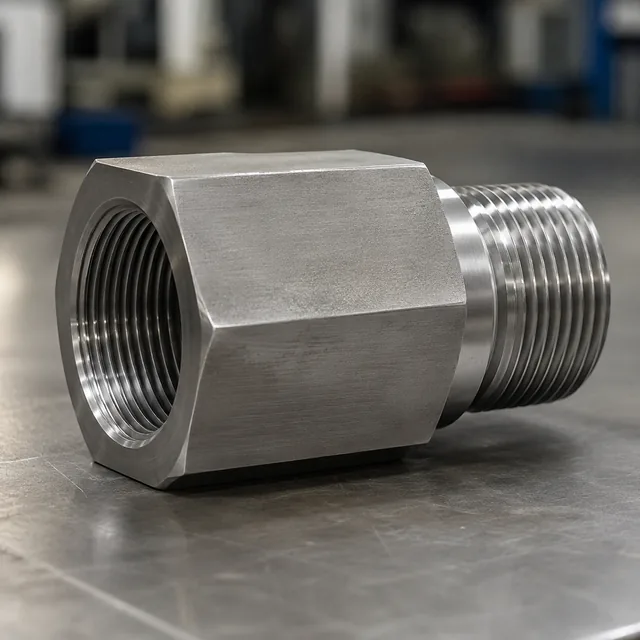
Male, female or both — the three hex adapter forms
Buyers type these three ways, and the catalogues file them under three different names. Same hexagon, different ends:
| What you search | The part | Full pair table |
|---|---|---|
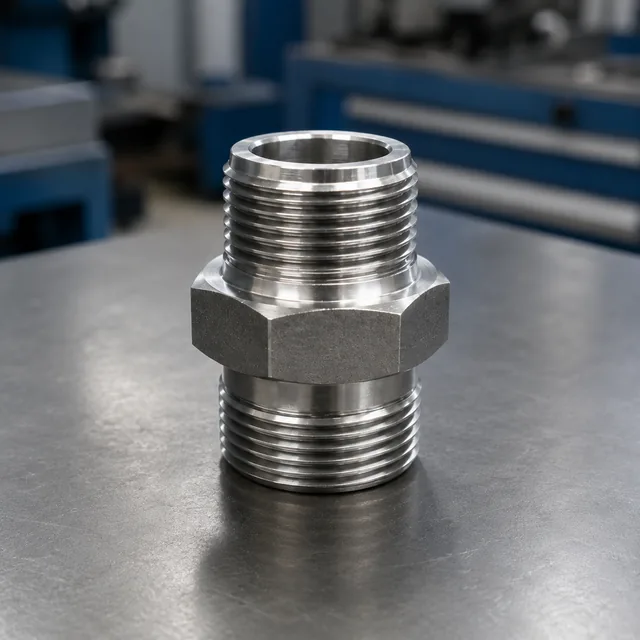
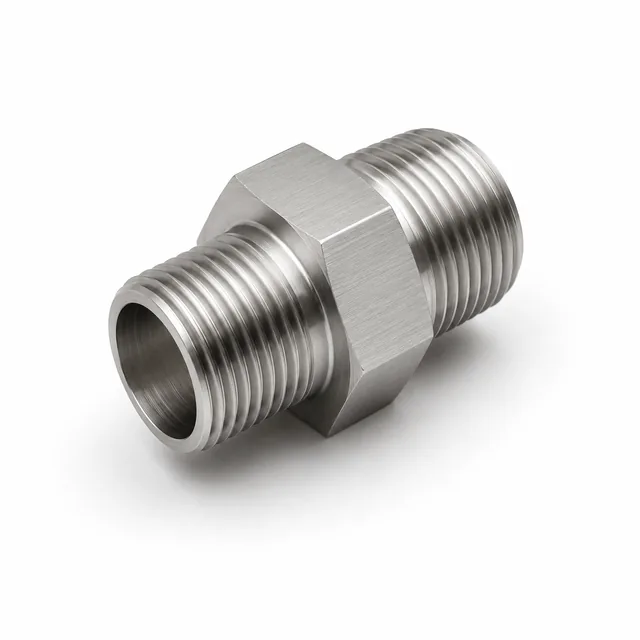
| male hex thread adapter, hex nipple | External thread both ends, hexagon in the middle. A different size or standard each end is the normal case here. | male-to-male thread adapters — 653 metric pairs |
| male-female hex thread adapter, hex bushing, hex reducing bushing | Male outside, female inside, hexagon on the female body. The one-part answer to “the sensor is too small for the port”. | female-to-male thread adapters — 620 pairs |
| female hex thread adapter, hex thread adapter female-female, hex coupler | Female both ends, hexagon full length. Joins two studs or two male fittings that will never meet. | female-to-female thread adapters — 653 pairs |
Every row in those three tables can be machined with a hexagon body — metric-to-metric, inch-to-inch or inch-to-metric male, female or male-female hex thread adapters, and left-hand to right-hand at either end. If your pair is in a table, the geometry is already worked out; the hexagon is a body option, not a different part. An overview of all three geometries is on thread adapter types.
Two naming traps worth thirty seconds
Trap one: hex drive. A “hex to hex adapter” or “hex drive thread adapter” in the tool aisle is a 1/4″ hex shank for a drill or impact driver — a drive interface, not a threaded joint. If you landed here from that search, this page is the other family: threaded ends, hexagon used only for the spanner.
Trap two: coupling nut. A stocked coupling nut (DIN 6334) is a hex coupler whose two ends are the same thread — and off the shelf the series runs out around M36. Two different sizes, a fine pitch, an inch-metric mix or anything past the series end is a machined part, which is the lane this page covers.
Across-flats: which SW belongs to which thread
The nut series is the reference everyone's spanners are built around. ISO 272 sets today's widths; the old DIN 934 series differed at four sizes, and both are still in circulation — which is why an “M10 nut” can be 16 or 17 mm across flats depending on the drawer it came from. Corner-to-corner is SW × 1.1547, which is what decides clearance next to a wall.
| Thread | ISO 272 SW, mm | Old DIN 934 SW, mm | How the hexagon is made |
|---|---|---|---|
| M6 | 10 | — | hex bar |
| M8 | 13 | — | hex bar |
| M10 | 16 | 17 | hex bar |
| M12 | 18 | 19 | hex bar |
| M14 | 21 | 22 | hex bar |
| M16 | 24 | — | hex bar |
| M20 | 30 | — | hex bar |
| M22 | 34 | 32 | hex bar |
| M24 | 36 | — | hex bar |
| M27 | 41 | — | hex bar |
| M30 | 46 | — | hex bar |
| M33 | 50 | — | flats milled from round bar |
| M36 | 55 | — | flats milled from round bar |
| M39 | 60 | — | flats milled from round bar |
| M42 | 65 | — | flats milled from round bar |
| M45 | 70 | — | flats milled from round bar |
| M48 | 75 | — | flats milled from round bar |
| M52 | 80 | — | flats milled from round bar |
| M56 | 85 | — | flats milled from round bar |
| M60 | 90 | — | flats milled from round bar |
| M64 | 95 | — | flats milled from round bar |
Need hex thread adapters in a size, thread or material no catalogue lists? EKINSUN is a custom parts manufacturer: we make hex thread adapters to your drawing, sketch or sample — brass, steel, 304 or 316L stainless steel — from 1 piece, quoted in 12 hours and shipped duties paid. If the size is standard, ask anyway — it may be in stock, and the unit price drops as the quantity rises. All custom adapters and fittings →
Two working numbers from this table. A female M20×2.5 end inside the standard SW 30 hexagon leaves (30 − 17.5) / 2 = 6.25 mm of wall at the flats — comfortable. And an adapter does not owe the table anything: on a machined body the hexagon can be cut to any width, standard or not, because the flats are just geometry we mill.
Large hex: where the bar stops and milling starts
Cold-drawn hexagonal bar is how small hex adapters are made economically — the six flats come free from the mill. In stainless that bar is commonly stocked up to about SW 46 (the M30 nut size). Above it, the honest manufacturing answer is different: we start from round bar, turn and thread the part, then mill the six flats in the same setup. Cost rises a little; the size ceiling disappears.
That is how the large end of the range gets made: adapter bodies through M33–M52 and beyond, large metric to NPT conversions M50–M100, and heavy hexagons on custom nuts up to M160. A milled hexagon also unlocks the odd widths: SW 41 on an M30 body because that is the spanner your kit carries, or a slim SW where the standard hexagon would foul a neighbouring fitting.
One of these is written up with numbers: a one-off M30×1.5 to M12×1.75 female-female adapter in 316 — hexagon 46 mm across flats, 60 mm long, both ends 6H.
What you can ask for that no catalogue stocks
The stocked hex adapter world is small: common pipe sizes in brass, a short metric ladder in zinc-plated steel, nylon for cable glands. The moment the pair, the material or the hexagon itself is specific, the listings stop. This is the machined lane:
| What you need | In the catalogue? | What we machine |
|---|---|---|
| 1/2″ NPT to 1/2″ BSP hex nipple, brass | Yes — common pipe pairs are stocked | Buy it off the shelf, or ask us — we may have it in stock. Our lane starts where the listing ends. |
| M6×1 to 1/4-20 male-female hex, 316 stainless | Practically no — the ask that keeps appearing on electronics and lab forums | Turned from 316 bar, hexagon to ISO 272 or your width, both gauges checked |
| PG13.5 to M25×1.5 gland adapter in metal | Nylon only, as a rule | Machined in stainless or nickel-plated brass, hexagon sized for a gland spanner |
| Left-hand to right-hand female hex adapter | No | Single-point cut; the hand stamped on the flats so it cannot go in backwards — full family on left-hand thread adapters |
| Hexagon to your spanner, not the standard (SW 41 on M30) | No | Flats milled to any width — the thread does not care what the outside measures |
| Same thread both ends, past the coupling-nut series (M48 to M48) | No — DIN 6334 runs out around M36 | Machined from bar with the wall and length your joint needs |
| ACME or trapezoidal one end, fastener thread the other | No | Power-transmission forms single-point cut to lead and flank angle — see the full conversion map |
“I need an M6 to quarter-twenty adapter with a hex on it, in 316, and I cannot find one anywhere that isn't zinc or nylon.”
— the shape of the enquiry this page exists for. Two threads, a material, a spanner width: that is the whole specification.
Materials
| Material | When it is the right call | Note |
|---|---|---|
| 303 / 304 stainless | General service, food-adjacent, outdoors | 303 machines the cleanest hexagon corners |
| 316L stainless | Marine, chemical, washdown | Pairs with the 316 fittings it sits between; galling managed with anti-seize or a 4140 mate |
| Brass CuZn39Pb3 / CW614N (US ≈ C360) | Plumbing, glands, instruments | The most forgiving to seal; standard for gland adapters |
| Carbon steel, zinc plated | Structural joints, studs, jigs | Cheapest for large hexagons; plating spec on the drawing |
| 6061 aluminium | Weight-critical, low-load | Fine for fixtures; not for high-torque steel joints — the flats round off first |
| 7075 aluminium | Rarely justified here | We will quote it, but for an adapter its extra strength buys little and it corrodes faster than 6061 — honest advice: 6061 or steel |
Real hex adapters from our shop
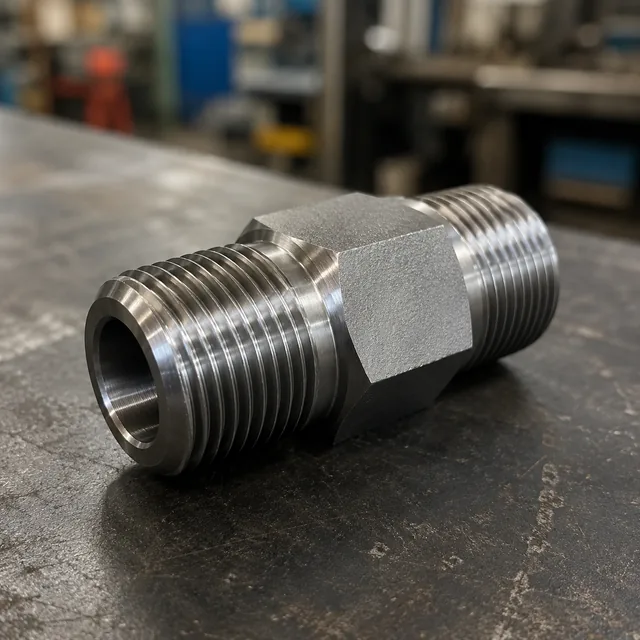
Parts photographed as they left the machine — hexagons from bar and hexagons milled from round.
How to order
No CAD needed. Send the two thread designations, the overall length, the across-flats width (or a photo of the spanner it must fit) and the material. A hand sketch or a photo with a caliper across each thread is enough — this is the same intake as our thread adapters from a sketch service. Quote back within 12 hours; one piece minimum (MOQ 1); production batches of the same hexagon run on the same program. If the part is not hexagonal at all, start at custom thread adapters or the metric reducers page.
See also the fitting types chart and fitting thread identification chart; 17 hex adapters in 304 stainless (NPT × BSP and BSP × metric) are in stock.
Frequently asked questions
It depends on the ends. Two male ends is a hex nipple; a male outside with a female inside is a hex bushing or hex reducing bushing; two female ends is a hex coupler or coupling nut. All of them are thread adapters with a hexagon body. If you search the gender name and find nothing in your size, that is normally where we come in.
No. A hex drive adapter is a tool-side part — a 1/4 inch hex shank that goes into a drill chuck or impact driver. A hex thread adapter joins two threads and only uses the hexagon as wrench flats. The two share a word and nothing else, and mixing them up is the most common dead end when searching.
For nuts, ISO 272 sets the series: M6 is 10 mm, M8 is 13, M10 is 16, M12 is 18, M16 is 24, M20 is 30, M24 is 36, M30 is 46, M36 is 55, M48 is 75, M64 is 95. Note the old DIN 934 sizes differ at four places: M10 was 17, M12 was 19, M14 was 22 and M22 was 32. An adapter does not have to follow either series — we cut the hexagon to the spanner you hold.
Cold-drawn stainless hex bar is commonly stocked up to about 46 mm across flats. Beyond that we start from round bar and mill the six flats, so the practical answer is any width your drawing calls for — we machine adapter bodies up to and past M64, and heavy hexagons on nuts up to M160 use the same milling approach.
Yes. One end left-hand, one end right-hand is a normal job here — it is turnbuckle logic in an adapter body. The hand of each end is stamped on the flats so the part cannot be fitted backwards.
Yes, and it is one of the quiet reasons to machine rather than buy: if your maintenance kit carries a 41 mm spanner, the body of an M30 adapter can be cut to 41 mm across flats instead of the standard 46. The thread does not care what the outside measures.
Yes — inch to inch, metric to metric or inch to metric, in the same body. A 1/4-20 UNC to M6 or a 3/8 BSP to M20 is machined the same way as any metric pair: each end is single-point cut or tapped to its own gauge.
One piece. Send the two thread designations, the overall length and the across-flats width you want — or just a photo of the spanner and the two parts — and a quote comes back within 12 hours.
Send the two threads and a spanner size
Both thread designations, overall length, across-flats width and material. A photo with a caliper is enough — no CAD. One piece minimum, quote within 12 hours.