How a Spiral Wound Gasket Is Built — Winding, Filler, Two Rings
The sealing element is a V-profile metal strip, 0.15 to 0.25 mm thick, wound in a spiral with a strip of filler laid in every turn and spot-welded at the start and the end. Under bolt load the V-sections flatten like a stack of springs and press the filler against the flange faces; when the joint cools and the bolts relax, the spring in the metal keeps the filler loaded, which is what a flat graphite sheet cannot do. The inner ring, in the same metal as the winding, stops the coil buckling inward into the pipe bore and fills the gap so nothing collects there. The outer ring, carbon steel painted or 316L, centres the gasket on the bolts and stops the winding being crushed past its working thickness.
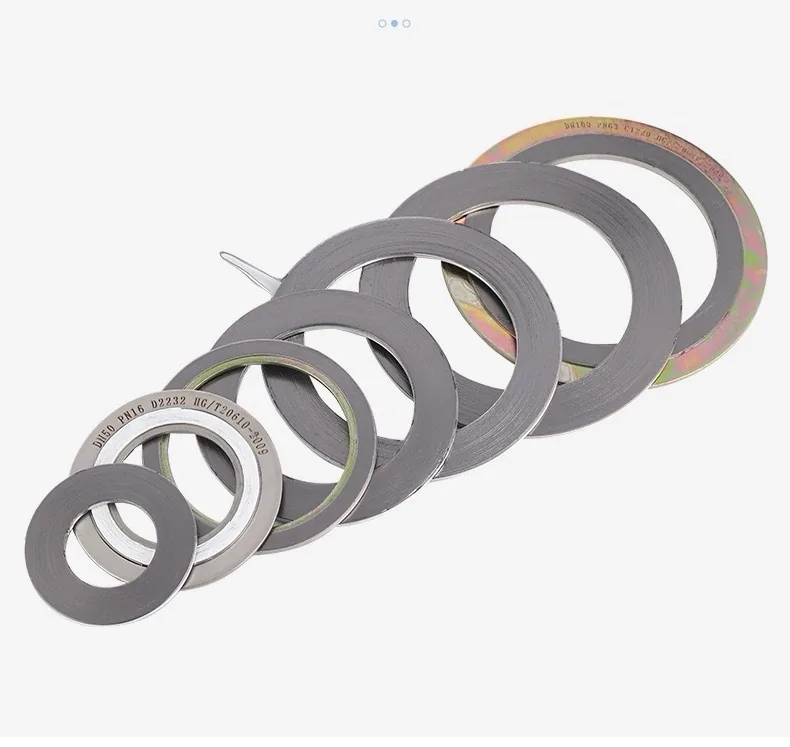
Size and Pressure Range — ID 20 to 800 mm, Class 150 to 2500, PN 10 to 100
Standard sizes follow the flange: ASME B16.20 for ASME B16.5 flanges to NPS 24 and B16.47 above, EN 1514-2 for EN 1092-1 flanges, HG/T 20610 for the Chinese PN series. The winding ID band in the table is the range across the pressure classes of that nominal size; the exact ID, OD and ring dimensions come from the standard for the flange and class you name.
| Nominal size | Winding ID band (mm) | Thickness (mm) | Classes / PN covered |
|---|---|---|---|
| DN 15 / NPS ½ | 20–22 | 3.2 | 150–2500 / PN 10–100 |
| DN 20 / NPS ¾ | 26–28 | 3.2 | 150–2500 / PN 10–100 |
| DN 25 / NPS 1 | 33–36 | 3.2 / 4.5 | 150–2500 / PN 10–100 |
| DN 40 / NPS 1½ | 48–52 | 3.2 / 4.5 | 150–2500 / PN 10–100 |
| DN 50 / NPS 2 | 60–70 | 4.5 | 150–2500 / PN 10–100 |
| DN 80 / NPS 3 | 88–98 | 4.5 | 150–2500 / PN 10–100 |
| DN 100 / NPS 4 | 114–125 | 4.5 | 150–2500 / PN 10–100 |
| DN 150 / NPS 6 | 168–180 | 4.5 | 150–2500 / PN 10–100 |
| DN 200 / NPS 8 | 219–232 | 4.5 | 150–1500 / PN 10–100 |
| DN 250 / NPS 10 | 273–290 | 4.5 | 150–1500 / PN 10–63 |
| DN 300 / NPS 12 | 324–340 | 4.5 | 150–1500 / PN 10–63 |
| DN 400 / NPS 16 | 406–425 | 4.5 | 150–900 / PN 10–40 |
| DN 500 / NPS 20 | 508–530 | 4.5 | 150–900 / PN 10–40 |
| DN 600 / NPS 24 | 610–635 | 4.5 | 150–900 / PN 10–40 |
| DN 800 / NPS 32 | 800–830 | 4.5 | 150–600 / PN 10–25 |
Between and beyond the rows: any ID from 20 to 800 mm and any OD to drawing. Thickness 4.5 mm (3/16 in) is the ASME standard, compressed to about 3.2 mm in the joint; 3.2 mm is used for the small sizes and for EN flanges; 6.4 mm is wound for large low-pressure flanges with poor faces.
Need a spiral wound gasket with an ID or OD no flange standard lists? EKINSUN is a custom parts manufacturer: we make spiral wound gaskets in non-standard sizes to your drawing, sketch or sample — 304, 316L or 321 winding with graphite or PTFE filler — in small quantities, quoted in 12 hours and shipped duties paid. Standard sizes can often be supplied from stock; the more pieces, the lower the unit price. All custom adapters and fittings →
Winding, Filler and Ring Materials — and the Colour Code on the Outer Ring
ASME B16.20 paints the edge of the outer ring in the colour of the winding metal and adds stripes in the colour of the filler, so a gasket can be read on the shelf without a data sheet. The gaskets in the photo are 316L and graphite: green ring, grey stripes.
| Winding metal / filler | Colour code | Max. temperature (°C) | Where it is used |
|---|---|---|---|
| 304 (1.4301) | yellow | 760 | general service, water, steam, mild chemicals; the low-cost winding |
| 316L (1.4404) | green | 815 | the refinery and chemical standard: chlorides, acids, sour service |
| 321 (1.4541) | turquoise | 815 | titanium-stabilised for long hot service without sensitisation |
| 347 (1.4550) | blue | 815 | niobium-stabilised, same use as 321 in welded hot lines |
| Monel 400 | orange | 815 | seawater, hydrofluoric acid, alkalis |
| Inconel 600 | gold | 1093 | hot gas, furnace and reformer flanges |
| Hastelloy C276 | beige | 1093 | hot oxidising and reducing acids, chlorine |
| Titanium Gr 2 | purple | 1093 | chlorides and wet chlorine, bleach plants |
| Filler: flexible graphite | grey stripe | 450 (550 non-oxidising) | steam, thermal oil, hydrocarbons, hot gas; the filler in the photo |
| Filler: PTFE | white stripe | 260 | strong acids, oxidisers, food and pharma lines |
| Filler: ceramic | light green stripe | 1000 | exhaust and furnace flanges where a small leak rate is accepted |
| Inner ring: as winding; outer ring: carbon steel (painted) or 316L | — | — | 316L outer ring for external corrosion or where paint is not allowed |
The Numbers Behind the Joint
| Fact | Value | Standard / source |
|---|---|---|
| Standard winding thickness | 4.5 mm (3/16 in); 3.2 mm (1/8 in) for small sizes and EN flanges; 6.4 mm for large low-pressure flanges | ASME B16.20; EN 1514-2 |
| Compressed thickness in the joint | about 3.2 mm from 4.5 mm, set by the outer ring; 2.3 mm from 3.2 mm | ASME B16.20 ring thickness |
| Minimum seating stress, graphite filler | about 69 MPa (10,000 psi) on the winding area; bolt-up to a higher stress is normal on Class 300 and above | manufacturers' data, ASME PCC-1 bolting practice |
| Winding strip | V-profile, 0.15–0.25 mm thick, 304 / 316L / 321 stainless or nickel alloy | ASME B16.20 §4 |
| Filler temperature limits | graphite 450 °C in air, 550 °C non-oxidising; PTFE 260 °C; ceramic 1000 °C | filler manufacturers' data |
| Marking on the outer ring | manufacturer, nominal size, pressure class, winding and filler material, standard (DN 50 PN 16 HG/T 20610 in the photo) | ASME B16.20 §4.6; HG/T 20610 |
| Styles | R winding only; RIR winding + inner ring; CG winding + outer ring; CGI winding + both rings (the usual specification) | ASME B16.20 |
Two mistakes that cost a shutdown. A spiral wound gasket on a flat-face (FF) flange, or on a raised face with a soft cast-iron mate, cracks the flange when the bolts are pulled to the seating stress the gasket needs; use a sheet gasket there. And a gasket without an inner ring in a high-temperature graphite service lets the winding buckle inward and the filler oxidise from the bore side; specify CGI, not CG, above 300 °C.
Standard Size from a Distributor, or Wound to Your Drawing
Standard flange gaskets are a distributor product and we say so. The reason to send a drawing here is the gasket the distributor does not have.
| What you need | In the catalogue? | What we make |
|---|---|---|
| A standard spiral wound gasket, ASME B16.20 or EN 1514-2 size, 316L / graphite, CGI style | Yes — every gasket distributor | Buy it from stock; gasket makers and their distributors carry these in every size and class, and we say so instead of quoting. Standard parts: ask us too — we may have them in stock. |
| A gasket in an ID or OD between two standard sizes, or for a non-standard bolt circle | No | Wound to your ID / OD, rings cut to the bolt circle, from 1 piece. |
| Heat-exchanger channel or floating-head gasket with pass partition bars | Not in the catalogue | Wound to the drawing with welded pass bars in the same metal and filler. |
| One flange in Monel, Inconel, Hastelloy or titanium winding with a 316L inner ring | Long lead from distributors | Wound to order in the alloy strip, ring materials to drawing, colour coded and marked. |
| A low-pressure water or air flange at room temperature | Yes — cut sheet gasket | Buy it from stock as a cut fibre or rubber sheet gasket; a spiral wound gasket is the wrong part there and costs five times as much. Standard parts: ask us too — we may have them in stock. |
The flange on the other side of the joint is often the reason the gasket is odd: a flange adapter between two systems, a custom sealed metal part, or a sealing washer under a fitting from the washer types chart; solid copper and soft-metal sealing rings are on custom washers machined to size.
What to Send
The flange standard, nominal size and pressure class, or the gasket ID, OD and thickness from a drawing; the service temperature, pressure and medium; and the winding metal, filler and rings if the specification already names them. A photo of the old gasket showing its colour code and ring marking identifies a replacement. Standard sizes ship in days, drawing sizes in about two weeks; quote in 12 hours.
Spiral Wound Gasket FAQ
A V-profile metal strip, usually 304, 316L or 321 stainless steel 0.15 to 0.25 mm thick, wound in a spiral with a strip of soft filler between each turn. The filler is flexible graphite for high temperature or PTFE for chemical service. An inner ring of the same metal as the winding stops the coil buckling inward and fills the gap to the pipe bore; an outer carbon steel or stainless centering ring locates the gasket on the bolts and limits compression. The winding alone (style R), winding with inner ring (RIR), with outer ring (CG) and with both rings (CGI) are the four styles of ASME B16.20.
The filler sets the limit. Flexible graphite is used to about 450 °C in air and to 550 °C where oxygen is excluded; PTFE filler to 260 °C; ceramic filler to about 1000 °C for non-critical exhaust and furnace flanges. The winding metal has its own limit, 760 °C for 304, 815 °C for 316L and 321, above 1000 °C for Inconel 600, which only matters once the filler has been chosen. The graphite gasket in the photo covers steam, thermal oil, hot gas and most refinery and chemical services.
To ASME B16.20, the outer ring edge is painted in the colour of the winding metal and striped in the colour of the filler. Winding: 304 yellow, 316L green, 321 turquoise, 347 blue, Monel orange, nickel red, titanium purple, Alloy 20 black, Inconel 600 gold, Hastelloy C276 beige. Filler stripes: graphite grey, PTFE white, ceramic light green. A green ring with grey stripes is 316L and graphite, the most common gasket in a refinery.
Winding ID 20 to 800 mm: DN 15 to DN 800 to EN 1514-2 and HG/T 20610, NPS ½ to 24 to ASME B16.5 and to 32 to ASME B16.47 series A and B, in Class 150 to 2500 and PN 10 to PN 100. Standard thickness is 4.5 mm (3/16 in) compressed to about 3.2 mm in the joint, or 3.2 mm for the small sizes and EN flanges. Outside those tables the gasket is made to your ID, OD and thickness.
Yes, and that is the reason to ask us rather than a distributor. Heat-exchanger channel and shell gaskets with pass partition bars, gaskets for a non-standard bolt circle, an ID or OD between two standard sizes, an inner ring in 316L on a carbon steel outer ring, or a winding in Monel, Inconel or titanium for one flange are wound to drawing from 1 piece, with the compressed thickness and seating stress stated on the quote.
The flange standard, nominal size and pressure class, or the gasket ID, OD and thickness from a drawing; the service temperature, pressure and medium; and the winding metal, filler and rings if already specified. A photo of the old gasket with its colour code and marking is enough to identify a replacement. Quote in 12 hours.