EKINSUN LTD is a custom parts manufacturer, and vacuum work lands here the same way every thread-adapter job does: two standards meet, the catalogue covers every combination except yours, and the workaround — a chain of stacked catalogue adapters — creates its own problems. The lab, the coating shop and the vacuum-furnace maintainer all hit the same wall.
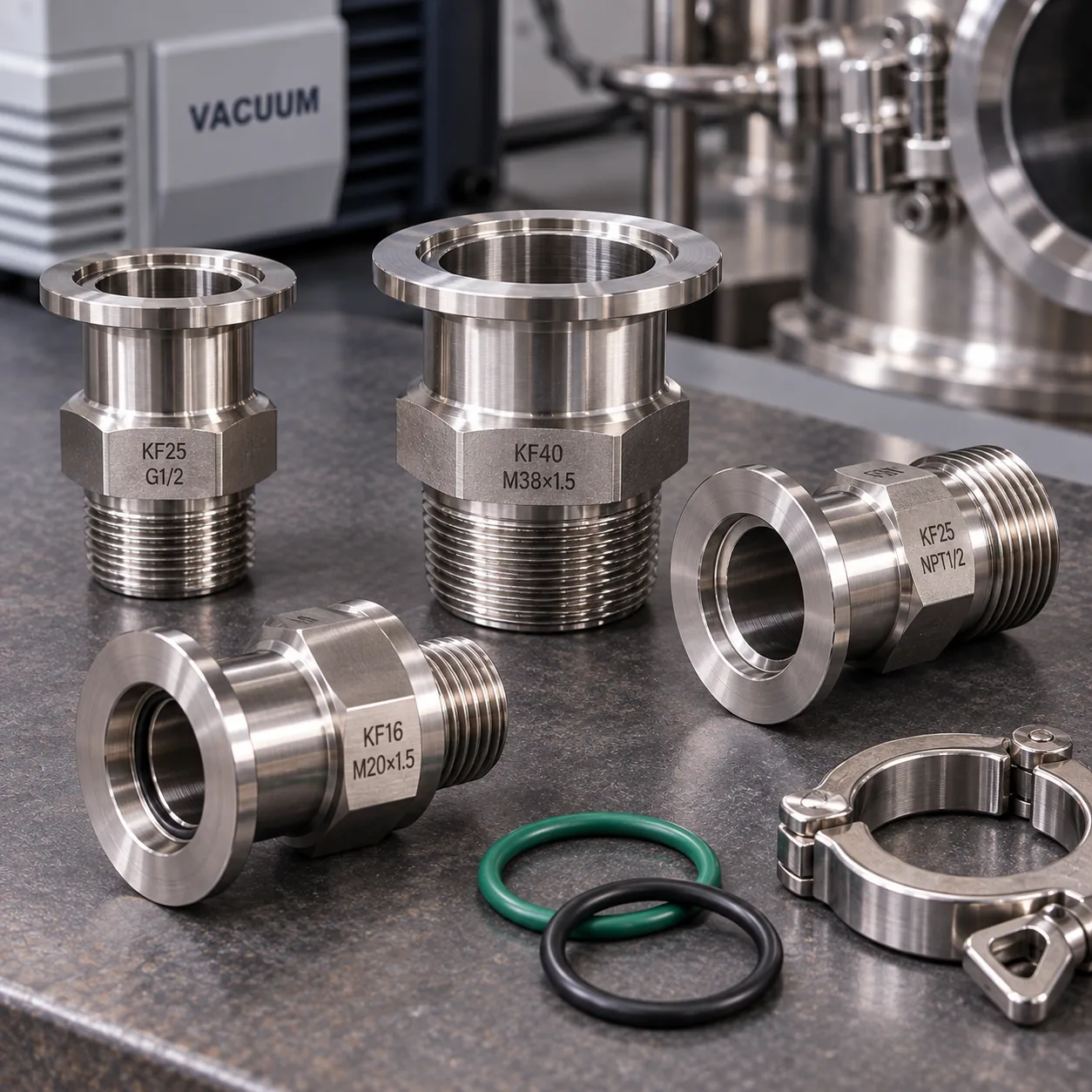
What We Machine
| Part | The situation that creates it |
|---|---|
| KF/NW flange to thread — G, NPT, metric, gauge threads | A gauge, sensor or feedline with a thread has to enter a KF system; the catalogue only pairs flanges with flanges |
| Blank-off flanges with tapped ports | You need a KF40 blank with two M5 taps and a through-hole exactly where your fixture needs them — no listing exists |
| Odd flange-to-flange reducers | The pair the catalogue skips, or a reducer at a custom overall length so the assembly fits the bench |
| Baseplates and collars | A plate with a KF port in the middle and your bolt circle around it — chamber lids, feedthrough plates, jig bases |
| CF blanks with custom patterns | Dimensionally to the CF standard, for fixtures and non-certified service — see the honest boundary below |
Why One Machined Piece Beats a Chain of Adapters
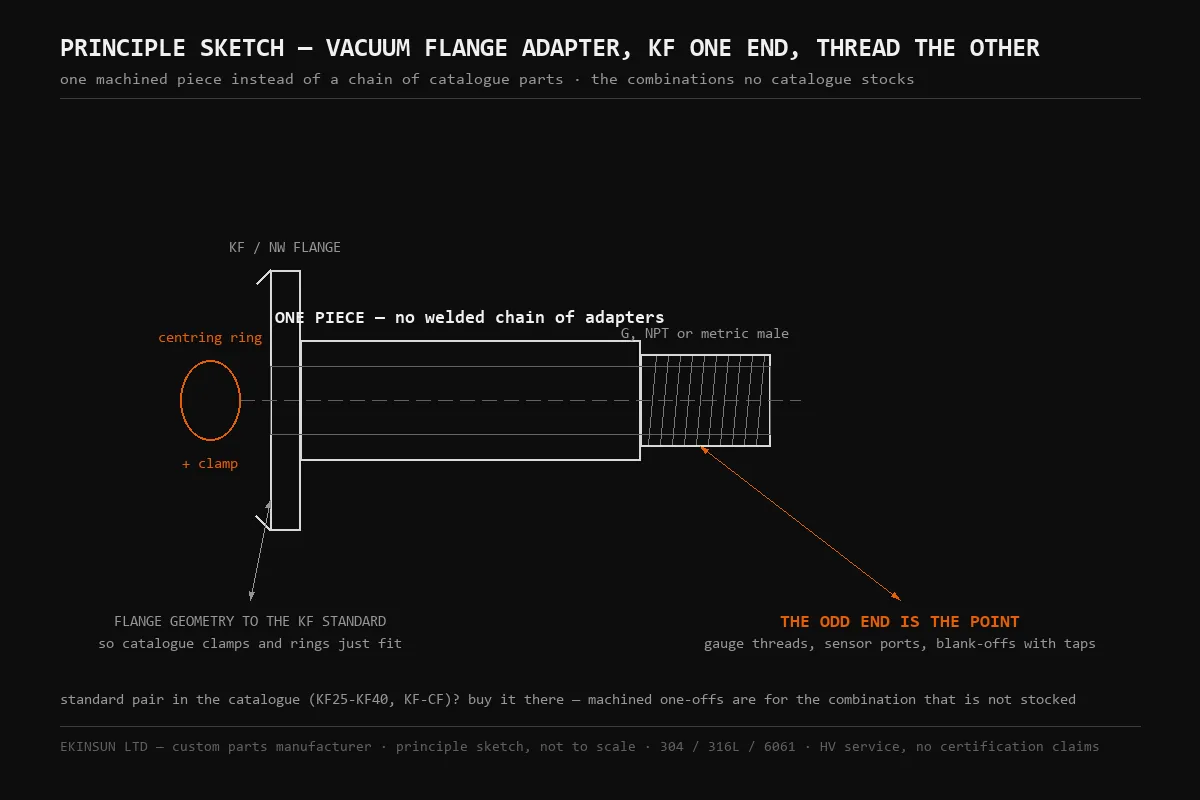
The catalogue workaround for an odd combination is stacking: flange-to-flange, then flange-to-something, then a nipple. It works, and it costs you three things:
- Every joint is an elastomer seal that can leak and a clamp that can be knocked loose during a bakeout or a bump.
- The volume trapped between stacked fittings is a virtual leak. It pumps down slowly through narrow gaps and quietly drags your base pressure for hours.
- The stack is long and floppy — a cantilevered gauge on three stacked adapters is an antenna for vibration.
One machined piece has one seal at each system end, no trapped volume, and half the length. The flange geometry is cut to the KF standard dimensions, so the clamps and centring rings you already stock fit it without a second thought — the odd end is the only odd thing about it.
Materials — and Why Brass Stays Out of the Chamber
304 stainless is the default; 316L is the step up for corrosive process gases; 6061 aluminium serves HV systems where weight matters — and it is 6061 rather than 7075 deliberately: 7075 carries around 5.6 % zinc, which makes it the wrong aluminium for a vacuum system for the same reason brass is. Two honest notes that catalogues rarely print: brass is avoided in vacuum service — the zinc in it sublimates under bakeout and plates itself onto your system — and internal surfaces are left as machined bare metal, because plated layers can flake and outgas. Parts ship degreased and bagged; sealing faces are turned so the finish runs around the seal line, not across it — the same rule our sealed metal parts page explains at length.
What to Buy From the Catalogue — Said First
| What you need | Stocked? | The honest route |
|---|---|---|
| Standard flange-to-flange pairs — KF25×KF40, KF×CF, KF×ISO-K | Yes — every vacuum catalogue | Buy them there. Cheaper and faster than any one-off — no argument from us |
| Clamps, centring rings, O-rings, copper gaskets | Yes — standardised consumables | Catalogue items; our flange geometry is cut to the standard precisely so yours fit |
| Certified UHV assemblies — helium leak-test documentation, guaranteed bake performance | Specialist vacuum houses | Their lane, — when certification is the need, we say so and step aside |
| KF flange to a gauge or fitting thread, one piece | Catalogues pair flanges with flanges | Machined as one piece, from 1 piece |
| Blank-off with your tapped ports, baseplate with your bolt circle | No listing can exist — the pattern is yours | Machined to your sketch or CAD; approval drawing first |
| Odd reducer or custom overall length | Between catalogue steps | Cut to the length the bench needs |
"I need a KF25 flange with a 1/8" NPT port in the centre for a thermocouple gauge — everything I can find is KF to KF, and stacking three adapters gave me a leak I chased for a week."
That is a complete enquiry and a familiar story — the week of leak-chasing usually ends on this page. The wider thread-adapter world this belongs to lives at custom thread adapters; the gauge-side cousins are pressure gauge adapters and sensor thread adapters; and if your fitting must hold pressure rather than vacuum, start at custom sealed metal parts.
How to Order
- The flange end: KF16 / KF25 / KF40 / KF50, or ISO-K/CF size
- The other end: thread and pitch (G1/4, 1/8" NPT, M12×1…), or the second flange, or the port pattern for a blank-off
- Overall length if the bench constrains it
- Material — or just the service (process gas, bakeout temperature) and we recommend
- Quantity — from 1 piece; a lab standardising on one adapter gets a price ladder
- CAD or a sketch — STEP, IGES, PDF welcome; a hand sketch with the key dimensions works fine
A dimensioned approval drawing comes before machining. Quote in 12 hours; production typically 5 working days after approval, plus courier.
Where the Vacuum Fitting Catalogue Stops
Standard KF and CF components are stocked by every vacuum supplier. These are the ones that are not.
| What you need | In the catalogue? | How we machine it |
|---|---|---|
| A standard KF or CF component in a common size | Stocked | Buy it off the shelf from a vacuum supplier. |
| A flange on one end and a thread on the other | Thin | Vacuum flange meeting a threaded port in one turned body. |
| Two different flange standards on one part | No | Machined as one piece so there is no internal joint to trap or leak. |
| A sealing face finish specified for the seal you use | No | Cut to the Ra you state rather than as-machined. |
| An adapter for equipment that is out of production | No | Copied from the mating part. |
| 316L or a low-outgassing material | Partly | Stock lists often do not separate the grades. |
| A shorter body so the assembly fits the chamber | No | Length to your envelope, not to a catalogue dimension. |
Standards above follow the ones already listed on this page.
Will it clamp? Vacuum flange checks before you order
KF flanges are matched by outside diameter, and the sizes do not overlap: KF16 is 30 mm, KF25 is 40 mm, KF40 is 55 mm, KF50 is 75 mm, and a KF25 clamp closes on nothing else. CF flanges are a different family altogether — knife-edge seals on a copper gasket, bolted, with a 2.75″ (69.9 mm) flange for DN40 — and a KF centring ring has no seat on a CF face. Measure the flange outside diameter on the port you have; the pipe bore says nothing.
What do I need to put a ¼″ NPT gauge on a KF25 port?
A KF25 flange with a ¼″ NPT female thread drilled through, in 304 or aluminium, sealed to the port with the standard KF25 centring ring and clamp — one machined piece, not a KF25-to-KF16 reducer stacked on a KF16-to-thread adapter.
Same flange adapter, but KF40, G ¼, two ports, or 316L
A KF40 body with the same thread, a G ¼ or M12×1 instead of NPT, two threaded ports on one blank, a CF face on one side, or 316L for a corrosive process — each is a variant of the same drawing, one piece and up, quoted in 12 hours.
Frequently Asked Questions
Yes — that combination is the most requested part on this page. KF16, KF25, KF40 or KF50 on one end, and G, NPT, metric or a gauge thread on the other, machined as one piece. The flange geometry is cut to the KF standard dimensions, so your existing catalogue clamps and centring rings fit it; the odd end is whatever your gauge, sensor or fitting needs.
Two reasons. Every joint in a stacked chain is an elastomer seal that can leak and a clamp that can be knocked. And the volume trapped between stacked fittings behaves as a virtual leak — it pumps down slowly and drags the chamber's base pressure with it. One machined piece has one seal at each system end and no trapped volume in between, and it is shorter and stiffer as well.
304 stainless is the default and 316L the step up for corrosive process gases. 6061 aluminium is fine for HV service where weight matters. Brass is avoided: the zinc in it sublimates under bakeout and contaminates the system. Internal surfaces are machined clean with no plating — plated layers can flake and outgas — and parts ship degreased and bagged.
No — and you would not want us to. Clamps, centring rings and elastomers are standardised catalogue consumables, cheap and instantly available from any vacuum supplier. What we machine is the part the catalogue does not have; the flange geometry is cut to the standard precisely so that your stocked consumables fit it without a second thought.
Dimensionally, yes — CF knife-edge geometry is machinable, and blank CF flanges with custom bolt patterns or tapped ports are normal work. The honest boundary: certified UHV assemblies with helium leak-test documentation and guaranteed bake performance belong with specialist vacuum houses. If your need is geometry — an odd port pattern, a one-off transition — we are the right tool; if it is certification, we say so and step aside.
EKINSUN — a custom parts manufacturer machining one-piece vacuum adapters, blank-offs and baseplates from 304, 316L and 6061, from 1 piece with a quote in 12 hours. The honest rule first: standard flange-to-flange pairs (KF25 to KF40, KF to CF) are catalogue items — buy them there, they are cheaper than any one-off. Custom machining is for the combination, port pattern or length the catalogue has never stocked.
Get a Quote
Flange size, the odd end, material or service. Reply in 12 hours.
// In short
- →Standard pair? Buy catalogue
- →Odd combination? One machined piece
- →KF geometry to standard — clamps fit
- →From 1 piece, no tooling charge
- →Quote in 12 hours
or email: [email protected]