The Enquiry
Two special hex nuts, M120 × 3, to a sketch. Quantity two. Delivery to the Lyon area. Material as we saw fit, plain or zinc plated, class 8.8 or the nearest. And one line underlined: the 3 mm pitch is imperative — M120 × 4, × 5, × 6 or any other pitch will not do.
The enquiry, paraphrased: “Two special hex nuts M120 × 3 to the attached sketch — the pitch is 3 mm and not negotiable; ×4, ×5 and ×6 do not fit. Plain or zinc, class 8.8 or the closest you have. Unit price for two pieces, lead time and delivery to France.”
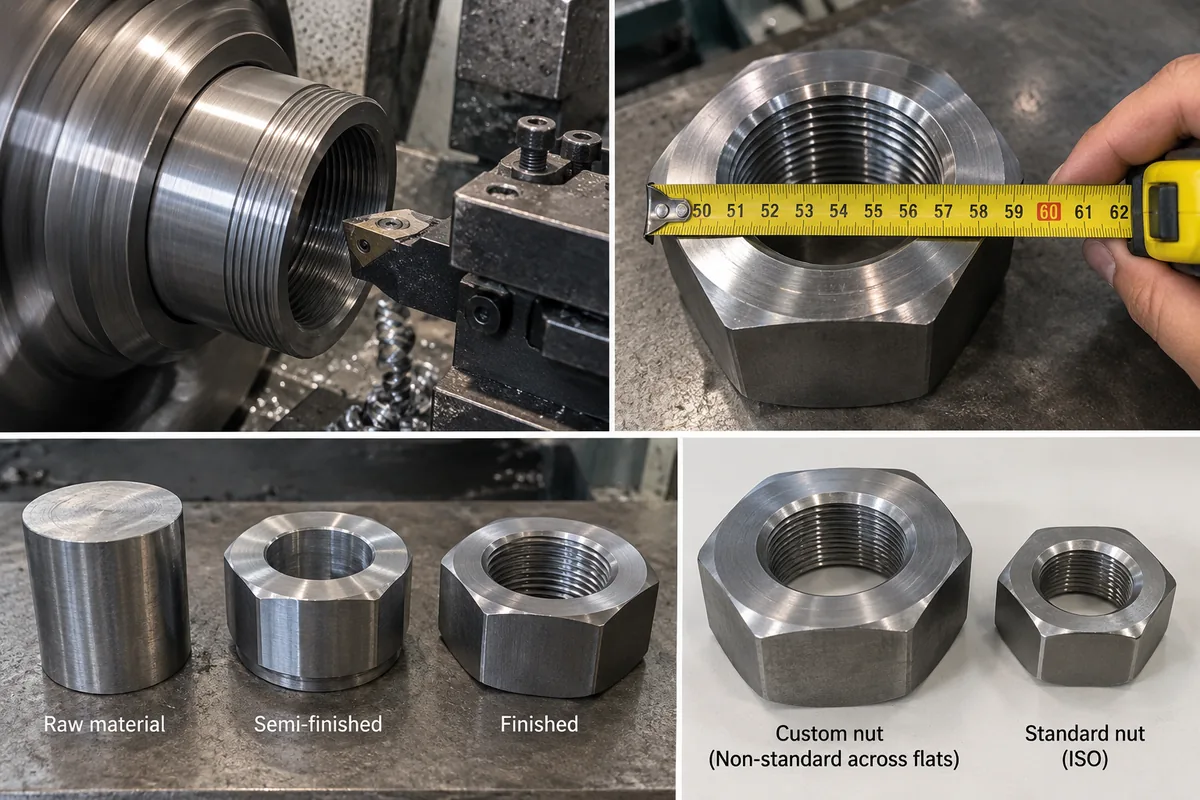
The sketch itself stays with the buyer — we never publish a customer’s drawing — but its one unusual number is the across-flats: 180 mm, wider than the 170 mm DIN 934 hex for M120, which puts the across-corners at about 208 mm. That width decides the bar; the pitch decides everything else.
Why No Catalogue Nut Fits
The buyer had done the shelf check before writing, and it is worth repeating because it is the whole case. ISO 261 defines no coarse thread above M68; for M120 it lists 6, 4, 3 and 2 mm, and DIN 13-8 gives the 3 mm thread a full set of dimensions. So M120 × 3 is a standard thread. It is also a thread nobody keeps nuts for: when we checked the fine-thread hex nut range at a large German distributor in September 2026, M120 was offered in the 4 mm pitch only. At M100 the same range carries 2, 4 and 6 mm. The shelf holds what sells, and at M120 that is one pitch.
- A 4 mm nut on a 3 mm shaft is out of step by a millimetre per turn. It will not start; if forced, it binds within a fraction of a turn and tears the shaft flanks on the way out.
- The shaft is the fixed side. It is in the machine, it was cut long ago, and recutting it to 4 mm means dismantling the machine and finding a 4 mm nut with 180 mm flats — which does not exist either.
- The hex is the second problem. Even in the right pitch, a stock nut comes with the standard across-flats. The sketch wants 180; the assembly’s spanner or pocket was drawn around that number.
- Ten pitches on a rule settle it. Measured from one crest to the eleventh, this shaft reads 30 mm; the catalogue nut reads 40. Anyone with a steel rule can make that check before ordering either — and should, because the diameter is printed on the label and the pitch is not.
Fine pitch above M64 is not rare in the standard — it is rare on the shelf. The catalogue chose one pitch per size; the shaft in the machine was cut to another. Which pitches exist, which are stocked, and how the rest are cut →
Three Routes for the Same Nut
| Route | What it needs | Where it fails | Verdict |
|---|---|---|---|
| Stock M120 × 4 fine-thread nut | Nothing — ships from a warehouse | Wrong pitch: does not assemble on a 3 mm shaft; standard across-flats, not 180 | Does not fit |
| Recut the shaft to M120 × 4 and buy the stock nut | Dismantling the machine, a lathe big enough for the shaft, and downtime | The stock nut still has the standard hex; the shaft loses a thread depth of material | Only when the shaft is being remade anyway |
| Nut turned from bar to M120 × 3, hex milled to 180 — this case | Ø210 round bar, a boring bar with a 3 mm threading insert, a gauge or the shaft data | Nothing on the assembly changes | The nut follows the shaft |
What We Specified
The route is settled by the shaft, so the specification is short. It is written here the way it went into the quote.
| Item | Specification | Why |
|---|---|---|
| Thread | M120 × 3, tolerance class 6H, single-pointed | The shaft’s pitch; 6H is the standard nut tolerance the stock ×4 nut would also carry |
| Minor diameter D1 | 116.75 mm bored before threading (DIN 13-8) | d − 1.0825 P; the bore the threading insert starts from |
| Thread depth, nut side | 1.62 mm (0.5413 P) | Cut in passes that get shallower as the flank fills in |
| Across flats / corners | 180 mm to the sketch / ≈ 208 mm | Across-corners = 1.1547 × across-flats; it fixes the bar, not the standard |
| Bar stock | Round bar Ø210, hex milled | Hex bar does not exist at this size, and the bar must clear the corners, not the flats |
| Material | 42CrMo4 (1.7225), quenched and tempered | Class 8 territory at this section for a bolt-class-8.8 joint; mill certificate to EN 10204 3.1; proof-load test on request |
| Finish | Plain, oiled — or zinc plated to ISO 4042 with the thread cut to leave room for the coating | The buyer offered both; plating on a 6H thread needs the allowance planned before cutting |
| Marking | “M120×3” on one flat | So nobody downstream takes it for the catalogue pitch |
| Quantity / lead time | 2 pieces; typically 5 working days after drawing confirmation, plus 5–7 days shipping to France | Two nuts do not justify anything but the lathe |
What You Need, and Where It Comes From
| What you need | In the catalogue? | What happens |
|---|---|---|
| A DIN 934 hex nut M120 in the 6 mm standard pitch, class 8 | Yes — stocked | Buy it from stock. No one-off can match a catalogue price on a standard nut, and we say so in the quote. |
| M120 fine thread in the pitch the catalogue carries — ×4 | Yes, at one large distributor in 2026 | Buy it, if your shaft is ×4 and the standard hex fits your spanner. |
| M120 × 3 — or ×2, or left-hand | No | Turned from Ø210 bar and single-pointed to the shaft’s pitch — this case |
| Any M120 nut with 180 mm across flats | No — the standard fixes the hex | Hex milled to the width the sketch asks for; only the bar size changes |
| The mating stud or shaft end in M120 × 3 | No | Cut as a pair with the nut on the same machine, gauged together |
Materials for a Nut Like This
| Material | Class it matches | Where it belongs |
|---|---|---|
| 42CrMo4 / 1.7225, Q+T (AISI 4140 class) | Class 8 territory at this section | The specification here: a load-carrying nut for a class-8.8 joint |
| C45 / 1.0503 (AISI 1045) | Class 6 to 8 depending on treatment | Nuts that locate rather than clamp |
| Stainless 304 / 1.4301 · 316L / 1.4404 | A2 · A4 to ISO 3506-2 | Corrosion first, load second; a large fine thread in austenitic stainless galls, so anti-seize and dissimilar grades on nut and shaft |
| Brass CuZn39Pb3 / CW614N | No class | Low-load nuts that must never seize on steel |
| Aluminium 6061 / 7075 | Not offered | An aluminium nut on a steel shaft strips; a nut like this is a steel part |
How the Job Runs
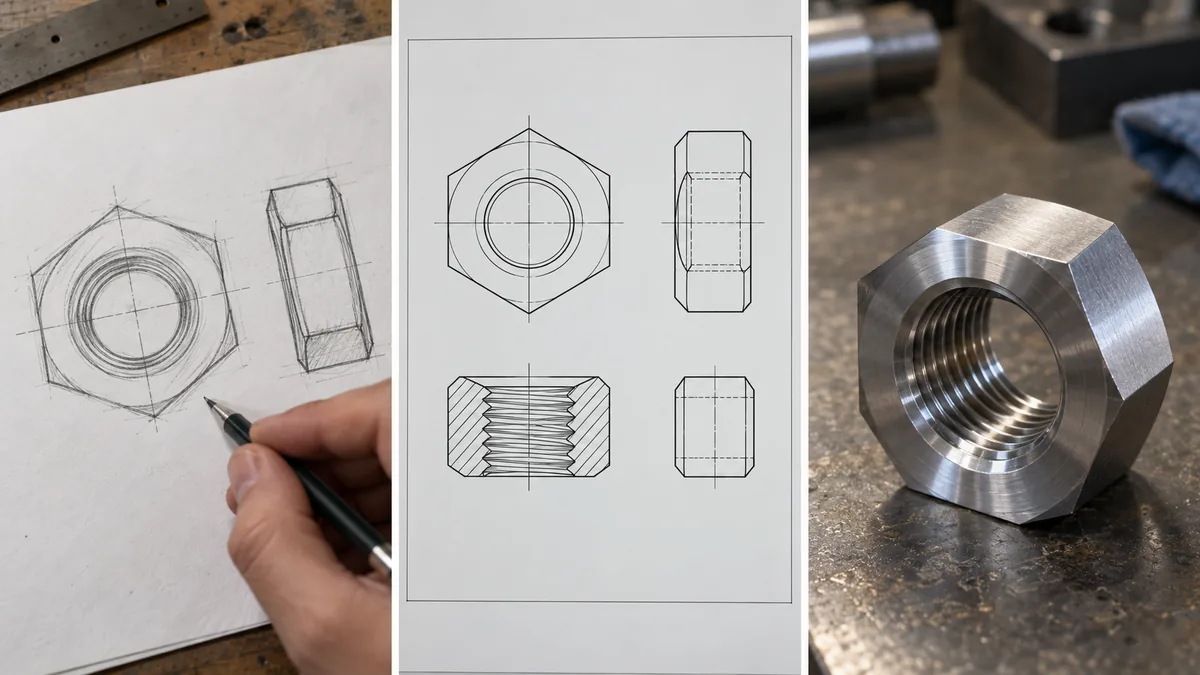
For a two-piece order the process is the specification above, in order. The only step that can go wrong is skipping the drawing confirmation.
Sketch received
Thread, across-flats, height, finish, quantity. A photo of the shaft end with a rule across ten threads confirms the pitch if there is any doubt.
Drawing rebuilt and confirmed
Our drawing goes back with the quote within 12 hours: M120×3 6H, D1 116.75, A/F 180, height and chamfers to the sketch, material 42CrMo4 Q+T. Nothing is cut until the buyer confirms it.
Bar, bore, thread
Ø210 bar faced and bored to 116.75; the 3 mm thread single-pointed in passes with a threading insert on a boring bar, spindle and feed locked to the pitch.
Hex, chamfers, gauge, mark
Hex milled to 180 across flats, faces chamfered, thread checked with a 6H plug gauge or against the buyer’s shaft data, “M120×3” marked on a flat.
Certificate and dispatch
Mill certificate to EN 10204 3.1 with the parts; plain and oiled or zinc plated as chosen; shipped to France, typically 5 to 7 days in transit.