A large fine-pitch nut is rarely exotic. The thread is in the standard, the steel is ordinary, the hex is a hex. What makes it unbuyable is one number: the pitch the shaft already carries, which is not the pitch the catalogue chose to stock. EKINSUN is a custom parts manufacturer; this page shows which pitches exist, which ones are on a shelf, and how the rest are cut from one piece.
What ISO 261 actually defines above M56
Two things surprise buyers here. First, the coarse series ends at M68: above that ISO 261 defines only fine pitches, and the 6 mm pitch takes over as the de-facto standard — DIN 934 nuts from M72 to M160 are all 6 mm. Second, the fine pitches are generous on paper: 4, 3 and 2 mm all the way up, 1.5 mm to M80, 8 mm on the preferred sizes from M130. The DIN 13 series goes further still and gives every one of them dimensions. The last column shows what was on a distributor’s shelf when we checked in September 2026.
| Thread | Coarse pitch | Fine pitches defined (mm) | Minor ø D1 for ×4 / ×3 (mm) | Stocked as a DIN 934 fine nut |
|---|---|---|---|---|
| M56 | 5.5 | 4 · 3 · 2 · 1.5 | 51.67 / 52.75 | — |
| M60 | 5.5 | 4 · 3 · 2 · 1.5 | 55.67 / 56.75 | — |
| M64 | 6 | 4 · 3 · 2 · 1.5 | 59.67 / 60.75 | — |
| M68 | 6 | 4 · 3 · 2 · 1.5 | 63.67 / 64.75 | — |
| M72 | — (6 mm serves as the standard pitch) | 6 · 4 · 3 · 2 · 1.5 | 67.67 / 68.75 | — |
| M76 | — (6 mm serves as the standard pitch) | 6 · 4 · 3 · 2 · 1.5 | 71.67 / 72.75 | — |
| M80 | — (6 mm serves as the standard pitch) | 6 · 4 · 3 · 2 · 1.5 | 75.67 / 76.75 | — |
| M85 | — (6 mm serves as the standard pitch) | 6 · 4 · 3 · 2 | 80.67 / 81.75 | — |
| M90 | — (6 mm serves as the standard pitch) | 6 · 4 · 3 · 2 | 85.67 / 86.75 | ×2 |
| M95 | — (6 mm serves as the standard pitch) | 6 · 4 · 3 · 2 | 90.67 / 91.75 | — |
| M100 | — (6 mm serves as the standard pitch) | 6 · 4 · 3 · 2 | 95.67 / 96.75 | ×2, ×4, ×6 |
| M105 | — (6 mm serves as the standard pitch) | 6 · 4 · 3 · 2 | 100.67 / 101.75 | — |
| M110 | — (6 mm serves as the standard pitch) | 6 · 4 · 3 · 2 | 105.67 / 106.75 | — |
| M115 | — (6 mm serves as the standard pitch) | 6 · 4 · 3 · 2 | 110.67 / 111.75 | — |
| M120 | — (6 mm serves as the standard pitch) | 6 · 4 · 3 · 2 | 115.67 / 116.75 | ×4 only |
| M125 | — (6 mm serves as the standard pitch) | 6 · 4 · 3 · 2 | 120.67 / 121.75 | — |
| M130 | — (6 mm serves as the standard pitch) | 8 · 6 · 4 · 3 · 2 | 125.67 / 126.75 | — |
| M135 | — (6 mm serves as the standard pitch) | 6 · 4 · 3 · 2 | 130.67 / 131.75 | — |
| M140 | — (6 mm serves as the standard pitch) | 8 · 6 · 4 · 3 · 2 | 135.67 / 136.75 | — |
| M145 | — (6 mm serves as the standard pitch) | 6 · 4 · 3 · 2 | 140.67 / 141.75 | — |
| M150 | — (6 mm serves as the standard pitch) | 8 · 6 · 4 · 3 · 2 | 145.67 / 146.75 | — |
| M155 | — (6 mm serves as the standard pitch) | 6 · 4 · 3 | 150.67 / 151.75 | — |
| M160 | — (6 mm serves as the standard pitch) | 8 · 6 · 4 · 3 | 155.67 / 156.75 | — |
Minor diameter D1 = d − 1.0825 P, the value the DIN 13 tables print as the core diameter. Catalogue column: spot-checked at two German distributors; a dash means not checked, not “unavailable”.
Need fine-pitch nuts, bolts and shaft ends above M64 in a size, thread or material no catalogue lists? EKINSUN is a custom parts manufacturer: we make fine-pitch nuts, bolts and shaft ends above M64 to your drawing, sketch or sample — steel, 42CrMo4, 304 or 316L stainless steel — from 1 piece, quoted in 12 hours and shipped duties paid. Standard sizes can often be supplied from stock; the more pieces, the lower the unit price. All custom fasteners →
Why the pitch is not negotiable
Diameter and pitch both have to match, but pitch is the one a substitute cannot fudge. An M120×4 nut on an M120×3 shaft is one millimetre out of step after a single turn: it refuses to start, or jams within a fraction of a turn and gouges the shaft on the way out. The shaft is the fixed side of the problem — it is in the machine, it was cut years ago, and recutting it means dismantling the machine. So the nut follows the shaft.
“Two special hex nuts M120 × 3 to our sketch — the 3 mm pitch is imperative; ×4, ×5 and ×6 will not fit.”
That enquiry, from a machine in the Lyon area, is the shape of almost every large fine-pitch nut we make. The buyer had checked the shelf first — at M120 the fine-thread catalogue offers ×4 and nothing else — and knew exactly which pitch would fit. How that nut was specified →
First measure the pitch — then decide between stock and custom
Most wrong nuts are bought with the right diameter. The size is easy to read off a label or a caliper; the pitch is what sends nuts back. So before anyone orders anything — from a catalogue or from us — the pitch has to be measured, and on a large thread that takes a minute and no special equipment.
- Ten pitches on a rule. Lay a steel rule or a caliper along the thread and measure from one crest to the eleventh crest. Divide by ten. On a large thread the crests are far apart, so the reading is unambiguous: 30 mm means a 3 mm pitch, 40 mm means 4, 60 mm means 6, 20 mm means 2, 15 mm means 1.5. The 10 mm between “×3” and “×4” cannot be mistaken.
- A thread pitch gauge. The leaf gauge with metric blades from 0.25 to 6 mm: hold each blade in the thread against the light, and the one that seats with no gap is the pitch. Works inside a nut as well as on a shaft, which the rule does not.
- Inside a nut you cannot reach. Press a strip of modelling putty or soft solder wire into the thread, pull it out and measure the impression over ten crests — or measure the bolt that goes into it.
- Watch for inch threads. Pitch = 25.4 ÷ TPI. 8 TPI is 3.175 mm, 6 TPI is 4.233 mm, 4 TPI is 6.35 mm. Ten pitches of an 8 TPI thread measure 31.75 mm, not 30: close enough to feel right and far enough to jam after a few turns. If the ten-pitch reading is not a round number, check the metric-to-imperial near-miss chart before ordering anything. Coarse and fine pitches from M1 to M64 are on the metric thread pitch chart.
- Write down five things. Major diameter over the crests, pitch, hand (hold the shaft upright: threads rising to the right are right-hand), the across-flats the spanner or pocket allows, and the height the nut may take.
| You measured | What it is | Do this |
|---|---|---|
| 55 or 60 mm over ten pitches | The standard pitch (5.5 mm to M60, 6 mm above) | Buy the DIN 934 nut from stock in your size and class — no one-off competes with it. |
| A fine pitch the catalogue carries for that size — 20 mm on an M100 (×2), 40 mm on an M120 (×4) | A stocked fine-thread nut | Buy it from stock; check the across-flats fits your spanner. The table above shows which pitches were stocked in 2026. Standard parts: ask us too — we may have them in stock. |
| A fine pitch the catalogue does not carry for that size — 30 mm on an M120 (×3), 30 mm on an M100 (×3) | A standard thread with no shelf behind it | Send us diameter, pitch, hand, across-flats, height and quantity. We single-point the nut to the shaft, from one piece. |
| 31.75, 42.3 or 63.5 mm over ten | An inch thread — 8, 6 or 4 TPI | Buy the imperial nut if a stockist has it in your hex; otherwise the same custom route, cut to the inch pitch. |
| Threads rising to the left | Left-hand | Almost never stocked above M64 in any pitch — send the reading and we cut it. |
Where the fine-thread nut catalogue stops
| What you need | In the catalogue? | What we machine |
|---|---|---|
| DIN 934 nut in the standard pitch — 5.5 or 6 mm, M56–M160, class 8 | Yes — stocked | Buy it from stock. On a standard nut in a standard class no one-off can match that price, and we will say so in the quote. Standard parts: ask us too — we may have them in stock. |
| A fine-pitch nut in the pitch the catalogue carries — M90×2, M100×2, ×4 or ×6, M120×4 | Yes — distributor stock, checked 2026 | Buy it from stock — ask us, we may have it, or a distributor. A stock fine nut ships from a warehouse in days. |
| M120×3, M100×3, M80×3 — a pitch ISO 261 defines but no catalogue carries at that size | No | Single-pointed on the CNC lathe to the shaft’s pitch, tolerance class 6H, from one piece. Hex milled to the across-flats your spanner or pocket needs. |
| A left-hand fine pitch on a large diameter | No | Same route with a left-hand threading insert; the nut is marked LH on a flat. |
| The matching bolt, stud or shaft end in the same odd pitch | No | Cut as a pair on the same machine so the flanks are matched, then gauged together before either leaves. |
| A shaft with an unknown or worn pitch | No | Send the shaft end, or a pitch-gauge reading over ten threads and the major diameter. We identify the thread first, then cut the nut to it — the worn crests are not the reference, the flank spacing is. |
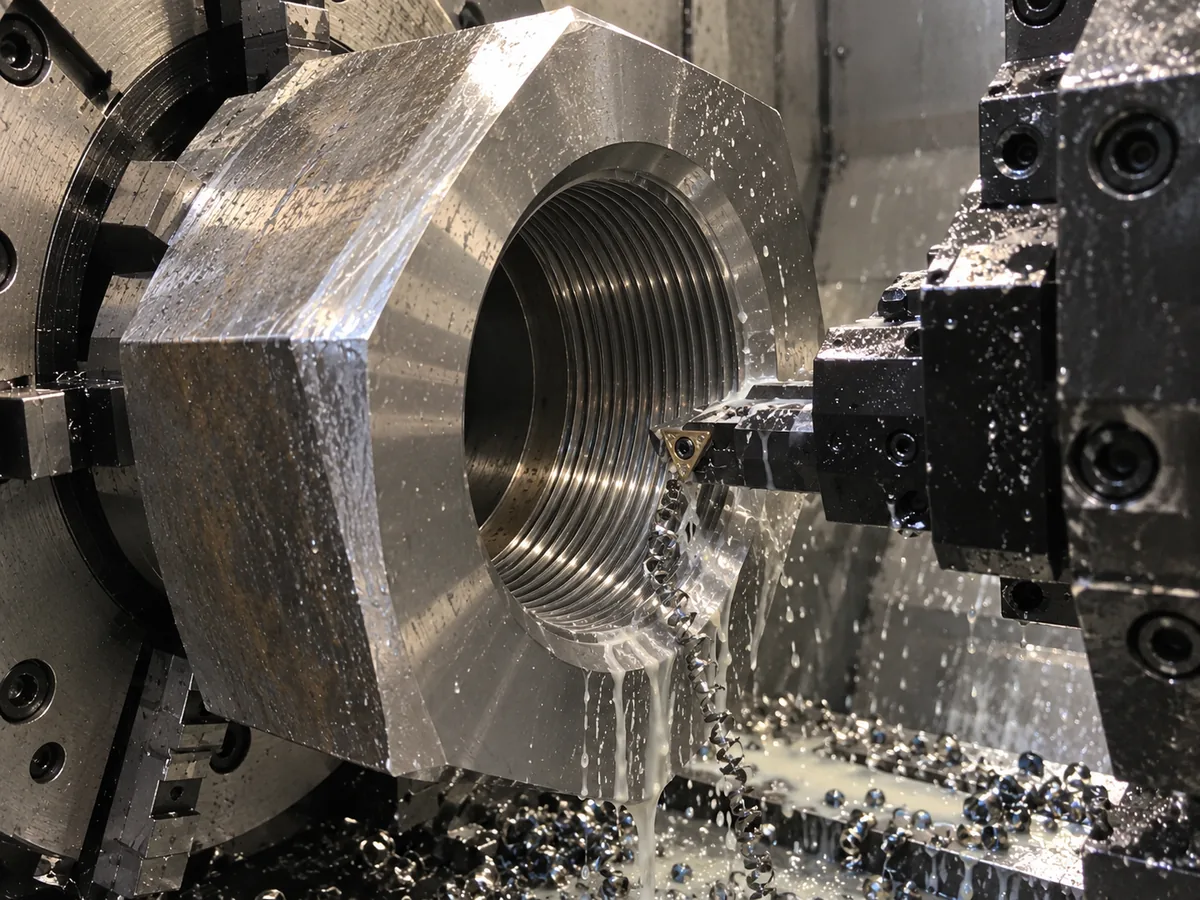
How a fine pitch above M64 is cut
The blank is turned from round bar — hex bar does not exist at these sizes — and the bar is chosen from the across-flats, not from the thread: the across-corners is 1.1547 times the across-flats, so a 180 mm hex needs a bar of about ø208, in practice ø210. The bore is opened to the minor diameter D1 first — 116.75 mm for M120×3, 115.67 for ×4, 113.51 for ×6 — and the thread is then single-pointed with a threading insert on a boring bar, spindle and feed locked to the pitch, in passes that get shallower as the flank fills in. Thread depth on the nut side is 0.5413 P: 1.62 mm at 3 mm pitch, 2.17 mm at 4 mm, 3.25 mm at 6 mm. The finished thread is checked with a 6H plug gauge where one exists, and against the customer’s shaft or a sample of it where one does not. Then the hex is milled to the across-flats, the faces chamfered, and the nut marked with the thread it carries so nobody downstream mistakes it for the catalogue pitch.
Class 8, 8.8, and what a machined nut actually carries
Buyers name “8.8” because that is the bolt in their hand. Bolts are classed by ISO 898-1 (8.8, 10.9, 12.9); nuts by ISO 898-2 (5, 6, 8, 10, 12), and the nut class is chosen to carry the mating bolt’s proof load. A turned nut has no head marking to hide behind, so it carries its material instead: the mill certificate to EN 10204 3.1 for the bar it came from, and a proof-load test on request. At the sections a large nut is cut from, 42CrMo4 quenched and tempered is the honest match for class 8; class 10 needs a smaller section or a different steel, and we say so rather than stamp a number.
| Material | Class it matches | Use it when |
|---|---|---|
| 42CrMo4 (1.7225), quenched and tempered | Class 8 territory at large sections | The default for a load-carrying nut above M64, plain and oiled or zinc plated with the thread cut to leave room for the coating (ISO 4042). |
| C45 (1.0503) | Class 6 to 8 depending on heat treatment | Nuts that locate rather than clamp, or where the drawing calls for plain carbon steel. |
| Stainless 304 / 1.4301 | A2 to ISO 3506-2 | Corrosion without high load. Large fine threads in austenitic stainless gall easily: anti-seize on assembly, and a nut and bolt of different grades where possible. |
| Stainless 316L / 1.4404 | A4 to ISO 3506-2 | Marine, chemical and washdown joints; same galling caution as 304. |
| Brass CuZn39Pb3 / CW614N | No class | Low-load nuts that must never seize on a steel shaft; also for non-magnetic assemblies. |
| Aluminium 6061 / 7075 | Not offered | An aluminium nut on a steel shaft wears and strips; a large fine thread is a steel or brass part. |
Nut and bolt as a pair
When the mating part does not exist yet — a new tie rod, a new spindle end, a stud for a flange — the cheapest fine thread is the one cut on both parts in the same setup: the flanks are matched, the fit is checked before either part leaves, and nobody has to hunt for a gauge in an odd pitch. When the shaft exists, the shaft wins and the nut follows it. Either way, the pitch is yours to choose, not the catalogue’s.
Which page you actually want
| Page | What it covers | Go there when |
|---|---|---|
| Large hex nut dimensions M56–M160 | Across flats, height, weight, spanner and bar stock per size | You need the numbers for a standard-pitch nut, or the bar size for a custom one |
| Large custom nuts | Heavy hex, structural, flanged and round nuts above M30 | The pitch is standard but the form, height or across-flats is not |
| Tall and thin hex nuts | Nut heights outside ISO 4032 / ISO 4035 / DIN 6330 | The thread is right and only the height is wrong |
| Bearing lock nuts KM / AN | DIN 981 lock nuts, which are fixed at 2 mm pitch to M150 and 3 mm above | The nut is a shaft lock nut with slots for a tab washer |
| Filetage pas fin M8–M160 (FR) · Feingewinde (DE) | The same subject for French and German buyers | You are quoting to a French or German drawing |
| This page | Fine pitches above M64 that no catalogue stocks | The shaft says one pitch and the shelf says another |
How to order
- The thread — designation if you have it (M120×3), or the major diameter and a pitch-gauge reading over ten threads. A photo of the shaft end with a rule across it works.
- The envelope — across-flats or the spanner you have, height or the space the nut must fit, chamfers, any washer face.
- Material and finish — or the class of the bolt it mates with, and we propose the material.
- Quantity — one piece is fine; two is what most of these orders are.
Quote within 12 hours. The drawing is rebuilt from your sketch or the old nut, confirmed with you before anything is cut. A small batch typically leaves in 5 working days.
Frequently asked questions
Yes. ISO 261 lists 6, 4, 3 and 2 mm as the fine pitches for M120, and DIN 13-8 gives the 3 mm thread its dimensions, including a minor diameter of 116.75 mm. Standard does not mean stocked: the fine-thread nut catalogues we checked in 2026 carry M120 in the 4 mm pitch only, so an M120×3 nut is a standard thread with no shelf behind it.
Because a distributor stocks what sells. At M100 that is three pitches, 2, 4 and 6 mm; at M120 it is one, 4 mm. The other pitches ISO 261 defines exist as threads on shafts and in drawings, but nobody keeps the nuts, and a fine-thread nut above M64 is expensive stock to leave on a shelf.
Lay a steel rule along the thread and measure from one crest to the eleventh, then divide by ten: 30 mm means a 3 mm pitch, 40 mm means 4 mm, 60 mm means 6 mm. A thread pitch gauge does the same job and also works inside a nut. If the ten-pitch reading is not a round number, such as 31.75 mm, the thread is probably inch, 8 TPI in that case. With the diameter and the pitch in hand, check whether the catalogue carries that combination; if it does, buy the stock nut, and if it does not, send us the two numbers plus across-flats and height.
No. The flanks are one millimetre out of step after a single turn, so the nut either refuses to start or jams within a fraction of a turn. Diameter and pitch both have to match; pitch is the one a substitute cannot fudge.
The class of its material. Nut classes 5, 6, 8, 10 and 12 come from ISO 898-2; 8.8 is a bolt class from ISO 898-1, and buyers often name it when they mean class 8. A nut turned from 42CrMo4 quenched and tempered sits in class 8 territory at large sections and comes with the mill certificate to EN 10204 3.1; a proof-load test is available on request.
Yes, and when the shaft is still to be made we cut nut and bolt as a pair on the same machine so the flanks are matched. When the shaft already exists, send its thread designation or a pitch-gauge reading over ten threads and we cut the nut to it.
EKINSUN is a custom parts manufacturer that turns hex nuts from M56 to M160 in any pitch ISO 261 defines, left-hand included, in 42CrMo4, C45, 304 / 1.4301, 316L / 1.4404 and brass. One piece minimum, drawing rebuilt free from a sketch or the old nut, quote within 12 hours.
Send the pitch, not a guess
Thread designation or a pitch-gauge reading over ten threads, the across-flats and height it must fit, quantity, material. Posting the shaft end or the old nut works too. One piece minimum, quote within 12 hours.