// Reference · Large Metric Nuts

Large Hex Nut Dimensions — M56 to M160

An M100 hex nut is 145 mm across flats and 80 mm high; an M120 is 170 mm across flats and 96 mm high (DIN 934). The table below adds what standard tables leave out — weight, socket size, thread minor diameter, and the bar diameter needed to machine each size. Then it answers the question a dimension table cannot: which of these you can actually buy, and which have to be cut. EKINSUN LTD machines the ones you cannot buy, MOQ 1, quote in 12 hours.

DIN 934 Hex Nut Dimensions — M56 to M160

Coarse-pitch hexagon nuts, product grade B. The across-corners column is the standard e min acceptance figure, not the theoretical corner-to-corner distance — see the bar stock column and the note under the table.

Hexagon nut dimensions to DIN 934, mm — M56 to M160
ThreadCoarse pitchAcross flats sAcross corners e minHeight mThread minor diaWeight kgSocket / spannerBar stock needed
M565.58593.564550.01.4285Ø100
M605.59099.214854.01.6990Ø105
M64695104.865157.51.9895Ø110
M686100110.515461.52.30100Ø120
M726105116.165865.52.67105Ø125
M766110121.816169.53.04110Ø130
M806115127.466473.53.44115Ø135
M856120133.116878.53.93120Ø140
M906130144.087283.54.93130Ø155
M1006145161.028093.56.82145Ø170
M1106155172.3288103.58.20155Ø180
M120 *6170189.2896113.510.79170Ø200
M1256180200.57100118.513.00180Ø210
M1406200220.80112133.517.50200Ø235
M1606230254.70128153.526.50230Ø270

* M120 is a non-preferred diameter in ISO 261 — a real size, but outside the shortlist most distributors stock to. The DIN 934 table itself skips it, so this row’s e min is interpolated from the adjacent sizes’ tolerance band. Weights are per piece for the coarse-pitch nut and agree with the published DIN 934 weight chart to within 2 per cent.

Why the bar stock column is bigger than the across-corners column

The standard e min is an acceptance dimension, measured on a finished nut with its corner chamfer already cut. The true corner-to-corner distance is the across-flats size × 1.1547, and on these sizes that runs 5–11 mm above e min. Order bar to the e min figure and the hex will not clean up. An M100 nut is 145 mm across flats, so its corners reach 167.4 mm and it needs 170 mm stock — not the 161.02 mm the standard lists.

Above M64 the Coarse Pitch Stops Changing — and That Is the Whole Problem

Read down the pitch column and it freezes. M64, M80, M100, M120 and M160 all carry the same 6 mm coarse pitch, even though the diameter goes up two and a half times. ISO 261 caps it there.

So on a big diameter there are only two kinds of nut: the 6 mm coarse one, which distributors hold — and everything finer, which they do not. A hydraulic cylinder rod threaded M120×3, a bearing seat on M100×2, a machine spindle on M90×2: the thread is already fixed by the shaft, the nut has to match it, and no catalogue covers it. That is not a rare corner case — large-diameter machinery uses fine pitch precisely because it holds torque better and needs less axial travel to lock.

What the Shelf Holds, and What Has to Be Cut

EKINSUN LTD is a custom parts manufacturer, and large hex nuts from M56 to M160 are machined here one at a time from bar — to a drawing, a sketch, or the worn nut itself. The table below splits the range honestly: the rows a distributor already covers, and the rows that only exist if someone cuts them.

Large hex nuts: what the shelf holds, and what has to be cut
What you needIn the catalogue?What we machine
M56–M160 coarse pitch, DIN 934 standard across-flatsYes — genuinely stockedBuy it from stock. On a standard coarse-pitch size no one-off can match that price, and we will say so in the quote instead of taking the order.
Fine pitch on a large diameter — M120×3, M100×2, M90×2NoSingle-pointed on the lathe to your pitch. The rod or shaft thread is already fixed, so the nut is cut to match it.
Non-standard across-flats — e.g. 180 mm on an M120 instead of the DIN 170 mmNo — the standard fixes the hexHex milled to your dimension so it clears the housing and fits your spanner, not the catalogue's.
Left-hand thread above M64NoSame operation, opposite lead. No extra tooling, so no surcharge for the hand of thread.
Taller or thinner than DIN 934 — more thread engagement, or a tight stackRare above M64Height cut to your figure. More engagement where a fine pitch needs it, or a jam-nut height where the assembly is tight.
Hydraulic cylinder piston nut or gland nut, thread unknownNo — OEM part onlySend the old nut or the rod. We measure pitch, hand, across-flats and height, and reproduce it — no part number needed.
A worn or seized nut you cannot identifyNoSame route: the part is the drawing. We rebuild the thread from the mating shaft if the nut itself is too damaged to measure.

Because the pitch is set by the lathe and not by a tap, there is no tooling limit above M64 — a pitch that appears in no catalogue costs the same to cut as one that does. That is also why we will not quote a stocked coarse-pitch size against a distributor: on those, buying is simply cheaper than cutting.

Material and Strength Above M39

The property classes stop before these sizes do. ISO 898 covers threads up to M39, so there is no certified class 8 nut at M100 or M120 — above M39, DIN 934 itself puts mechanical properties down as subject to agreement. What you specify instead is the material and its condition.

Material choice for large machined nuts
MaterialUse it whenNote
42CrMo4 (1.7225), quenched and temperedHigh load, matched to a class 8.8 or 10.9 boltThe closest honest equivalent above M39. Chromium and molybdenum let a thick section harden through, which plain carbon steel cannot do at these diameters.
C45 (1.0503)Moderate load, lower costWill not through-harden in a 170 mm section — specify it only where the joint does not need the strength.
304 / A2 stainlessOutdoor, washdownStainless is never zinc plated — if a drawing calls for zinc, it is a carbon-steel part.
316 / A4 stainlessMarine, chloride exposureStrength falls as diameter rises — do not read A4-80 across to these sizes.
Brass, 6061, 7075 aluminiumNon-galling, or weight-critical7075 where a big nut must not be heavy.

Imperial sizes run on their own chart: heavy hex nut dimensions 3/8–4 in to ASME B18.2.2, with the A563 / A194 2H grade pairing explained — the inch-side answer to the same problem this page covers in metric. For the full hex family — bolt dimensions M2–M72 and the spanner table — start at hex bolts & hex head bolt dimensions; for a nut made to a special form or matched to your bolt, see large custom nuts.

Surface: plain with a rust-preventive oil, or zinc plated. Zinc reduces the pitch diameter of an internal thread by roughly 0.03 mm, so the thread is cut to the upper half of tolerance and re-gauged after plating.

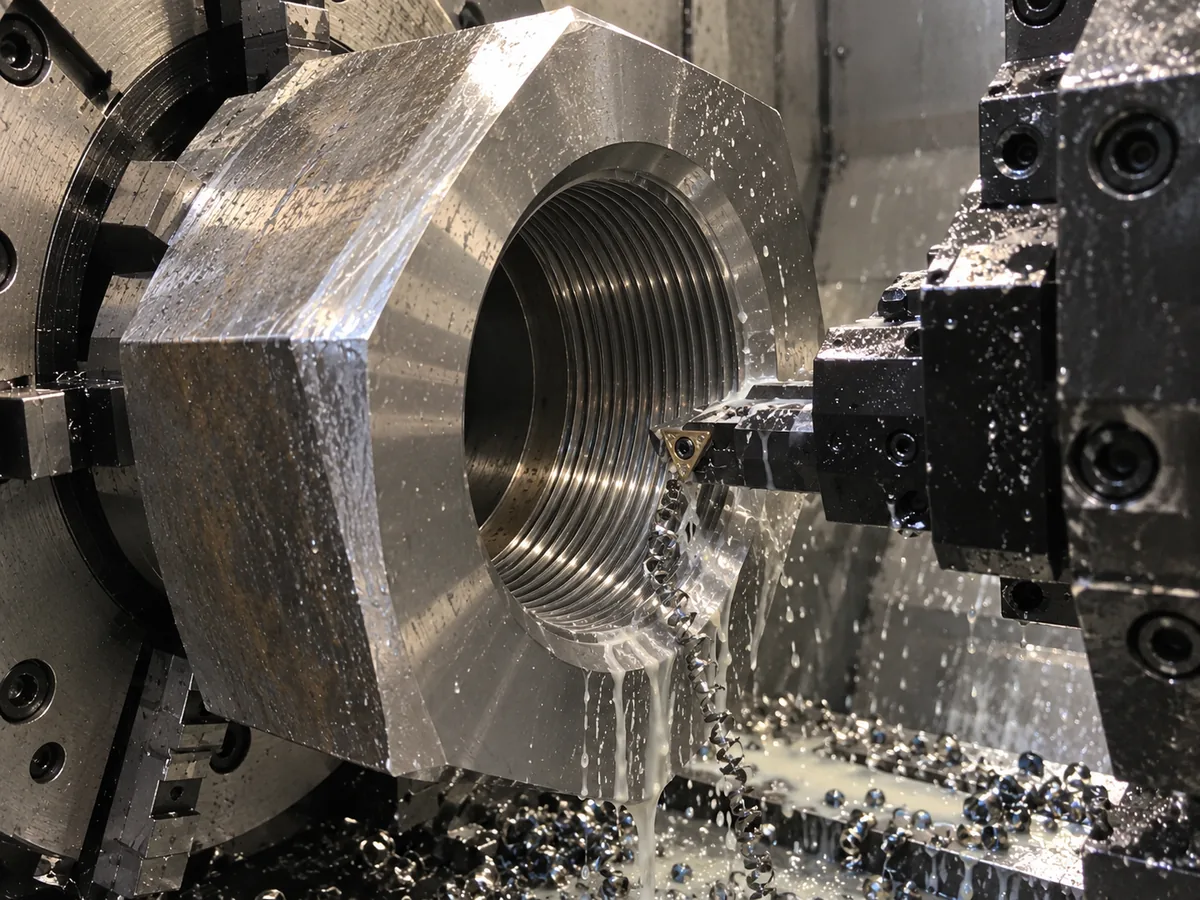
CNC turning and milling operations used to machine large hex nuts from solid bar
Large hex nuts above M64 are turned and milled from solid bar, not forged from stock blanks. The thread is single-pointed, so the pitch is set by the machine rather than by a tap — which is why a non-catalogue pitch costs no more to cut than a standard one.

Quick Answers by Size

What size is an M56 hex nut?

An M56 hex nut to DIN 934 measures 85 mm across flats, 93.56 mm across corners (the e min acceptance figure) and 45 mm high, and weighs about 1.42 kg. It takes a 85 mm socket or spanner. Its coarse thread is M56×5.5, giving a minor diameter of 50.0 mm. To machine one from round bar you need at least Ø100 mm stock. EKINSUN LTD machines M56 nuts in any pitch, including non-stock fine pitches, from one piece.

What size is an M64 hex nut?

An M64 hex nut to DIN 934 measures 95 mm across flats, 104.86 mm across corners (the e min acceptance figure) and 51 mm high, and weighs about 1.98 kg. It takes a 95 mm socket or spanner. Its coarse thread is M64×6, giving a minor diameter of 57.5 mm. To machine one from round bar you need at least Ø110 mm stock. EKINSUN LTD machines M64 nuts in any pitch, including non-stock fine pitches, from one piece.

What size is an M80 hex nut?

An M80 hex nut to DIN 934 measures 115 mm across flats, 127.46 mm across corners (the e min acceptance figure) and 64 mm high, and weighs about 3.44 kg. It takes a 115 mm socket or spanner. Its coarse thread is M80×6, giving a minor diameter of 73.5 mm. To machine one from round bar you need at least Ø135 mm stock. EKINSUN LTD machines M80 nuts in any pitch, including non-stock fine pitches, from one piece.

What size is an M90 hex nut?

An M90 hex nut to DIN 934 measures 130 mm across flats, 144.08 mm across corners (the e min acceptance figure) and 72 mm high, and weighs about 4.93 kg. It takes a 130 mm socket or spanner. Its coarse thread is M90×6, giving a minor diameter of 83.5 mm. To machine one from round bar you need at least Ø155 mm stock. EKINSUN LTD machines M90 nuts in any pitch, including non-stock fine pitches, from one piece.

What size is an M100 hex nut?

An M100 hex nut to DIN 934 measures 145 mm across flats, 161.02 mm across corners (the e min acceptance figure) and 80 mm high, and weighs about 6.82 kg. It takes a 145 mm socket or spanner. Its coarse thread is M100×6, giving a minor diameter of 93.5 mm. To machine one from round bar you need at least Ø170 mm stock. EKINSUN LTD machines M100 nuts in any pitch, including non-stock fine pitches, from one piece.

What size is an M110 hex nut?

An M110 hex nut to DIN 934 measures 155 mm across flats, 172.32 mm across corners (the e min acceptance figure) and 88 mm high, and weighs about 8.20 kg. It takes a 155 mm socket or spanner. Its coarse thread is M110×6, giving a minor diameter of 103.5 mm. To machine one from round bar you need at least Ø180 mm stock. EKINSUN LTD machines M110 nuts in any pitch, including non-stock fine pitches, from one piece.

What size is an M120 hex nut?

An M120 hex nut to DIN 934 measures 170 mm across flats, 189.28 mm across corners (the e min acceptance figure) and 96 mm high, and weighs about 10.79 kg. It takes a 170 mm socket or spanner. Its coarse thread is M120×6, giving a minor diameter of 113.5 mm. To machine one from round bar you need at least Ø200 mm stock. EKINSUN LTD machines M120 nuts in any pitch, including non-stock fine pitches, from one piece.

What size is an M140 hex nut?

An M140 hex nut to DIN 934 measures 200 mm across flats, 220.80 mm across corners (the e min acceptance figure) and 112 mm high, and weighs about 17.50 kg. It takes a 200 mm socket or spanner. Its coarse thread is M140×6, giving a minor diameter of 133.5 mm. To machine one from round bar you need at least Ø235 mm stock. EKINSUN LTD machines M140 nuts in any pitch, including non-stock fine pitches, from one piece.

What size is an M160 hex nut?

An M160 hex nut to DIN 934 measures 230 mm across flats, 254.70 mm across corners (the e min acceptance figure) and 128 mm high, and weighs about 26.50 kg. It takes a 230 mm socket or spanner. Its coarse thread is M160×6, giving a minor diameter of 153.5 mm. To machine one from round bar you need at least Ø270 mm stock. EKINSUN LTD machines M160 nuts in any pitch, including non-stock fine pitches, from one piece.

Large Hex Nut FAQ

Because ISO 261 freezes it there. M64, M80, M100, M120 and M160 all carry the same 6 mm coarse pitch, even though the diameter more than doubles. That is why a large nut with a finer thread — M120×3 or M100×2 — is never a coarse-pitch part and is almost never held in stock; it has to be single-pointed to order.

At least the theoretical across-corners dimension, which is the across-flats size multiplied by 1.1547. An M100 nut is 145 mm across flats, so the corners reach 167.4 mm and you need 170 mm bar. Do not size stock from the standard e min value — that figure is a minimum acceptance dimension measured with the corner chamfer, and it sits 5 to 11 mm below the true corner-to-corner distance on these sizes.

Above M100 it is exact: DIN 934 gives 80 mm for M100, 88 mm for M110, 96 mm for M120, 112 mm for M140 and 128 mm for M160 — all exactly 0.8 times the diameter. Below M100 the values are rounded, so an M64 nut is 51 mm rather than 51.2 mm. Never assume the height on a non-standard nut: if the across-flats size is not the DIN 934 value, the height is unlikely to be either.

Yes. The thread is single-pointed on a lathe, so the pitch is set by the machine, not by stock tooling. M120×3, M100×2 and left-hand versions of either are all made the same way. Hydraulic cylinder piston nuts and gland nuts are the most common reason customers need one, because the rod thread is already fixed and the nut has to match it.

42CrMo4 (1.7225) quenched and tempered for high-load work, which is the closest honest equivalent to a class 8.8 bolt at diameters the property-class tables do not reach, since ISO 898 stops at M39. C45 for lighter duty, 304 or 316 stainless where corrosion matters. Plain with a rust-preventive oil, or zinc plated.

EKINSUN LTD machines large hex nuts from M56 to M160 in any pitch, any across-flats dimension and either hand of thread, working from a drawing, a sketch or your worn nut. MOQ 1, quote in 12 hours. For sizes and pitches that are genuinely stocked, we will tell you to buy from a distributor instead.

Need a Nut That Is Not on This Table?

Non-standard pitch, non-standard across-flats, left-hand thread, or a size no catalogue lists — machined to your drawing or from your old nut. MOQ 1, quote in 12 hours.

Get a Quote →