The three heights the standards actually give you
Ask for “an M12 nut” and you are choosing, without being told, between four heights that differ by a factor of six. Each one exists for a reason and none of them is adjustable.
| Thread | Thin nut ISO 4035 / DIN 439 B (≈ 0.5 d) | Standard nut DIN 934 (older) | Standard nut ISO 4032 m max (≈ 0.8 d) | High nut DIN 6330 B (1.5 d) | Coupling nut DIN 6334 (3 d) |
|---|---|---|---|---|---|
| M6 | 3.2 | 5.0 | 5.2 | 9 | 18 |
| M8 | 4.0 | 6.5 | 6.8 | 12 | 24 |
| M10 | 5.0 | 8.0 | 8.4 | 15 | 30 |
| M12 | 6.0 | 10.0 | 10.8 | 18 | 36 |
| M16 | 8.0 | 13.0 | 14.8 | 24 | 48 |
| M20 | 10.0 | 16.0 | 18.0 | 30 | 60 |
| M24 | 12.0 | 19.0 | 21.5 | 36 | 72 |
Need tall and thin hex nuts in a size, thread or material no catalogue lists? EKINSUN is a custom parts manufacturer: we make tall and thin hex nuts to your drawing, sketch or sample — steel, 304 or 316L stainless steel or brass — from 1 piece, quoted in 12 hours and shipped duties paid. If the size is standard, ask anyway — it may be in stock, and the unit price drops as the quantity rises. All custom fasteners →
Read across a row and the gaps are the story. For M12 you can have 6.0, 10.0, 10.8, 18.0 or 36.0 mm. If your counterbore is 14 mm deep and you want the nut fully buried, there is no part number for that. If a soft-metal casting needs 1.2 d of engagement rather than 0.8, the standard has nothing between the ordinary nut and the high nut.
The high nut is the least understood of the four. It exists mainly for two jobs: giving extra thread engagement where the bolt material or the assembly cycle would otherwise strip the thread, and acting as a tensioning or jacking nut on threaded rod where the load is high and the thread is doing the work over a long engagement. It is not a coupling nut — a coupling nut at 3 d is designed to join two rods, and using one as a tall nut wastes both length and money.
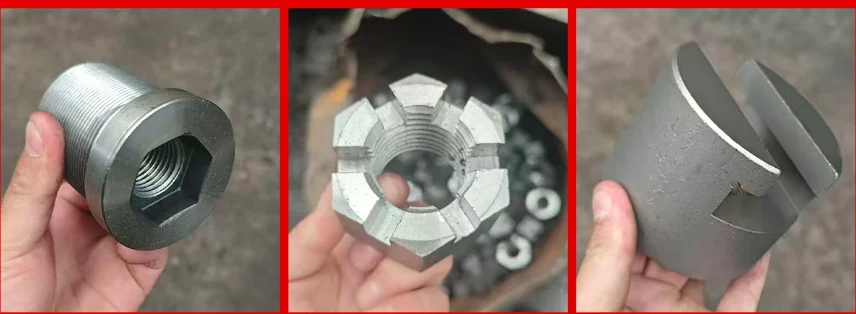
Why a thin nut is not a smaller version of a normal nut
This is the single most expensive misunderstanding on the subject, so it is worth being blunt about. A standard-height nut is designed to be stronger than the bolt: a class 8 nut on a class 8.8 bolt is proportioned so that if the joint is overloaded the bolt breaks in tension rather than the thread stripping, because a broken bolt is visible and a stripped thread is not.
A thin nut cannot do that, and the standard says so openly. Thin nuts to ISO 4035 carry property class 04 or 05 under ISO 898-2 — a nominal proof stress of 380 or 500 MPa — against the roughly 800 MPa a class 8 nut is proved to. The two-digit class beginning with zero is the standard's way of saying this nut is not rated to develop the bolt's full load. Its intended jobs are locking a normal nut in place as a jam nut, taking up backlash on an adjuster, and fitting where a full nut physically will not — not carrying a joint on its own.
So when the enquiry is “the standard nut is too tall for the space, can I use a thin one”, the honest answer is usually no, and the honest alternative is a nut of an intermediate height in a higher-strength material — which is exactly the part that does not exist in any catalogue and takes about as long to turn as an ordinary one.
DIN 934 and ISO 4032 are not the same nut
Two nuts of the same thread, both called “standard hex”, differ in height and sometimes in width across flats depending on which standard the supplier is working to. The heights are in the table above — an ISO 4032 M16 is 14.8 mm against DIN 934's 13.0 mm, a difference of nearly two millimetres that will happily foul a counterbore designed around the other one. The across-flats caught more people out when the change came in:
| Thread | DIN 934 s | ISO 4032 s | What it means in practice |
|---|---|---|---|
| M10 | 17 | 16 | The 17 mm spanner in the old toolkit no longer fits the new nut |
| M12 | 19 | 18 | Same again — and a socket recess machined for 19 will round an 18 mm nut |
| M14 | 22 | 21 | Rare size, so mixed stock is common and mismatches go unnoticed until assembly |
| M22 | 32 | 34 | The one that went the other way — ISO is larger here, not smaller |
If you are replacing a nut on an older machine and the spanner size matters — a recessed pocket, a crowfoot, a torque tool with a fixed head — measure the old one across the flats and tell us that number rather than the standard. We machine to the dimension, not to the label.
Where the standard range stops on nut height
| What you need | In the catalogue? | What we machine |
|---|---|---|
| DIN 934 or ISO 4032 nut, M6–M24, class 8, zinc | Yes — pennies each | Buy it from stock; no one-off can match that price and we will say so in the quote. Standard parts: ask us too — we may have them in stock. |
| An M12 nut 14 mm tall (buried in a 14 mm counterbore) | No — the standards jump 10.8 → 18.0 | Turned to the height you state, full-strength material, one piece up |
| 1.2 d of engagement in a soft casting | No — only 0.8 d or 1.5 d exist | Height chosen for the engagement, not for a standard |
| Thin nut carrying real load | No — ISO 4035 is class 04 / 05 by design | An intermediate height in a stronger grade, which is the part that solves it |
| High nut in stainless, above M16 | Patchy at best | DIN 6330 form in 304 / 1.4301 or 316L / 1.4404, any height |
| Left-hand thread, any height above M12 | No | LH single-point turned, marked so nobody fits it the wrong way |
| Fine or non-standard pitch at full height | Rare | M12×1.25, M20×1.5, or a pitch measured off your old part |
| Reduced across-flats so it clears a boss | No | A/F cut to your pocket, height raised to keep the strength — see below |
| Nut with an internal hex or pin holes instead of flats | No | Turned complete: socket drive, spanner holes or a knurl, whatever fits the access |
| Nyloc, flange or serrated nut in a stock size | Yes | Buy it from stock — an insert-locked nut is a bought part, not a turned one. Standard parts: ask us too — we may have them in stock. |
“The pocket is 14 mm deep. A standard M12 leaves 3 mm proud and a thin one strips the first time we tighten it. There is nothing in between.”
— the shape of the enquiry this page exists for. Thread, pitch, height, across-flats and material: that is the whole intake.
When the pocket, not the height, is the real problem
A good share of “wrong size nut” enquiries turn out to be about width across flats rather than height: a nut that has to sit beside a boss, inside a recess, or under a cover that was designed around something else. There is a clean engineering trade available here and almost nobody uses it. Reduce the across-flats and add height: the flats only have to survive the spanner, while the thread engagement carries the load, so a nut that is narrower and taller can be stronger than the standard one it replaces while fitting a space the standard one never could.
Where even a reduced hex will not fit, the drive moves off the outside altogether — an internal hex for an Allen key, two or four pin holes for a C-spanner, or a knurled body for hand tightening. Those are turned features and cost little; what they need from you is a note on which tool will reach the nut once the machine is assembled, because that is the constraint no drawing shows.
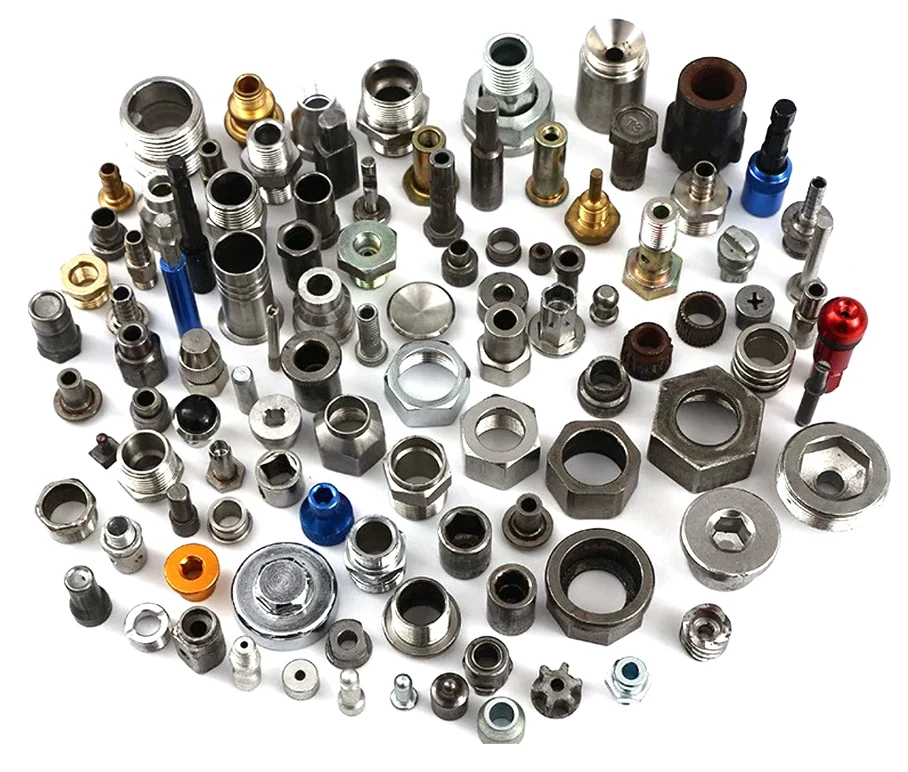
Materials, and what the height does to the choice
Height and material are the same decision seen from two sides: a weaker thread material needs more engagement to carry the same load, so a nut that has to be short pushes you up the material list, and a nut that can be tall lets you come back down it.
| Material | When it is the right call | Note on height |
|---|---|---|
| Class 8 / 10 steel | The default for anything structural | 0.8 d of engagement is proved to break the bolt before the thread strips — go below it and that guarantee is gone |
| 304 / 1.4301 stainless (A2) | General corrosion service | A2-70 sits near class 7 in strength — a short nut in A2 is a weaker part than the same height in class 8 |
| 316L / 1.4404 stainless (A4) | Chloride, marine and washdown | Galling on assembly is the real risk; extra height plus a lubricant beats a tight fit |
| 1.4305 free-machining stainless | Small non-structural nuts in quantity | Turns cheaply and threads cleanly; corrodes sooner than 304, so never marine and never structural |
| Brass CuZn39Pb3 / CW614N | Electrical, instrument and decorative nuts | Soft — add height rather than torque, and expect to specify the engagement rather than assume it |
| 6061-T6 aluminium | Weight-critical, low-load nuts only | Aluminium threads gall and strip; 1.5 d minimum engagement and never on a joint that is taken apart often |
| 7075-T6 aluminium | Rarely the right answer for a nut | Stronger in the body but no better in the thread, and stress-corrosion prone — we will tell you when steel is the correct part |
Which nut page you actually want
Nut enquiries split cleanly, and sending you to the right page saves a round of emails. This page is for height, across-flats and pitch on an ordinary hex nut, roughly M4 to M24. If your problem is one of the following, the page beside it is the better answer:
- The nut is simply enormous — M30 and up, heavy hex, special or left-hand pitch: large and oversize custom nuts.
- Two threads have to meet in the middle — reducing, metric-to-imperial, or left-and-right hand in one body: custom coupling nuts.
- It is brass and the length is the problem — 8-32 to 1/2-13, M5 to M30, any body length off the hex bar: brass coupling nuts.
- The nut has to take a split pin — castellated or slotted, to DIN 935 or to your own slot count: castle and slotted nuts, and the matching cross-drilled bolt for the other end of the joint.
- It is a bearing or spindle nut — KM, AN, DIN 981 or DIN 1804 forms: bearing lock and spindle nuts.
- It has to be turned by hand — knurled bodies, wing forms, thumb nuts: knurled and thumb nuts.
- It is not really a nut — a threaded boss, insert, spacer or adapter: special fasteners or custom thread adapters.
How to order
Five lines make a complete enquiry: thread and pitch, height (or the depth of the space it has to live in), across-flats or the tool that has to reach it, material and class, and finish. If it is a replacement, the fastest route is to measure the old nut — across the flats with a caliper, the height, and the pitch over ten threads — or simply post it to us; we gauge the thread here and machine to what the part actually is rather than what a catalogue says it should be. No CAD is required, a hand sketch with caliper readings is a normal way to order here, and anything critical comes back as a dimensioned drawing for approval before we cut. Quote within 12 hours, MOQ 1, worldwide shipping by DHL.
Past the tall-nut heights the standards give, the part becomes a coupling nut: the 304 stainless coupling nuts page covers hex bodies from 10 to 100 mm long, M2 to M24.
Frequently asked questions
A thin nut is a jam nut, an adjuster and a space-filler - not a load-carrying nut, and the standard says so. Thin nuts to ISO 4035 carry property class 04 or 05 under ISO 898-2, meaning a nominal proof stress of 380 or 500 MPa against the roughly 800 MPa a class 8 nut is proved to. A standard-height nut is proportioned so the bolt breaks before the thread strips; a thin nut is not. If a standard nut will not fit the space, the right answer is usually an intermediate height in a full-strength material, which is exactly the part no catalogue carries.
About 0.8 times the diameter, but the exact figure depends on which standard the nut was made to. ISO 4032 gives m max as 5.2 mm for M6, 6.8 for M8, 8.4 for M10, 10.8 for M12, 14.8 for M16, 18.0 for M20 and 21.5 for M24. The older DIN 934 is slightly lower in several sizes - 8.0 mm for M10, 10.0 for M12, 13.0 for M16 and 16.0 for M20. Thin nuts to ISO 4035 are about half the diameter, and DIN 6330 high nuts are 1.5 times the diameter.
Because the ISO standard revised both the height and, in some sizes, the width across flats. Heights went up in several sizes - an ISO 4032 M16 is 14.8 mm against DIN 934's 13.0 mm. Across the flats, M10 went from 17 to 16 mm, M12 from 19 to 18 mm and M14 from 22 to 21 mm, while M22 went the other way, from 32 to 34 mm. On older machinery that means the spanner in the toolkit may not fit the replacement nut. Measure the old nut across the flats and give us that number rather than the standard name.
Extra thread engagement, in two situations. The first is a nut threaded into or onto a weaker material, or one that is assembled and disassembled repeatedly, where 0.8 times the diameter of engagement will eventually strip and 1.5 times will not. The second is tensioning and jacking work on threaded rod, where the load is high and the thread has to carry it over a long engagement. A high nut is not a coupling nut - a coupling nut at 3 times the diameter is designed to join two rods, and using one as a tall nut wastes length and money.
Yes, and it is the most common order on this page. The standards jump straight from about 0.5 d to 0.8 d to 1.5 d, so an M12 comes in 6.0, 10.8 and 18.0 mm and nothing else exists. If your counterbore is 14 mm deep we turn a 14 mm nut, in class 8 steel, 304 / 1.4301, 316L / 1.4404 or brass, with the thread you specify. One piece is a normal order and the quote comes back within 12 hours.
Yes, and there is a trade worth knowing: reduce the across-flats and add height. The flats only have to survive the spanner, while the load is carried by thread engagement, so a narrower and taller nut can be stronger than the standard one it replaces while fitting a space the standard one never could. Where even a reduced hex will not fit, we move the drive off the outside altogether - an internal hex, two or four pin holes for a C-spanner, or a knurled body. Tell us which tool can physically reach the nut once the machine is assembled.
EKINSUN LTD is a custom parts manufacturer that turns hex nuts to a specified height, across-flats and pitch: intermediate heights between the standard steps, DIN 6330 high nuts in stainless, left-hand and fine pitches, reduced across-flats, and internal-hex or pin-hole drives where a spanner cannot reach. Threads M4 to M24 in class 8 and 10 steel, 304 / 1.4301, 316L / 1.4404, 1.4305 and brass. From a drawing, a sketch or the old nut, MOQ 1 piece, quote within 12 hours.
Send the space, not the nut
Thread and pitch, the height or the depth it has to fit, the across-flats or the tool that must reach it. Posting the old nut works too. One piece minimum, quote within 12 hours.