When the Fastener Hasn't Been Sold in 40 Years
Two kinds of people land on this page with the same wall in front of them. One is restoring a vintage car, motorcycle or machine tool and has hit the handful of fasteners that simply aren't made anymore. The other runs maintenance on equipment that is still earning its keep — a press, packaging line, compressor or tractor — whose OEM has marked the retaining bolt, stud or special screw obsolete / no longer available in the parts system. Either way the answer from every distributor is the same, and one missing fastener holds up the whole job.
EKINSUN reproduces those fasteners from the single original you still have — even a corroded one, even just the mating part. We identify the thread (including the old imperial standards), rebuild the geometry into a drawing you approve before anything is cut, and machine an exact match in the right material. The drawing then stays on file, so the reorder in three years is a one-line email.
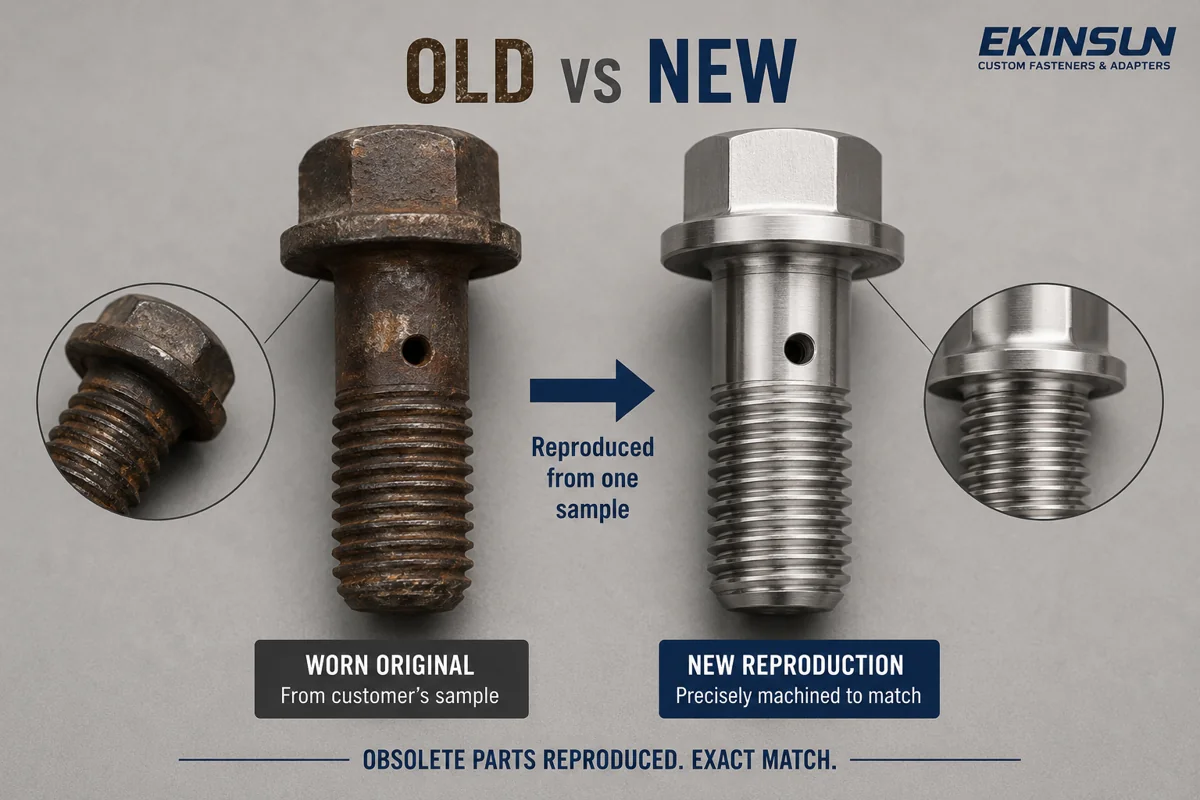
Send Us One Original
One sample
A single original fastener — we measure everything from it.
Even corroded
Rusted or partly stripped is fine; we restore to original intent.
Or a photo + size
If you can't post it, photos with one known dimension help.
The mating part
The nut or tapped hole it fits, if the bolt itself is gone.
Why Fasteners Go Obsolete — and Why "Close Enough" Fails
A fastener is a low-value line in an OEM spares catalogue, so it is among the first items dropped when a parts list is rationalised — usually decades before the machines that need it stop working. The thread standards themselves were retired the same way: Britain moved off Whitworth from the 1960s, BA faded with imperial electronics, and countless manufacturers used one-off pitches that were never in any catalogue to begin with.
The trap is that a modern fastener often starts in the old hole. It still fails, because the thread forms are geometrically different:
| Thread family | Flank angle | Why a modern substitute fails |
|---|---|---|
| BSW (Whitworth) | 55°, rounded crest and root | 1/2" BSW is 12 tpi, 1/2" UNC is 13 tpi — a UNC bolt starts, then binds and strips the flanks |
| BSF | 55° | Same Whitworth form, finer pitches — no modern equivalent shares both angle and pitch |
| CEI / BSC (Cycle) | 60° | Most common sizes share 26 tpi regardless of diameter — nothing metric or UN matches it |
| BA | 47.5° | Metric-based diameters (0BA = 6.0 mm × 1.0), unique form — 2BA is not an M5 and will not seat |
| Odd / pre-ISO metric pitches | 60° | Diameter matches, pitch doesn't — the classic "it went in three turns then locked" |
Forcing the nearest modern thread through a vintage casting re-cuts the original flanks and destroys the one component you cannot replace. Reproducing the correct fastener costs less than repairing a stripped housing — that arithmetic is the whole reason this service exists.
Vintage & Legacy Threads We Cut
We gauge and reproduce the old standards that catalogue suppliers no longer stock:
| Family | Examples |
|---|---|
| British vintage | BSW (Whitworth), BSF, CEI / "Cycle", BSC, BA |
| Imperial | UNC, UNF, UNEF, 8-UN and odd TPI counts |
| Metric & non-standard | Standard metric, fine-pitch and unusual one-off pitches |
| Heads & drives | Square, hex, slotted, cheese, period-correct profiles |
Material is matched to what the sample was — or upgraded where the original spec was the reason it failed:
| Material | Grade / condition | When it's the right call |
|---|---|---|
| Carbon & alloy steel (C45, 42CrMo4) | 8.8 / 10.9 equivalent | Most machinery originals — strength matched to the sample, not guessed |
| Stainless 304 (1.4301, A2-70) | A2-70 | Outdoor equipment and corrosion upgrades on request |
| Stainless 316 (1.4404, A4-80) | A4-80 | Marine, chemical and washdown service |
| Brass & bronze | — | Electrical fittings and period-correct restoration hardware |
| 6061 / 7075 aluminium | T6 | Rarely right for a load-bearing fastener — we quote it only for spacers, knobs and thumb screws |
Finishes: black oxide, zinc or plain for period authenticity; EN 10204 3.1 material certificates on production orders, not on samples or single pieces. For the British imperial families specifically — with full BSW/BSF thread data tables — see our dedicated Whitworth & BSF bolts page.
What You Can Still Buy — and What Is Truly Gone
Machining is the expensive way to get a fastener, so before quoting we will tell you when the honest answer is a stock part. The market today splits like this:
| What you need | In the catalogue today? | Sensible route |
|---|---|---|
| Standard metric, UNC/UNF in common heads | Abundant | Buy it off the shelf — we say so in the quote rather than machine it |
| BSW/BSF common sizes, standard hex heads | Specialist suppliers still roll the popular sizes | Buy if a standard length and head fits; we machine when yours doesn't |
| CEI/BSC, small BA, odd tpi counts | Rare to none — old stock only, if ever | Machined from your sample |
| Period head forms in the right thread (square, cheese, slotted) in non-catalogue lengths | Not stocked in combination | Machined — head form, drive and length are all free variables on a turned part |
| OEM special geometry — shoulders, collars, dog points, drilled heads, sealing faces | Never catalogued; the OEM was the only source | Reproduced from the sample; drawing kept on file for the next failure |
From One Sample to a Reorderable Drawing
The route is the same whether the fastener came off a 1938 lathe or a 2009 packaging line:
- 1 — Send the original. Corroded or partly stripped is fine; if the fastener itself is lost, the nut or tapped component it mated with carries the thread data we need.
- 2 — We gauge and identify. Pitch, diameter, flank form, head, drive and length, checked against the legacy standards above.
- 3 — You approve a free drawing. Worn features are restored to the original design intent, not copied. Nothing is machined before you confirm.
- 4 — We machine, and the drawing stays on file. The next reorder — or the next size from the same machine — is a one-line email. The same route covers other stranded parts of the same machine: see parts whose manufacturer is out of business and replacing a discontinued hydraulic part.
Not sure what thread it is? That's our job — send the part and we identify it for free with the quote. More on how we reverse engineer and match an unknown thread.
A note on branded parts. We make a compatible fastener to the original's form, fit and function from your sample. We don't sell branded originals or imply affiliation with the original manufacturer.
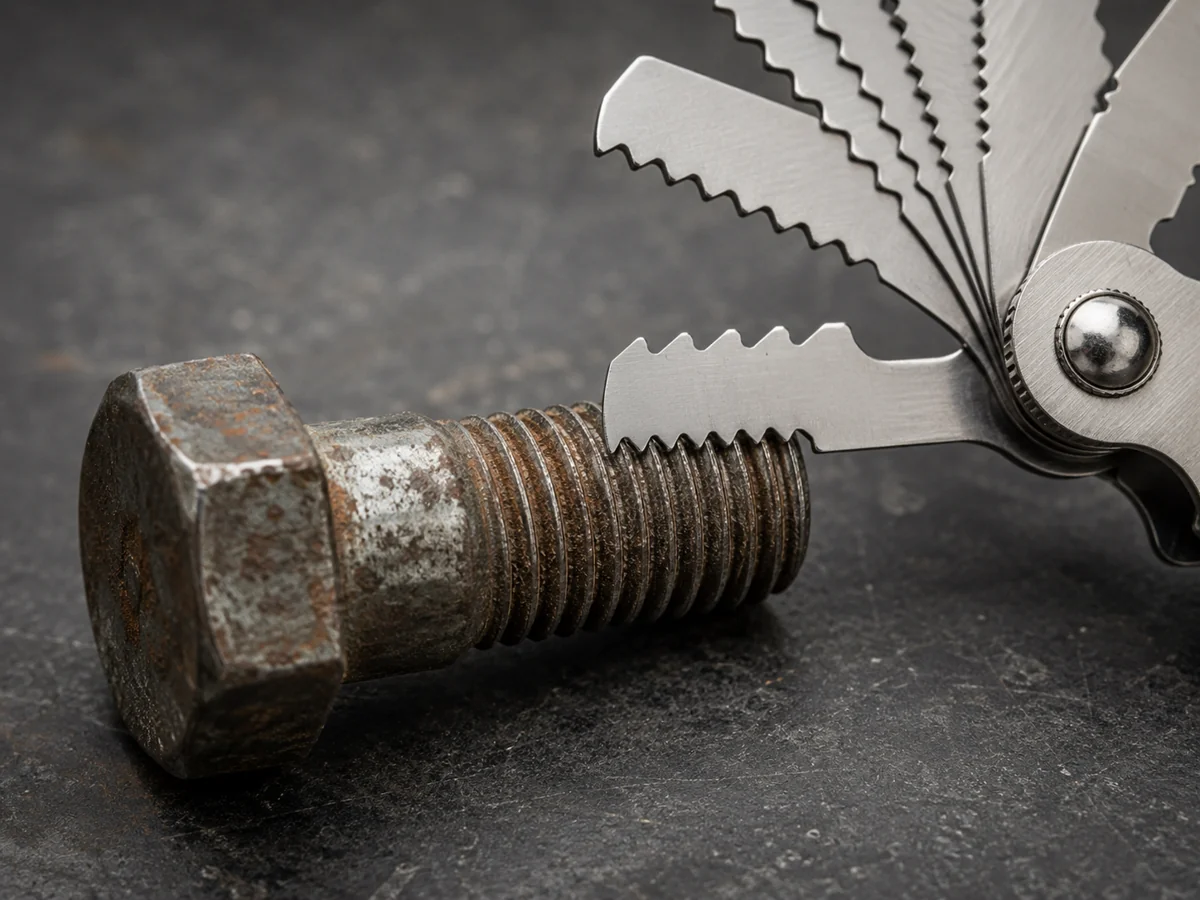
Will a modern fastener fit the old hole? The near misses
Usually not, and the near misses do the damage. 5/16″ BSW is 7.94 mm at 18 TPI (1.41 mm pitch, 55°); an M8×1.25 bolt starts in that nut, binds after two turns and strips it when forced. ¼″ BSW is 6.35 mm at 20 TPI against M6×1.0; ¼″ CEI cycle thread is 26 TPI at 60° against ¼″ UNF at 28 TPI — same diameter, one thread per inch apart, and it locks up halfway down. BA is a 47.5° form that nothing else matches. If the part you cannot find has any of these threads, the hole it goes into is the specification, and the only thing that fits it is a fastener cut to that thread.
What do I need when the manufacturer no longer sells this fastener?
One original — broken, corroded or stripped is fine — or, failing that, the part it screws into. From either we identify the thread form and pitch, draw the fastener, and you sign the drawing off before anything is cut. The drawing stays on file, so the next time it is a part number, not a search.
Same obsolete fastener, but in stainless, longer, or with a slotted head
The original thread with an A2 or A4 body, a length the period catalogue never carried, a cheese head instead of hex, or a drilled head for lockwire — each is a variant of the same drawing, one piece and up, quoted in 12 hours.
Frequently Asked Questions
Yes. Send one physical sample — even corroded — and we gauge the thread, head, drive and length, identify the standard, rebuild the drawing for free, then manufacture. No catalogue listing, part number or CAD file needed.
Yes — we identify and cut legacy threads (BSW/Whitworth, BSF, CEI, BSC, BA, UNC/UNF) by gauging pitch, diameter and form on your sample, and reproduce odd metric pitches too.
Yes — one sample is enough; we measure everything from it. If it's badly worn we restore the worn features to the original design intent rather than copying the damage.
Yes. No tooling cost on machined fasteners, so small restoration quantities — even a single matched set — are welcome, in the correct material and finish.
We make a compatible fastener to the original's form, fit and function from your sample. We don't sell branded originals or imply affiliation with the original manufacturer.
Both — plant maintenance is the larger half of this work. Presses, packaging lines, compressors and agricultural machinery outlive their spares catalogues; we remake the retaining bolts, studs and specials the OEM no longer lists, with EN 10204 3.1 material certificates from series quantities, not single pieces for your MRO records on request.
Send the mating part instead — the nut, tapped hole or component it clamps. We gauge the internal thread and rebuild the missing fastener from that, together with a photo or sketch of the original if one exists.
Reproduce an Obsolete Fastener
Send one original — we identify the thread free with your quote.
// Qty & price
1 pc
Sample price
Confirm fit before a run
10–50
Unit price drops
Setup cost shared
100+
Best price
All tiers quoted upfront
- →No distributor — you pay the maker directly
- →CAD saved after first order — reorder anytime at lower unit price