Why a rack enclosure ends up needing a length nobody lists
A rack unit is 44.45 mm on paper. Take off the front panel, a 1.5 mm base plate, the board itself and the clearance you want above the tallest component, and the height left for the standoffs is rarely a catalogue number. The same happens sideways: a 19-inch chassis drilled for #6-32 meets a board drilled for M3, a mezzanine card needs 11.3 mm where the range jumps from 10 to 12, a drive cage wants a shoulder so the screw cannot over-travel. Catalogue standoffs are excellent products for catalogue heights; this page is for the height the chassis gives you.
The forum question that describes this best came from a UK engineer: "I need custom-length standoffs for a rack-mount server enclosure — which UK supplier does custom machining?" The honest answer is that most UK suppliers with the word standoff on the page are stockists. We machine them: one piece or a thousand, to the mm, delivered to the UK in roughly two weeks door to door.
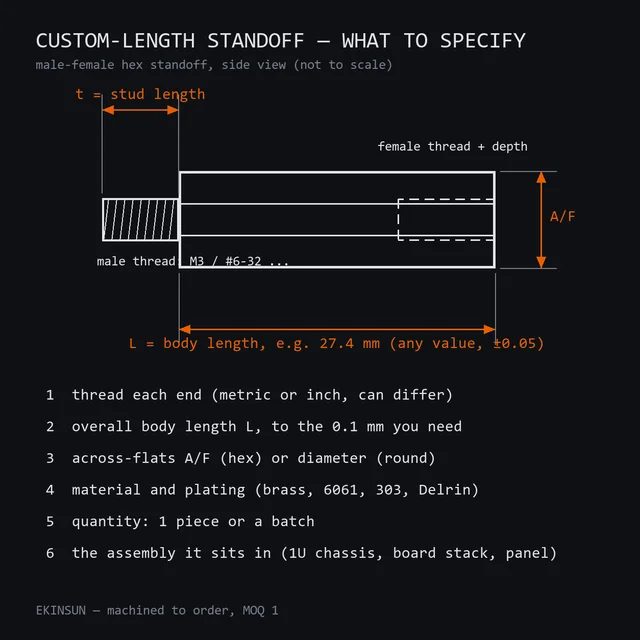
The six numbers that make a standoff quotable
A standoff is a simple turned part, so an enquiry needs little — but it needs these six things, because each one changes the part:
| # | What to give | Why it matters |
|---|---|---|
| 1 | Thread on each end — M3, M4, #6-32, #4-40 — and whether each end is male (stud) or female (bore), with stud length or bore depth | Ends can differ. A female bore needs about 1.5 × thread diameter of depth in aluminium, 1 × in brass or steel, to carry full screw torque |
| 2 | Overall body length, to the 0.1 mm | This is the number no catalogue has. We hold it to ±0.05 mm so every board in the rack sits flat |
| 3 | Across-flats for hex, or diameter for round | Hex gives a spanner grip; 5 or 5.5 mm A/F for M3, 7 mm for M4, 1/4" for #6-32 are the common sizes. Round fits where flats would foul a trace |
| 4 | Material and finish | Nickel-plated brass for a ground path; 6061 aluminium for weight (anodised faces insulate); 303 stainless for washdown; Delrin or nylon to isolate |
| 5 | Quantity — and whether it will repeat | One piece is fine. The quote at 1, 10 and 100 shows where the set-up cost stops mattering |
| 6 | The assembly — 1U chassis, board stack, panel offset | Lets us flag a shoulder, a longer stud or a stepped body before you find out on the bench |
Need standoffs in the length your enclosure needs in a size, thread or material no catalogue lists? EKINSUN is a custom parts manufacturer: we make standoffs in the length your enclosure needs to your drawing, sketch or sample — 6061 aluminium, brass or 304 stainless steel — from 1 piece, quoted in 12 hours and shipped duties paid. If the size is standard, ask anyway — it may be in stock, and the unit price drops as the quantity rises. How ordering without CAD works →
Rack heights, and where the standoff height comes from
The panel heights below are the EIA-310 figures we machine front panels and rack ears to; the usable inside height is what is left after the enclosure's top and bottom skins. Standoff height is then that space minus board thickness minus the tallest component's clearance — which is why it is almost never a round number.
| Format | Panel height (EIA-310) | Typical inside height with 1.5 mm skins | Where the standoff usually lands |
|---|---|---|---|
| 1U | 43.7 mm | about 40 mm | 6–12 mm under a board, custom under a mezzanine card |
| 2U | 88.1 mm | about 85 mm | 10–35 mm; stacked boards need matched pairs |
| 3U / 4U | 132.6 / 177.0 mm | about 130 / 174 mm | up to 100 mm pillars between decks |
| Motherboard on a tray | ATX specifies a 0.25" (6.35 mm) standoff height under the board | Buy the catalogue #6-32 standoff for a standard tray; ours is for trays and boards that are not standard. Standard parts: ask us too — we may have them in stock. | |
Materials — what a rack standoff should be, honestly
| Material | Use it when | Watch out for |
|---|---|---|
| Brass CW614N, nickel-plated | The standoff is part of the ground path; the default for electronics | Heaviest option — 8.5 g/cm³ |
| 6061-T6 aluminium | Weight matters, or the enclosure is aluminium anyway | Anodised surface insulates — specify bare faces or chromate conversion for ground continuity |
| 303 / 304 stainless | Washdown, outdoor or marine racks | Stainless screw into stainless standoff can gall — use 303 or a plated screw |
| Delrin (POM) / nylon 66 | The board must be isolated from the chassis | Nylon grows slightly when damp; Delrin is the stabler choice |
| PEEK | Isolation plus heat, above 100 °C | Costly — and catalogue PEEK standoffs exist; buy those if the size is listed |
| 7075-T6 aluminium | Almost never — 6061 does the job in a standoff | Poor corrosion resistance unless anodised; listed so the honest answer is on the page |
Buy it, or have it made — the honest split
Catalogue here means the electronics and fastener stockists a buyer would try first, and should — or ask us, we may have the part in stock.
| Situation | In the catalogue? | EKINSUN |
|---|---|---|
| Standard #6-32 × 6.35 mm motherboard standoff, M3 × 10 hex pillar | Buy it there — pence each, next day | Not worth machining |
| Length between catalogue steps, in metal, one to a few hundred pieces | Fixed steps; some stockists cut nylon to length, but with a 100-piece minimum | Any length from 1 piece, ±0.05 mm |
| M3 one end, #6-32 the other; stud longer than standard; shoulder or step | Rarely listed, special-feature surcharges, minimums | Quoted as one part |
| Metal standoff over 60 mm | M3 hex ranges stop around 60 mm; longer is mostly nylon | Turned from bar to about 250 mm, stepped for stiffness |
| Busbar or switchgear insulator standoffs, kV-rated | A moulded, rated product — buy from a switchgear supplier | We do not make these |
If a catalogue standoff fits, buy the catalogue standoff. We are for the one that does not exist — and we say so on the quote if we think you can buy it.
Quantity, lead time and delivery to the UK
The first piece pays for set-up; pieces two to ten pay almost only for bar and machine time; past a hundred the unit price is nearly flat. Every quote comes back at more than one quantity so you can see that curve for your own part.
| Quantity | Production | Shipping and paperwork |
|---|---|---|
| 1 to a few dozen | 5 working days (rush 3 working days, +30–50 %) | 5–7 working days by DHL or FedEx. UK buyers: DDP with duty and VAT paid on request, GBP quotation and invoice, so the delivered price is the price |
| 50–500 | 15 working days | |
| 500+ | 15–25 working days |
How to order
Send the six numbers above in an email, or a photo of the old standoff with a ruler in frame, or a drawing if you have one. We redraw simple turned parts and send the drawing back for approval before cutting — no CAD needed on your side. The generic custom standoff page covers every configuration and material; plain spacers and spacers and bushings from a sketch go through the same intake. If the whole housing is the problem, see custom enclosures and heatsink enclosures.
Will it fit? Standoff thread checks before you order
M3 and #4-40 look alike and are not: #4-40 is 2.85 mm at 40 TPI (0.635 mm pitch), M3 is 3 mm at 0.5 mm pitch, and an M3 screw will not enter a #4-40 standoff. #6-32 (3.5 mm, 0.794 mm pitch) against M3.5×0.6 starts and binds. A rack chassis from a US maker is usually #4-40 and #6-32, a European one M3 and M4, and a board designed for one on a chassis built for the other is exactly the standoff the catalogue does not list: one thread at each end. Check the chassis holes with a known screw before ordering.
What do I need to stand a board 12.7 mm off a 1U chassis floor?
A male-female standoff 12.7 mm long, the male end in the chassis thread and the female end in the board's — M3 both ends, or #4-40 into M3 if the two do not match — hex 5.5 mm across flats, in brass or aluminium, and enough height left under the 43.7 mm panel for the tallest component. Six numbers, no drawing.
Same standoff, but M3 to #6-32, 316, or 15.2 mm long
A different thread at each end, stainless for a ground path, a length to the 0.1 mm the catalogue skips, a round body instead of hex, or 200 of them for a production run — each is a variant of the same drawing, one piece and up, quoted in 12 hours.
Where the standoff is female at both ends and the enclosure needs stainless, the 304 stainless coupling nuts page covers M2 to M6 hex bodies at 10 to 100 mm in the same way.
Frequently asked questions
Yes — that is the whole job. Give the length to the 0.1 mm your chassis needs, 27.4 mm or 61.5 mm or anything else, and we turn it from bar and hold ±0.05 mm across the batch. There is no catalogue step to round to and no minimum beyond one piece.
Yes. An imperial chassis meeting a metric board, or a legacy backplane meeting a new card, is the most common reason a rack standoff has to be made rather than bought. Tell us the thread and depth for each end; it is quoted as one part.
One piece is a normal order. One to a few dozen ship in 5 working days (3 with a rush charge); 50 to 500 in 15 working days; over 500 in 15 to 25. Shipping to the UK, EU and US takes 5 to 7 working days by DHL or FedEx, with DDP — duty and VAT paid — and GBP invoicing on request.
No. Anodising is an insulating oxide layer, so an anodised aluminium standoff will not bond a board to the chassis. Specify bare or chromate-conversion faces, or use nickel-plated brass, where the standoff is part of the ground path; use Delrin or nylon where it must isolate.
For a standoff, yes — it is a simple turned part. Send a clear photo with a ruler in frame and three numbers: thread size, overall length, and across-flats or diameter. We redraw it, send the drawing for your approval, and machine to it. Post the old part only if the thread is unusual.
More per piece, always — a catalogue standoff is pence and ours carries set-up. That is why we say plainly: if a catalogue length fits, buy it. Ours pays when the alternative is shimming with washers, re-drilling a chassis, or a board that sits at an angle; ask for the quote at 1, 10 and 100 pieces to see where the curve flattens.
Send the six numbers
Thread each end, body length, across-flats, material, quantity, and what it sits in. A photo of the old standoff with a ruler beats no CAD. One piece minimum, quote within 12 hours.