// Replacement Parts · Lock & Safety Pins · Ø5–Ø40 mm · Retaining Chain 2–8 mm
Lock Pins With a Retaining Chain — the Pin Is Not Worn Out, It Is Gone
A lock pin is the headed pin you pull out by hand to open a guard, drop a tailgate or split a linkage — held in by a split pin, an R-clip, a lynch ring or a ball detent, and kept from being lost by a chain. We make them to the size your hole is, ø5 to ø40 mm, with the clip and chain fitted, from one piece. Remaking one takes three numbers: shank diameter, grip length, and where the cross hole sits.
This page covers the pins a machine is meant to be opened with: clevis and hitch pins, lynch pins, ring-head lock pins, R-clips and ball-lock quick-release pins. EKINSUN is a custom parts manufacturer — we turn these in the diameter your hole is, fit the clip and the retaining chain, and tool up when the quantity justifies it. Pressed-in locating and dowel pins are a different job and have their own page.
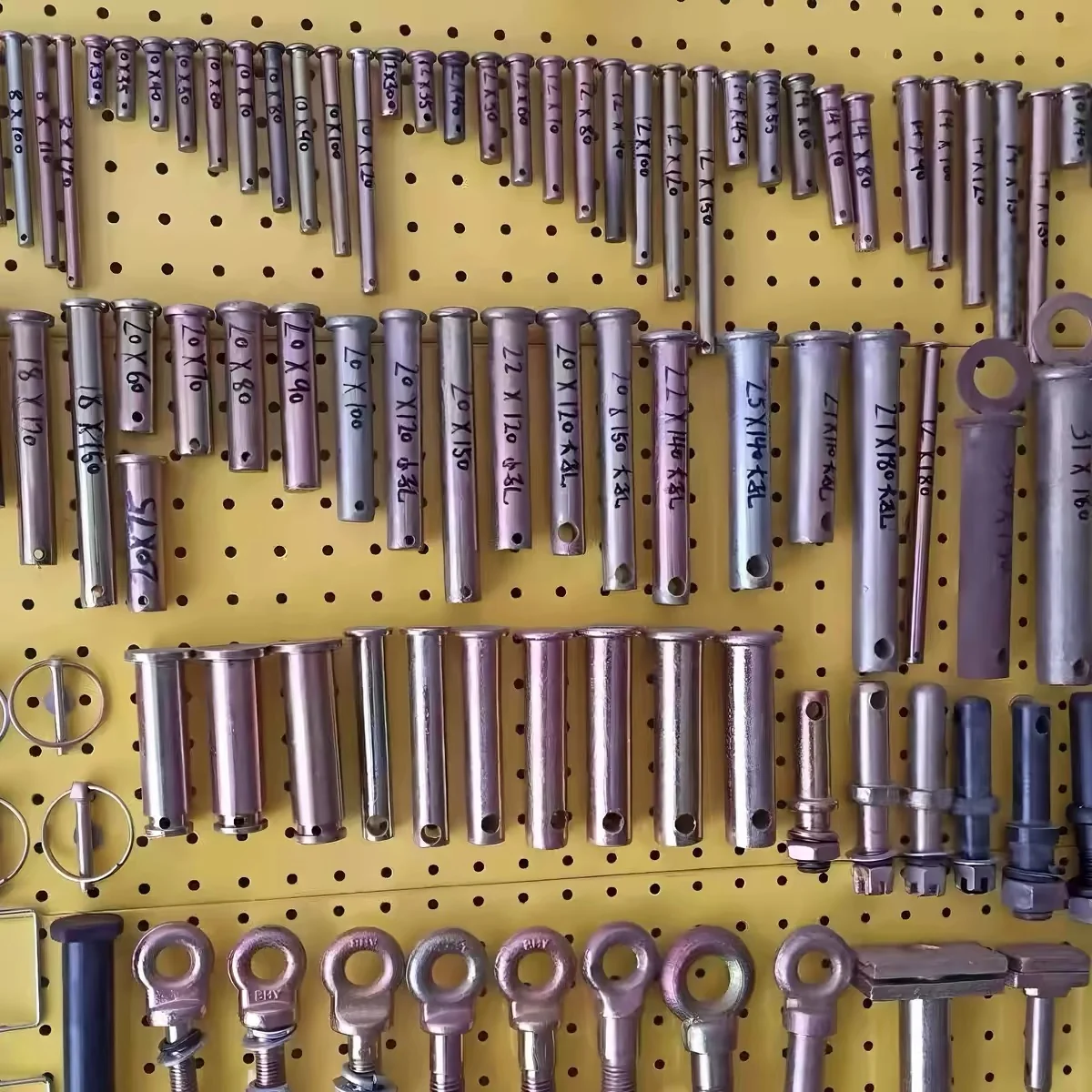
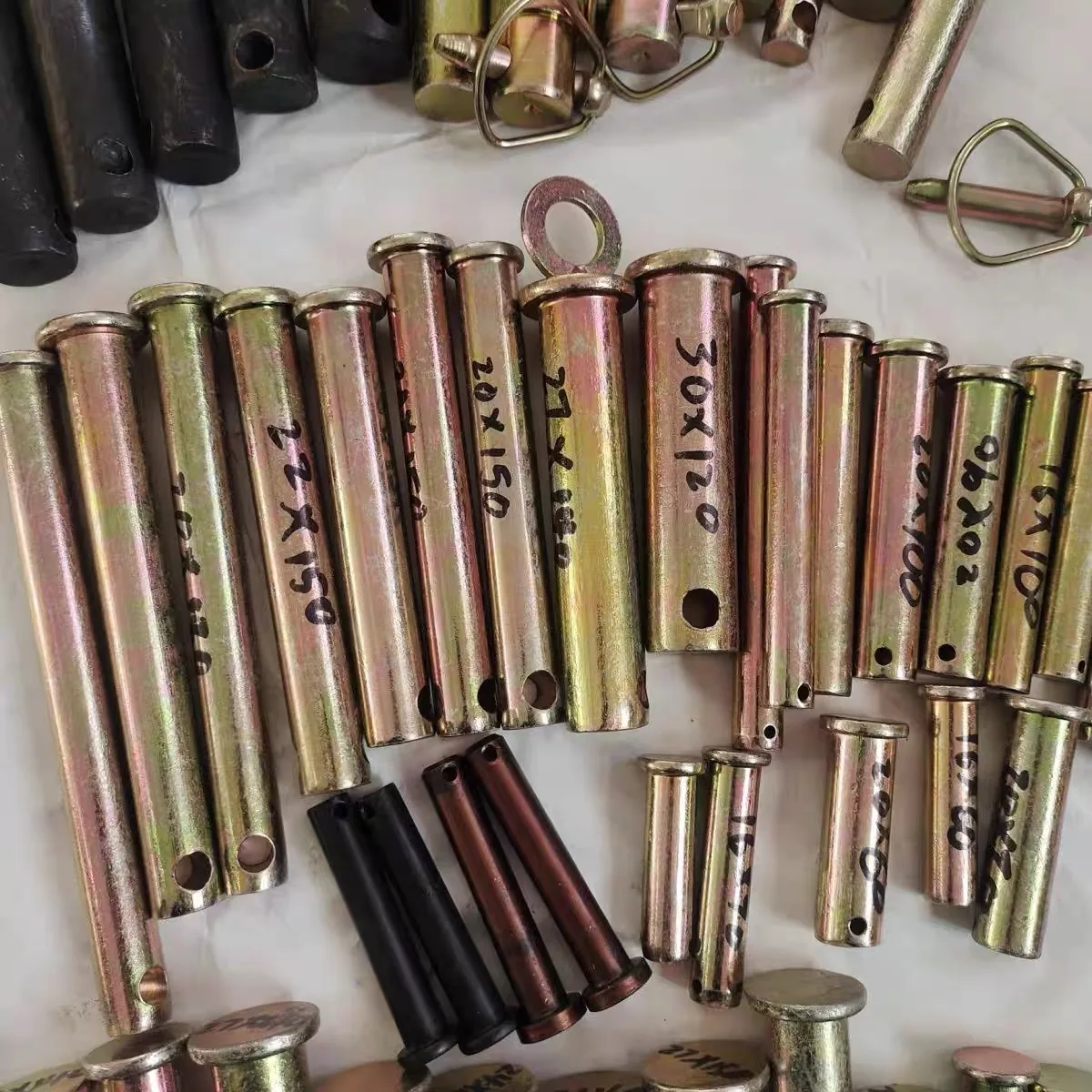
Sample board from the pin line, every piece marked: 8 × 100 through 30 × 120 mm, including the in-between diameters — ø14, ø18, ø22, ø27 — that catalogues skip, plus lynch pins and forged eye bolts along the bottom. An odd size costs what a standard one costs: both start as a bar diameter and a length.
First, which pin is on your machine
Catalogues use the same five words for about nine parts, and French, German and English parts lists each pick a different one. The table names them as they are sold — or send a row number and skip the vocabulary.
Locking and safety pins by what they look like, with the German and French terms buyers search for
What you are holding
What it is called, and to which standard
What retains it
Off by hand?
Headed pin, cross hole at the far end, a bent cotter through it searched as “pin with a split pin through the end”
Clevis pin · Bolzen mit Kopf · Axe de chape ISO 2341 form B, DIN 1444 B
Split pin, ISO 1234 / DIN 94
No — pliers, and the cotter is scrap after
The same pin with a sprung wire clip round the shank searched as “pin with a spring clip”
Clevis pin with R-clip · Steckbolzen mit Federstecker · Axe avec goupille bêta Pin ISO 2341, clip DIN 11024
Spring cotter round the shank
Yes
Headed pin with a wire ring hinged over its own head searched as “pin with a ring that flips over”
Need lock pins with a retaining chain in a size, thread or material no catalogue lists? EKINSUN is a custom parts manufacturer: we make lock pins with a retaining chain to your drawing, sketch or sample — steel, 304 or 316L stainless steel — from 1 piece, quoted in 12 hours and shipped duties paid. Standard sizes can often be supplied from stock; the more pieces, the lower the unit price. Custom replacement parts →
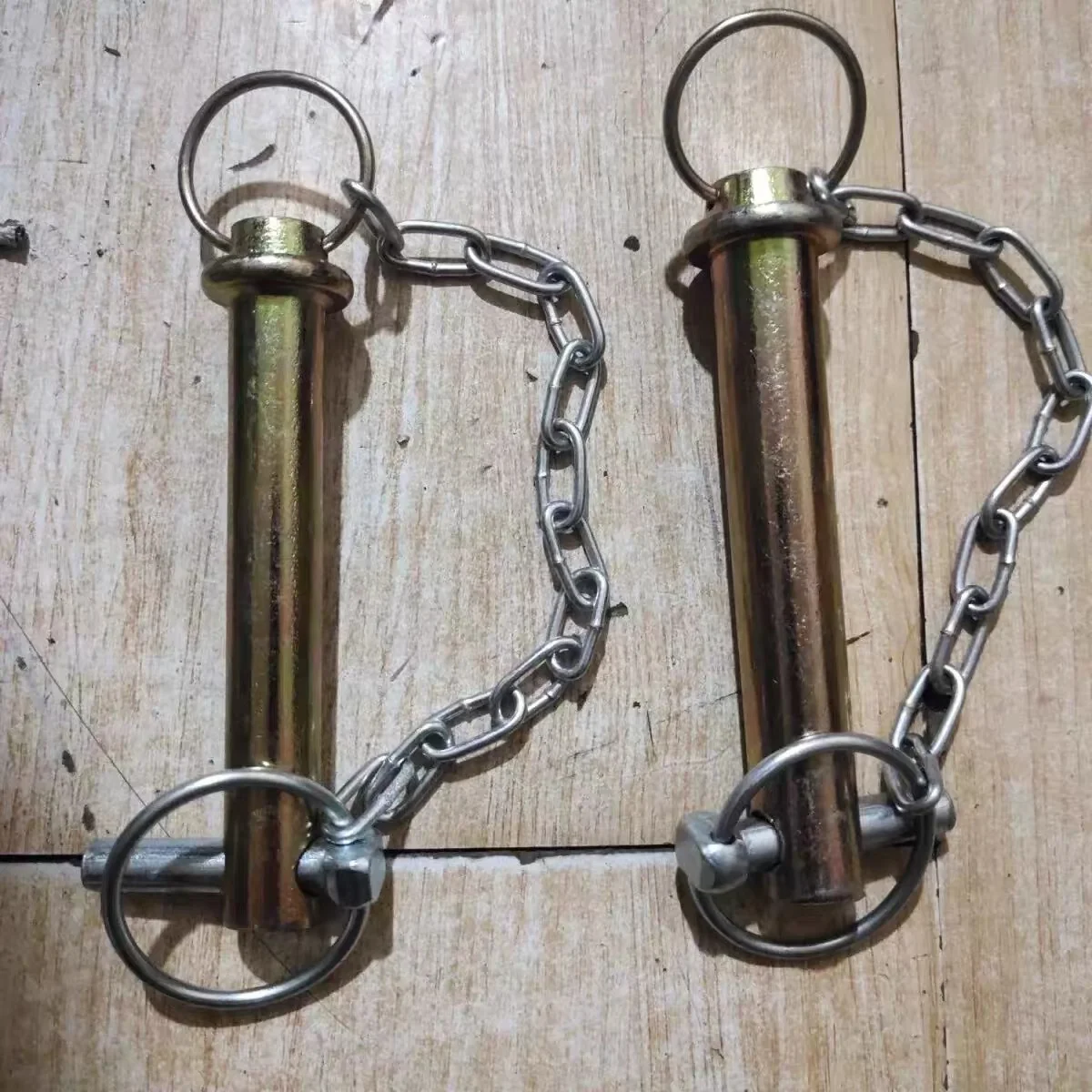
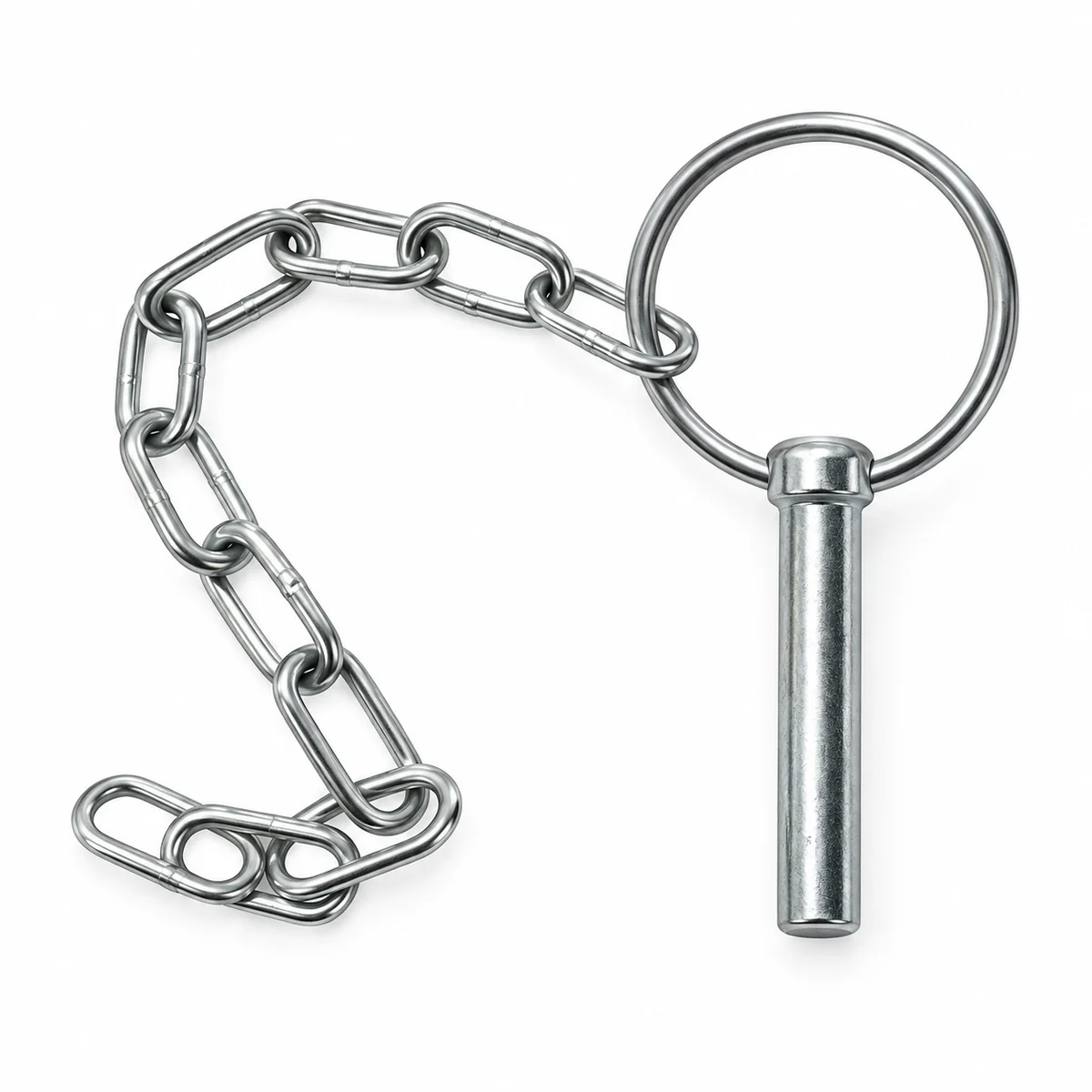
The complete part as it leaves us: pin, pull ring at the head, linch pin through the cross hole, and a chain joining the two so neither half can be put down and lost. The chain is 3 mm wire on a ø20 pin — light enough to give way before it drags the pin out.
What the retaining chain is worth
The chain looks like the least important thing on the part. It is the reason the part is still on the machine in two years. Six things it buys you, in the order they matter:
It stops the wrong pin going in. When the clip is gone nobody stops work — a bolt or a bent screwdriver goes through the hole. An unhardened M10 bolt in a ø10 clevis hole has neither the shear strength nor the fit, and that is what breaks something.
It keeps the pin at the joint it fits. Pins in a toolbox get mixed up, and a ø19 pin in a ø20 hole rattles, wears the lug oval and doubles the repair bill.
It makes the pre-use check possible. A chained pin is either in the hole or hanging beside it, and both are visible from three metres away — which is what a walk-round inspection is.
It removes the dropped object. Where a joint sits above people — racking beams, gantries, guardrails, tail lifts — a loose pin is a falling object. ANSI/ISEA 121-2018 covers that for tethered tools; a chained pin applies the same idea.
It speeds up the operation it exists for. A tailgate or quick coupler opened twenty times a shift works faster when the pin hangs at the hole, not in a pocket.
It costs a fraction of the pin. A short length of chain and a welded ring are cents against a ø20 turned pin, or an hour of downtime.
The boundary, plainly: a chain is an anti-loss device. It is not the retention — the R-clip, lynch ring or ball detent holds the pin in the hole, and a chain with slack cannot. Nor is it a lifting or towing component: DIN 5685 chain is supplied untested and the standard sets no working load limit.
Two details decide whether the chain helps or annoys. Length: long enough to reach the hole from its anchor, short enough that it cannot reach anything that turns — our default is reach plus about 40 mm. Anchor: the fixed frame, never the part that swings, or it swings every cycle and fails at the weld.
Ring-head form: the ring is handle and chain anchor in one, so the head stays flat against the lug with nothing sticking out to catch. The free end finishes in an open link or split ring, sized to match the eye you anchor to.
Chain sizes — wire diameter, and which pin it belongs on
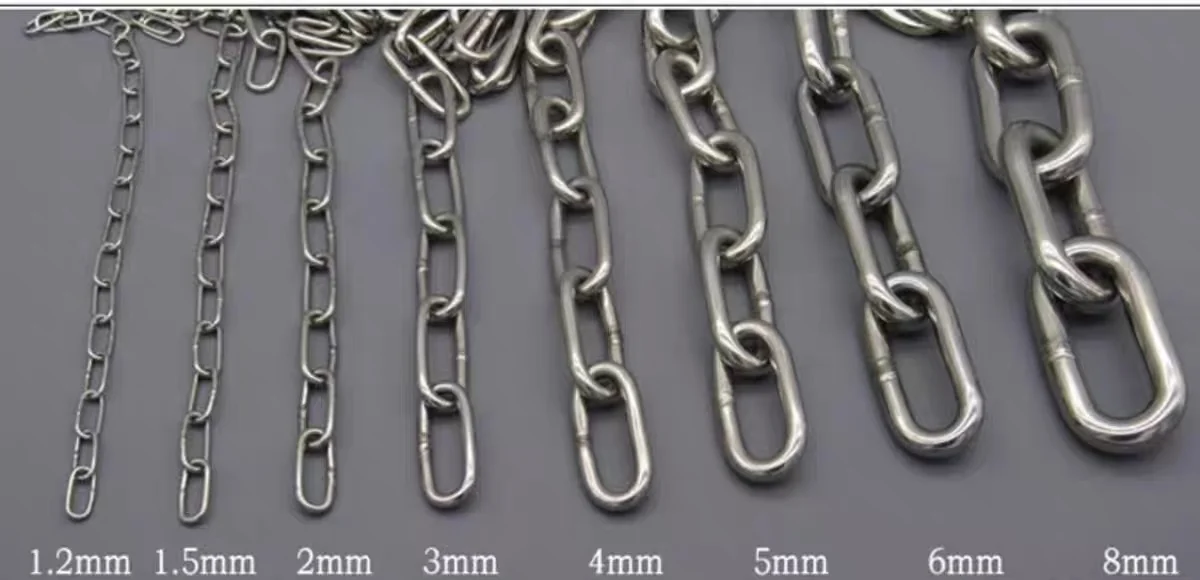
That one number sets the pitch, the inside width and the weight. Short-link round steel chain to DIN 5685 form C is the usual choice, and the same wire sizes exist in stainless. The last column is our pairing rule, not a standard: chain wire ø of roughly 0.2 to 0.3 times the pin ø, never below 2 mm, so the chain stays lighter than the pin and gives way first if it snags.
Chain is bought by the diameter of the wire it is bent from, and the jump is easy to under-estimate: 8 mm wire is four times the wire of 2 mm chain but eighteen times the weight per metre.
Retaining chain, DIN 5685-C short link — dimensions per wire diameter, and the pin size it suits
Wire ø d (mm)
Pitch t (mm)
Inside width b (mm)
Calculated static load (kg)
We fit it to
2
22
3.5
20
Ø5–Ø8 pins, guards and covers
2.5
24
4.5
30
Ø8–Ø10 pins
3
26
5.5
40
Ø6–Ø14 pins — the most common size we fit
3.5
28
6
60
Ø12–Ø16 pins
4
32
7
80
Ø16–Ø20 pins, trailer and hitch work
5
35
9
125
Ø20–Ø25 pins
6
42
11
160
Ø25–Ø32 pins, three-point linkage
8
52
14
320
Ø32–Ø40 pins and anything that gets stood on
Published DIN 5685-C figures from a German chain supplier, checked 2026-09-10; weight runs 0.06 kg/m at 2 mm wire to 1.10 kg/m at 8 mm. The load column is not a working load limit — DIN 5685 chain is delivered untested and the standard defines no WLL. Finer chains exist (1.2 and 1.5 mm link and ball chain) and we fit them, but on light covers rather than load-carrying pins.
Chain is not the only lanyard. Stainless wire rope suits places where a chain would rattle or mark paintwork, but kinks if trodden on; ball chain is for light covers; coiled cable keeps slack off the ground.
The end fitting decides how the lanyard comes off: a welded link is permanent, a split ring semi-permanent, and a spring snap hook lets the pin be unclipped and put back — useful on shared tooling, a liability where anyone can walk off with it.
Clip sizes that match the pin
R-clips are sized by the hole they pass through — the number on the box is not the pin diameter, which is why so many are ordered wrong. Lynch pins go by the shank.
R-clip / spring cotter, DIN 11024 form D — hole size, the shank it suits, and wire
Hole ø d1 (mm, H13)
Suits a pin shank of (mm)
Clip wire ø (mm)
Overall length (mm)
2.5
9–11.2
2.25
42
3.2
11.2–14
2.8
48
4
14–20
3.6
64
5
20–26
4.5
80
6.3
26–34
5.6
97
7
34–45
6.3
125
8
45–56
7
150
Lynch pin, DIN 11023 — the four sizes that exist as stock
Pin ø d (mm)
Ring reach c (mm)
Ring wire f (mm)
Length L (mm)
4.5
34
3
42
6
41
3.4
42
8
41
3.4
42
10
41
3.4
42
Clevis pin heads and cross holes, ISO 2341 — the twelve diameters that exist as standard
Pin ø d (mm, h11)
Head ø (mm)
Split-pin hole (mm)
4
6
1
5
8
1.2
6
10
1.6
8
14
2
10
18
3.2
12
20
3.2
14
22
4
16
25
4
18
28
5
20
30
5
22
33
5
24
36
6.3
R-clip outside width: 20 mm on sizes 2.5–4, 25 mm on 5 and 6.3, 30 mm on 7 and 8. DIN 11023 lynch pins suit shafts to ø32 mm; above that the retention moves to an R-clip or ball detent. Nothing standard sits between the ISO 2341 steps — ø13, ø17, ø19, ø21 and ø27 are machined only.
The three numbers — measured off the machine, not off the old pin
A missing pin leaves nothing to copy; a surviving one is worn. Either way: measure the joint.
Shank diameter. Measure the lug hole with the inside jaws of a caliper, in two directions. If the readings differ by more than a few tenths the hole has gone oval: make the pin to the smaller one and ream or bush the lug — a fatter pin in an oval hole accelerates the wear.
Grip length. Outside face of one lug to the other, plus any washers — it decides where the cross hole goes, and catalogue pins most often get it wrong.
Hole position. Just clear of the outer face, typically 2 to 4 mm past it. Too close and the clip fouls the lug; too far and the pin slides before the clip catches, which beats holes oval.
If a worn pin is in your hand: measure the section that never turned in the hole — under the head, or the nose. The polished middle is the wrong place.
What to send: those three numbers, the clip (split pin, R-clip, lynch ring, ball detent), the chain reach or none, material or just where the machine lives, and quantity — from 1 piece, and say if it is hundreds a year so we can price the tooled route too. A phone photo with a rule across the part is enough; no CAD needed, and posting the old pin works.
Quote within 12 hours. The drawing we rebuild comes back to you for confirmation before anything is cut, and a small batch typically leaves in 5 working days.
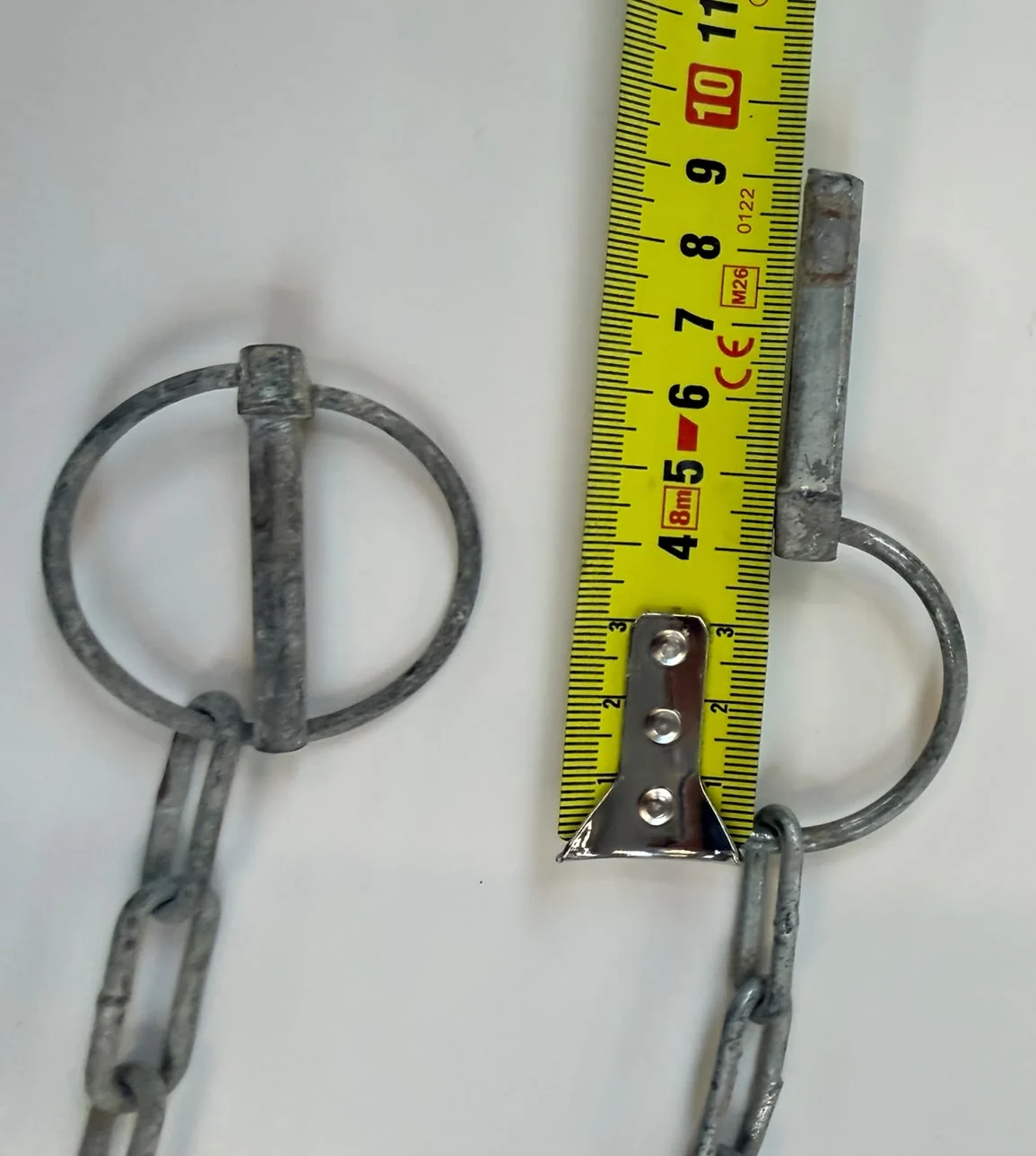
How these jobs arrive: the old pins and a rule in one frame, no drawing and no part number. The rule settles the lengths; shank and chain wire diameters want a caliper.
The pin in the photograph, measured — and where it leaves the standard
Feature
This pin
DIN 11023 lynch pin, size 6
Shank diameter
6 mm
6 mm — one of the four stock sizes
Shank length
50 mm
42 mm — the standard has one length, and it is not this one
Ring outside diameter
50 mm
The standard dimensions the ring differently, so there is nothing to compare
Ring wire diameter
3 mm
3.4 mm
Chain
250 mm long, 3 mm wire
Not part of the standard at all
Eight millimetres of shank is the whole reason that pin was made rather than bought. Its chain is heavier than the ratio alone would give: below about ø10 the ratio falls under the 2 mm floor, and the choice moves to what survives handling.
Where the catalogue stops and we start
Standard pins are cheap, and we say so. Below is what buyers bring after the shelf says no.
What you need, what the shelf holds, what has to be made
What you need
On the shelf?
What we do
Ø8–Ø24 clevis pin, a catalogue grip length, zinc plated
Yes — stocked
Buy it from stock. On a standard pin in a standard length no one-off competes on price, and our quote will say so. Standard parts: ask us too — we may have them in stock.
Lynch pin ø6, ø8 or ø10; R-clip 3.2 to 6.3 mm
Yes
Buy those from stock too — or let us supply them fitted to the pins, which is usually why people ask. Standard parts: ask us too — we may have them in stock.
A pin with the chain already on it, at a length that suits your bracket
Rarely
Chain welded or split-ringed to the head, cut to your reach plus slack, clip fitted, the whole assembly delivered as one part number.
Ø13, ø17, ø19, ø21, ø27 — a diameter between the ISO 2341 steps
No
Turned to the hole you measured, h11 or closer, cross hole drilled where your clip needs it.
A grip length between catalogue steps, or a long pin
No
Cut to length with the cross hole positioned from the grip, not from a standard table.
316 / A4 stainless in a size only sold in zinc-plated steel
No
Same pin turned from 1.4404 bar, with a stainless chain and clip so nothing sacrifices itself to the pin.
A ring head, eye head, T-handle or square head in your diameter
No
Machined from solid, or a ring welded and dressed before plating — the geometry your bracket needs, not the one the OEM happened to forge.
A hardened pin because the lugs are eating soft ones
No
Case-hardened 20MnCr5 or through-hardened 42CrMo4, ground after heat treatment where the fit demands it.
An imperial pin with a metric clip hole, or the reverse
No
Turned to the inch diameter with whatever cross hole your clip is.
Five hundred a year of your own design, with your part number on the head
No
Tooled up — see the tooling section below — and marked with your number.
The same part in three finishes — yellow zinc, clear zinc and black oxide — with marked sizes running past ø27 × 180. Finish follows the environment, not the drawing: yellow zinc for outdoor duty, black oxide where plating build-up would spoil a close fit, stainless where salt is involved.
Material, hardness and finish
A lock pin fails in shear, in bearing against the lug, or by corroding into the hole — the material choice is about which you are fighting.
Materials for lock and safety pins, and when each earns its place
Material
Finish we normally pair with it
Use it when
C45 / 1.0503 carbon steel
Yellow or clear zinc; hot-dip for outdoor steelwork
The default. Trailer, agricultural, guard and linkage pins where the load is moderate and the pin is cheap to replace.
42CrMo4 / 1.7225, quenched and tempered
Zinc or plain oiled
The lugs are eating soft pins, or the joint is loaded and you want the pin to be the hard part.
Case-hardened 20MnCr5 / 16MnCr5
Zinc, or black oxide where the surface must not build up
The pin turns in the hole every cycle — a hard skin over a tough core outlasts a through-hardened pin in bending.
Stainless 304 / 1.4301 (A2)
Passivated, no plating
Outdoor and washdown work with moderate load. Pair with a stainless chain and clip.
Stainless 316 / 1.4404 (A4)
Passivated
Marine, coastal and chemical exposure. Watch for galling if the pin turns in a stainless lug — a bronze bush or a different grade on one side solves it.
Mixed metals in one assembly
Avoid
A zinc-plated chain on a stainless pin in salt air sacrifices the chain within a season. Chain, clip, ring and pin should be the same family.
Diameter, not material, does most of the work in shear. For scale, published double-shear figures for a hardened stainless ball-lock pin:
Double shear, calculated, for a hardened stainless pin shank
Shank ø (mm)
Double shear
Ø5
24 kN
Ø6
35 kN
Ø8
63 kN
Ø10
100 kN
Ø12
144 kN
Ø16
257 kN
Ø20
403 kN
Ø25
631 kN
GN 113.10 ball lock pins in AISI 630, calculated to DIN 50141 — a reference for how capacity climbs with diameter, not a rating for any pin we supply. Doubling the diameter multiplies shear area by four. Where a joint is safety-relevant we ask what load it sees first.
One piece, five hundred, or a tool of your own
Volume changes the process; we would rather name yours than quote a tool nobody needs.
1 to about 50 pieces — turned from bar, no tooling. Pin turned, head formed or welded, cross hole drilled, part plated, clip and chain fitted by hand. This is why one piece is a normal order, and why a ø19 costs what a ø20 costs.
50 to a few hundred — still machined, batched. Same route, setup spread across the batch; clips, rings and end links bent on simple formers rather than tooled.
Recurring hundreds to thousands — tooling pays. A cold-heading or forging die for the head, a stamping or wire-form die for the clip and ring, a welding jig for the chain end. Unit price drops, the head shape becomes exactly repeatable, and your part number can be marked as the head is formed. We keep the tool for repeat orders.
To quote a tool: a drawing or sample, the annual quantity and call-off pattern, material, finish and any marking. You get tooling cost and piece price side by side — including the case where machining the whole annual quantity beats the tool.
Remaking the pin that is no longer sold
Most of these orders start with an obsolete machine: the pin came with a trailer, a press or an implement whose maker has gone, and the part number returns nothing. We rebuild the drawing from the broken pin, from a photograph with a rule in it, or from the hole itself, and we copy the geometry the machine needs rather than the process the original happened to use — a forged ring head becomes a machined or welded one, and the joint cannot tell the difference. Where the lugs are worse than the pin, say so: the repair is often a larger pin with the lugs bushed back to size. A recent one-off, a ø22 × 165 mm eye-head pin in C45, is written up here.
Nothing is left to measure but the pieces, and the drawing has to be rebuilt first.
Frequently asked questions
A hitch pin or lock pin with a retaining chain. If the ring is hinged over the head rather than upright it is a linch pin, spelled lynch pin about as often and the same part either way (DIN 11023); if a sprung wire clip goes round the shank it is an R-clip or beta pin (DIN 11024); if the cotter must be bent open with pliers it is a clevis pin with a split pin (ISO 2341 with ISO 1234). They come off trailer tailgates, three-point linkages, quick couplers, log splitters, mower decks, scaffold and pallet racking. Send a photo with a rule across it and we will name it.
It stops the pin and its clip being lost, and that is all it is for. The clip is the cheapest part of the joint and the one that ends up in the gravel, so the next person puts a bolt or screwdriver through the hole — that substitution is what hurts. A chain keeps the right pin at the joint it belongs to, makes it visible at a pre-use check, and above people stops a loose pin becoming a dropped object. What it does not do is retain the pin — the R-clip, lynch ring or ball detent does.
Our rule is chain wire Ø of roughly 0.2 to 0.3 times the pin Ø, with a floor of 2 mm because a lighter link opens by hand. That is 2 to 3 mm wire on Ø5–Ø10 pins, 3 mm on Ø10–Ø14, 4 mm on Ø16–Ø20, 5 mm on Ø20–Ø25, 6 mm on Ø25–Ø32 and 8 mm above. The chain is meant to be the weak link — if it snags, it should give before the pin is dragged out.
No. A chain has slack by definition, so it cannot stop a pin walking out of a hole under vibration — only from walking away. The retention is the split pin, R-clip, lynch ring or ball detent. Round-steel chain to DIN 5685 is also supplied untested and the standard sets no working load limit, so it is not a lifting, towing or fall-arrest component either.
A split pin (ISO 1234, DIN 94) is a soft cotter pushed through the cross hole and bent open with pliers — a one-use part. An R-clip or spring cotter (DIN 11024) snaps round the shank and comes off by hand, and is sized by the hole it passes through, not by the pin. A linch pin — the same part whether a catalogue spells it linch pin or lynch pin (DIN 11023) — has its own sprung ring hinged over its head, so pin and retention are one part — stock sizes Ø4.5, 6, 8 and 10 mm.
Yes. Measure the joint, not the missing pin. Three numbers do it: the hole diameter in the two lugs, the gap the pin has to bridge (the grip length), and where the cross hole sits — just clear of the outside face, usually 2 to 4 mm past it. No CAD is needed; a phone photo with a caliper or rule across the joint is enough, and we send a dimensioned drawing back for approval before anything is cut.
Yes, and that is most of this work. Clevis pins to ISO 2341 exist in Ø4, 5, 6, 8, 10, 12, 14, 16, 18, 20, 22 and 24 mm, so a worn Ø13, Ø17, Ø19, Ø21 or Ø27 hole has nothing on any shelf. We turn the pin to the hole you measured, drill the cross hole where your clip needs it, and fit the chain and clip. One piece is a normal order.
Both. Up to a few hundred pieces the pins are turned from bar with no tooling, which is why one piece is possible. Above that, tooling pays: a cold-heading or forging die for the head, a wire-form or stamping die for the clip and ring, a jig for the chain. Send a drawing or sample plus the annual quantity and we quote tool and piece price together.
EKINSUN is a custom parts manufacturer that machines clevis, lynch, hitch and ring-head lock pins from Ø5 to Ø40 mm in C45, 42CrMo4, case-hardened 20MnCr5, 304 / 1.4301 and 316 / 1.4404, fits R-clips, lynch rings and DIN 5685 retaining chain from 2 to 8 mm wire, and tools up for volume when the quantity justifies it. One piece minimum, no CAD needed — a photo with a rule works — quote within 12 hours.
Send the joint, not the part number
Hole diameter, grip length, where the cross hole sits — plus which clip and whether you want a chain. A phone photo with a rule across it is enough, and posting the old pin works too. One piece minimum, quote within 12 hours.