EKINSUN LTD is a custom parts manufacturer, and "phone case mold" means three different projects depending on a number you already know: how many you need. This page prices the three — including the third route, which is not us. And two clarifications up front: a case for your own phone is a retail purchase, and hobby resin molds are craft-store territory — this page is for your design going into production, or a device whose cases vanished from the market.
The Three Routes, by Quantity
| Quantity | The tooling | The honest economics |
|---|---|---|
| 10–100 pcs | No steel mold. One CNC-machined master → silicone molds, roughly 20 casts each → vacuum-cast cases in rigid or rubber-like PU shore grades | Tooling cost = the master + cheap silicone; 50 cases just means three molds from the same master. Mold life details: mold life & quantity |
| 1,000–50,000 pcs | Single-cavity aluminium injection tool (6061/7075), molding TPU, PC, ABS or PC/ABS | The brand-production sweet spot. Run your geometry through the injection molding cost calculator for a live number before you even email us |
| 100,000+ pcs | Multi-cavity hardened steel, hot runners, texture libraries | Commodity case factories win here —. Their tooling libraries and cavity counts beat any one-off toolmaker, including us |
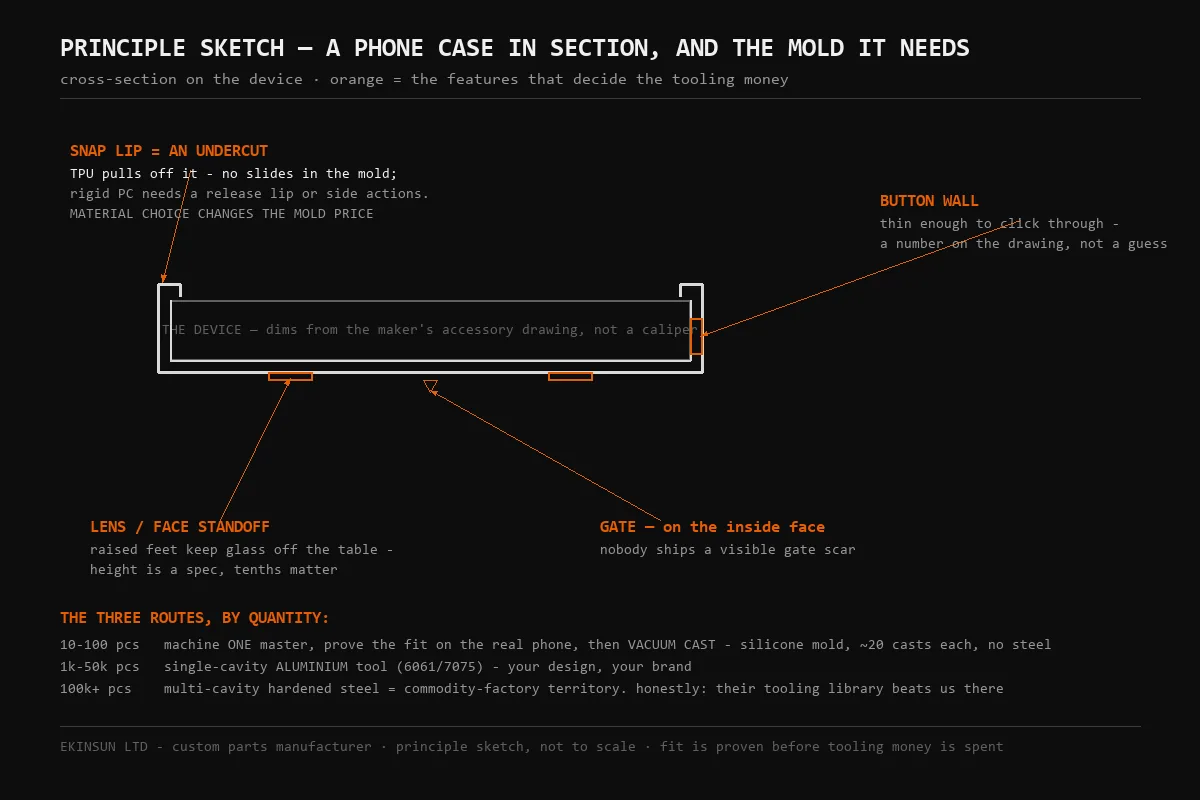
The Undercut That Prices Your Mold
Every case grips its phone by a snap lip curling over the face — and a snap lip is an undercut, the feature molds hate. Here is the fact that surprises first-time brands: flexible TPU simply stretches and pulls off the undercut, so a TPU case tool needs no slides and stays cheap. Rigid PC cannot stretch; its lip must be engineered to release, or the tool grows side actions — and side actions grow the invoice. A PC-shell-plus-TPU-liner design is two tools, not one. Material choice changes the mold price, which is why we ask about material before quoting steel, and why a "quick change" from TPU to PC late in a project is never quick.
Where the Dimensions Come From
Not from a caliper on a phone. Device makers publish accessory design guidelines — exact body dimensions, corner radii, button and lens keep-outs; Apple's are public documents. The case starts from the official drawing, and the engineering that makes it feel right gets written down, not guessed: button walls thin enough to click through, lens and face standoffs toleranced in tenths so the glass never touches the table, the gate placed on the inside face where no one sees the scar. For devices with no published drawing — see the next section — the device itself is measured and the master carries the proof.
The master goes first, always. One case is CNC machined and fitted on the physical device — buttons, lenses, snap feel — before any mold exists. Approve the fit, then spend tooling money. For casting the master becomes the pattern; for injection it becomes the reference the aluminium is cut to. The expensive step never goes first.
The Quiet Niche: Devices Nobody Serves Anymore
New-brand cases get the attention, but the stronger custom lane is the unglamorous one: fleets of barcode scanners, rugged handhelds and medical devices that outlive their accessories by a decade, and discontinued phones with loyal users the aftermarket abandoned. A warehouse running two hundred aging scanners does not need 100,000 boots — it needs eighty, in a rubber-like shore grade, with the strap bosses where the old ones were. That is a machined master and a stack of silicone molds, which is to say: exactly the small-batch route above, applied to the same obsolete-parts problem this site solves in metal every week.
Materials — Case, Mold and the Clear-Case Caveat
| Material | Where it belongs |
|---|---|
| TPU (thermoplastic polyurethane) | The default case material — grippy, drop-friendly, and it demolds undercuts without slides |
| PC / ABS / PC+ABS | Rigid shells and two-piece designs — stiffer feel, tighter tooling questions |
| PU casting resins | The vacuum-cast route: rigid to rubber-like shore grades that stand in for TPU at 10–100 pcs |
| 6061 / 7075 aluminium | The single-cavity production tool itself — cut fast, polishes well, right up to ~50k shots |
| Hardened stainless tool steel (S136 class) | Only for optically clear cases, mirror-polished — a different animal from the 304/316 on our machined-parts pages, and priced like it |
What to Buy, and What to Have Tooled
| What you need | Stocked? | The honest route |
|---|---|---|
| A case for your own phone | Yes — retail, in every color | Buy it. No custom route beats a $15 case for one phone |
| Hobby resin / silicone craft molds | Yes — craft suppliers | A different hobby, — not what this page tools |
| 100k+ standard cases | Commodity factories, tooling libraries ready | They win on price and we say so — take the design there |
| 10–100 of your own design | No listing can exist — the design is yours | Machined master → fit proven → vacuum cast. From 10 pieces |
| 1k–50k brand production | No — your geometry, your tool | Single-cavity aluminium tool, molded in TPU / PC / ABS |
| Cases for discontinued or industrial devices | No — the aftermarket left | Device measured, master fitted, fleet quantities cast — the obsolete-parts route, in plastic |
| Engineering cases — antenna windows, magnet pockets, lanyard bosses, sensor cutouts | No catalogue anticipates them | Features go on the drawing; the master proves them before the mold does |
"We run about 300 rugged handhelds in our warehouses — the model's been discontinued and the rubber boots are crumbling. Can you make 100 replacements if I send you two devices and one surviving boot?"
That is a complete enquiry, and the fleet-boot case is this page's quiet center of gravity: a machined master fitted to the real device, the surviving boot as the shore-grade reference, and a hundred cast in PU rubber grades — no steel, no minimums drama. The same conversation with a new brand starts from CAD instead of a crumbling original, and lands on the casting-versus-injection decision at exactly the quantity line in the table above. Device-adjacent metalwork — front panels and rack ears, cold plates — lives one shelf over.
How to Order
- Your CAD if it exists — STEP or IGES; a sketch over the device's published drawing also starts the job
- No CAD, no drawing? Post the device (it comes back) — it gets measured and the master carries the proof
- The material intent: TPU-soft, PC-rigid, or cast PU shore grade — it decides the tooling route and price
- Quantity, stated as a range — 20? 500? 5,000? The table above shows why this is the first question. And if the answer is literally one: MOQ 1 is the machined master itself — a single CNC-machined case with no mold at all is a normal order, and it is how every project here starts anyway
- Finish: texture, gloss, logo in the mold or printed after — decided on the drawing, not discovered at delivery
A machined master and its fit-check come before any mold. Quote within 12 hours; casting batches typically ship in 7–15 days after master approval.
Frequently Asked Questions
Split it by quantity, because the answer changes three times. For 10-100 cases there is no steel mold at all: one master is CNC machined and vacuum cast in silicone molds good for roughly 20 casts each — tooling cost is the master plus cheap molds. For roughly 1,000-50,000 cases a single-cavity aluminium injection tool is cut; run your geometry through our injection molding cost calculator for a live number. Above 100,000, multi-cavity hardened-steel tooling at commodity case factories beats any one-off toolmaker — including us, and we say so.
Yes — that is exactly what vacuum casting is for. One master case is machined and test-fitted on the real device, a silicone mold is poured around it, and cases are cast in rigid or rubber-like polyurethane shore grades. A silicone mold is good for roughly 20 casts, so 50 cases simply means three molds from the same master. No steel is cut, and the master is kept for the next batch.
From the maker's published drawings, not from calipers. Device manufacturers publish accessory design guidelines with exact body dimensions, corner radii, and keep-out zones for buttons, lenses and antennas — Apple's are public documents, and the case starts from that drawing. Measuring a phone by hand adds a tolerance nobody needs. The machined master then proves the fit on the physical device before any tooling money is spent.
It changes the mold price, and that surprises people. A case grips the phone by a snap lip, which is an undercut. Flexible TPU simply stretches and pulls off that undercut, so the tool needs no slides. Rigid PC cannot stretch — the lip must be designed to release or the tool needs side actions, and side actions cost money. A PC-plus-TPU two-piece case is two tools, not one, and we say that before you fall in love with the design.
Yes, and it is quietly the strongest custom-case niche there is: fleets of barcode scanners, rugged handhelds and medical devices run for a decade after their accessories vanish, and old phone models keep loyal users nobody serves. With no published drawing, the device itself is measured and a master machined and test-fitted the same way. Small fleet quantities are exactly what the vacuum casting route was built for.
That is the master's job. One case is CNC machined first, you or we fit it on the real device — buttons, lenses, snap feel — and only after that fit is approved does any mold get made. For vacuum casting the approved master becomes the pattern; for injection molding it becomes the reference the aluminium tool is cut to. The expensive step never goes first.
EKINSUN — a custom parts manufacturer covering the machined master, vacuum-cast batches from 10 pieces, and single-cavity aluminium injection tooling for production runs, quote in 12 hours. Honest boundaries: a case for your own phone is a retail purchase, not a project; hobby resin molds are craft-store territory; and six-figure runs of standard cases belong with commodity factories whose tooling libraries we do not pretend to beat.
Get a Quote
CAD, a sketch, or the device itself. Say the quantity — it picks the route. Reply in 12 hours.
// In short
- →10–100 pcs? Master + vacuum cast, no steel
- →1k–50k? Aluminium tool
- →100k+? Commodity factories win —
- →Fit proven before tooling money
- →Quote in 12 hours
or email: [email protected]