Indexing Plunger Sizes M10 × 1 to M20 × 1.5
Four thread sizes cover most indexing plungers: M10 × 1 with a 5 mm pin, M12 × 1.5 with 6 mm, M16 × 1.5 with 8 mm and M20 × 1.5 with 10 mm; two makers’ tables agree on these pairs. EKINSUN LTD is a custom fastener manufacturer that makes plungers outside these sizes and machines the plates, swivels and slides they lock.
| Thread | Pin Ø | Pin projection ≈ | Thread length ≈ | Knob Ø ≈ | Overall length ≈ | Spring force start / end (N) | Tap drill |
|---|---|---|---|---|---|---|---|
| M10 × 1 | 5 | 5 | 17 | 21 | 45 | 7 / 17 | 9 |
| M12 × 1.5 | 6 | 6 | 20 | 25 | 55 | 9 / 24 | 10.5 |
| M16 × 1.5 | 8 | 8 | 26 | 31 | 69 | 11 / 30 | 14.5 |
| M20 × 1.5 | 10 | 10 | 33 | 31 | 80 | 19 / 45 | 18.5 |
A plunger or index plate to your size? Name the thread, pin, lock-out or plain, material and quantity, or the plate with its positions. Standard plungers can also be supplied from stock; others are made from 1 piece, and the more pieces, the lower the unit price. Quote in 12 hours.
Pin diameters per two makers’ tables; projection, lengths, knob and spring force from one maker’s metric table, rounded to the millimetre. Tap drill = thread diameter − pitch. Plain versions and lock-out versions (knob turned 90° holds the pin back) share these dimensions.
The Hole the Pin Locks Into
A 6 mm pin locks into a 6 mm hole reamed to H7 with a small chamfer at the entry, drilled a little deeper than the 6 mm the pin stands out. The plunger body screws into a tapped hole beside it: 10.5 mm tap drill for M12 × 1.5. When the part is indexed thousands of times, a hardened steel bush pressed into the index hole carries the wear and is changed instead of the part.
Index Plates: Angle and Hole Spacing
Twelve positions on a 100 mm pitch circle are 30° apart and 25.88 mm from hole to hole, which leaves 17.88 mm of plate between two 8 mm holes. The distance between neighbouring holes is the pitch circle times sin(180° / positions); fewer positions or a larger circle leave more material.
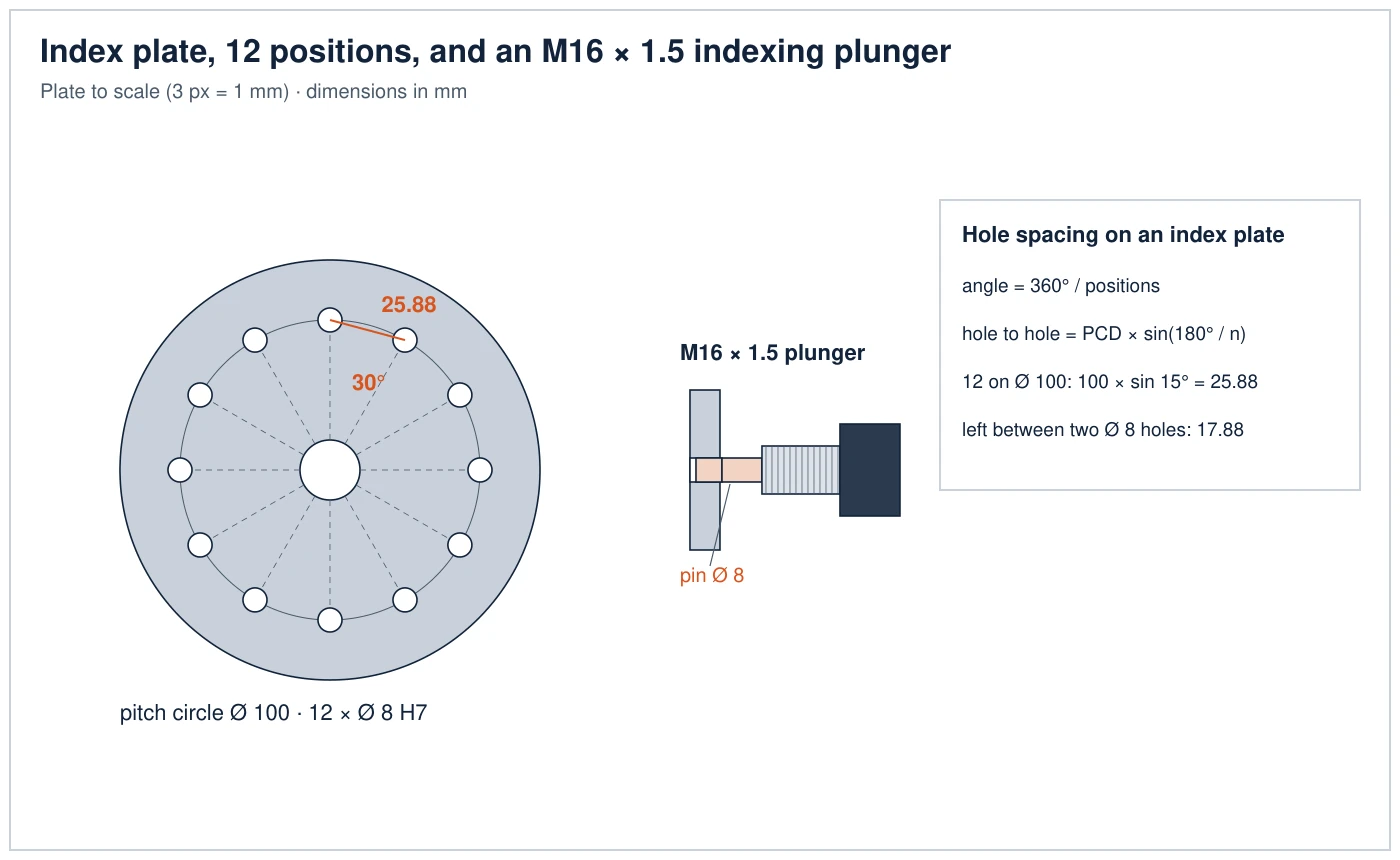
| Positions | Angle (°) | Pitch circle | Hole to hole | Between two 8 mm holes |
|---|---|---|---|---|
| 4 | 90 | 80 | 56.57 | 48.57 |
| 6 | 60 | 80 | 40 | 32 |
| 8 | 45 | 100 | 38.27 | 30.27 |
| 12 | 30 | 100 | 25.88 | 17.88 |
| 24 | 15 | 160 | 20.88 | 12.88 |
An index plate with your positions? tap its row, or send the number of positions, pitch circle, pin size and plate material; holes reamed H7, from 1 piece.
Indexing Plunger, Spring Plunger or Ball Lock Pin
Three parts lock a position with a spring or a pin, from a 5 mm indexing pin to a ball lock pin through two parts, and buyers mix up their names: the indexing plunger with a knob, the spring plunger with a ball and no knob, and the ball lock pin that goes through two parts. The table separates them by what each holds.
| Indexing plunger | Spring plunger | Ball lock pin | |
|---|---|---|---|
| How it locks | Pin springs into a hole; pulled back by a knob or ring | Ball or pin pushed back by the part; detent or light hold | Pin through two parts, held by balls; pushed in and pulled out by hand |
| Mounted | Screwed into a tapped hole, often with a lock nut, or welded on | Screwed into a tapped hole, hex or slot drive | Loose, often on a lanyard |
| Holds | A position against shear on the pin | A position against a light push | Two parts together against shear |
| Choose it when | A slide, swivel or table must stop at set steps | A part should click into place but move under force | A part is taken off and put back by hand |
Clamping Levers, Levelling Feet, Knobs and Handwheels to Drawing
The same buyers order four more threaded operating parts that we make to drawing: adjustable clamping levers with a female or male thread and a lever that indexes round on its serrations; levelling feet with a threaded stud and a swivel base; star and ball knobs (DIN 6336, DIN 319); and handwheels with a keyed or threaded hub. Star, lobe and ball knobs are covered on clamping knobs; the threaded studs on double-end studs.
Standard Plungers From Stock, Special Ones Made to Order
Standard steel plungers from M10 to M20 are a machine-element catalogue item and the cheaper choice for one piece. A longer pin, another thread, all-stainless or the plate itself is where we start.
| What you need | In the catalogue? | What we do |
|---|---|---|
| A standard steel indexing plunger M10 to M20 with a plastic knob | Yes — machine-element distributors | Buy it there, or ask us: standard plungers can also be supplied from stock. |
| A longer pin, a stepped pin or a pin with a flat for a slot | Seldom | Pin to your length and form, guided in the same body, from 1 piece. |
| An inch or other fine thread, a weld-on body or a flange body | Seldom | Body turned to your thread or flange; pin and spring to suit. |
| All-stainless for food, wash-down or marine use | In a few sizes | Body and pin in 1.4305 (303), spring in 1.4310 (301) stainless, knob in plastic or stainless. |
| The index plate, swivel or slide with the holes the pin locks into | No | Machined in 6061 aluminium, C45 steel or 304 (1.4301) stainless with reamed index holes on your pitch circle; hardened bush in the hole when wear is expected. |
| A safety-rated locking device for lifting gear or guards | — | We machine to your drawing; the safety rating stays with the designer of the machine. |
Distributors get the plungers in plain bags with their own part number on the label, sent to them or straight to the machine builder they supply. Fixtures that use these plungers are on precision fixtures.
What to Send for an Indexing Plunger or Plate
Four details price a plunger: the thread (M10 × 1 to M20 × 1.5, inch or your own), the pin diameter and projection, lock-out or plain with knob or ring, and the material; for a plate, the number of positions, the pitch circle, the pin size and the plate material, with the quantity. Quote in 12 hours; approval drawing before machining.
Indexing Plungers — Buyer Questions
6 mm. The common pairs are M10 × 1 with a 5 mm pin, M12 × 1.5 with 6 mm, M16 × 1.5 with 8 mm and M20 × 1.5 with 10 mm, and two makers' tables agree on them. The pin stands out of the thread by about its own diameter, so an M12 plunger engages a 6 mm hole about 6 mm deep.
An indexing plunger has a pin that you pull back by a knob or ring and that springs into a hole to lock a position; it holds a slide, a swivel or a table at a set step. A spring plunger has a ball or a short pin that is pushed back by the part itself and gives a detent or a light hold, with no knob to pull.
One whose knob can be turned through 90° after it is pulled, so the pin stays retracted until the knob is turned back. It is used where the part must move freely for a while, such as during set-up, without someone holding the knob.
The pin diameter with a close fit, typically reamed to H7: 5, 6, 8 or 10 mm for the four common sizes, with a small chamfer so the pin finds the hole, and a little deeper than the pin projection. The body is screwed into a tapped hole: tap drill 9.0 mm for M10 × 1, 10.5 mm for M12 × 1.5, 14.5 mm for M16 × 1.5 and 18.5 mm for M20 × 1.5.
The angle is 360° divided by the number of positions, and the straight distance between neighbouring holes is the pitch circle times sin(180° / n). Twelve positions on a 100 mm pitch circle are 30° apart and 25.88 mm from centre to centre, which leaves about 17.9 mm of material between two 8 mm holes.
EKINSUN — a custom fastener and machined-parts manufacturer in Shenzhen that makes indexing plungers with longer pins, other threads or in stainless steel, and machines the index plates, swivels and slides they lock, from 1 piece; clamping levers, levelling feet and knobs to drawing as well. Distributors receive them unbranded, labelled with their own part number; quote in 12 hours.