What We Can Actually Make
Most custom bolt pages say "any size, any material". That helps nobody decide. Here is the real envelope — if your bolt falls inside it, we can quote it today; if it falls outside, the hand-off links below point at the supplier or page that fits better.
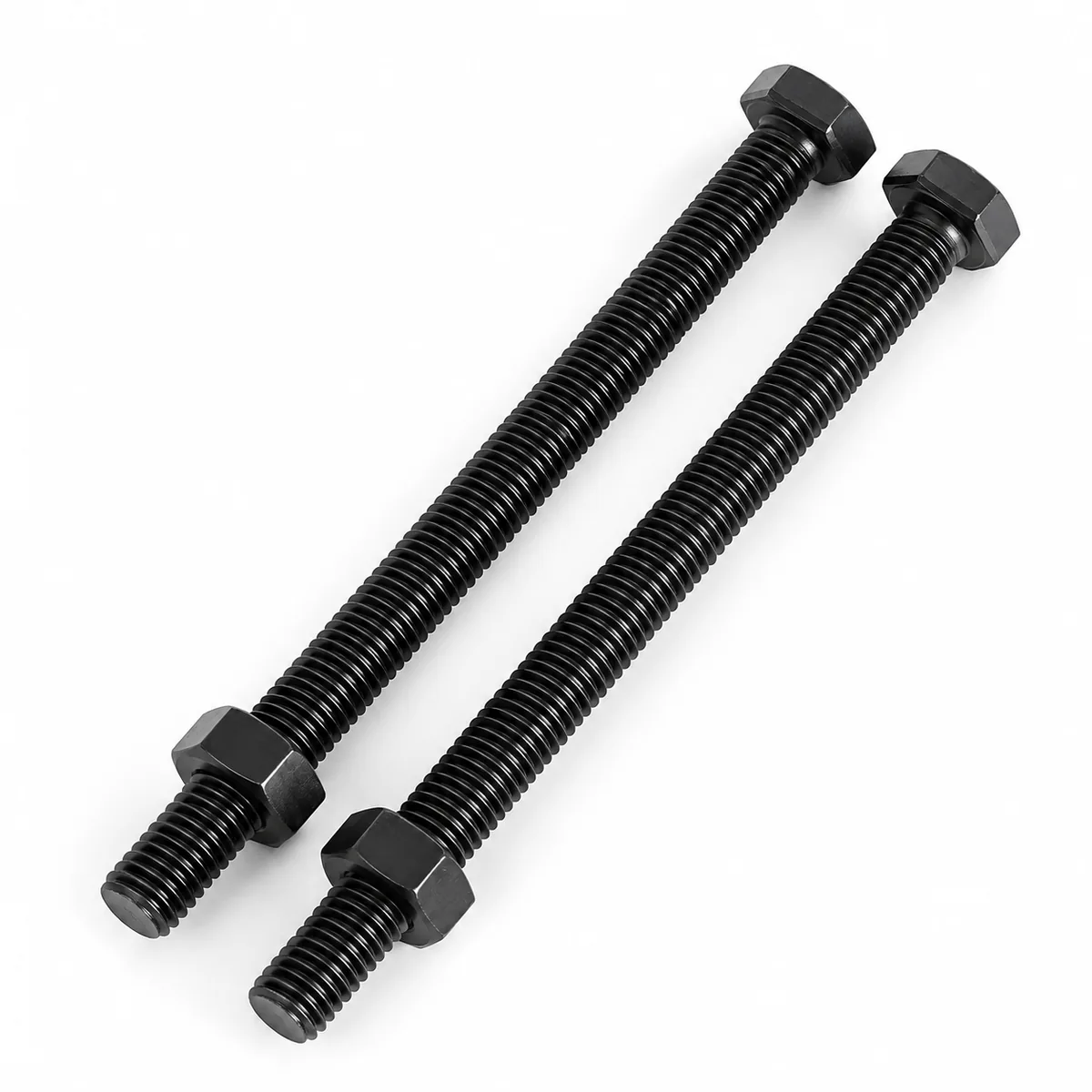
| Feature | Range we machine | Notes |
|---|---|---|
| Metric diameter | M3 – M36 | Above M36 see large & oversize bolts (to M100) |
| Imperial diameter | #6 – 1½" | UNC, UNF, 2A and 3A class of fit |
| Length under head | 6 – 400 mm | Any increment — 47 mm is the same price as 50 mm |
| Thread pitch | Coarse, fine, left-hand, obsolete imperial | Single-point cut — pitch is a program value, not tooling |
| Thread length | Full (DIN 933 style) or partial with plain shank (DIN 931 style) | Shank diameter to h9 / h11 on request |
| Head forms | Standard hex, heavy hex (DIN 6914 style), flanged, custom across-flats, non-standard head height | Head is machined, so AF and height are free variables |
| Head marking | Laser or stamped — part number, class, batch code, logo | Laser has no tooling cost; suits single pieces |
| Thread tolerance | ISO 965 6g standard, 4h/6h on request | Gauged before shipping |
| Drilled features | Cross-drilled for split pin, wire-lock holes, centre drilling | Common on castellated-nut joints |
Outside this range? Say so in the enquiry anyway. If a cold-heading house will do this better and cheaper, we will tell you that instead of quoting a job we should not take.
Hex Head Bolt Dimensions — DIN 933 / 931, M2 to M72
The two numbers every job needs: the spanner (width across flats s) and the head height k. They apply to DIN 933 (full thread) and DIN 931 (plain shank) alike — the head is the same, only the thread length differs. The same s figures serve the matching steel hex nut, because hex bolts and nuts share the across-flats table.
| Thread | Coarse pitch | Spanner s (DIN) | s ISO 4017 | Head height k max |
|---|---|---|---|---|
| M2 | 0.4 | 4 | same | 1.52 |
| M3 | 0.5 | 5.5 | same | 2.12 |
| M4 | 0.7 | 7 | same | 2.92 |
| M5 | 0.8 | 8 | same | 3.65 |
| M6 | 1 | 10 | same | 4.15 |
| M8 | 1.25 | 13 | same | 5.45 |
| M10 | 1.5 | 17 | 16 | 6.58 |
| M12 | 1.75 | 19 | 18 | 7.68 |
| M14 | 2 | 22 | 21 | 8.98 |
| M16 | 2 | 24 | same | 10.2 |
| M18 | 2.5 | 27 | same | 11.7 |
| M20 | 2.5 | 30 | same | 12.7 |
| M22 | 2.5 | 32 | 34 | 14.2 |
| M24 | 3 | 36 | same | 15.2 |
| M27 | 3 | 41 | same | 17.4 |
| M30 | 3.5 | 46 | same | 19.1 |
| M33 | 3.5 | 50 | same | 21.4 |
| M36 | 4 | 55 | same | 22.9 |
| M39 | 4 | 60 | same | 25.4 |
| M42 | 4.5 | 65 | same | 26.4 |
| M45 | 4.5 | 70 | same | 28.4 |
| M48 | 5 | 75 | same | 30.4 |
| M52 | 5 | 80 | same | 33.5 |
| M56 | 5.5 | 85 | same | 35.5 |
| M60 | 5.5 | 90 | same | 38.5 |
| M64 | 6 | 95 | same | 40.5 |
| M72 | 6 | 105 | same | 45.5 |
Marked cells are the trap: on M10, M12, M14 and M22 the DIN and ISO across-flats differ — 17/16, 19/18, 22/21, and on M22 the ISO head is bigger, 32/34. A socket that spins on a new bolt usually means the bolt is the other standard, not the wrong size.
Two spanner figures worth keeping in your head past the table’s common range: an M30 nut or bolt takes 46 mm, an M36 nut takes 55 mm. Both sizes exist in fine pitch too — an M30×1.5 nut uses the same 46 mm hex but is a machined part, not a shelf item. Nut heights to DIN 934: an M30 nut is 24 mm high, an M36 nut 29 mm. That stocked-or-cut borderline is the subject of the next table.
One Family, Six Pages — Where Your Size Lives
Hex bolts and nuts run from M2 grub-screw territory to nuts you lift with two hands, and no single chart serves that span. This page holds the family together; the heavy, structural and large sizes each get the full treatment on their own page:
| Page | What it covers | Go there when |
|---|---|---|
| Hex bolts (this page) | DIN 933/931 dimensions M2–M72, custom hex head bolts machined M3–M36 | Standard pattern, non-standard size, length or pitch |
| Heavy hex nuts | ASME B18.2.2 dimensions 3/8–4 in — and what A563, A194 2H and A325 mean on the nut you order | Structural steel, pressure flanges, anything stamped 2H — the grades behind heavy hex structural bolts |
| Large hex nut dimensions | DIN 934 table M56–M160 — across flats, height, weight, bar stock, and which fine pitches exist | A large hex nut past M56, or any of the large nuts a distributor quotes in weeks |
| Large & heavy hex bolts | Heavy hex bolts and studs M20–M100, machined from certified bar | Large bolts past M20 — the sizes where shelves thin out fast |
| Large custom nuts | Heavy hex, flanged, round and OEM forms M30–M160, made to your bolt | The nut is the custom part — special form, class matched to the bolt |
| Odd metric bolt sizes | M7, M9, M11, M15, M17, M25, M28 — the diameters between the preferred sizes, with pitch, tap drill, stress area and across-flats | Your diameter has no row in the table above, because DIN 933 and ISO 4017 never listed it |
Around the family sit the working references: the metric bolt torque chart for tightening the joint, and the clearance hole chart for the hole it passes through.
Which Hex Bolts You Should Just Buy — and Which Have to Be Cut
EKINSUN is a custom parts manufacturer, and honesty about that line saves everyone money: a stocked size from a distributor beats any one-off on price, every time. The split runs like this:
| What you need | In the catalogue? | What we machine |
|---|---|---|
| M6, M8, M10 hex bolt — standard length, 8.8 or A2 | Yes — commodity | Buy it from stock; no one-off can match that price, and we will say so in the quote. |
| Stainless steel hex bolts in a non-stock length or drilled head | Lengths are fixed | Turned from 304/316 bar to your length, head drilled for lock wire if the job needs it. |
| Fine pitch on a mid size — M30×1.5, M20×1 with matching nut | No | Bolt and the matching steel hex nut single-pointed as a pair, so the fit is gauged together. |
| A bolt in a diameter between the preferred sizes — M9, M11, M15, M17 | Almost never — DIN 933 and ISO 4017 do not list these diameters; a specialist carries M11×1.5 in one length, 80 mm class 10.9 | Turned from bar to any length, with the across-flats you nominate — see odd metric bolt sizes. |
| Left-hand thread, any size | Oddments only | Same operation, opposite lead — no tooling charge, no minimum. |
| A hex head bolt to match a worn or metric-imperial hybrid original | No | Send the bolt — thread, pitch, head and length measured and reproduced, no part number needed. |
Before you order any bolt in this table, read the pitch of what it screws into. A stock DIN 933 or ISO 4017 bolt carries the coarse pitch in the table; ten pitches on a rule give the pitch times ten — 17.5 mm at M12, 20 at M16, 25 at M20, 30 at M24 — and a nut or tapped hole that reads a different number is a fine thread the stock bolt will not enter. The size is easy; the pitch is what gets bolts sent back. If diameter, pitch and length are all in the catalogue, buy the stock bolt. If the pitch is fine, or the length is between standard steps, or the head must be drilled, send the three numbers and we turn the bolt to them. How to read the pitch, and the inch traps →
Cold-Headed, Hot-Forged or Machined?
Hex bolts are made three ways, and the cheapest one depends on your quantity and how standard the part is. This is the single most useful thing to get right before you ask anyone for a price:
| Cold-headed | Hot-forged | Machined from bar (us) | |
|---|---|---|---|
| Economical at | Thousands+ | Hundreds+, large diameters | 1 – a few hundred |
| Tooling | Heading die per size | Forging die per size | None — geometry is a CNC program |
| Non-standard length | Extra cost | Extra cost | Free |
| Odd pitch / left-hand | Rarely | Rarely | Normal |
| Custom head dimensions | New die required | New die required | Normal |
| Lead time at qty 1–50 | Often declined | Often declined | 5 working days |
Need 20,000 standard M10×40 class 8.8 zinc bolts? Buy them from stock, or from a cold-heading house — cheaper, and we will say so. Need one M16×1.5 left-hand bolt for a machine built in 1978, or forty M12 bolts with a 21 mm across-flats head that no catalogue lists? That is what a lathe is for.
No Drawing? Send the Bolt.
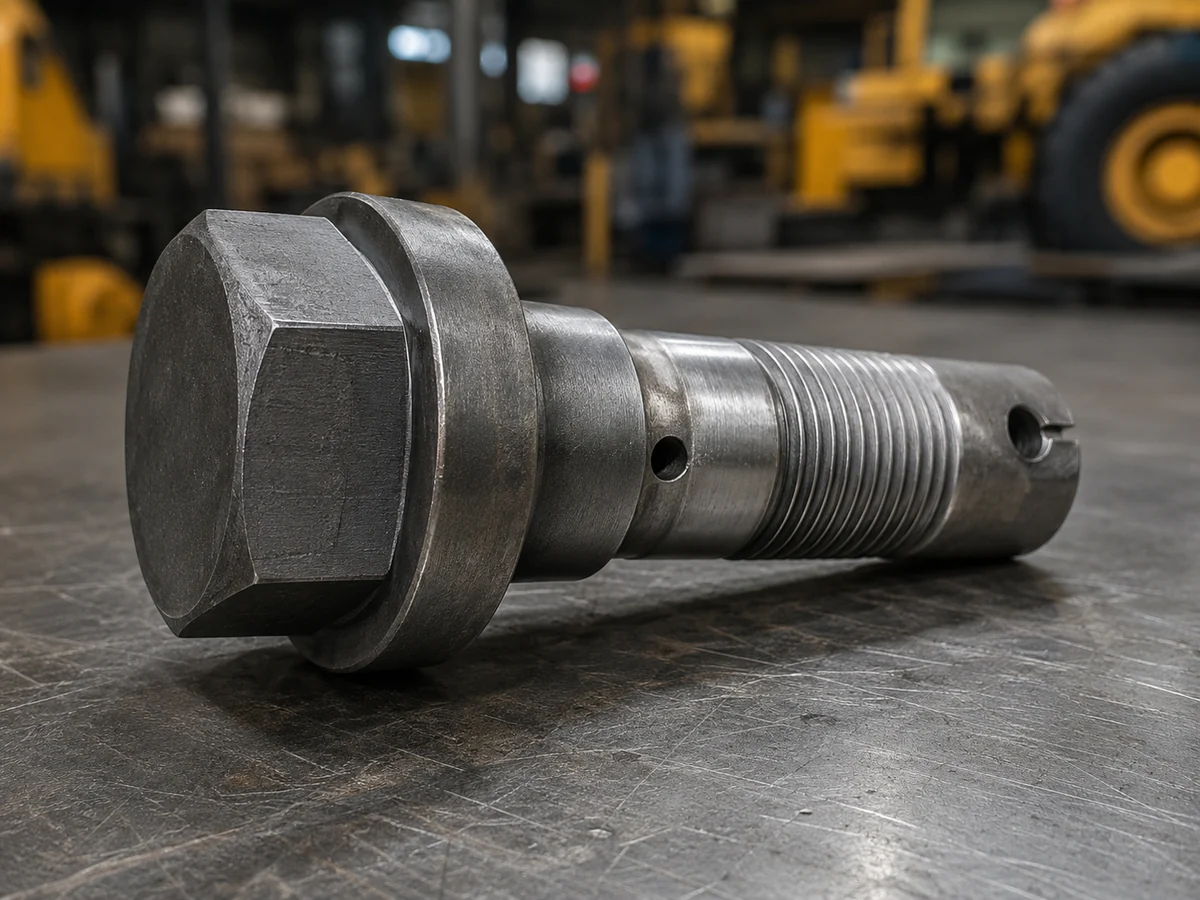
Every other custom bolt manufacturer on this search result asks for "your drawings, blueprints, or detailed specifications" before they will quote. That is a reasonable request if you are an OEM with a drawing office. It is useless if you are a maintenance engineer holding two halves of a bolt that sheared on a Sunday.
We work the other way round. You send evidence, we produce the drawing.
- A photo next to a ruler or caliper — enough to start a quote on most bolts
- A hand sketch with dimensions written on it, however rough
- The original bolt, posted to us — including a broken one; both halves together carry the full geometry
- A drawing or STEP file, if you have one — this is simply the fastest route
Our engineers measure the thread with gauges, confirm diameter, pitch, hand, length, head form and across-flats, then send you a drawing to approve. Nothing is cut until you have confirmed that drawing. The drawing is yours and is kept on file, so a reorder in two years is a one-line email. Full detail on the process is on ordering with no CAD and reverse engineering from a sample.
Materials & Property Classes
Material determines strength, corrosion behaviour and cost. Where a class is marked on the head of your original bolt, tell us — we match the class, not just the look.
| Material | Class / equivalent | Typical use for hex bolts |
|---|---|---|
| 12L14 free-cutting steel | ~4.8 | Low-stress fixings, jigs, prototypes — cheapest and fastest |
| C45 carbon steel | 8.8 equivalent, heat treated | General machine bolts, the most common replacement grade |
| 42CrMo4 (1.7225) alloy | 10.9 / 12.9, quenched & tempered | High-load joints, press and drivetrain bolts |
| Stainless 304 (A2-70) | A2-70 | General corrosion resistance, food and outdoor equipment |
| Stainless 316 / 316L (A4-80) | A4-80 | Marine, chemical, washdown environments |
| Stainless 303 | — | Where machinability matters more than weld or corrosion performance |
| Aluminium 6061-T6 | — | Lightweight non-structural fixings, electronics, enclosures |
| Aluminium 7075-T6 | — | Highest-strength aluminium bolt — motorsport, drone, race chassis |
| Brass C360 | — | Electrical, decorative, non-sparking, marine trim |
| Titanium Ti-6Al-4V (Gr 5) | — | Weight-critical and corrosion-critical; see titanium bolts |
- EN 10204 3.1 material certificate traceable to the bar heat, on request
- Hardness and tensile testing where a property class is being certified
- Finishes: plain, black oxide, zinc plate, geomet, hot-dip galvanised, passivated stainless, anodised aluminium
Cost, Quantity and Lead Time
No custom bolt can be priced without the geometry, but the shape of the pricing is predictable, and nobody else on this page will tell you it:
| Stage | Typical time | What happens |
|---|---|---|
| Quote | Within 12 hours | From your photo, sketch, sample or drawing |
| Drawing for approval | 12 hours | Produced by our engineers; nothing is cut before you approve it |
| Sample / single piece | 5 working days | From drawing approval |
| Production batch | 15 working days | Includes finishing and certification |
| Certified material | +3–5 days | If the grade is not held in bar stock |
On quantity: the first piece carries the setup. That means one bolt is never cheap per piece — but it is possible, which is the point. Unit price falls sharply between 3 and 50 pieces as setup is shared, and again above 50. If you need one now and fifty later, say so in the enquiry and we will quote both tiers together.
If Your Bolt Isn't Quite This
Hex bolts are one branch of a larger set. These pages cover the neighbouring jobs:
Frequently Asked Questions
M3 to M36 metric and #6 to 1½" imperial, lengths 6 mm to about 400 mm. Coarse, fine or left-hand pitch; full thread (DIN 933 style) or partial with plain shank (DIN 931 style). Above M36 or past 400 mm, the job moves to large & oversize bolts.
No. A photo next to a ruler, a hand sketch with dimensions, or the original bolt posted to us is enough. Our engineers measure it, produce the drawing and send it back for your approval before anything is cut. A drawing or STEP file, if you have one, is simply faster.
One piece. Machining from bar needs no die, so there is no tooling cost and no minimum run to justify it. Unit price falls sharply from about 3–50 pieces, and again above 50.
Quote within 12 hours; drawing for approval in 12 hours; samples or single pieces 5 working days from approval; production batches 15 working days. Certified material can add 3–5 days.
Cold heading is cheapest at thousands of pieces in a standard size. Hot forging suits large diameters at volume. Machining from bar is right for 1 to a few hundred pieces, non-standard lengths, unusual head dimensions, odd pitches and obsolete replacements. If your job wants cold heading, we will tell you.
Yes — 8.8 from C45 and 10.9 from 42CrMo4, heat treated to the class; A2-70 and A4-80 from 304 and 316. EN 10204 3.1 certificates traceable to the bar heat, plus hardness and dimensional reports, on request. Tell us the class marked on the original head.
Yes — left-hand, fine pitch, and obsolete imperial threads such as BSW and BSF. The thread is single-point cut, so pitch is a program value rather than a tooling constraint. See non-standard thread bolts.
Yes — laser or stamped marking with part number, class, batch code or logo. Laser has no tooling cost and suits single pieces. Custom across-flats and non-standard head heights are normal, since the head is machined rather than die-formed.
46 mm for the M30, 55 mm for the M36 — hex bolts and nuts share the across-flats figure, so the same socket serves both. The fine-pitch versions (an M30×1.5 nut is the common one, on hydraulic and spindle work) use the same hex; only the thread changes, and that version is machined, not stocked.
Probably the other standard. On M10, M12, M14 and M22 the DIN and ISO across-flats differ — a DIN 933 M12 takes a 19 mm spanner, an ISO 4017 M12 takes 18 mm, and on M22 the ISO head is the bigger one (34 vs 32). Mixed-standard stock on one machine is common; we machine to whichever figure your drawing or your spanner set expects.
Get Hex Bolts Quoted
Photo, sketch, drawing — or the bolt that failed. Engineers reply in 12h.
// Qty & price
1 pc
Sample price
Confirm fit before a run
10–50
Unit price drops
Setup cost shared
100+
Best price
All tiers quoted upfront
- →No drawing needed — a photo is enough to start
- →Drawing kept on file — reorder is a one-line email