The robot is a catalogue product — most of what bolts to it is not
Be clear about the boundary first, because the automation world is better served than most machining pages admit. Gripper makers sell standardised adapter plates between their units and the common ISO flanges and robot models — if your pairing is on that list, buy it there, or ask us — we may have it in stock. The listed plate is cheaper, proven, and arrives faster than any one-off. The same makers sell finger blanks for their gripper series, in aluminium or hardenable steel, with the mounting interface already machined. None of that is our lane, and we will say so in the quote rather than compete with a part that already exists.
Our lane opens exactly where the catalogue's knowledge ends: at your workpiece and your cell. The blank's mounting holes are catalogue; the step, vee or nest that has to hold a Ø38 domed housing without marring it is yours alone. The ISO flange pattern is standardised; the plate that carries your specific camera, sensor and cable clip on the other face is not. That geometry — measured from your parts, drawn for your approval, machined at one piece — is what this page is for.
What you can ask for that no catalogue stocks
| What you need | In the catalogue? | What we machine |
|---|---|---|
| Adapter plate between two listed ISO flanges | Yes — gripper makers sell them ready-made | Buy the listed plate; it is the better part for that job |
| Finger blanks for a common gripper series | Yes — aluminium or hardenable steel, interface pre-machined | Buy the blank — then send it here for the workpiece geometry, or have us cut the finished jaw from solid |
| Jaws matched to your workpiece profile | No — that shape is yours alone | Steps, vees, nests, serrations and burr relief machined into blanks or from solid |
| A flange pairing on nobody's list (older arm, new tool — or the reverse) | No | One plate, ISO 9409-1 pattern from the robot manual on one face, the tool's pattern on the other, dowel holes reamed |
| A plate that also carries the camera, sensor boss and cable clip | No — catalogue plates adapt flanges, nothing else | One machined plate replacing a stack of brackets, pocketed to the payload budget |
| Washdown and food-line jaws or plates | Patchy | 316L, crevice-conscious forms, machined to the same jaw geometry |
| Polymer contact jaws (PEEK, POM) | Rare outside listed series | Machined via our custom plastic parts route, same intake |
| A machined spare for an arm no longer supported | No — the maker moved on | Measured from the worn original and remade to nominal dimensions |
| The gripper, actuator or reducer itself | Yes — and it should stay a bought part | An honest no — we machine around those parts, not them |
Need gripper jaws, flange plates and robot mounts in a size, thread or material no catalogue lists? EKINSUN is a custom parts manufacturer: we make gripper jaws, flange plates and robot mounts to your drawing, sketch or sample — 6061 or 7075 aluminium, 304 stainless steel or POM — from 1 piece, quoted in 12 hours and shipped duties paid. Standard sizes can often be supplied from stock; the more pieces, the lower the unit price. How ordering without CAD works →
“The gripper arrives Friday and the demo is Wednesday. It ships with flat jaws; the part is a Ø38 domed housing. Nobody lists fingers that hold it.”
— the shape of the enquiry this page exists for. Gripper series, workpiece drawing or dimensioned photo, target weight: that is the whole intake.
Gripper jaws and fingertips — from the blank or from solid
A jaw job needs three things from you: the gripper make and series (stamped on the body), the workpiece geometry (STEP, drawing, or a dimensioned photo), and how the part may be touched — because the jaw face is a contact-mechanics decision before it is a machining one. 6061 aluminium is the default: softer than almost any steel workpiece, so it grips without marring, and light enough that the pair barely dents the payload budget. Abrasive or hot parts move the jaw to hardenable steel; washdown chemistry moves it to 316L; glass, polished and anodised surfaces often want a PEEK or POM contact face instead of metal. Serrations add grip on rough castings and cost you on finished surfaces — we ask what the part looks like after the robot puts it down.
Whether we start from a catalogue blank you supply or cut the whole finger from solid is a cost question, not a quality one: the blank saves machining the mounting interface, solid stock opens geometry the blank's envelope cannot reach. Both arrive as a dimensioned drawing for your confirmation before cutting, and a second iteration after the first grip test is normal work, not a warranty claim — version two usually follows the first video of the gripper missing.
Flange, tool and base plates — ISO 9409-1 without guesswork
ISO 9409-1 is the standard that makes robot tooling interchangeable: a designation such as 50-4-M6 reads as a 50 mm pitch circle carrying four M6 threads, with the centring boss and dowel position drawn in the standard and, more usefully, in your robot's own manual. We machine adapter and tool plates to that drawing on the robot face and to whatever the tool needs on the other — a gripper's pattern, a camera's 1/4-20, a force sensor's ring — with dowel holes reamed so the tool returns to the same position every time it comes off for cleaning or a crash check. Repeatability lives in the dowels, not the bolts; a plate drilled without them relies on bolt clearance, and the vision team pays for it later.
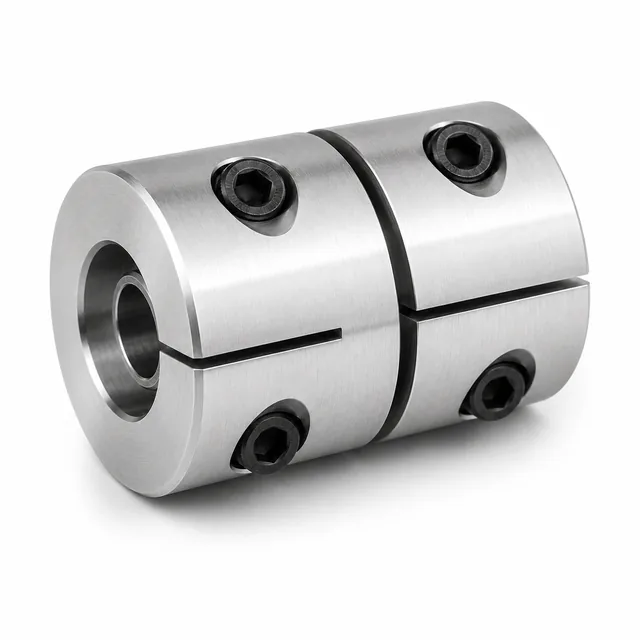
Base and cell plates go through the same intake: tapped grids, dowel positions matched to the robot's base pattern, pockets that drop grams that count one-for-one against payload. Where the stack today is plate-on-bracket-on-bracket, one machined plate usually replaces it — fewer joints, fewer shims, one drawing. The adjacent parts are pages of their own: sensor mounting brackets, machined standoffs, rigid shaft couplings for the drive side, and custom dowel pins when the position is odd.
One robot, one part — prototypes and small batches
Most robot hardware orders are quantity one, because most cells only need one — and the intake is built for that. A startup proving an end-effector, an integrator bridging the week between “the gripper shipped” and “the demo runs”, a lab fitting a camera where no bracket exists: all three arrive with different paperwork, and all three work. CAD is welcome, never required — a hand sketch with caliper readings or the physical parts in a photo are a complete enquiry, and anything critical comes back as a dimensioned drawing for approval before metal moves. Quote in 12 hours, MOQ 1, and the drawing is archived so the version-two jaw or the second cell starts from the measuring work already done.
The arm outlived its maker — machined spares for unsupported robots
Robots age into the same corner as any other machine: the arm still runs, the maker or the importer is gone, and one machined part is down. Flanges, adapter hubs, hard stops, covers, bushings and shafts are reverse-engineered from the worn original — measured to nominal dimensions, never copied wear-for-wear, because the worn part is a pattern and not a drawing. The honest boundary sits inside the joints: gearboxes, encoders and drive boards are not machining work, and when the failed part is one of those, the quote says so and points you at the right kind of supplier instead.
Materials — what robot hardware should be, honestly
| Material | When it is the right call | Note |
|---|---|---|
| 6061-T6 aluminium | The default for jaws, plates and mounts | Light, stable, anodisable — and softer than the workpiece, so it grips without marring |
| 7075-T6 aluminium | Payload-critical jaws and plates | Roughly 570 MPa tensile against 6061's 310 at nearly the same density — pay for it at the flange, where grams matter most |
| 304 stainless | General stainless brackets and plates | Everyday washdown; the workhorse when aluminium is too soft |
| 316L stainless | Food-line and chemical washdown | The chloride answer — specify it where the cleaning chemistry, not the load, governs |
| C45 / 42CrMo4 steel | Shafts, hard stops, pins | Induction-hardenable where a stop face takes the same hit every cycle |
| PEEK / POM | Non-marring contact faces on glass, polished or anodised parts | Machined through the plastic parts route, bolted to metal fingers |
| Carbon-fibre plate | Not from us | Buy cut CF plate from a composites house — we machine metals and engineering plastics, and say so |
How to order
Send whichever of the three you have: the STEP or PDF drawing; a hand sketch with caliper readings; or the parts themselves — gripper series marking, workpiece, and a photo with a ruler in frame, the same from-a-sample intake as the rest of the site. Name the robot or cobot model so the flange pattern comes off the manual, say what the part may weigh if payload is tight, and mention the wash chemistry if there is one — it decides between 6061, 316L and PEEK before any geometry does. A dimensioned approval drawing comes back before machining; quote within 12 hours, one piece minimum (MOQ 1).
Mounting plates for steppers, valve actuators and linear rails around the robot cell are on adapter and mounting plates.
Frequently asked questions
Yes — that is the most common robot job here. Send the gripper make and series plus a drawing, STEP file or clear dimensioned photos of the workpiece, and we machine the jaw geometry — steps, vees, nests or serrations — into catalogue finger blanks or from solid 6061, 7075, hardenable steel or 316L. Aluminium jaws are softer than most workpieces, so they grip without marring, and a single set for one gripper is a normal order.
Yes. ISO 9409-1 names the bolt pattern on the robot's tool flange — 50-4-M6, for example, means four M6 threads on a 50 mm pitch circle — and your robot manual carries the full drawing with the centring boss and dowel position. We machine the plate to that drawing on one face and to whatever the tool, camera or sensor needs on the other, with dowel holes reamed so the tool goes back in the same place every time it comes off. MOQ 1 piece.
Yes. A phone photo of both, the gripper's series marking, and caliper measurements of the faces you care about are enough for a quote — the same no-CAD intake we use for any machined part. Where the geometry is critical we redraw it and send a dimensioned drawing back for your confirmation before cutting.
No — and you would not want them from a machine shop. Grippers, actuators, reducers and arms are catalogue products from their makers, with ratings we have no business re-issuing; buy them there. Our work is the machined metal and plastic around those parts: the jaws, plates, mounts, bushings and shafts that fit them to your workpiece and your cell.
If it is a machined part — a flange, adapter hub, hard stop, cover, bushing or shaft — yes: we measure the worn original and machine to nominal dimensions, not to the wear, the same reverse-engineering intake as any obsolete machine part. Gearbox internals, encoders and boards are not machining work, and we say so rather than quote them.
Yes — grams bolted to the flange count against payload exactly like the workpiece does. We pocket and window 6061 plates, move payload-critical jaws to 7075, which carries roughly 570 MPa tensile against 6061's 310 MPa at nearly the same density, and relieve anything that does not carry load. Name the target weight in the enquiry and the drawing is designed to it.
One piece — a single set of jaws or one adapter plate is a normal order, because most cells only need one. Quotes come back within 12 hours from a drawing, sketch or measured photos, and parts ship worldwide by DHL.
EKINSUN — a custom parts manufacturer — machines one-off and small-batch robot hardware from your drawing, hand sketch or sample: gripper jaws matched to the workpiece, ISO 9409-1 flange adapter plates, base and mounting plates, standoffs, bushings and shafts. MOQ 1 piece, quote within 12 hours.
Send the joint
Gripper series and workpiece, or robot model and the tool it must carry. Photos with a ruler beat no CAD. One piece minimum, quote within 12 hours.