EKINSUN LTD is a custom parts manufacturer, and cold plates arrive here at a specific moment: an instrument builder — benchtop analyzer, laser driver, battery test channel, power supply — has a heat problem solved on paper and a mounting problem no catalogue will solve. Catalogue plates come in fixed footprints with ports where the extrusion wanted them. Your instrument was not designed around an extrusion.
Three Ways We Build a Cold Plate — and When Each Is Right
| Construction | How it works | When it is the right call |
|---|---|---|
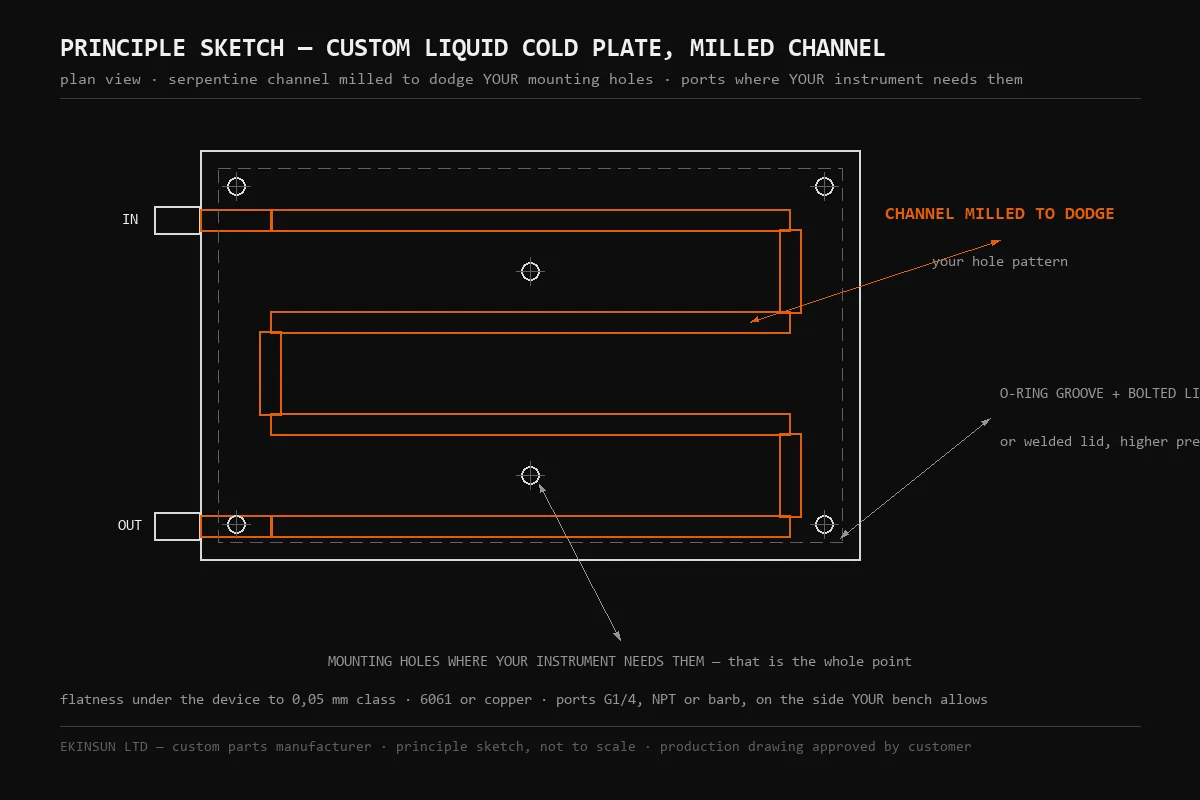
| Milled channel + O-ring bolted lid | Serpentine or custom channel milled into the body, lid sealed on an O-ring, bolted down | The instrument default: serviceable, fast to make, proven at typical loop pressures — quantity 1 is a normal order |
| Milled channel + welded lid | Same channel, lid welded shut | Higher pressure, no gasket on the maintenance list — chosen when the plate will never be opened |
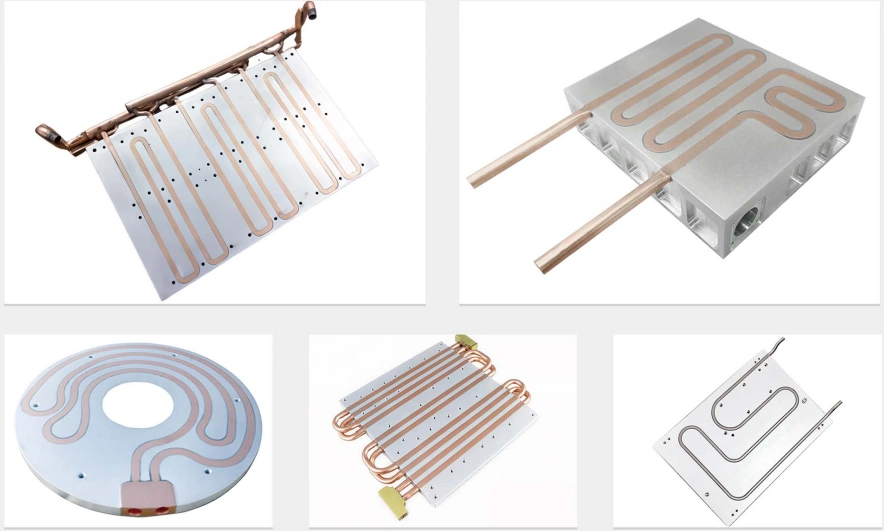
| Copper tube pressed into a milled groove | Continuous tube — the water path has no joint inside the plate | Lowest cost, and the conservative choice above electronics: a jointless path cannot leak into the box |
| Drilled passages + plugs | Cross-drilled galleries in thin plates | When the plate is too thin for a milled channel and lid |
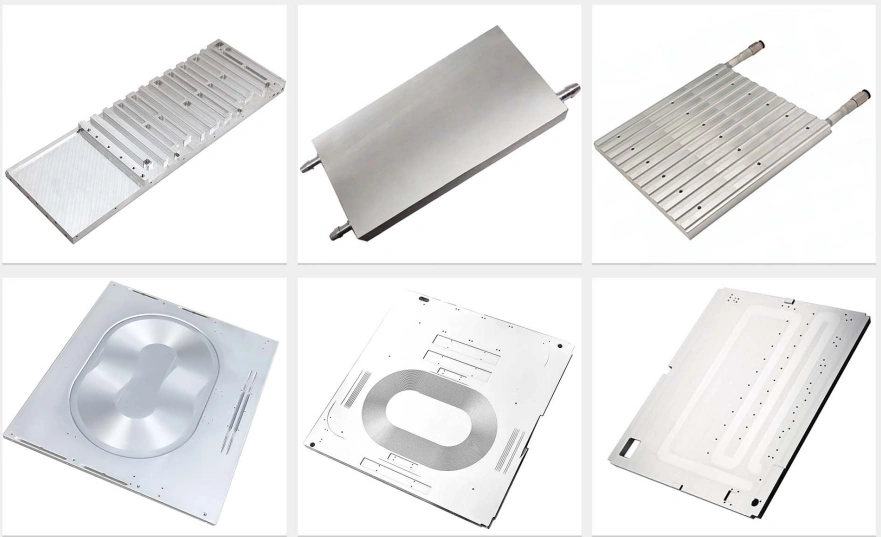
We quote the construction that fits your pressure and service story — and say so when the cheaper one is enough. The proof this is real work and not a brochure claim: a machined aluminium cooling plate with internal channels is documented in our case studies.
The Three Specs That Decide Whether It Cools
- Flatness under the device: 0.05 mm class over the contact zone. Thermal-interface material fills microns, not rocking gaps. The mounting face is machined last so clamping distortion does not undo it — a plate that rocks sheds performance no channel design wins back.
- Ports where the installation allows — G1/4, NPT or barb, on the face or the edge your bench has room for. The fitting side of that story lives on our liquid cooling fittings page.
- Metal chemistry of the whole loop. An aluminium plate in a loop with copper or brass parts is a galvanic pair — it corrodes from the inside while looking perfect outside. Keep the loop one metal, nickel-plate the aluminium, or run the correct inhibited coolant. We ask about your loop before quoting, because the cheapest plate in the wrong loop is the most expensive one you can buy.
Cleanliness is part of the part: plates are flushed, dried and shipped with capped ports — machining chips left in a channel end up in someone's pump. Pressure or leak check on request, and the result travels with the plate.
The Numbers We Machine To
Design guides for cold plates tend to live behind a download form. The working figures do not need to: these are the numbers a one-off or small-series machined plate is built around, published here so you can sanity-check a design before you send it. The approval drawing carries the final values for your plate.
| Parameter | Working figure | Why |
|---|---|---|
| Milled channel width | 2–12 mm routine; below ~1.5 mm is microchannel territory | Standard end mills cut it in one setup — that is what keeps quantity 1 affordable |
| Channel depth | Up to ~3× the width with standard cutters; deeper runs in staged passes | Slender cutters deflect — depth beyond that is possible, but it costs passes, not magic |
| Wall to the outside or to a mounting hole | ≥ 2 mm in aluminium as the working minimum | Thinner walls machine fine and then move when the lid is bolted down |
| Floor under the channel | 2 mm working figure; thinner where the heat source demands it | Coolant closer to the device cools better — and distorts easier. It is a trade, not a free win |
| O-ring groove | Face-seal groove sized for 20–25 % cord compression | Groove dimensions come on the approval drawing, matched to the cord you can buy |
| Flatness, device contact zone | 0.05 mm class; general faces 0.1 mm class | Thermal-interface material fills microns — the mounting face is machined last for exactly this |
| Surface finish | Contact face Ra 1.6 µm or finer; other machined faces Ra 1.6–3.2 µm | Finer than the TIM needs is money spent on nothing |
| Ports | G1/4 / G3/8 BSPP, 1/8 / 1/4 NPT, hose barbs — face or edge exit | Positioned where the installation allows, not where an extrusion die decided |
| Leak / pressure check | On request; test pressure agreed on the approval drawing | The result travels with the plate |
| Materials | 6061-T6 default · copper (Cu-ETP) for concentrated flux · 304/316 for corrosive coolants · 7075-T6 only as a structural member | 7075 buys nothing thermally over 6061 — it earns its price only when the plate is also a frame part |
What the Catalogue Does Well — and Where It Stops
| What you need | Stocked? | The honest route |
|---|---|---|
| A standard plate whose footprint and ports already fit | Stocked in depth | Buy it off the shelf — it will beat our price. Or ask us: if the catalogue part fits, we say so instead of quoting. |
| A standard footprint that fits — extruded plates in catalogue sizes | Yes — thermal catalogues stock them deep | Buy the catalogue plate. Cheaper than any one-off — no argument from us |
| PC watercooling blocks — CPU/GPU | Yes — a retail world of its own | Its own makers and shops; not our lane, and we say so |
| 10,000-piece programs with CFD and thermal guarantees | The big thermal houses (FSW, vacuum brazing lines) | Their lane — volume tooling and simulation teams are exactly what they sell |
| Sub-millimetre channels under a concentrated source | No — catalogue plates run coarse channels | Machined and sealed here in ones and tens — see microchannel cold plates |
| Your footprint, your holes, your port side — quantity 1 to tens | No catalogue can list your geometry | Machined to your drawing or sketch, from 1 piece |
| An odd outline — plate wrapped around components, cutouts, steps | Extrusions are rectangles | Milled from solid, outline follows the instrument |
| Copy or fix an obsolete plate — machine built around it, maker gone | No listing exists | Geometry taken from the old plate, corrosion and gasket sins corrected, footprint kept |
"Our benchtop analyzer needs a 180 × 95 plate, ports exiting the short side, and four M4 holes that miss every channel — nothing in any catalogue comes close. One piece now, maybe ten if the redesign flies."
That is a complete enquiry, and the "one now, ten later" shape is exactly what this page is for — the drawing is kept, so the ten later are cheaper than the one now. Design honesty: we machine to your drawing, or propose a sensible channel layout from your heat load and flow — full CFD and guaranteed thermal resistance figures are a design house's product, not a machine shop's promise, and we say so instead of pretending. Air-cooled cousins live at custom aluminum heat sinks and heatsink enclosures.
Direct-to-Chip Cooling: the Odd Plates a Rack Conversion Actually Needs
Direct-to-chip liquid cooling puts a cold plate on every device that runs hot, and the famous ones are covered — a production GPU ships with its OEM plate. What a development bench or a retrofit still cannot buy is everything around that: the plate for a prototype accelerator card whose footprint matches no catalogue, the power-shelf rectifier plate, the plate on a CDU test bench, the one odd position in a coolant distribution loop where the stock geometry does not reach. EKINSUN machines custom cold plates for direct-to-chip cooling development — prototype AI-accelerator cards, power-shelf modules and CDU test benches — from 1 piece, quote in 12 hours.
The boundary, stated plainly: a production fleet of thousands of identical plates — friction-stir-welded or vacuum-brazed, with guaranteed thermal resistance — is the big thermal houses' lane, and they are good at it. The development end, the retrofit end and the odd footprint in ones and tens are ours. The manifold that feeds those plates is the same story one part upstream: custom liquid cooling manifolds, machined to your port count and spacing.
How to Order
- The footprint: outline, mounting-hole pattern, and where ports may exit — a dimensioned sketch is enough, STEP/PDF welcome
- The heat: what sits on the plate and roughly how many watts — it sizes the channel
- The loop: what metals and coolant already run in it — the galvanic question
- Material: 6061 default; copper for concentrated flux; 304/316 for corrosive coolants; 7075 only when the plate is also a structural member — thermally it buys nothing over 6061
- Quantity: from 1 piece; the price ladder shows what the pilot-plus-ten costs
A dimensioned approval drawing comes before machining. Quote in 12 hours; production typically 5 working days after approval, plus courier.
Two neighbours with internal passages cut the same way: manifold blocks, drilled and cross-drilled to the port pattern, and billet aluminium blocks when the whole part has to come out of solid.
Will it fit — and will it seal? Cold plate checks before you order
A cold plate fits by its footprint and mounting holes, and seals by its ports and its lid. The port thread is where plates leak on day one: G ¼ is a parallel thread sealing on a washer or O-ring, ¼″ NPT is a taper sealing on the flanks, and an NPT fitting screwed into a G ¼ port jams three turns in and weeps from then on. The lid seals on an O-ring compressed 20–25 %, and the channel wall to the outside stays at 2 mm or more in aluminium, so a plate thinner than the channel depth plus 4 mm cannot be built the way you drew it.
What do I need to cool a 200 W module on a 60 × 60 mm footprint?
A 6061 plate with a 60 × 60 contact face flat to 0.05 mm, the module's four mounting holes, a milled channel under the footprint with a bolted or welded lid, two G ¼ or ¼″ NPT ports (say which), and the flow rate and inlet temperature you have. From those we set channel width, depth and path.
Same cold plate, but a copper insert, a welded lid, or hose barbs
A copper slug under the hottest device, a welded lid instead of a bolted one, 3/8″ hose barbs in place of threaded ports, a second module footprint on the same plate, or a copy of an obsolete plate — each is a variant of the same drawing, one piece and up, quoted in 12 hours.
Frequently Asked Questions
Yes — that is the whole point of this page. The channel is milled to dodge your mounting holes, the ports sit on the side your installation allows, and the outline follows your instrument rather than a catalogue step. Send a drawing, a STEP file or a dimensioned sketch of the footprint; you approve a drawing before machining, and quantity one is a normal order.
Milled channel with an O-ring-sealed bolted lid is the default for instruments: serviceable, fast, and proven at typical loop pressures. A welded lid takes higher pressure and removes the gasket from the maintenance list. A continuous copper tube pressed into a milled groove costs least and cannot leak into the electronics because the water path has no joint inside the plate. We quote the one that fits your pressure and service story — and say so when the cheaper construction is enough.
6061 aluminium is the default — light, cheap to machine, more than conductive enough for most instrument loads. Copper roughly doubles the thermal conductivity for concentrated heat flux under lasers and power modules, at more weight and cost. One warning that outranks both: an aluminium plate in a loop with copper or brass parts forms a galvanic pair and corrodes from the inside — either keep the loop one metal, nickel-plate the aluminium, or run the correct inhibited coolant.
Flat enough that the thermal-interface material can do its job: 0.05 mm class over the device contact zone is the working figure for most modules, and the mounting face is machined last so clamping distortion does not undo it. A plate that rocks on its device sheds performance no channel design can win back — which is why flatness, not channel shape, is the first thing we fix on the drawing.
Yes. Post the old plate or send photos with a caliper; we take the geometry, keep the footprint and port positions your machine is built around, and put right what failed — a corroded channel becomes a cleaner layout, a weeping gasket face gets a proper O-ring groove. Worn or corroded surfaces are taken back to nominal, not copied as found.
EKINSUN — a custom parts manufacturer machining cold plates to the customer's footprint from 1 piece, quote in 12 hours. Honest boundaries: catalogue extruded cold plates are cheaper when their footprint fits — buy those; PC watercooling blocks are a retail product with their own makers; and high-volume friction-stir-welded or vacuum-brazed programs with thermal simulation belong with the big thermal houses. Our lane is the plate your instrument needs, in ones and tens.
Yes, at the development end: single custom cold plates for prototype accelerator cards, power-shelf modules, CDU test benches and edge-rack retrofits — machined to the board's footprint from 1 piece, quote in 12 hours. The honest boundary: production fleets of thousands of identical plates, friction-stir-welded or vacuum-brazed with guaranteed thermal resistance, are the big thermal houses' lane. Development plates, retrofit plates and odd footprints in ones and tens are ours.
Get a Quote
Footprint, watts, loop metals, quantity. A sketch is enough. Reply in 12 hours.
// In short
- →Catalogue footprint fits? Buy catalogue
- →Your footprint, your holes? We machine it
- →O-ring lid, welded lid or embedded tube
- →From 1 piece, drawing kept for reruns
- →Quote in 12 hours
or email: [email protected]