EKINSUN LTD is a custom parts manufacturer, and old woodworking iron is a steady part of the work: machines from makers long gone — and newer production machines whose importer stopped answering. The used-parts market for them is a lottery of parted-out machines; the machined parts themselves are straightforward to remake. This page marks the line between the two.
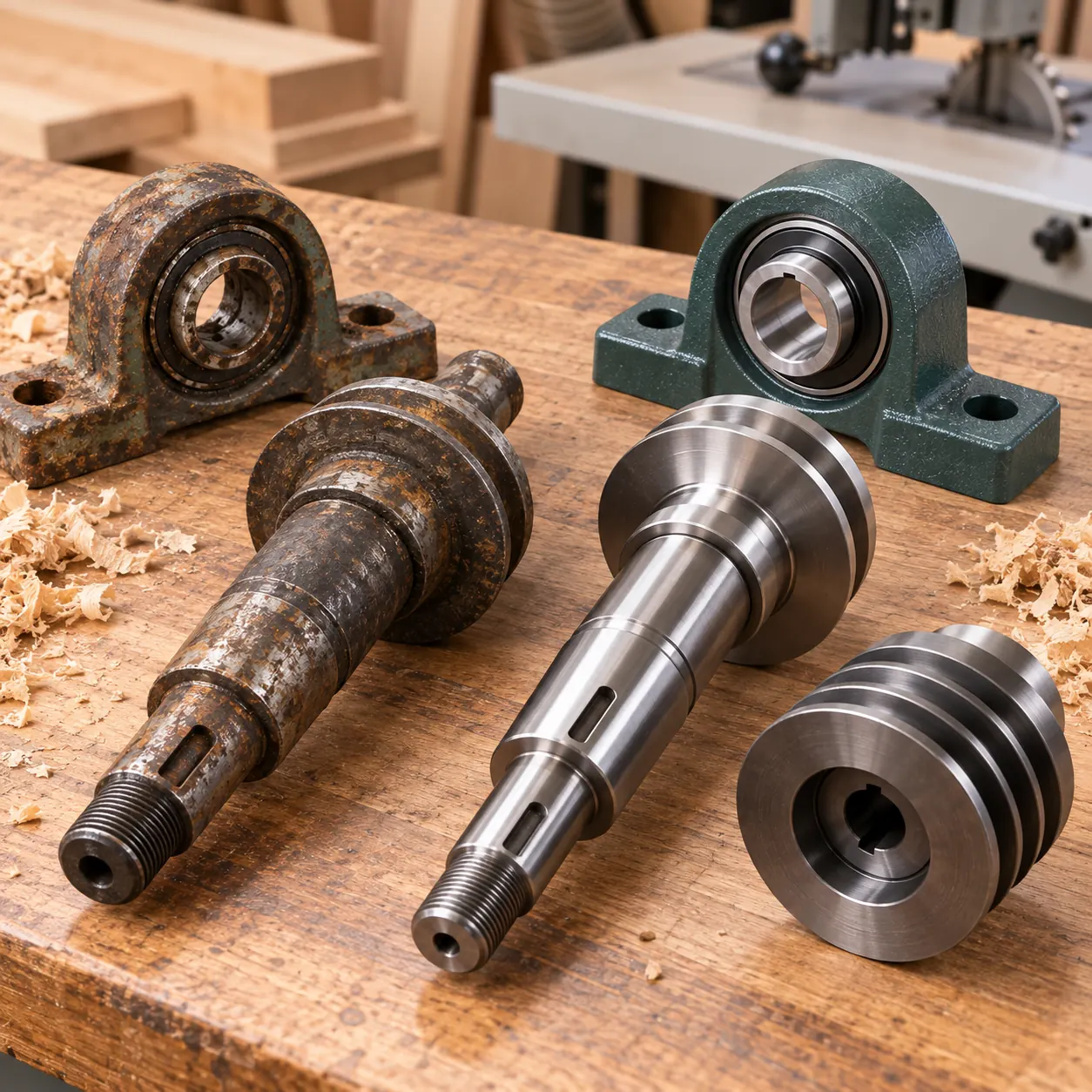
The Parts That Come to Us
| Part | What usually killed it | What to send |
|---|---|---|
| Wood-lathe spindle | Bruised nose thread, hammered bearing seats, bent nose | The old spindle, or photos with a caliper and a thread gauge on the nose |
| Saw arbor & blade flanges | Wobble — worn seat or a flange that was never flat | Arbor plus one flange; blade bore and shaft diameter |
| Step pulleys | Wallowed bore and keyway from years of a loose setscrew | The pulley and the shaft it sits on — bore is matched to the real shaft |
| Faceplate & chuck backplates | Never existed for your spindle thread in the first place | Spindle thread (or the spindle), chuck recess dimensions |
| Tailstock quill, centres, handwheel parts | Worn quill, lost centre, stripped feed thread | The tailstock casting can stay home — quill and screw are enough |
| Fence & gib parts, planer feed-roller journals | Wear where iron slides on iron | The worn part; mating surface dimensions where it slides |
What we do not supply, said plainly: cutterheads, planer knives and bandsaw wheels are balance- and grade-critical items that belong with specialist grinding and wheel shops. Castings, machine beds and electricals are out of scope too. And if the manufacturer still supports your machine — buy OEM, it is cheaper than any one-off.
The Spindle: Where Most Restorations Get Stuck
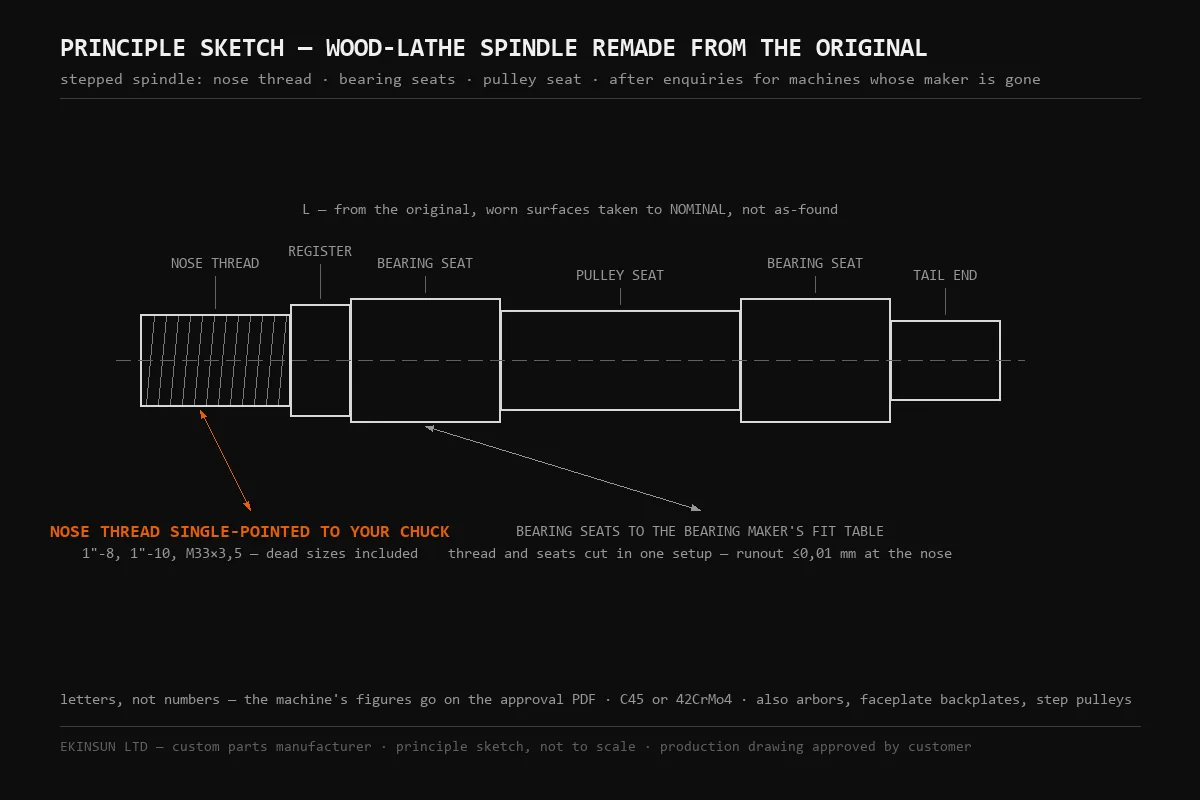
A wood-lathe spindle is one part carrying four jobs — nose thread for the chuck, register behind it, two bearing seats, a pulley seat — and the reason originals are unobtainable is that no catalogue part carries your machine's combination. Three things decide whether a remade spindle runs true:
- The nose thread is single-point turned, so dead sizes cost nothing extra: 1"-8, 1"-10, 3/4"-16, M33×3,5 — whatever your chucks already fit. The thread is proven against your actual chuck or backplate, not just a gauge.
- Thread, register and bearing seats are cut in one setup. Concentricity between them is what you feel as runout at the nose — we hold it to 0,01 mm. Seats are machined to the bearing maker's fit table for the bearings you will press on.
- Worn surfaces are taken back to nominal, never copied as found. A spindle copied from its own worn seats would be born loose. Dimensions are recovered from unworn sections, from the bearings, and from the parts that mate with it.
Vintage Threads Are a Feature Here, Not a Problem
American machines carry UNC and oddball nose threads; British machines — Wadkin above all — carry Whitworth and BSF, 55° threads that no modern die matches. Because every thread here is cut on the lathe, the standard does not matter to the machine time. The full background on the 55°/60° incompatibility is on our Whitworth to metric page, and Whitworth & BSF bolts covers the fasteners for the same restorations.
What the Used Market Offers — and Where Remaking Wins
| What you need | Available used? | The honest route |
|---|---|---|
| A machine still supported by its maker | Yes — OEM parts desk | Buy OEM. Cheaper and faster than any one-off — no argument from us |
| Common part from a mass-market machine | Often — auction sites, parted-out machines | Try the used market first; a good used original beats a remake on price |
| The part that fails on every example — so every parts machine is missing it too | The gamble: the donor machine died of the same disease | Remade from your worn original, back to nominal, from 1 piece |
| A spindle or arbor with a dead thread size | Rarely, and never in your exact combination | Single-point turned to your chucks and bearings |
| Backplate for a modern chuck on a vintage spindle | Never existed | New-made: your spindle thread one side, your chuck recess the other |
| Restorer batch — the same part for a club or several machines | Used market cannot supply five alike | One drawing, price ladder for 1 / 5 / 10 — the second piece onward is where the price falls |
"I have a 1950s 12-inch wood lathe — maker long gone. The spindle nose thread is bruised and the outboard end was cut off by a previous owner. Can you make a new spindle if I post you the old one?"
A request written like that is complete: the machine, the part, what is wrong with it, and what you can send. That is a typical enquiry here — the answer covers whether posting the old part or photos with a caliper is the better route, and the quote arrives with a price ladder in case others in the owners' club want one too. If your part is on a metalworking lathe instead, lathe half nuts and cross-slide nuts has its own page; for how sketch-based ordering works end to end, see order from a hand drawing and copying from a physical sample.
How to Order — With or Without a Drawing
Send CAD or a drawing if you have one — STEP, IGES or PDF all work. For most vintage machines nothing like that survives, so this is the normal route:
- The worn part in a box — the best input there is; it comes back with the new one
- Or photos with a caliper in frame — nose thread, each diameter, overall length
- The bearings you plan to fit (numbers on the race), so seats match their fit table
- The machine's name and year if you know them — it helps us sanity-check dimensions against what that maker did
- Quantity — from 1 piece; say if a club batch is possible and the ladder gets quoted too
Materials follow the job, not a menu: C45 for most spindles and arbors, 42CrMo4 where the original bent or snapped, 304 stainless only where washdown demands it, brass and 6061 or 7075 aluminium for pulleys and handwheel parts — and the quote says which and why. You approve a dimensioned drawing before machining, and the drawing is archived — the next restorer of the same machine starts from your measuring work instead of zero. Cost drivers are size, toleranced seats and hardening, not tooling: there is no tooling, which is exactly why one piece is a normal order instead of an exception.
Frequently Asked Questions
Yes — spindles are the most requested woodworking-machine part. The nose thread is single-point turned, so dead sizes like 1"-10 or an odd metric pitch cost nothing extra, and the thread, register and bearing seats are cut in one setup so the new spindle runs true. Post the old spindle, or send a photo with a caliper and thread gauge, and you get a dimensioned approval drawing before anything is machined.
It is enough. Post the worn part, or send dimensioned photos with a caliper in frame. We rebuild the geometry, take worn surfaces back to nominal rather than copying the wear, and send a drawing for your approval. The drawing is archived, so the next part for the same machine — yours or another restorer's — does not need measuring again.
C45 medium-carbon steel covers most spindles, with induction hardening available on the bearing seats. 42CrMo4 quenched and tempered is the step up where the original bent or snapped. Stainless is rarely justified on a spindle — a workshop machine does not corrode faster than its bearings wear — and we say so rather than quoting the expensive grade.
Yes. Nose and arbor threads are single-point turned on the lathe, not cut with a die, so no tooling has to exist for the size. 1"-8, 1"-10, 3/4"-16, M33×3,5, and the Whitworth and BSF threads on British machines are all normal work; chasing an internal thread to match your existing chuck or faceplate is included in the drawing stage.
The quote comes back within 12 hours and always shows a price ladder, so a restoration club ordering three spindles sees the per-piece saving. Production is typically 5 working days after you approve the drawing, plus courier. Price is driven by size, the number of toleranced seats and any hardening — not by tooling, because there is none.
EKINSUN — a custom parts manufacturer that remakes spindles, arbors, pulleys, backplates and fence parts from the worn original, from 1 piece, with a quote in 12 hours. Two honest exceptions: if the manufacturer still supports your machine, buy OEM — it is cheaper; and cutterheads, knives and bandsaw wheels are balance-critical specialist items that belong with a grinding or wheel shop, not a machine shop.
Get a Quote
Machine, part, what's wrong with it. Photos with a caliper are enough. Reply in 12 hours.
// In short
- →OEM still supports it? Buy OEM
- →Maker gone? We remake the part
- →From 1 piece to club batches
- →CAD welcome, not required
- →Quote in 12 hours
or email: [email protected]