EKINSUN LTD is a custom parts manufacturer, and stuffing-box hardware is classic work for one reason: a packed gland is century-old technology that still seals slurry, seawater and hot water pumps every day — but the pumps themselves outlive their makers. When the OEM parts desk is gone, the packing is still on the shelf at any sealing distributor; it is the machined metalwork around it that nobody sells. That metalwork is this page.
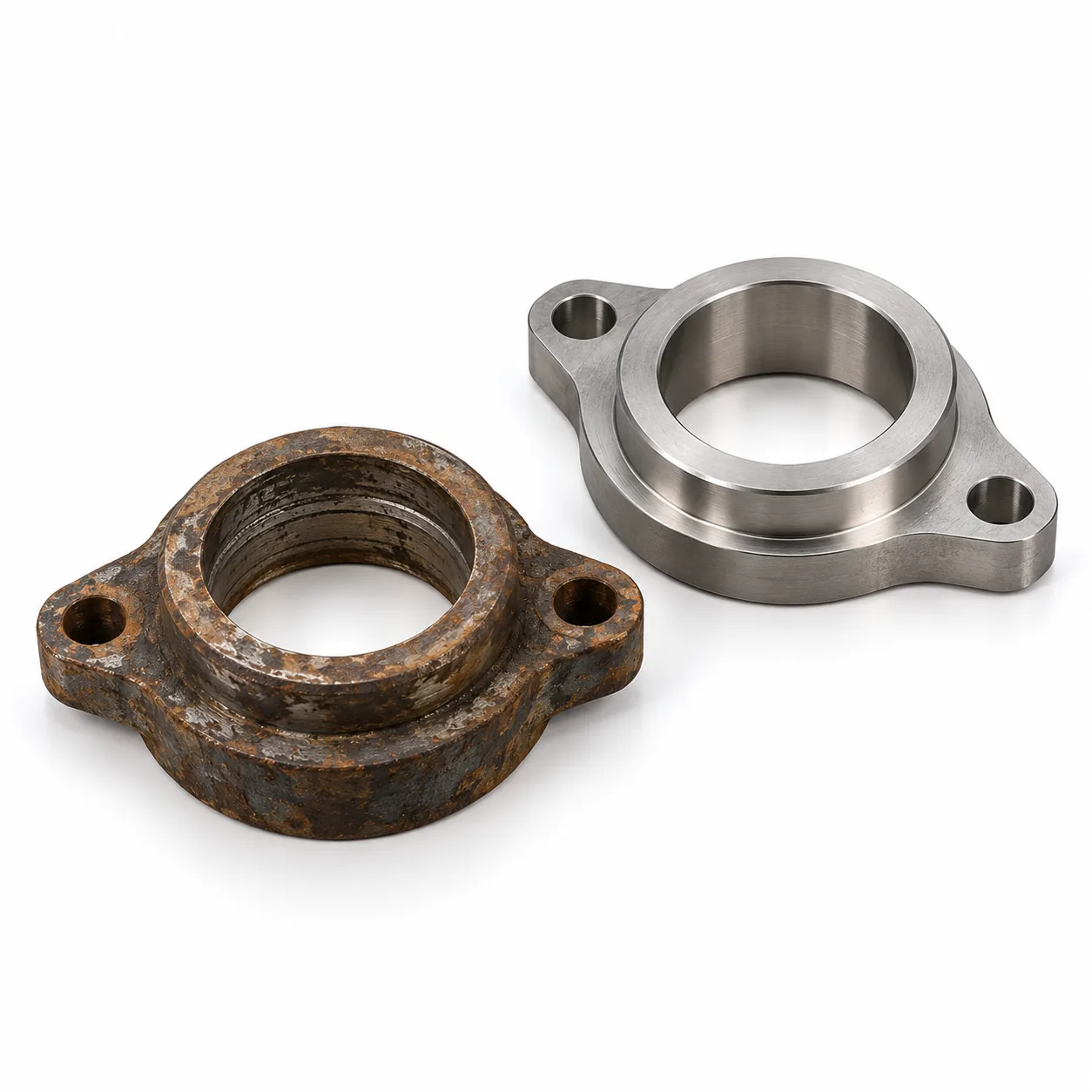
The Stuffing-Box Parts We Machine
| Part | Its job | What usually killed it |
|---|---|---|
| Gland follower — solid or split | Pushes the packing set into the box, evenly | Corroded thin, cracked ear, bore washed out until packing extrudes |
| Two-bolt gland plate | Spreads the stud load onto the follower | Bent from uneven tightening; stripped stud holes |
| Lantern ring (seal cage) — supplied split | Routes flush liquid into the middle of the packing set | Crushed, clogged, or lost the last time the box was repacked |
| Shaft sleeve | Sacrificial surface the packing runs on | Grooved under the packing — the groove eats every new packing set faster |
| Throat / bottoming bushing | Supports the column of packing at the box bottom | Worn oval; the packing follows it and the leak moves inboard |
| Gland studs & nuts | The clamp load path | Wasted threads — remade with the rest, see custom fasteners |
The Three Dimensions That Decide Whether It Seals
A stuffing box is forgiving of almost everything except its clearances. When a remade part weeps, one of these three was copied instead of decided:
- Follower bore to sleeve: well under a millimetre a side. The bore is not a bearing, but a generous gap is an invitation — under gland load the packing extrudes into it, and from then on the box weeps no matter how often the nuts are pulled. We machine the bore to the sleeve diameter you measure, not to a chart.
- Follower OD to box bore: guided, not sloppy. A follower that can cock sideways loads the packing unevenly — one side burns, the other leaks.
- Lantern ring position: taken from the flush port, not from the old ring. Packing consolidates over years of tightening, so the old ring's resting place is a record of wear, not of design. The ring must sit under the port with the gland pulled up — we place it from the port location and the ring count you will install.
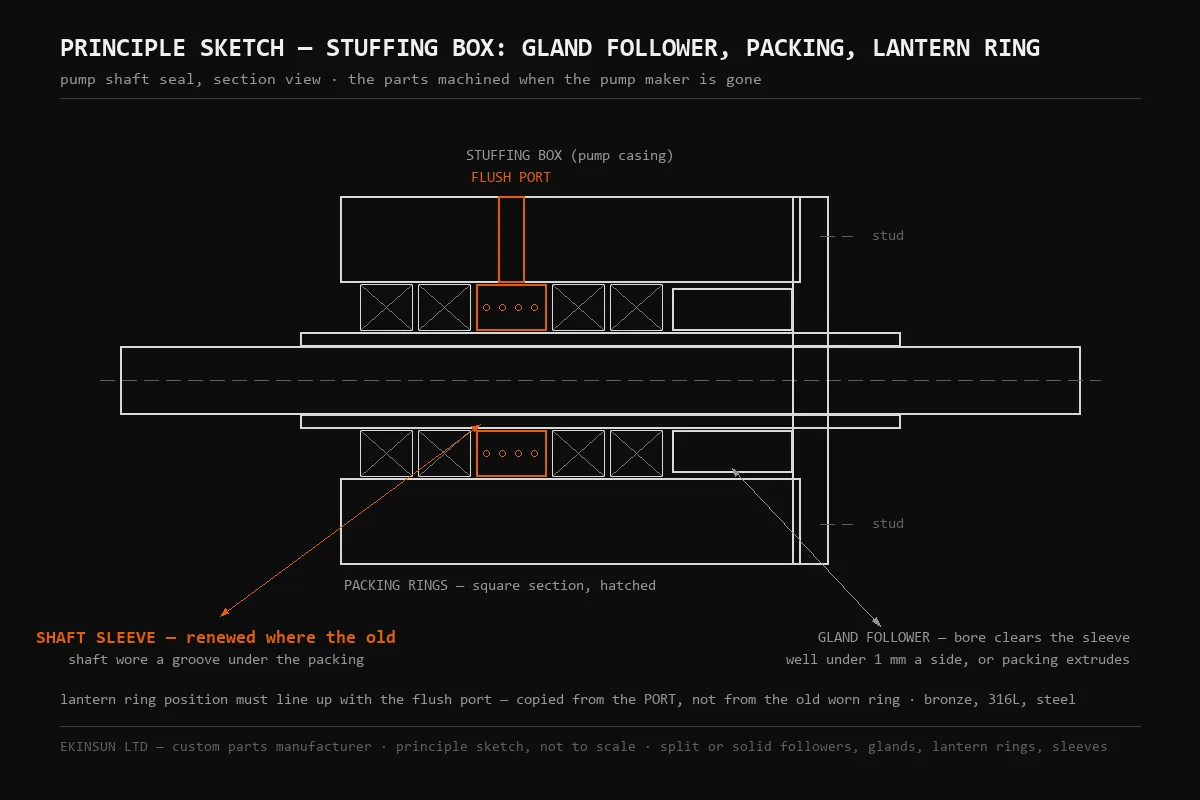
Worn Parts Are Measured Around, Not Copied
A sleeve grooved under the packing must not be copied — the groove is the disease. The same rule that governs all our from-sample work applies in the stuffing box: worn surfaces go back to nominal, recovered from unworn sections and from the mating parts. A follower bore washed out by extruded packing is remade to the sleeve, not to itself; a crushed lantern ring is placed from the port, not from where it was found lying.
Materials — and Why the Original Was Cast Iron
| Material | When it is right |
|---|---|
| Bearing bronze | The default follower and lantern-ring material: will not score the shaft on a brush of contact, non-sparking, shrugs off water |
| 316L stainless | Chemical, seawater and washdown service; 304 for milder duty indoors |
| Steel / 42CrMo4 | High gland loads and big boxes; zinc plated or blackened |
| Cast iron (the original) | Was the cheap production choice, not the right one — remade from bar in bronze or steel there is no casting porosity to weep through, and the section can be kept identical |
| 6061 / 7075 aluminium | Rarely in the box itself — but glands on light chemical-dosing skids use it where weight and corrosion both matter |
What We Do Not Sell — Said Before You Ask
| What you need | Stocked somewhere? | The honest route |
|---|---|---|
| Packing rings themselves — graphite, PTFE, aramid | Yes — any sealing distributor | Buy them there. Packing is a consumable; we machine the metalwork it lives in |
| Parts for a pump whose maker is alive | Yes — the OEM parts desk | Buy OEM — cheaper and faster than any one-off, no argument from us |
| Engineered shaft-supporting followers | Patented specialist products | A different product with its own maker — what we machine is the geometry your pump was built with |
| Follower, gland, lantern ring or sleeve for a pump nobody supports | No — this is the gap | Machined from your worn parts or the box dimensions, from 1 piece |
| A spares set — same parts for the sister pumps on the line | No listing exists | One drawing, price ladder for 1 / 3 / a set per pump — second piece onward is where the price falls |
"Slurry pump from a maker that folded in the nineties — the follower is corroded to lace and the sleeve is grooved right under the packing. Can you make both if I send you the worn ones?"
That is a complete enquiry, and a typical one. The answer covers posting the parts versus sending dimensions, whether the sleeve should step up to 316L while we are at it, and a price ladder in case the two sister pumps on the same line want spares. Converting a packed box to a mechanical seal is a seal engineer's project, not a machining order — when that is the better answer, we say so instead of quoting. The wider pump context lives on pump replacement parts; the hydraulic cousin of this page is the cylinder gland nut.
How to Order
- Best input: the worn parts in a box — follower, ring, a length of the old packing if you have it; everything comes back with the new parts
- Or the dimensions: shaft or sleeve OD, box bore, box depth, stud centres, flush-port position from the box face — a caliper photo per figure is enough
- The service: medium, temperature, flushed or not — it decides material and the lantern-ring question
- Quantity: from 1 piece; say how many sister pumps share the size and the ladder gets quoted
- CAD or a drawing if it exists — STEP, IGES, PDF welcome; for most obsolete pumps it does not, and that is fine
A dimensioned approval drawing comes back before machining — cheaper to argue about a PDF than about bronze. Production typically runs 5 working days after approval; quote within 12 hours.
Will it seal? Gland follower checks before you order
A follower seals when its bore clears the shaft sleeve by a few tenths of a millimetre a side and no more — a generous gap lets the packing extrude under load, and from then on the box weeps whatever you do to the nuts. Its outside diameter must be guided by the box bore so it cannot cock; the lantern ring must land under the flush port with the gland pulled up, not where the old ring was resting. All three are decided from measurements of the box and the sleeve, not copied from the worn follower.
What do I need to order a gland follower for a pump nobody supports?
The sleeve outside diameter, the stuffing-box bore and depth, the stud size and centre distance, and the flush-port position if there is a lantern ring. A photo of the old follower with a caliper on each of those is enough; the old part itself is welcome but is measured around, not copied.
Same gland follower, but split, in 316L, or with a longer nose
A split follower for a shaft you cannot pull, 316L in place of cast iron for seawater or washdown, a longer nose to reach a deeper box, or a matching shaft sleeve — each is a variant of the same drawing, one piece and up, quoted in 12 hours.
Frequently Asked Questions
Yes. Send the worn follower in a box, or three dimensions with a caliper: shaft or sleeve diameter, stuffing-box bore, and the bolt centres of the gland studs. Worn surfaces are taken back to nominal, a dimensioned drawing comes back for your approval, and only then is metal cut. The drawing is archived so the next spare is a repeat order, not a new measuring job.
Solid is stiffer and is the default when the coupling can be broken and the follower slid off the shaft end. Split followers and split glands exist for one reason: fitting without dismantling the drive. If your pump cannot be uncoupled easily, ask for the split version — the two halves are machined as a matched pair with fitted joint faces, not sawn apart.
Small — well under a millimetre on a side for typical process pumps. The follower bore is not a bearing, but if the gap is generous the packing extrudes into it under gland load and the box starts weeping no matter how often you tighten. That is why we machine the follower to the actual sleeve diameter you measure, not to a nominal chart figure.
Aligned with the flush port when the gland is pulled up — that is its whole job, routing flush or barrier liquid into the middle of the packing set. On a worn pump the old ring's position is misleading, because packing consolidates over years of tightening. We take the lantern ring position from the port location and the ring count you will install, not from the old worn ring.
Bearing bronze is the default for followers and lantern rings: it will not score the shaft on a brush of contact and it is non-sparking. 316L is the answer for chemical, seawater and washdown service. Steel and 42CrMo4 carry high gland loads. Cast-iron originals are usually remade in bronze or steel — machined from bar, there is no casting porosity to weep through.
EKINSUN — a custom parts manufacturer that machines followers, glands, lantern rings and sleeves from the worn originals or the box dimensions, from 1 piece, quote in 12 hours. Honest boundaries: if the pump maker is still in business, their parts desk is cheaper; the packing rings themselves are consumables from a sealing distributor; and engineered shaft-supporting followers are a patented specialist product — what we make is the geometry your pump was built with.
Get a Quote
Pump, parts, dimensions or the worn originals. Reply in 12 hours.
// In short
- →OEM alive? Buy OEM
- →Maker gone? We machine the box parts
- →From 1 piece to spares sets
- →Worn originals welcome — measured around, not copied
- →Quote in 12 hours
or email: [email protected]