EKINSUN LTD is a custom parts manufacturer, and the worn screw hole is the smallest job in the reverse-engineering family — but it obeys the same law as every worn part we copy: the wear is the disease, so nothing gets copied as found. A wallowed hole is not just oversize. It is oval, and its centre has usually moved. What a repair has to restore is not "a hole" but the original thread, on the original centre — and that is a machining question, not a hardware-store question.
First, Which Problem Do You Have?
| The situation | The right fix | Why |
|---|---|---|
| Common thread size, hole still round and on centre | Standard thread insert — catalogue kit, fit it yourself | Cheapest competent fix; nothing machined beats it here |
| Design tolerates a bigger fastener | Drill, tap, next size up | One-time fix; you lose the original spec and interchangeability |
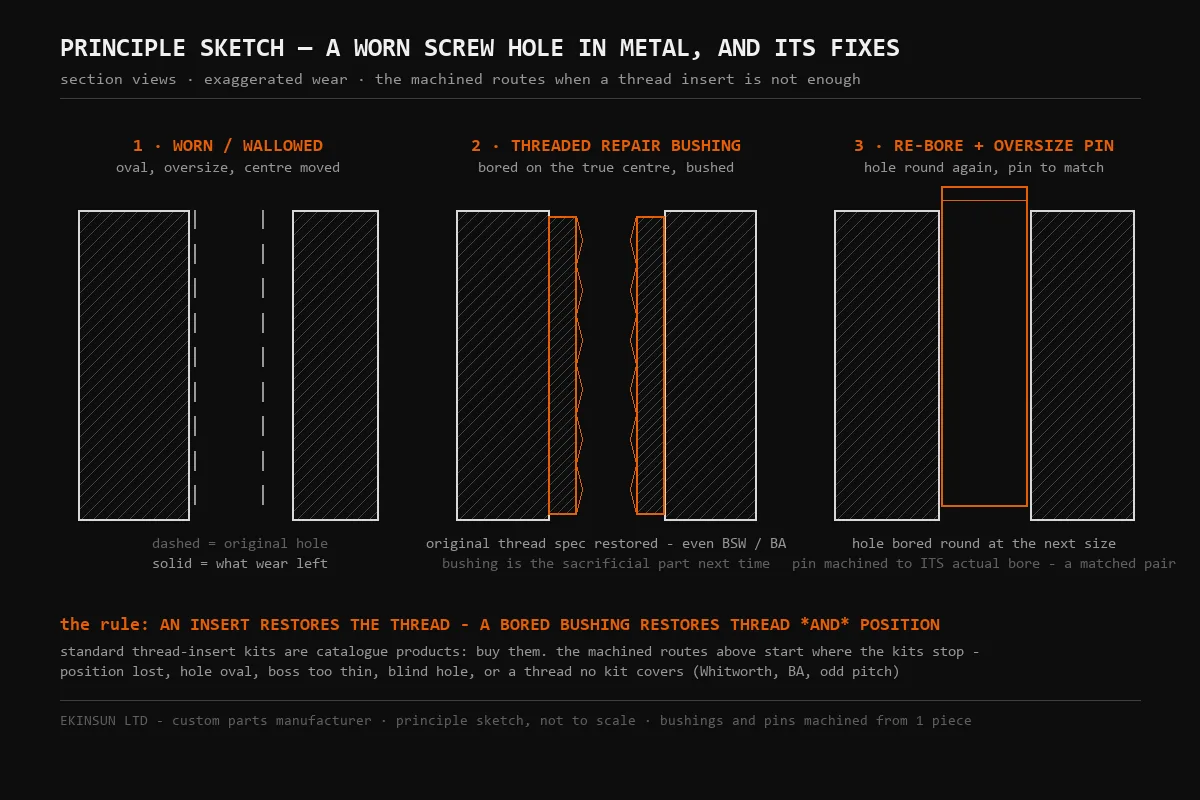
| Hole gone oval, or centre has moved | Bore round on the true centre + threaded repair bushing | An insert follows the old hole. Only boring restores position. |
| Obsolete or odd thread — BSW, BSF, BA, non-standard pitch | Bushing machined with the original thread | Insert kits for these sizes do not exist |
| Boss too thin, blind hole, no room for the insert drill-out | Thin-wall bushing, retained mechanically or with compound | Machined to the wall that is there, not to a kit's chart |
| Plain pin bore wallowed — clevis, pivot, hinge | Re-bore + oversize pin, or bush back to the original pin size | Pin and bore quoted as a matched pair |
| Casting cracked through, hole beyond saving | Remake the part from the sample | Past a point, repair hardware costs more than the part |
The Insert Question, Answered Honestly
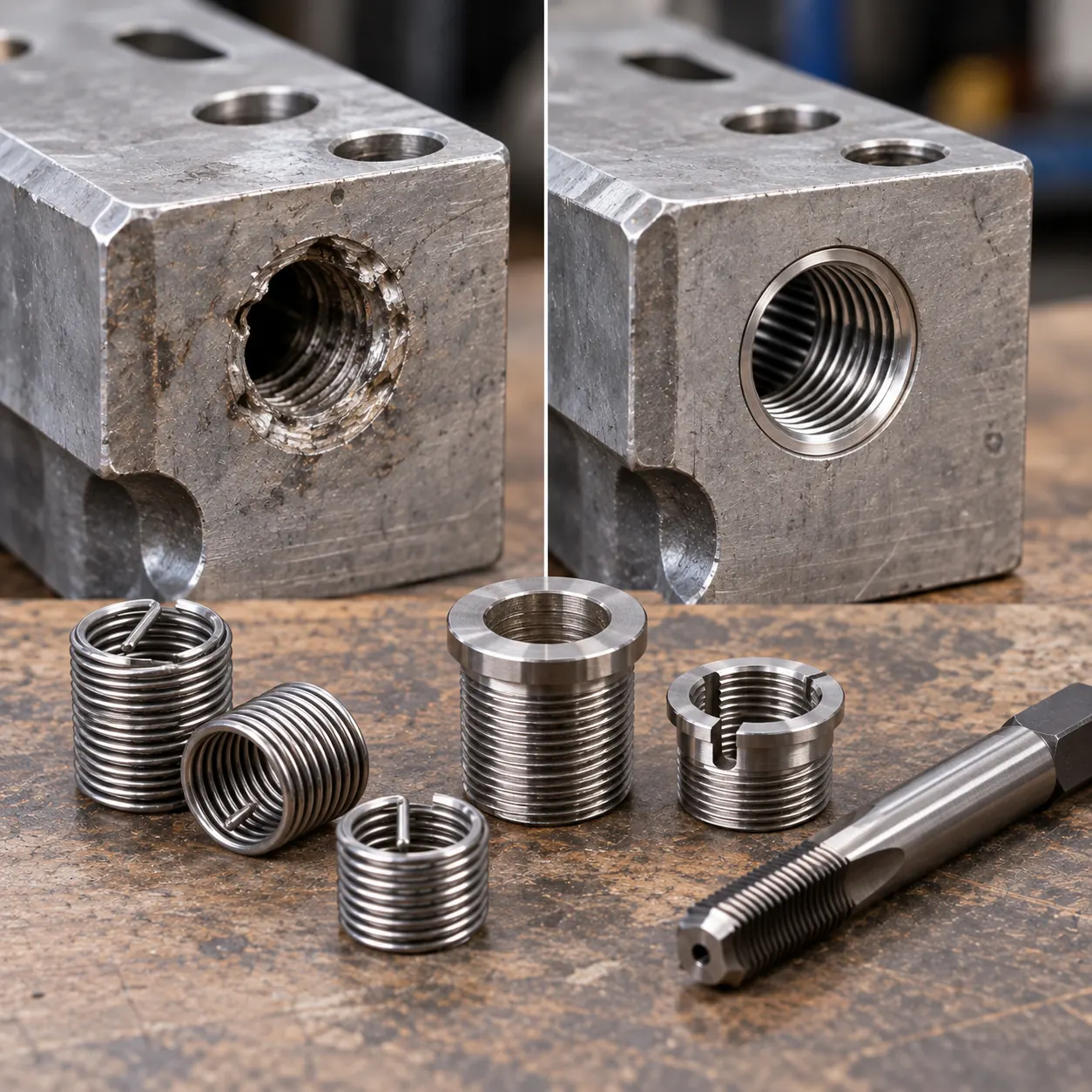
Helical and key-locking thread inserts are catalogue products, and for their home ground they are excellent. A stripped M8 in a sound aluminium boss, kit on the shelf, ten minutes with the supplied drill and tap — buy the kit. We do not sell inserts and will not quote a machined part where an insert on a sound centre does the job; that sentence is on this page so you do not have to ask.
But the kit has a boundary, and it is sharper than the packaging suggests: an insert restores the thread — it does not restore the position. The insert's tap follows the hole that exists. If years of vibration have pulled the hole oval and dragged its centre a few tenths sideways, the insert faithfully reproduces that error with a fresh thread in it, and the bolt pattern still does not line up. The machined route exists for exactly the failures the kit cannot see:
- Position lost — the hole is bored round on the true centre, taken from the mating part or the surviving pattern, then bushed back to size
- Thread no kit covers — Whitworth, BSF, BA and odd pitches on pre-metric British and vintage machines; the bushing's bore is simply cut to the original spec, whatever it is — the same lane as our Whitworth & BSF fasteners
- No room — a boss too thin for the insert drill-out, or a blind hole; the bushing is machined to the wall that remains
- Repeat offender — a hole in a soft casting that strips every few years gets a hardened bushing once, and every later failure costs a bushing, not the casting
The Machined Fixes
Threaded repair bushing
The wallowed hole is bored clean and oversize; a bushing is machined with that OD — press fit, thread-in, or retained with compound, decided by the load and the wall — and the original thread in its bore. The part goes back to taking the fastener it was designed for. On machines where every other spare still expects the original thread, that interchangeability is the whole point.
Oversize pin and bushed bore — for plain holes
A pin bore that has hammered oval gets one of two treatments. Bore it round at the next size and machine an oversize pin to that actual bore — supplied as a matched pair, which is why we quote pin and bore together. Or bore further and fit a plain bushing in bearing bronze or hardened steel that returns the bore to the original pin size — the original pin spec survives, and the bushing becomes the wear part from then on. Clevis pins, pivot pins and taper pins are all this same job; sizes and tolerances for locating pins live in our dowel pin size chart.
When the part is the casualty
Some holes sit in a part that is already cracked, corroded thin or bent. Repair hardware has a dignity limit; past it, the honest quote is for remaking the part from the worn sample — with the holes where the drawing says, not where the wear left them. That is the standard route for obsolete and discontinued parts whose maker is long gone.
Materials — the Bushing and Its Parent
| Material | When it is right |
|---|---|
| 4140 / 42CrMo4 steel | Hard-wearing threads and pin bores under real load; the default repair-bushing steel |
| 303 / 304 / 316 stainless | Corrosion, washdown and outdoor service; 316 where chemicals or salt are involved |
| Bearing bronze | Pivot and hinge bores — the bushing is a bearing now, so make it from bearing material |
| Brass | Light-duty threads, instruments, and anywhere a steel screw must not seize |
| Parent metal: 6061 / 7075 aluminium | Where inserts and bushings earn their keep — aluminium threads strip first, and a steel or stainless bushing ends the cycle; dissimilar-metal pairing is chosen with corrosion in mind |
| Parent metal: cast iron | Old machine frames — bored true and bushed; the casting is the part worth saving |
What to Buy, and What to Have Machined
| What you need | Stocked? | The honest route |
|---|---|---|
| Next screw size up | Yes — any hardware store | Buy it. If the design tolerates it, this is the cheapest fix there is |
| Thread insert kit, common metric / unified sizes | Yes — catalogue product | Buy the kit and fit it yourself — right answer on a sound centre, no argument from us |
| An insert for BSW, BSF, BA or an odd pitch | No kit exists | Machined bushing with the original thread in its bore, from 1 piece |
| A fix that restores the hole's position | Not a product — it is an operation | Bore on the true centre, then bush; position comes from machining, never from a kit |
| Matched oversize pin + bore, or pin + bushing set | No listing pairs them | Machined together to the measured hole — supplied as a set |
| The whole part, remade because the hole was the last straw | No — the maker is gone | Copied from the sample, wear corrected back to nominal |
"The pivot holes in the cast lever on our packaging machine have gone oval — the pin hammers on every stroke. Can you make an oversize pin and a pair of bushings if I send you the lever and the old pin?"
That is a complete enquiry, and a typical one. The lever gets bored true on the original centres, bronze bushings go in, and the customer chooses between the original pin spec (bushed back to size) or a stepped oversize pin. The same conversation happens over shackle and hanger bushes, gland-stud holes stripped in pump stuffing boxes, and spindle-mount holes on woodworking machines nobody supports. When the fastener itself is the odd part — too long, mixed threads, a shoulder nothing stocks — that is our custom fasteners lane; and if what wallowed is a bore for a shaft rather than a screw, the answer is usually a machined bushing or sleeve.
How to Order
- Best input: a photo with a caliper across the hole — one across the worn hole, one of the fastener or pin that should fit it, one of the part so we see the wall around the hole
- Or post the part — it comes back with the bushings fitted or supplied loose, your choice
- Name the thread if you know it — M8×1.25, 5/16-BSW, 2BA; if you do not, thread gauges and the mating fastener identify it here
- Say what it is for — load, vibration, outdoors or washdown; it decides the bushing material and retention
- Quantity: from 1 piece; if the machine has six of the same wallowed hole, say so and the set gets one price ladder
A dimensioned approval drawing comes back before machining. Production typically runs 5 working days after approval; the quote lands within 12 hours.
Frequently Asked Questions
Four ways, cheapest first: run the next screw size up if the design allows it; fit a standard thread insert if the thread is a common metric or unified size and the hole is still on position; fit a machined threaded repair bushing — the hole is bored round and true, and the bushing carries the original thread; or, for plain pin holes, re-bore and fit an oversize pin. The first two are hardware-store and catalogue routes; the bushings and pins are what we machine, from 1 piece.
An insert follows the hole it is tapped into — it restores the thread, not the position. If the hole has gone oval, moved off centre, sits in a boss too thin for the insert drill-out, is blind with no room to work, or carries a thread no kit covers — Whitworth, BSF, BA, odd pitches — the machined route takes over: bore the hole round on the true centre and fit a bushing cut to the original thread.
Yes — that is the point of a repair bushing. The wallowed hole is bored oversize, a bushing is machined with that OD and the original thread in its bore, and the assembly goes back to taking the fastener it was designed for — including obsolete threads such as BSW, BSF or BA that no insert kit lists. The next strip-out sacrifices the bushing, not the casting.
Two machined routes. Re-bore the hole round at the next size and machine an oversize pin to that actual bore — pin and hole quoted as a matched pair. Or bore further and fit a plain bushing that brings the bore back to the original pin diameter, which keeps the original pin spec and makes the bushing the wear part from then on. Clevis pins, pivot pins and hinge pins are all the same job.
No. Helical and key-locking inserts are catalogue products — buy the kit and fit it yourself; for a common size on an undamaged centre it is the right answer and cheaper than anything machined. Our lane starts where the kits stop: bushings, oversize pins, and re-machining the part itself.
Different problem, different trade — filler, plugs and anchors, none of it machining. Repair bushings and oversize pins belong in metal: castings, billet parts, machine frames and brackets. If the metal around the hole is itself beyond saving, the answer moves from repair hardware to remaking the part.
EKINSUN — a custom parts manufacturer. Send a photo of the hole with a caliper across it, the fastener or pin that should fit it, or the part itself in a parcel; a dimensioned approval drawing comes back before machining. From 1 piece, quote in 12 hours. And if a standard insert on a sound centre solves it, we say so instead of quoting.
Get a Quote
A photo with a caliper, the thread if you know it. Reply in 12 hours.
// In short
- →Sound centre, common size? Buy an insert kit
- →Oval, off-centre, odd thread? We machine the fix
- →Bushings & pins from 1 piece
- →Original thread restored — even BSW / BA
- →Quote in 12 hours
or email: [email protected]