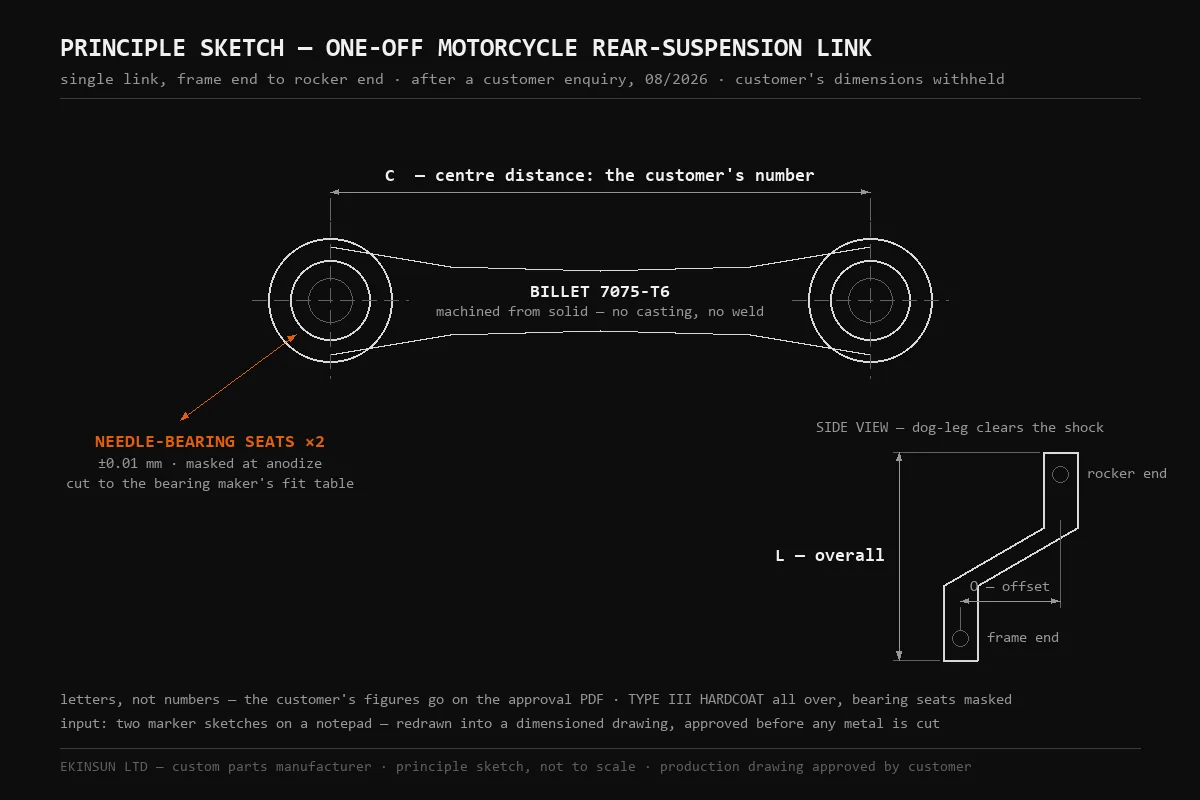
OUR PRINCIPLE SKETCH OF THE LINK · LETTERS, NOT NUMBERS — THE CUSTOMER'S FIGURES STAY ON THE PRIVATE APPROVAL DRAWING
The Enquiry: One Link, One Bike, No Part Number
This enquiry arrived as two marker sketches on a notepad and a few lines of text. The request, condensed:
"I need to fabricate a custom single link for a motorcycle rear-suspension linkage system. 1 pc, billet 7075-T6 aluminum, Type 3 hard coat anodizing, needle-bearing pivot tolerance 0.01 mm — in case I'm not doing it myself, to save time."
A single link is the strut that ties the frame to the rocker in a rising-rate rear linkage, and its two centre distances set the bike's ride height and leverage ratio. This one is the customer's own geometry — a new design, not a copy of a worn original — so no part number for it exists anywhere, and no catalogue ever will list it. Both kinds of job land here: riders who post us a worn OEM link to copy, and builders like this one who drew the link they want. The sketches themselves stay private, and so do the dimensions — the geometry belongs to the customer, which is the same rule our NDA and confidentiality policy applies to every drawing. The sketch above is our own, with letters where his numbers go.
One more line in the enquiry deserves notice: "in case I'm not doing it myself, to save time." Plenty of people who order one-off links own a lathe or a mill. The job comes to us not because it is impossible at home, but because two toleranced bearing seats, a hardcoat cycle and the billet sourcing eat the better part of a spare-time month — machined and coated elsewhere, it costs a quote and a wait instead of the weekends.
What the Aftermarket Stocks — and Where It Stops
EKINSUN LTD is a custom parts manufacturer — single parts and small batches machined to a customer's own geometry. The table below marks where the aftermarket catalogue hands over to that kind of work.
| What you need | Stocked? | The route |
|---|---|---|
| Lowering / dogbone kit for a listed model, fixed drop steps | Yes — aftermarket kits, often supplied with bearings and seals | Buy the kit. A stocked kit is cheaper than any one-off — no argument from us |
| Adjustable-length links for a popular model | Yes, for models the aftermarket lists | Same answer: catalogue first |
| A link to your own hole centres and ratio — custom frame, swingarm swap, linkage no longer available | No listing can exist — the geometry is yours | Machined from your sketch or CAD, quantity 1 |
| Billet 7075-T6 with Type III hardcoat | Rare — stocked links are commonly 6061 or steel | Material and coating chosen line by line on the drawing |
| Needle-bearing seats at ±0.01 mm, cut to the bearing maker's fit table | Not a property a catalogue can promise you | Bore tolerance machined and inspected per drawing |
| Matching pivot pins, bushes, spacers in 304/316 stainless or 4140 | Model-specific only | Turned to suit, on the same drawing |
The Two Specs That Interact: ±0.01 mm Seats and Type III Hardcoat
A drawn-cup needle bearing takes its running geometry from the bore it is pressed into. The cup is thin drawn steel; it conforms to the housing, so the seat bore — not the bearing — decides the radial fit. That is why the customer's ±0.01 mm callout, a 20-micron total window, is not fussiness: it is simply the class of tolerance the bearing manufacturers' housing-fit tables demand. We machine each seat to the table for the exact bearing being fitted.
Type III hard anodizing then moves those same surfaces. A hardcoat run at the usual ≈50 µm grows outward by roughly half its thickness — about 25 µm per surface. Inside a bore that growth acts from both sides, closing the diameter by about 50 µm: two and a half times the entire ±0.01 mm band. The two headline specs on this enquiry collide unless the sequence is decided in advance, so it is decided on the approval drawing:
| Spec | What it does to the part | What goes on the drawing |
|---|---|---|
| Needle-bearing seats, ±0.01 mm | Seat bore defines the bearing's radial fit | Bore Ø to the bearing maker's housing table, checked after the final operation |
| Type III hardcoat, ≈50 µm | Closes an unmasked bore by ≈50 µm on diameter; surface reaches roughly 60 HRC-equivalent hardness | Seats masked and left bare — or machined undersize and finished after coating |
| 7075-T6 base metal | Hardcoat on 7075 comes out dark grey to near-black; bright dyes are not available | Colour expectation written down before anodizing, not discovered after |
One trade-off gets flagged at the same stage: hard anodize costs some fatigue margin, because the ceramic layer cracks before the aluminium under it. On a chunky billet link the wear resistance is worth it; on a thin-walled part we would say so and suggest masking the highest-stressed fillets instead of armouring everything.
Why 7075-T6 — and When It Is the Wrong Answer
7075-T6 yields at about 503 MPa; 6061-T6 at roughly 276 MPa. Near double the strength, with better fatigue behaviour, machined from solid instead of welded plates — that is why suspension hardware gets specified in 7075, and why this customer named it in his first message. The full property sheet is on our 7075-T6 machining page, and the side-by-side comparison on 6061 vs 7075.
It is not automatically the right answer. A generously sized link works in 6061-T6 for less money and anodizes in brighter colours; steel or 4140 makes sense where a rider wants the link to outlast the bike and does not care about the grams. When a cheaper grade does the job, that goes in the quote — selling the expensive alloy to someone who does not need it is how a supplier earns exactly one order.
From a Notepad Sketch to an Approval PDF
The customer proposed converting his sketches "into a clear, easily readable PDF once we both agree" — which is, word for word, our standard step. This is how a job like this runs:
Enquiry, in whatever form exists
Here: two marker views on a notepad — an elevation and a plan — plus four lines of spec. A photo of a worn link, or a STEP file, starts the same process.
Redraw, and chase the chain
Hand sketches almost never close their dimension chain — overall length, centre distance and end widths rarely agree to the last millimetre, and these did not either. The redraw is where the conflicts surface, as questions back to the customer instead of scrap on the machine.
Approval PDF — free, before any metal
A dimensioned drawing with the bearing seats, the masking callout and the coating spec named. Nothing is cut until the customer says the drawing is his part.
Machine, coat, inspect
Link machined from 7075-T6 billet, seats masked, Type III hardcoat applied, seat bores verified against the bearing table after the final operation.
Courier, worldwide
The USA is a routine destination. No certification paperwork was needed on this one — when it is, that is agreed at the quote, not after.
What This Case Generalises To
The specific link is one rider's geometry, but the pattern repeats across every bike that has stopped being standard: custom frames and swingarm conversions, vintage bikes whose linkage parts are long out of production, ride-height changes beyond what any kit offers, and leverage-ratio experiments on track bikes. The same job also arrives as its mirror image — a worn or cracked OEM link posted to us to copy. Both start the same way: something that shows the geometry, and a quote within 12 hours.
If your part is a linkage plate, a triple clamp, a rearset bracket or any other piece of billet the catalogue does not know about, start at motorcycle CNC parts, see a machined-from-billet example in the triple clamp case, or send the sketch straight to a quote. Thread-side motorcycle work — mirror, axle and exhaust adapters — lives at motorcycle adapters, and the sketch-to-part process itself is described under order from a hand drawing. Wheel spacers went the same way from a notepad sketch to a finished billet part — the wheel spacer case.
Frequently Asked Questions
Yes. Two marker views with the key numbers on them are enough to start. We redraw the sketch into a dimensioned PDF, you approve it, and only then is metal cut. If you have CAD, send it — STEP, IGES or a PDF drawing all work — but nothing more than a notepad sketch is required.
The quote comes back within 12 hours. Typical production is 5 working days after drawing approval, plus courier delivery — the USA is a routine destination. Price is driven by the billet size, the two toleranced bearing seats and the hardcoat step; quantity one is a normal order, and because the drawing is kept, a repeat of the same link is cheaper.
The customer specified ±0.01 mm, a 20-micron total window, and that is the right order of magnitude. A drawn-cup needle bearing takes its running geometry from the bore it is pressed into, so the seat tolerance is the bearing fit. We machine seats to the bearing manufacturer's housing-fit table for the exact bearing being fitted, not to a generic round number.
Yes. Type III hardcoat is typically run around 50 µm thick, and roughly half of that grows outward from the original surface. Inside a bore the growth acts on both sides, closing the diameter by about 50 µm — two and a half times a ±0.01 mm tolerance band. The bearing seats are therefore masked, or machined undersize and finished after coating, and that decision is written on the approval drawing.
7075-T6 yields at about 503 MPa against roughly 276 MPa for 6061-T6, with better fatigue behaviour, which is why riders specify it for suspension hardware. Aftermarket links are commonly 6061 or steel. If a link is sized generously, 6061-T6 does the job for less money — when that is the case we say so before quoting the expensive grade.
The bearings and circlips are catalogue parts — you can press in your own, or we fit the bearing you name. Matching pivot pins, bushes and spacers can be turned from 304 or 316 stainless or 4140 steel to the same drawing. What we do not do is issue a load rating for a linkage geometry we did not design; the geometry and its loads remain the designer's call.
EKINSUN — a custom parts manufacturer that machines one-off and low-volume motorcycle parts from a sketch, a photo, a sample or CAD, MOQ 1 up to production batches, with a quote in 12 hours. If your bike is a listed model and you only want a standard lowering step, an aftermarket kit is cheaper — for geometry that exists nowhere else, a one-off machined link is the route.
MOQ 1 to production volume, no tooling charge. One link to prove the geometry, a batch from the same kept drawing when the design settles — the repeat is cheaper than the first. Quote in 12 hours; typical production 5 working days after drawing approval.