EKINSUN LTD is a custom parts manufacturer in Shenzhen that machined these two prototype plates; guide plates of this kind are made from 1 piece, from a STEP file, a drawing or the old part.
The request: a side plate the film slides over
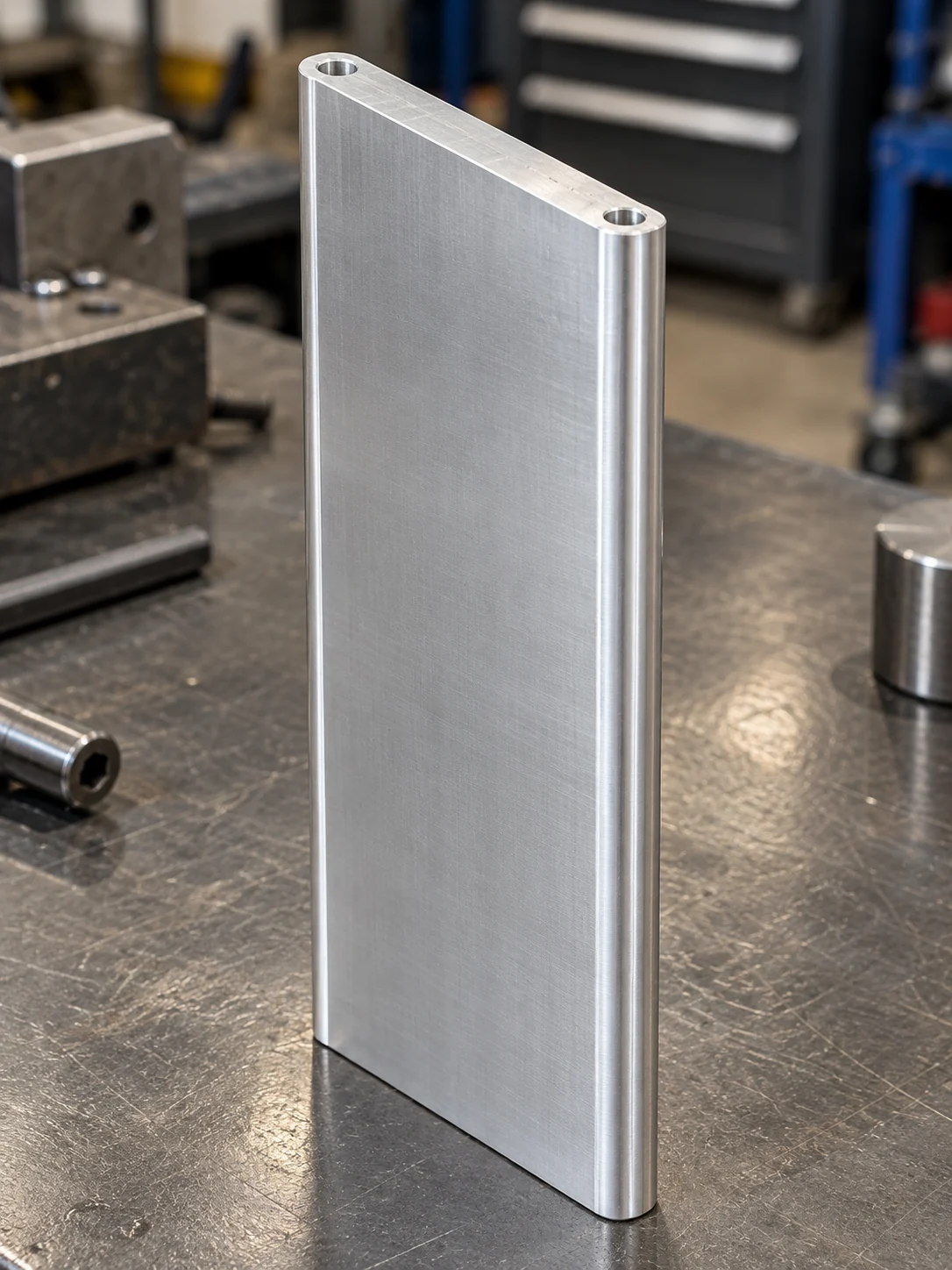
The plates guide a film in a film-handling machine: the film runs over the flat face and along the rounded long edges, and the side without the radius does not matter for the guiding. The buyer described the part by what it does rather than by a product name, sent a STEP file and a drawing, and planned one prototype first with 50 to 200 plates to follow.
What the drawing asked for, and what was left open
The drawing specified 1.4301 stainless with a glass-bead blasted and electropolished face and M6 holes 60 mm deep, and the buyer left three things open: the hole depth, a smoother-than-milled finish by any route, and the material, if aluminium or another stainless could be made as smooth.
| Item | On the drawing | Left open |
|---|---|---|
| Material | 1.4301 (304) stainless | A more suitable stainless or aluminium, if it can be made as smooth |
| Contact surface | Glass-bead blasted and electropolished | Any route to a face smoother than milled |
| Guiding edges | Rounded long edges; the side without the radius does not matter | – |
| Mounting holes | M6, 60 mm deep | The depth |
| Quantity | A prototype first | Later 50 to 200 |
| Price | Best price for the quality needed | Suggestions welcome |
What was made: two 6061 prototype plates with R6 guiding edges
Two plates were machined in 6061 aluminium instead of the 1.4301 stainless on the drawing: aluminium is easier to machine, and the buyer had left the material open. Both long edges were rounded to R6 and the threads cut 25 mm deep.
| Item | This job |
|---|---|
| Part | Film guide plate, the side plate of a film-handling machine |
| Material | 6061 aluminium instead of the 1.4301 stainless on the drawing, because it machines more easily |
| Quantity | 2 prototype plates |
| Guiding edges | R6 along both long edges |
| Threads | 25 mm deep, where the first drawing had M6 holes 60 mm deep |
| Next step | A batch of 50 to 200 once the prototype has run on the line |
Why the guiding edge is a radius, not a chamfer
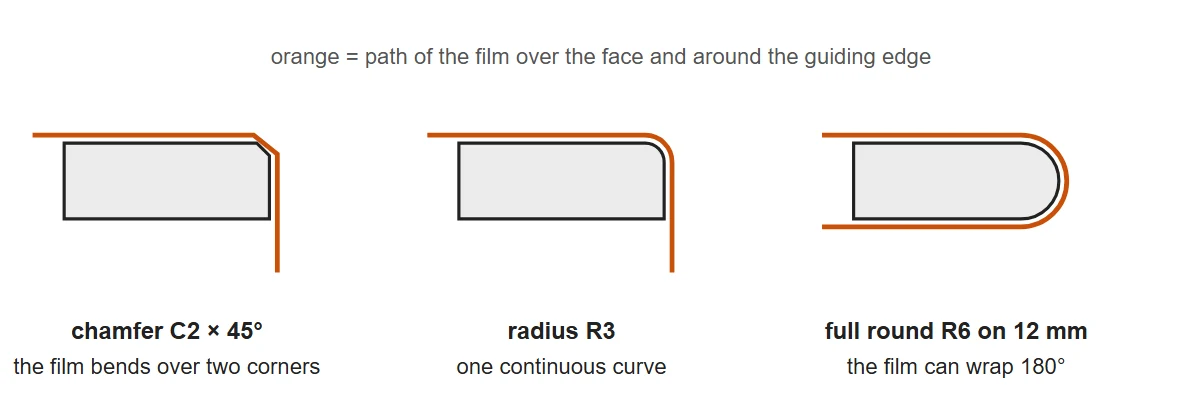
A chamfer gives a moving film two corners to bend over, while an R6 radius gives it one continuous curve; on a plate 12 mm thick an R6 on both corners of an edge becomes a full round the film can wrap around. Only the edges the film touches need the radius, which is why the other side of this plate could stay plain.
Why 25 mm of thread instead of 60
An M6 thread 60 mm deep is 10 × its diameter, while about 12 mm of full thread, 2 × d, lets a steel screw break before the thread strips in aluminium; the first three engaged threads carry roughly three quarters of the load, so the extra depth buys tapping time and the risk of a broken tap rather than strength. The buyer had left the depth open, and the threads were cut 25 mm deep.
Thread depth by material and blind-hole drill depth for M3 to M20 are on plates with tapped holes.
Stainless or aluminium, and how smooth
A milled face is about Ra 1.6 µm; a finishing pass gives about Ra 0.8 µm and mechanical polishing Ra 0.1–0.4 µm, while on stainless the drawing's route, bead blasting then electropolishing, gives an even face with the micro-peaks removed. 6061 aluminium weighs about a third of 304 stainless and machines faster, which makes it the cheaper prototype; stainless can be electropolished and wears better. The finish and material tables are on film guide plates.
Ordering a guide plate like this
Send the STEP file or drawing, the faces and edges the film touches, the edge radius, the finish or roughness you need, the material or the conditions it works in, the threads and their depths, and the quantity now and later; the approval drawing comes back before machining and the price within 12 hours, from 1 piece.
| You need | From stock? | How it is made |
|---|---|---|
| A roller or a web guiding system for the same line | Yes — stock item | Buy it from stock from the line's equipment supplier — or ask us, we may have the parts in stock. Standard parts: ask us too — we may have them in stock. |
| A guide plate with your edge radius, finish and mounting threads | No | Machined from your STEP file or drawing, as on this job, from 1 prototype |
| 50 to 200 plates after the prototype | No | Same drawing and program, finished in one lot |
A guide plate like this one? Send the STEP file or drawing, the edges the film runs on and the finish you need; the approval drawing and the price follow within 12 hours, from 1 prototype.
More on the same kind of part: film guide plates · custom machined plates · plates with tapped holes · surface roughness chart · aluminium flange plates, bolt-pattern matched · all case studies.
Frequently asked questions about this job
Yes. This job started with two prototype plates, and plates are made from 1 piece; a batch of 50 to 200 is quoted from the same drawing and program once the prototype has been tried on the line.
No. This buyer specified 1.4301 stainless, bead blasted and electropolished, and asked for a more suitable stainless or aluminium if it could be made as smooth; the prototypes were made in 6061 aluminium, which machines more easily. Material, finish and thread depth are reviewed before the quote.
Because the screw does not need 60 mm. In aluminium about 2 × d of full thread, 12 mm for an M6, lets the screw break before the thread strips, and the first three engaged threads carry roughly three quarters of the load; the buyer had left the M6 × 60 depth open, and the plates were made with 25 mm of thread.
The STEP file or drawing, the faces and edges the film touches, the edge radius, the finish or roughness you need, the material or the conditions it works in, the threads and their depths, and the quantity now and later.