EKINSUN LTD is a custom parts manufacturer in Shenzhen that machines guide plates, mounting plates and turned parts to order, from a single prototype to batches of a few hundred.
What a film guide plate does, and what it is called
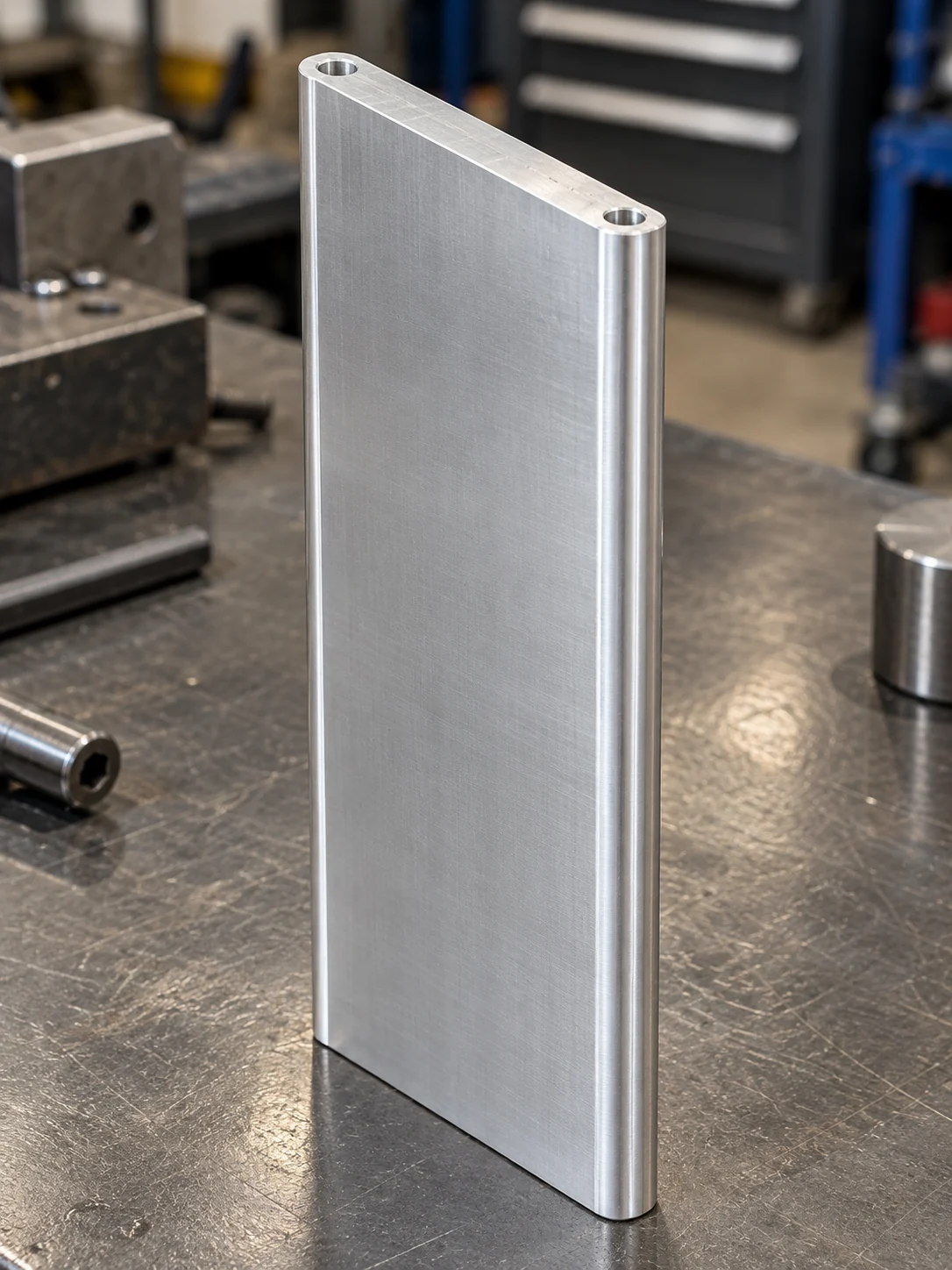
A film guide plate holds a moving film, foil or paper web on its path: the web slides over the flat face and bends around the rounded edge, R6 for example, and only those faces and edges need the smooth finish and the radius. A buyer often describes it by that job, a plate the film is guided over and around, before giving it a name.
| Name | What it stresses |
|---|---|
| Film guide plate, film guiding plate | The part guides plastic film |
| Web guide plate | Any continuous web: film, foil, paper or label stock |
| Side guide plate | Its place at the side of the web path |
| Guide plate with a rounded edge | The radiused edge the web runs around |
| Not a web guide system | A web guide system steers the web with sensors and actuators; the guide plate is the fixed part the web slides on |
Rounded guiding edge or chamfer: why a moving film needs a radius
A chamfer gives a moving film two corners to bend over, while a radius such as R6 gives it one continuous curve, so the guiding edge of a film guide plate is drawn as a radius, blended into both faces, along its full length. On a plate twice as thick as the radius, R6 on 12 mm, the edge becomes a full round the film can wrap around.
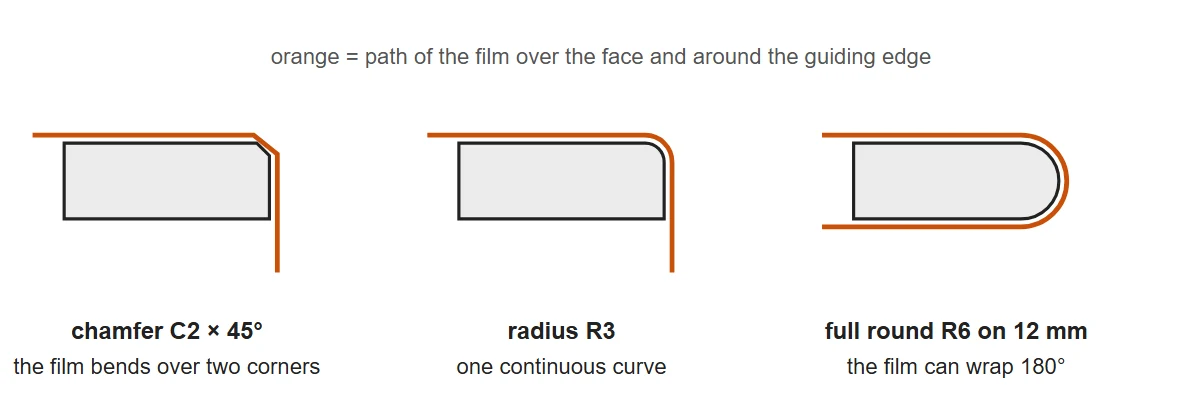
| Edge | Profile | What the film meets | On the drawing |
|---|---|---|---|
| Sharp, deburred | Square corner with the burr removed | A corner to bend over | Break edges |
| Chamfer | A 45° flat, for example C1 | Two corners instead of one | C1 × 45° |
| Radius | A quarter circle blended into both faces | One continuous curve | R3, R6 or R10 on the guiding edge |
| Full round | Radius equal to half the thickness, R6 on 12 mm | A curve it can wrap around by 180° | R6 full round on both long edges |
Only the edges the film touches need the radius; the other edges can stay chamfered or only deburred, which saves machining time. Write the radius, the edges it runs along and that it blends into the faces without a step, and the approval drawing shows it before machining.
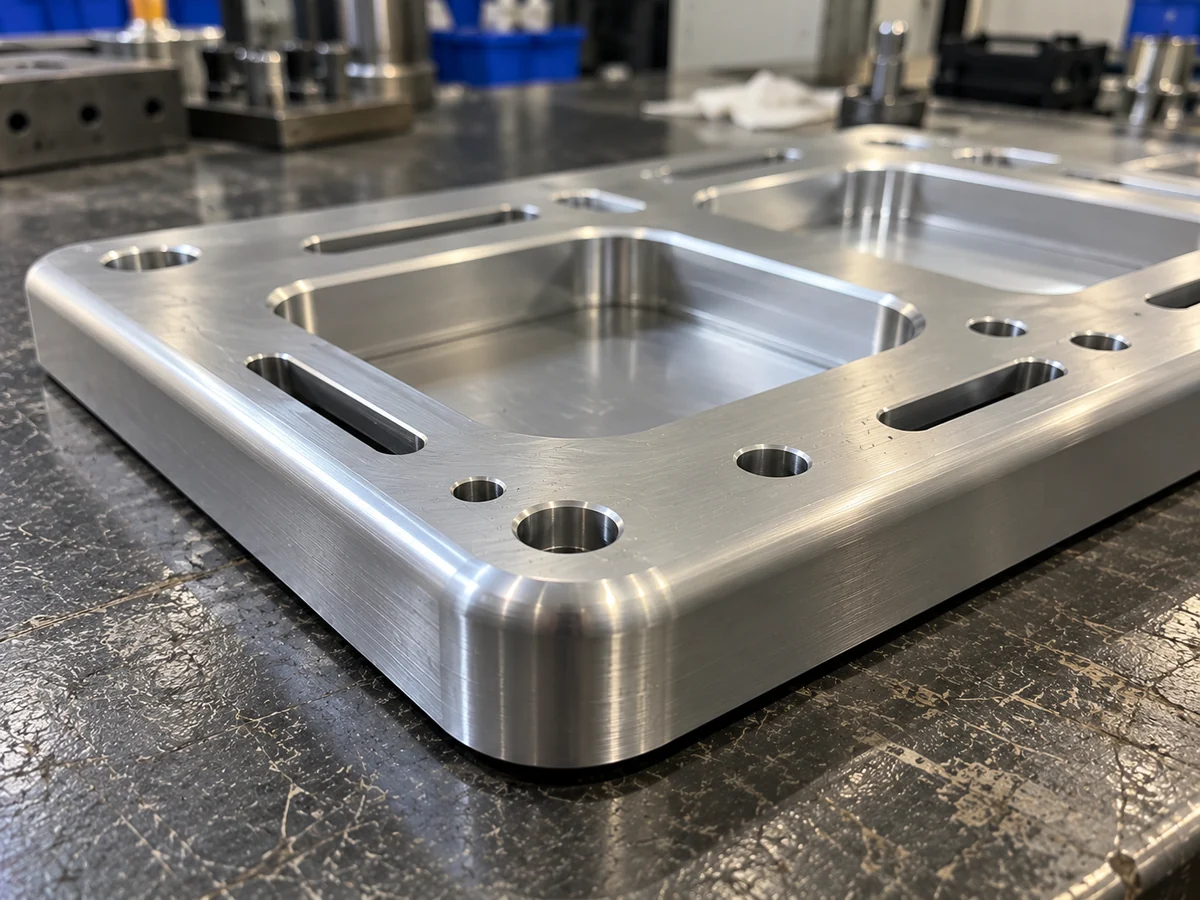
Send the STEP file and mark the edges the film runs over. Film guide plates from 1 prototype in 304 stainless or 6061 aluminium; the radius, the finish and the threads are in the same quote. Approval drawing and price within 12 hours.
Smoother than milled: finishes for the film-contact face
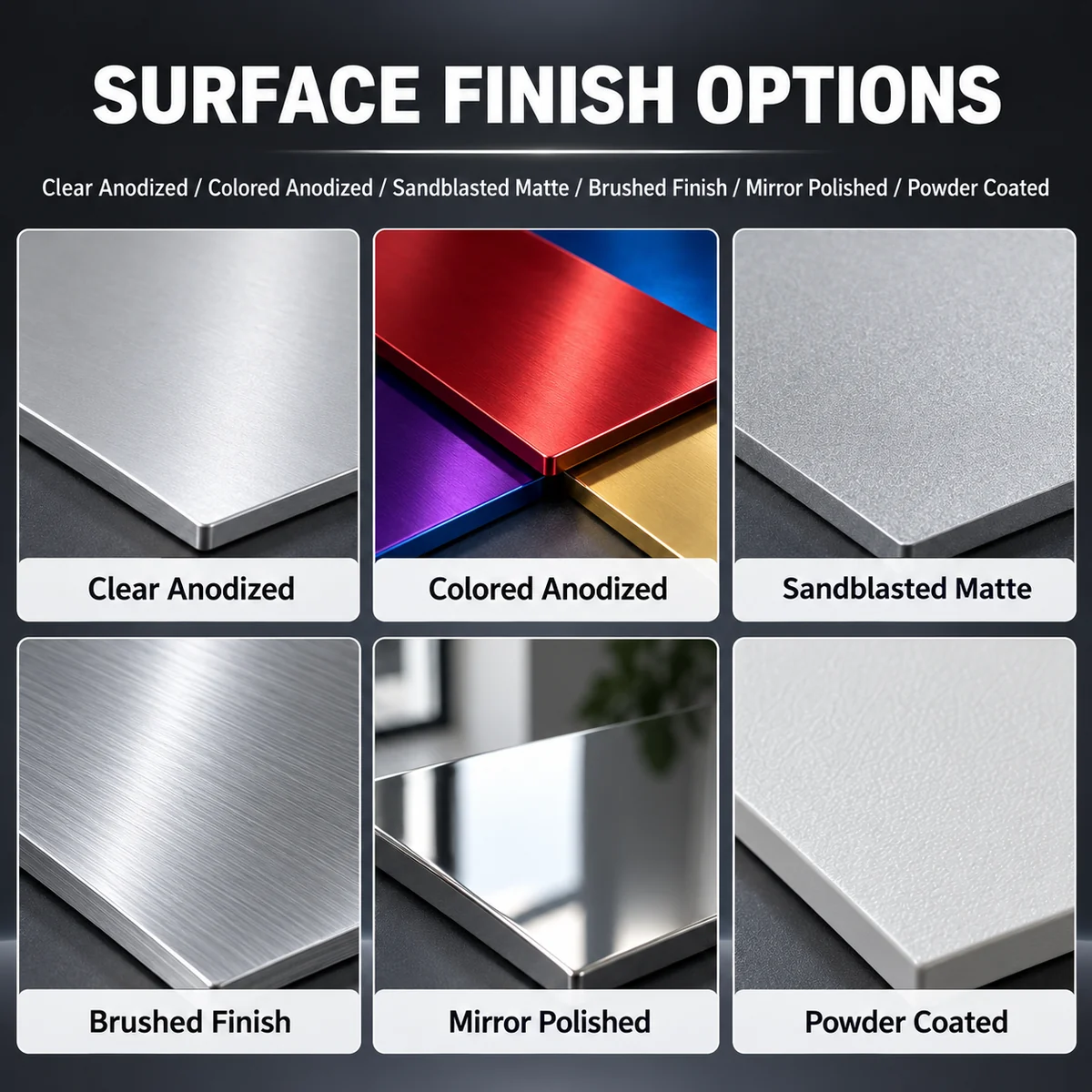
A milled face is about Ra 1.6 µm with visible tool marks, so a face a film slides over is finished further: a finishing pass to about Ra 0.8 µm, polishing to Ra 0.1–0.4 µm, or on stainless bead blasting and then electropolishing. The values are typical and the finish is confirmed on the part.
| Finish | Surface | Material | What to know |
|---|---|---|---|
| As milled | Ra 1.6 µm, visible tool marks | Any | The reference; the marks follow the cutter's path |
| Finishing pass | Ra 0.8 µm, fainter marks | Any | A light second pass on the contact faces and the radius |
| Bead blasting | Even matt texture, tool marks hidden | Stainless, aluminium | A uniform look, not the lowest roughness; often the step before electropolishing or anodising |
| Mechanical polishing | Ra 0.1–0.4 µm, smooth to mirror | Stainless, aluminium | Removes tool marks with abrasives; fine polishing lines can remain |
| Electropolishing | Bright and clean, micro-peaks removed | Stainless 304, 316 | Dissolves peaks faster than valleys and leaves a passive surface; removes a thin layer only, so deeper marks are blasted or polished first |
| Anodising | Hard oxide layer, clear or coloured | Aluminium | Follows the texture underneath, so the face is polished or blasted before it; hard anodise for wear |
Electropolishing or mechanical polishing
Mechanical polishing cuts the surface smooth with abrasives and can leave fine lines and abrasive particles behind, while electropolishing dissolves the micro-peaks of a stainless surface electrochemically and leaves it clean and passive; it removes only a thin layer, which is why a stainless guide plate is often bead blasted to an even texture first and electropolished after. Roughness values by process are on the surface roughness chart.
Stainless or aluminium for a film guide plate
304 stainless (1.4301) can be electropolished and resists cleaning agents and wear, while 6061 aluminium weighs about a third as much, machines faster and is often the cheaper prototype; the film, the cleaning, the wear and the finish decide between them.
| Stainless 304 (1.4301) | Aluminium 6061 | |
|---|---|---|
| Density | About 8.0 g/cm³ | 2.7 g/cm³, about a third |
| Machining | Slower, costs more per plate | Faster, usually the cheaper prototype |
| Smoothest face | Polished, or blasted and electropolished | Polished, then anodised if needed |
| Electropolishing | Yes | Not usual |
| Anodising | No | Yes: clear, coloured or hard |
| Cleaning agents and moisture | Good; 316 (1.4404) where chlorides are present | Good when anodised; check the agents used |
| Wear from a running web | Hard-wearing face | Hard anodise for wear |
Mounting threads: the depth the plate needs
A guide plate is screwed to the machine through tapped holes, and a thread in aluminium needs about 2 × d of full thread, 12 mm for an M6, so a drawn depth of 60 mm can come down to 25 mm without losing holding strength; the first three engaged threads carry roughly three quarters of the load. Thread depth by material and blind-hole drill depth are on plates with tapped holes.
From one prototype to 50–200 plates
A guide plate is tried on the line before a batch, so the first order is one or two prototypes from the approved drawing and the batch of 50 to 200 follows from the same program, with the radius or the finish changed if the test asks for it.
| Step | What happens | Typical time |
|---|---|---|
| Approval drawing | Edge radius, finish, holes and threads drawn from your STEP file or sketch | With the quote, within 12 hours |
| Prototype, 1 or 2 plates | Machined, finished and measured | About 5 working days plus the finish |
| Test on your line | The film runs on the plate; radius, finish or material change if needed | Your time |
| Batch of 50 to 200 | Same program and finish; the first plate measured against the approved drawing | About 15 working days |
Prototype now, batch later? Ask for 1 prototype and for 50 and 200 plates in one message; the reply prices all three, and the batch is made from the program of the approved prototype.
A real request: a film guide plate with R6 edges
A film-handling machine needed side plates the film slides over and around; the drawing asked for 1.4301 stainless, bead blasted and electropolished, with M6 holes 60 mm deep, and the buyer left the depth, the finish route and the material open. Aluminium is easier to machine and the buyer had allowed it, so the two prototypes were cut from 6061 with both long edges rounded to R6 and threads 25 mm deep; the full story is in the film guide plate case study.
Where a catalogue part does the job
An idler roller or a complete web guiding system comes from a web-handling supplier and a plain strip from a metal stockholder; a guide plate is made when the radius, the finish or the mounting is yours.
| You need | From stock? | How it is made |
|---|---|---|
| An idler roller or a complete web guiding system | Yes — stock item | Buy it from stock from a web-handling supplier — or ask us, we may have the parts in stock. Standard parts: ask us too — we may have them in stock. |
| A plain stainless or aluminium strip, no holes, no radius | Yes — stock item | Buy it from stock at a metal stockholder near you; one-off machining cannot beat a stock strip on price |
| A guide plate with your radius, your finish and your mounting threads | No | Machined from your STEP file or sketch, finished and measured, from 1 prototype |
| A worn guide plate from a line whose builder no longer supplies it | No | Measured from the old plate, the radius and finish restored, made from 1 piece |
| 50 to 200 plates after a prototype | No | Same drawing and program, finished in one lot |
What to send for a film guide plate quote
- Plate size and thickness, or the STEP file and drawing.
- The guiding edge radius and which edges and faces the film touches.
- The finish or the roughness you need, or the words "smoother than milled".
- Material preference, or the conditions: cleaning agents, moisture, wear.
- Holes, threads and their depths; say if a depth can change.
- The film or web: material and thickness, and its width and speed if known.
- Quantity now and later, for example 1 prototype, then 50 to 200.
Related: film guide plate case study · custom machined plates · plates with tapped holes · fixture and tooling plates · 304 stainless machining · 6061 aluminium machining · surface roughness chart · one-off parts.
Frequently asked questions about film guide plates
Yes, from 1 piece. A STEP file and a drawing with the edge radius, the finish and the tolerances are machined as drawn; a sketch with the plate size, the edge radius and the hole positions works too, and the drawing made from it comes back for approval before machining.
Yes. A continuous radius such as R3, R6 or R10 is machined along the whole guiding edge and blended into both faces without a step; on a plate twice as thick as the radius, R6 on 12 mm for example, the edge becomes a full round the film can wrap around.
Yes. A milled face is about Ra 1.6 µm; a finishing pass brings it to about Ra 0.8 µm and mechanical polishing to Ra 0.1–0.4 µm. On stainless, bead blasting followed by electropolishing gives an even, clean face with the micro-peaks removed. The finish is chosen per plate and checked on the part.
Often, yes. 6061 aluminium weighs about a third of 304 stainless, machines faster and can be polished and anodised; 304 stainless (1.4301) resists cleaning agents and wear better and can be electropolished. The film, the cleaning, the wear and the finish decide it, and a prototype in the chosen material settles it.
Yes. The prototype is made from the approved drawing and a kept program; once the film has run on it, the radius or the finish can be changed, and 50 to 200 plates are made from the same program. One to a few dozen plates take about 5 working days plus the finish, 50 to 200 about 15 working days.
A smoother face and a continuous edge radius remove the tool marks and corners that catch a film, but no finish is a guarantee: the film material, its tension and speed, and dust on the line also decide it. The plate is made to the roughness and radius you specify, and a prototype is the way to test it on your film.