What a Banjo Bolt Has to Get Right
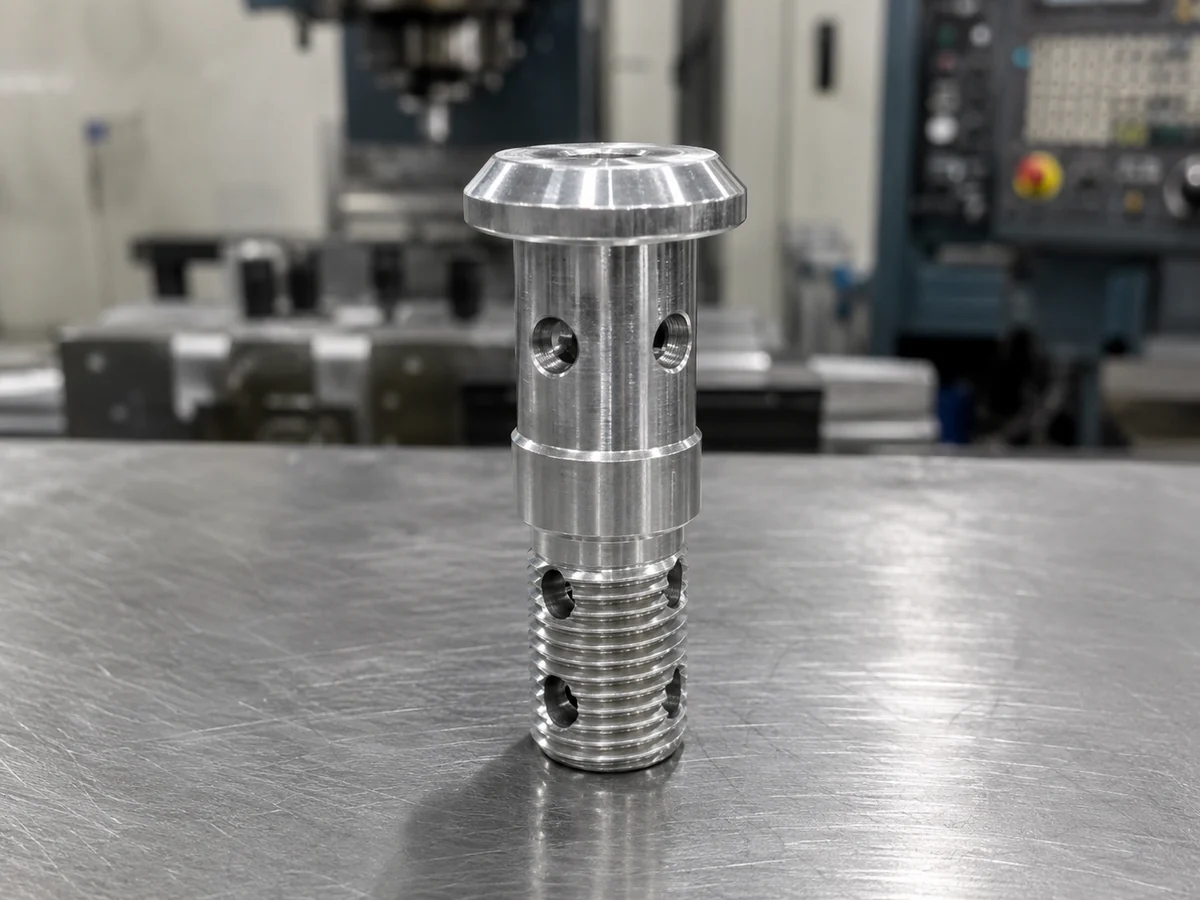
A banjo bolt is a bolt with a drilled central bore and one or more radial ports through the shank. It clamps a ring-shaped fitting — the eye, or banjo — against a port face. Fluid enters the eye, crosses into the radial ports, runs down the central bore and out through the threaded end. Two crush washers, one either side of the eye, make the seal.
That geometry is why it exists: the hose can swivel to any angle and is only locked when the bolt is tightened. It is also why four dimensions have to be right at the same time, and why an approximate substitute leaks:
- Bore diameter — sets the flow area, and is independent of the thread size
- Port position and count — the radial holes must land inside the eye's internal groove, not above or below it
- Grip length — the unthreaded length must match the eye thickness plus two washers, or the bolt bottoms out before it clamps
- Seat face — flat and square under the flange, because the washer is the only seal
What We Can Actually Make
Competitor pages for this part say "custom sizes to your specification" and stop there. Here is the real envelope. If your bolt sits inside it we can quote it today.
| Feature | Range we machine | Notes |
|---|---|---|
| Metric thread | M6 – M27 | Coarse, fine or non-standard pitch — thread is single-point cut |
| BSP / BSPP | 1/8" – 3/4" | Parallel; tapered BSPT on request |
| Imperial / UNF | 3/8-24, 7/16-24, 1/2-20 and legacy sizes | Pre-metric and obsolete imperial threads gauged from your sample |
| Central bore | 2.5 – 14 mm | Set independently of thread size to tune flow area |
| Restrictor orifice | 0.8 – 2.0 mm | Turbo oil feed and damping; size marked on the head on request |
| Radial ports | 1, 2, 3 or 4 holes per row; 1–3 rows | Port Ø, angular spacing and axial position all specified by you |
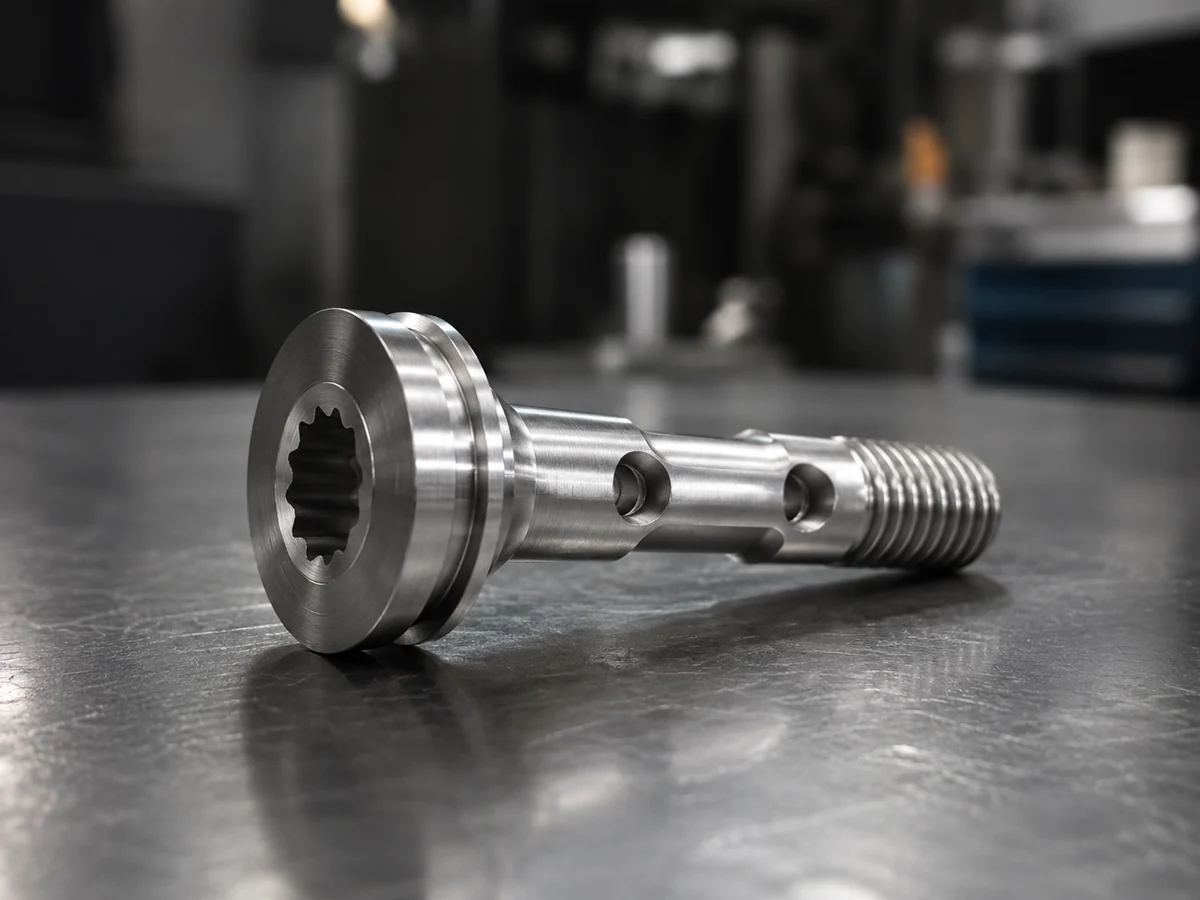
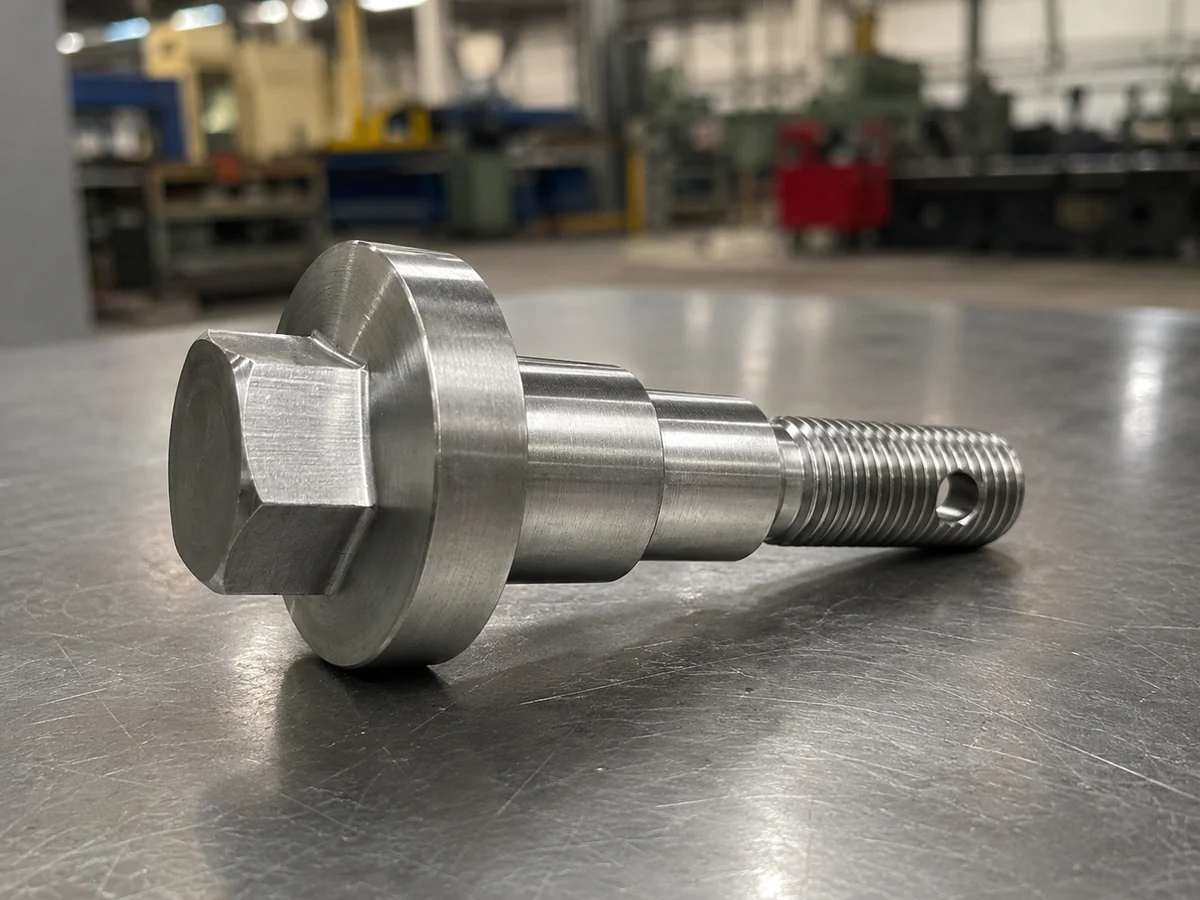
| Head form | Hex, hex flange, 12-point spline, custom across-flats | Head is machined, so A/F and height are free variables |
| Overall length | 12 – 160 mm | Extended lengths for stacked double and triple eyes |
| Grip / unthreaded length | To your eye thickness + 2 washers | The dimension substitutes most often get wrong |
| Head marking | Laser or stamped | Orifice size, part number, batch code — laser has no tooling cost |
| Thread tolerance | ISO 965 6g standard | Gauged before shipping |
What You Can Buy From Stock — and What You Can't
We would rather you bought a standard part than paid us to make one. The common sizes are well stocked and no machine shop will beat them on price or speed:
Buy from stock: M10×1.0, M10×1.25, M10×1.5, M12×1.5, M14×1.5, M16×1.5; 3/8-24, 7/16-24, 1/2-20; BSP 1/8 to 1/2 — single or double port, plain steel or stainless, standard length. Any hydraulic or brake-line supplier holds these.
Machining earns its cost only when one of these is true:
- Non-standard pitch — an M12×1.25 where the world stocks M12×1.5, or a legacy imperial thread
- Unusual port arrangement — triple eye, asymmetric port spacing, ports clocked to clear a casting
- Extended length — stacking two or three eyes on one bolt
- Specific bore or restrictor orifice — turbo oil feed metering, flow balancing across a manifold
- Material stock does not offer — 316 for seawater, titanium for weight, brass for fuel, 7075 for a race chassis
- The part is obsolete — and cannot be bought at any price (below)
Obsolete & Discontinued Banjo Bolts
This is the order we see most often. Banjo bolts get marked obsolete or dead in OEM parts systems long before the machines they belong to stop working — a hollow bolt is a low-value line item, so it is among the first things dropped from a spares catalogue. Meanwhile the excavator, press, tractor or compressor still needs one, and the fitting it seals against is a specific geometry that no near-enough part will match.
You do not need a part number, a drawing, or a CAD file. Send the old bolt. Even a corroded or damaged one carries the geometry we need — thread, bore, port position and count, seat form, hex across-flats, grip and overall length. We measure it, produce a drawing, send it to you for approval, and machine the replacement. Nothing is cut before you have confirmed the drawing, and the drawing stays on file so a reorder in three years is a one-line email.
The same route covers a bolt you cannot identify at all: see reverse engineering from a sample and obsolete fasteners.
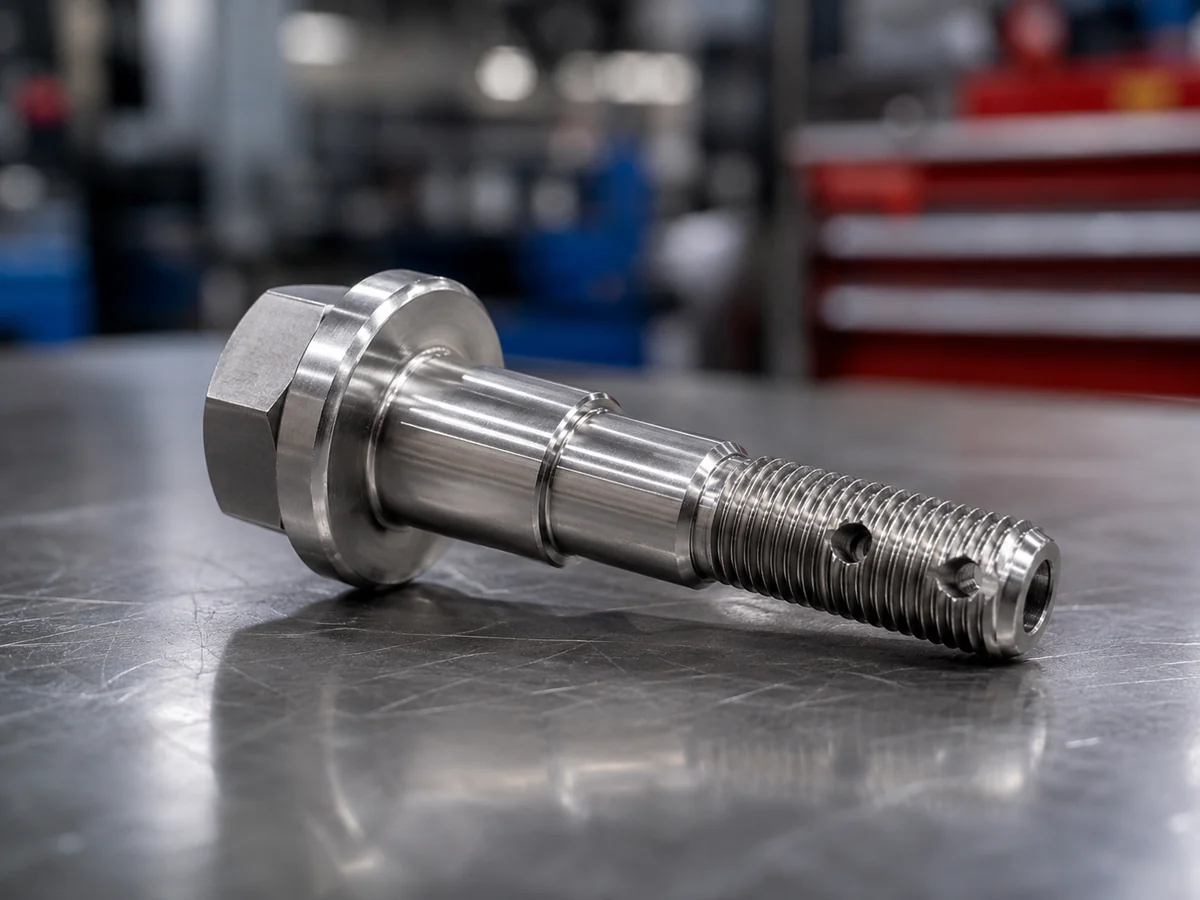
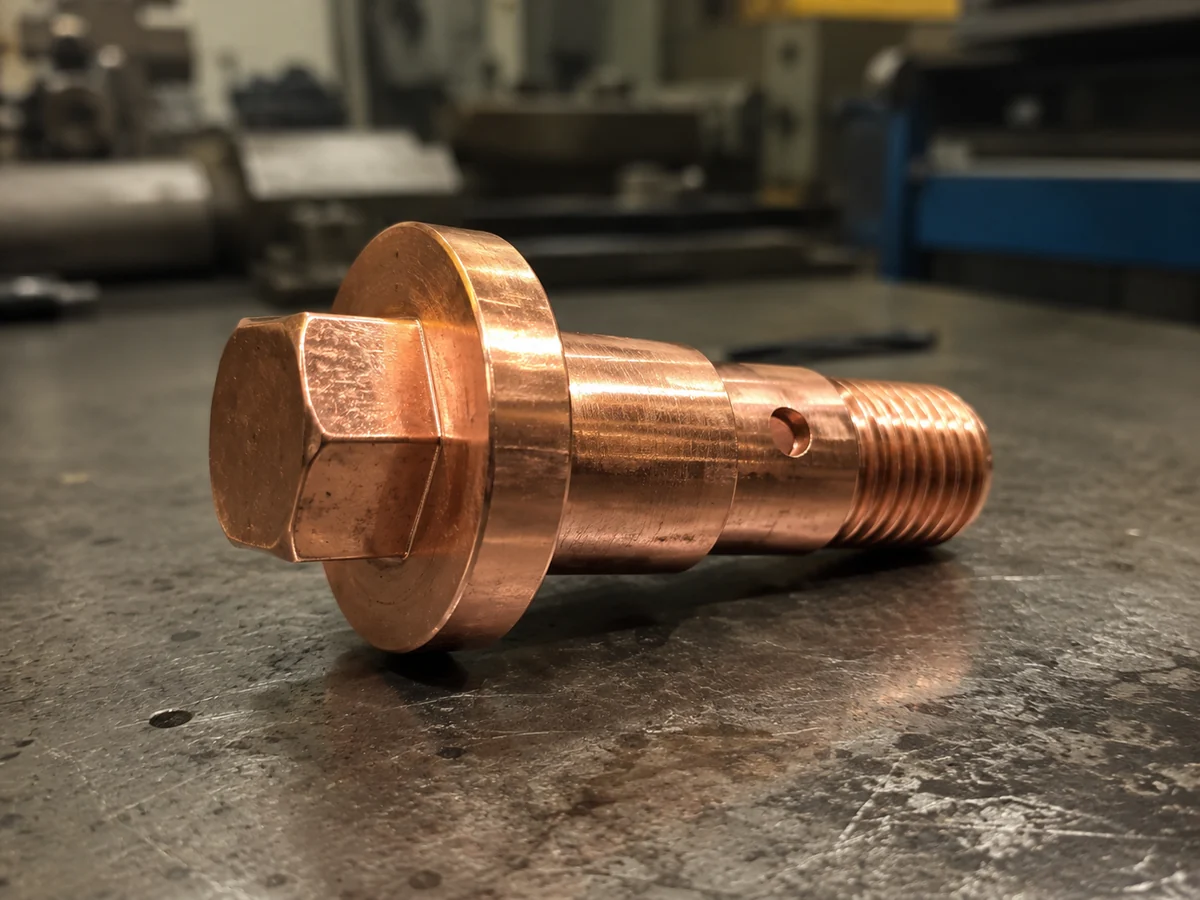
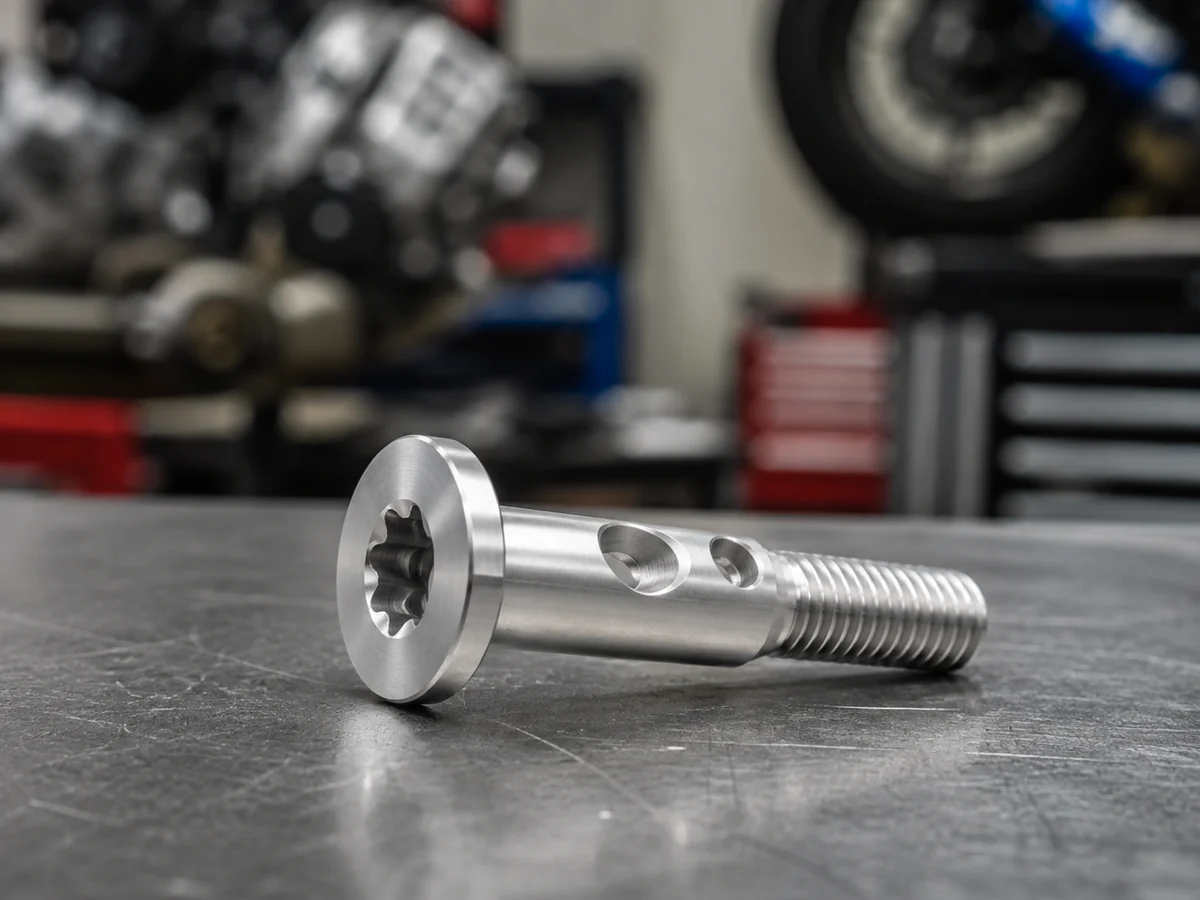
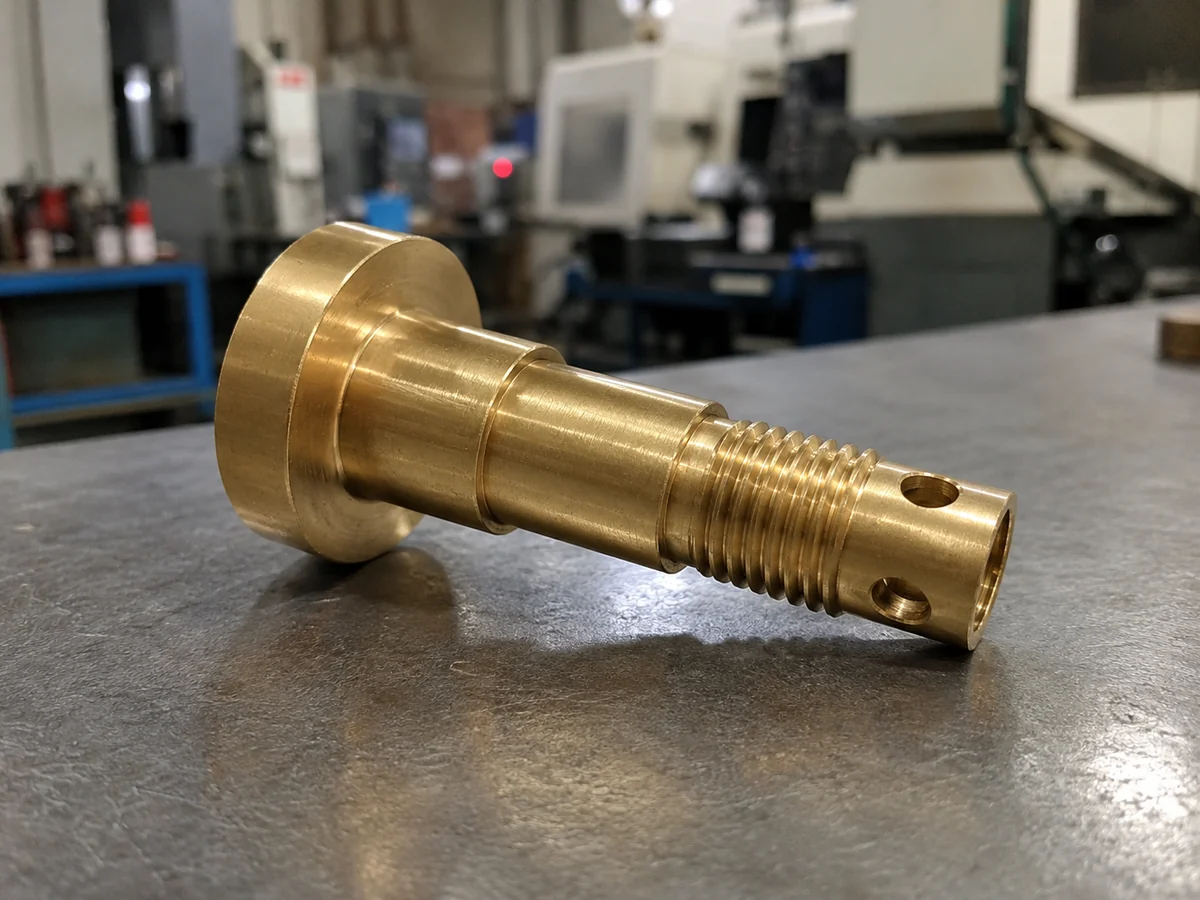
Materials & Finishes
Fluid, pressure and temperature drive the choice. Tell us the application and we will recommend rather than guess.
| Material | Class / temper | Typical banjo bolt use |
|---|---|---|
| 12L14 free-cutting steel | ~4.8 | Low-pressure and prototype work — cheapest and fastest |
| C45 carbon steel | 8.8 equivalent | General hydraulic service, most OEM replacements |
| 42CrMo4 (1.7225) | 10.9, quenched & tempered | High clamp load, heavy plant, press lines |
| Stainless 304 (A2-70) | A2-70 | Corrosion resistance, food and outdoor equipment |
| Stainless 316 / 316L (A4-80) | A4-80 | Marine, seawater, chemical and washdown |
| Aluminium 6061-T6 | T6 | Weight-critical low-pressure lines, enclosures |
| Aluminium 7075-T6 | T6 | Highest-strength aluminium — race chassis, motorsport |
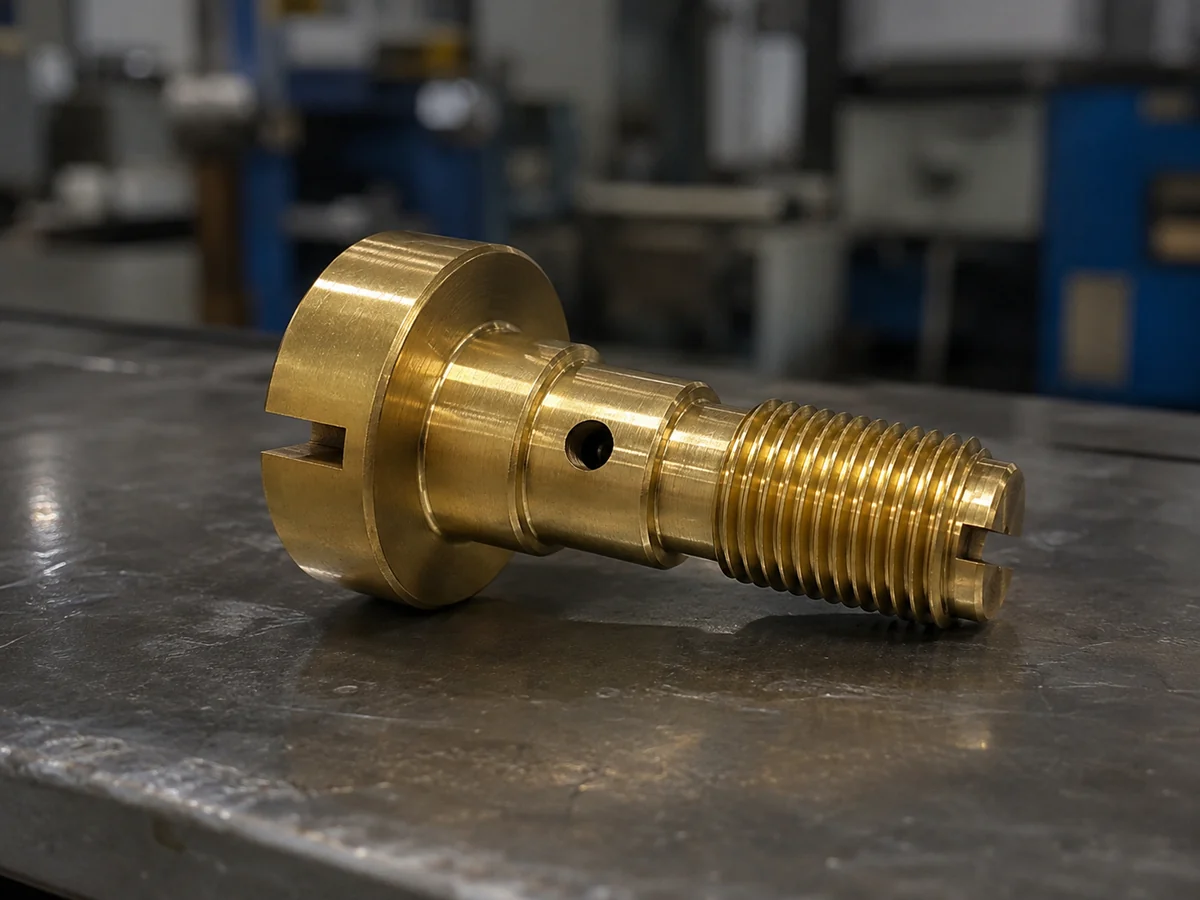
| Brass C360 | — | Fuel, low pressure, non-sparking, decorative |
| Titanium Ti-6Al-4V (Gr 5) | Grade 5 | Motorsport and aerospace; see titanium bolts |
Finishes: plain, black oxide, zinc plate, geomet, phosphate, passivated stainless, anodised aluminium. Certification: EN 10204 3.1 material certificates traceable to the bar heat, plus dimensional reports, on request.
The Crush Washer Nobody Mentions
The bolt is not the seal. The washers are. A machined banjo bolt will still weep if the washers are wrong or reused, and this is the single most common cause of a "faulty" replacement part:
| Washer type | Reusable? | Notes |
|---|---|---|
| Copper | No — renew or anneal | Most common. Work-hardens as it crushes and will not reliably reseal |
| Aluminium | No — renew | Softer, seats at lower torque, good on alloy housings |
| Fibre | No | Low pressure, fuel and pneumatic |
| Bonded / Dowty seal | Often yes | Steel body with nitrile or Viton insert; lower seating torque, tolerant of reuse |
We machine matching washers from the same material batch and supply them with the bolts, so the joint arrives as one set rather than a bolt plus a hunt for a seal. Tightening torque depends on washer type as much as on bolt size, which is why published banjo figures for one thread size disagree by more than tenfold — why banjo bolt torque specs differ, and how to find yours sets out the sources and the method.
Cost, Quantity and Lead Time
| Stage | Typical time | What happens |
|---|---|---|
| Quote | Within 12 hours | From your photo, sketch, sample or drawing |
| Drawing for approval | 12 hours | Produced by our engineers; nothing is cut before you approve it |
| Sample / single piece | 7–10 working days | From drawing approval |
| Production batch | 15–20 working days | Includes finishing and certification |
| Certified material | +3–5 days | If the grade is not held in bar stock |
The bore, ports and thread are cut on the same setup, so the first piece carries the setup cost and the rest are cheap. One obsolete replacement is a normal order — it will not be cheap per piece, but it is possible, which is the point when the alternative is a machine standing still.
If Your Part Isn't Quite This
Will it fit? Banjo bolt checks before you order
Two threads look identical on a banjo bolt and are not: M10×1.0 and M10×1.25. Most brake calipers and master cylinders are M10×1.0; many fuel, oil and clutch lines are M10×1.25. A ×1.25 bolt starts in a ×1.0 port, binds after two turns and takes the caliper thread with it when forced. A 3/8″-24 UNF bolt — 9.5 mm, the Girling and Lockheed size — drops loosely into an M10×1.0 port and never seals. Measure the pitch on the old bolt or the port with a gauge; the diameter alone does not identify a banjo thread.
What do I need to connect a banjo fitting to an M10×1.0 caliper port?
A single banjo bolt at M10×1.0 whose thread length equals the eye width plus two crush washers plus full engagement in the port, with the cross-drilling placed inside the eye and not under a washer. For two hoses on one port it is a double banjo bolt, longer by one eye and one washer, with two rows of radial holes.
Same banjo bolt, but longer, double, or with a restrictor
A longer bolt for a thicker eye, a double or triple stack, a 1.2 mm metered orifice, a 316 body for a marine engine, or a 7/16″-20 UNF instead of M10 — each is machined as a variant of the same drawing, one piece and up, quoted in 12 hours.
Frequently Asked Questions
A bolt with a drilled central bore and radial ports through the shank. It clamps a ring-shaped fitting — the eye — against a port face; fluid enters the eye, crosses into the ports, runs down the bore and out through the threaded end. Two crush washers seal it. The hose can swivel to any angle until the bolt is tightened.
Yes — the most common order we take. Banjo bolts go obsolete in OEM catalogues long before the machines do. Send the old bolt, even damaged; we measure thread, bore, port count and position, seat, hex A/F and length, draw it, get your approval, and machine it. Part number and CAD both welcome — neither is needed.
M6–M27 coarse, fine or non-standard pitch; BSP 1/8–3/4; UNF including 3/8-24, 7/16-24, 1/2-20; and legacy imperial threads. Single, double, triple or quad ports across 1–3 rows, with port Ø, angular spacing and axial position to your spec. Bore is set independently of thread size.
Yes — typically 0.8 to 2.0 mm, most often for turbocharger oil feed where excess pressure floods the bearing housing and pushes oil past the seals. We can mark the orifice size on the head so the part is identifiable later. Give us the orifice diameter, or the engine and turbo, and we will confirm before cutting.
Copper is most common, then aluminium, fibre, and bonded (Dowty) seals. Copper and aluminium work-harden as they crush and should be renewed or annealed each assembly; bonded seals tolerate reuse and a lower seating torque. We machine matching washers from the same material batch and supply them with the bolts.
One piece. Bore, ports and thread are cut on the same setup — no die, no tooling charge, no minimum run. Unit price falls sharply between 3 and 50 pieces, and again above 50.
Quote in 12 hours; drawing for approval in 12 hours; samples and single pieces 7–10 working days from approval; production batches 15–20 working days. Certified material adds 3–5 days.
If your size is common — M10×1.0/1.25/1.5, M12×1.5, M14×1.5, 3/8-24, 7/16-24, BSP 1/8–1/2, single or double port, plain steel or stainless — buy it from stock. Cheaper and faster, and we will say so. Machining pays when the pitch is non-standard, the ports or length are unusual, the bore or orifice is specific, the material is exotic, or the part is obsolete.
304 and 316 stainless, 12L14 and C45 carbon steel, 42CrMo4 alloy, 6061-T6 and 7075-T6 aluminium, C360 brass, and Ti-6Al-4V titanium. Tell us fluid, pressure and temperature and we will recommend rather than guess.
Get Banjo Bolts Quoted
Photo, sketch, drawing — or the old bolt. Engineers reply in 12h.
// Qty & price
1 pc
Sample price
Confirm fit before a run
10–50
Unit price drops
Setup cost shared
100+
Best price
All tiers quoted upfront
- →Obsolete part? Send the old bolt, not a drawing
- →Matching crush washers machined in the same batch