What a Locking Threaded Bushing Is
A locking threaded bushing holds a fine adjustment screw in two ways: its thread carries the screw, and a screw in its side stops the screw from turning once the setting is found. The bushing screws into the plate of the mount by a hex, and the ultra-fine adjustment screw runs through it. EKINSUN LTD is a custom parts manufacturer in Guangdong, China, that machines these bushings in the two common sizes below and to drawing from 1 piece, alone or as a set with the screw. Buyers ask for the part under several names:
| Name on the request | What it is | Where it goes |
|---|---|---|
| Locking threaded bushing, lockable bushing | hex bushing with an external thread, a 0.25 mm pitch internal thread and a locking screw in the side | this part: screwed into a tapped hole in the mount |
| Hex threaded bushing, threaded bushing with OD thread | the same part, named after the hex and the external thread it mounts by | plates that are tapped, not reamed |
| Braked bushing, adjuster lock, side lock | the same part, named after the screw that brakes the adjuster | adjusters that must hold through transport |
| Threaded insert with set screw | the same idea in fastener words: an insert whose set screw clamps the screw inside it | machine builders who do not use optics terms |
| Press-in flanged bushing | plain mounting diameter and flange, no lock; pressed or bonded into a reamed bore | fine-thread bushings |
| Lock nut or locking collar | a nut or thin ring on the adjustment screw, tightened against the bushing | screws with free thread behind the plate |
| Hex reducing bushing | a pipe fitting with a male and a female pipe thread; carries fluid, not an adjuster | female-to-male thread adapters |
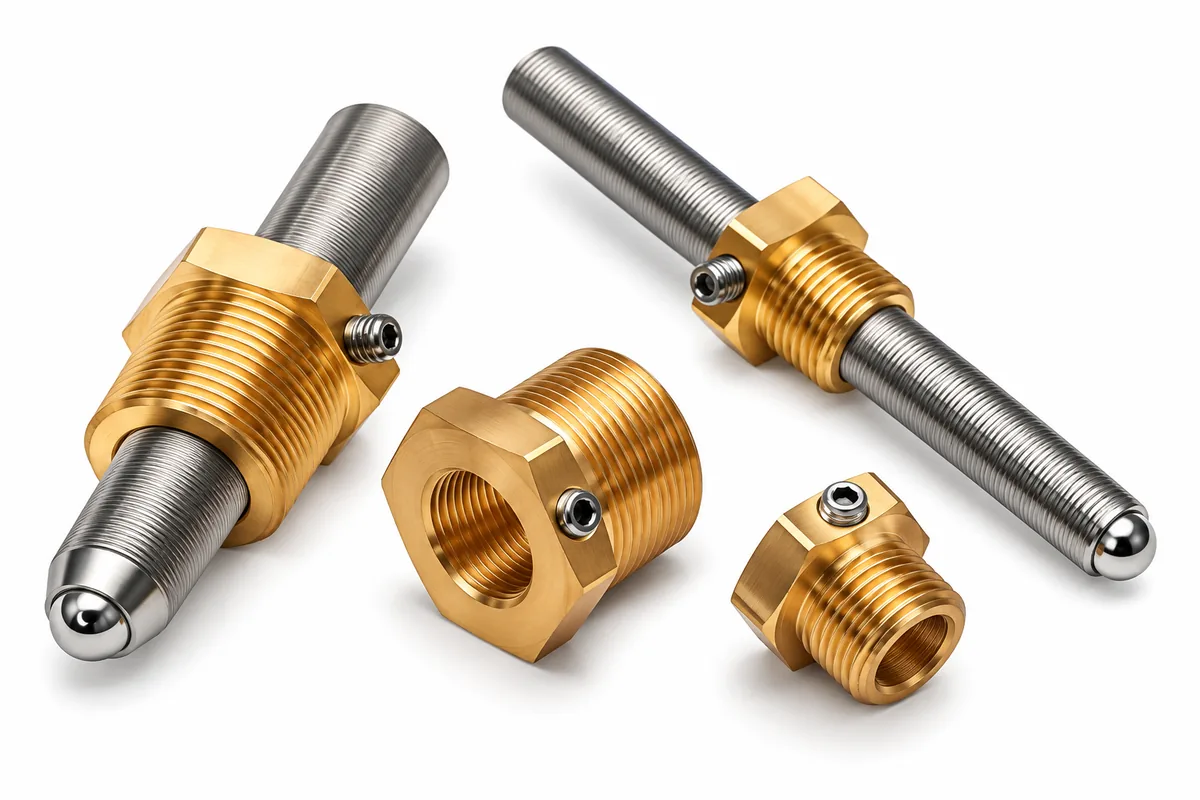
Hex Threaded Bushing Sizes — M4 × 0.25 in M6 × 0.5, M6 × 0.25 in M9.5 × 0.5
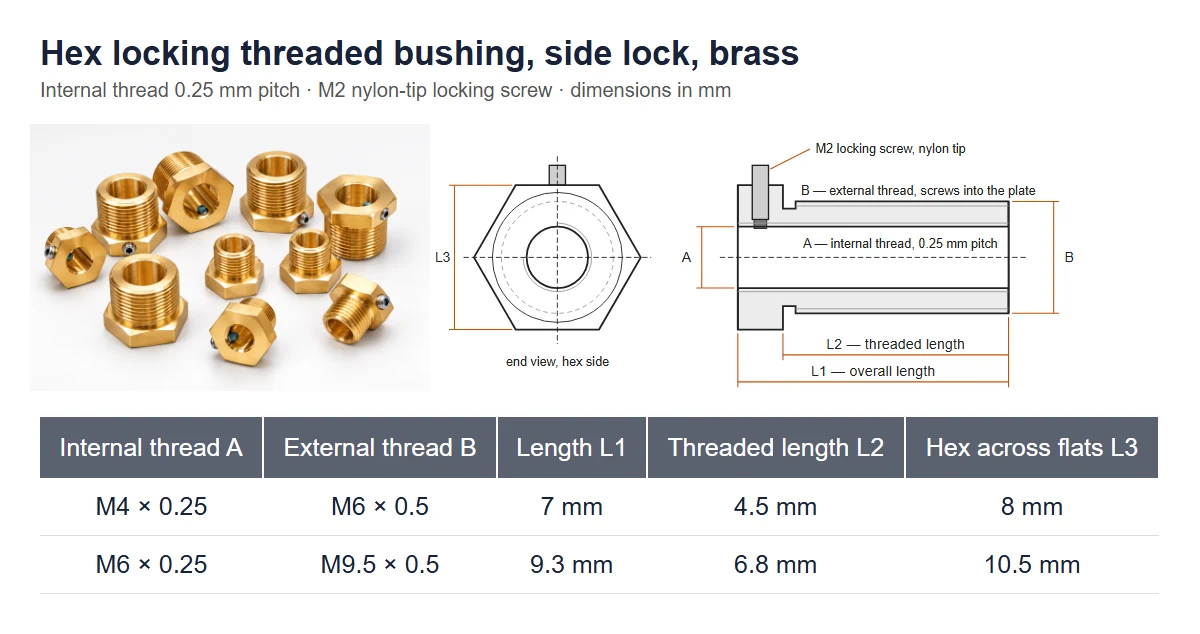
The M4 × 0.25 locking bushing has an M6 × 0.5 external thread, is 7 mm long and has an 8 mm hex; the M6 × 0.25 locking bushing has an M9.5 × 0.5 external thread, is 9.3 mm long and has a 10.5 mm hex. On both, the hex is 2.5 mm high and carries an M2 locking screw with a nylon tip.
| Internal thread A | External thread B | Length L1 | Threaded length L2 | Hex height (L1 − L2) | Hex across flats L3 | Locking screw | Ball-tip screw lengths in our range |
|---|---|---|---|---|---|---|---|
| M4 × 0.25 | M6 × 0.5 | 7 mm | 4.5 mm | 2.5 mm | 8 mm | M2, nylon tip, 0.9 mm hex key | 8–50 mm |
| M6 × 0.25 | M9.5 × 0.5 | 9.3 mm | 6.8 mm | 2.5 mm | 10.5 mm | M2, nylon tip, 0.9 mm hex key | 8–75 mm |
Buying one of these two sizes? Click a row and the button asks for that size. Standard sizes can also be supplied from stock; every other thread, length or material is made to order from 1 piece. 1, 10, 100 and 1,000 pieces are quoted together: the more pieces, the lower the unit price. Quote in 12 hours, DDP to your door.
How the Side Lock Holds the Adjustment Screw
The side lock is an M2 set screw with a nylon tip, threaded through the hex into the bore. Tightened with a 0.9 mm hex key, the tip presses on the thread of the adjustment screw and holds it by friction; loosened by a fraction of a turn, it lets the screw turn again. The tip is nylon because a 0.25 mm pitch thread is 0.15 mm deep: a steel point would mark it, nylon takes the shape of the thread and leaves it intact.
| Method | How it holds | What it needs | Where it fits |
|---|---|---|---|
| Side lock in the bushing (this part) | a nylon tip presses on the screw thread from the side | a 0.9 mm hex key and access to the side of the hex | compact mounts; settings that travel; no extra length on the screw |
| Lock nut on the screw | a nut tightened against the face of the bushing | free thread on the screw and room for fingers or a spanner | adjusters with the screw standing out behind the plate |
| Locking collar | a thin threaded ring, used as a nut or as a hard stop | a pin spanner | limiting travel as well as locking |
| Thread-locking adhesive | bonds screw and bushing | nothing; cleaning before the next adjustment | settings that are made once |
| No lock | a spring keeps the screw on one flank of the thread | the springs of the mount | laboratory mounts that are adjusted daily |
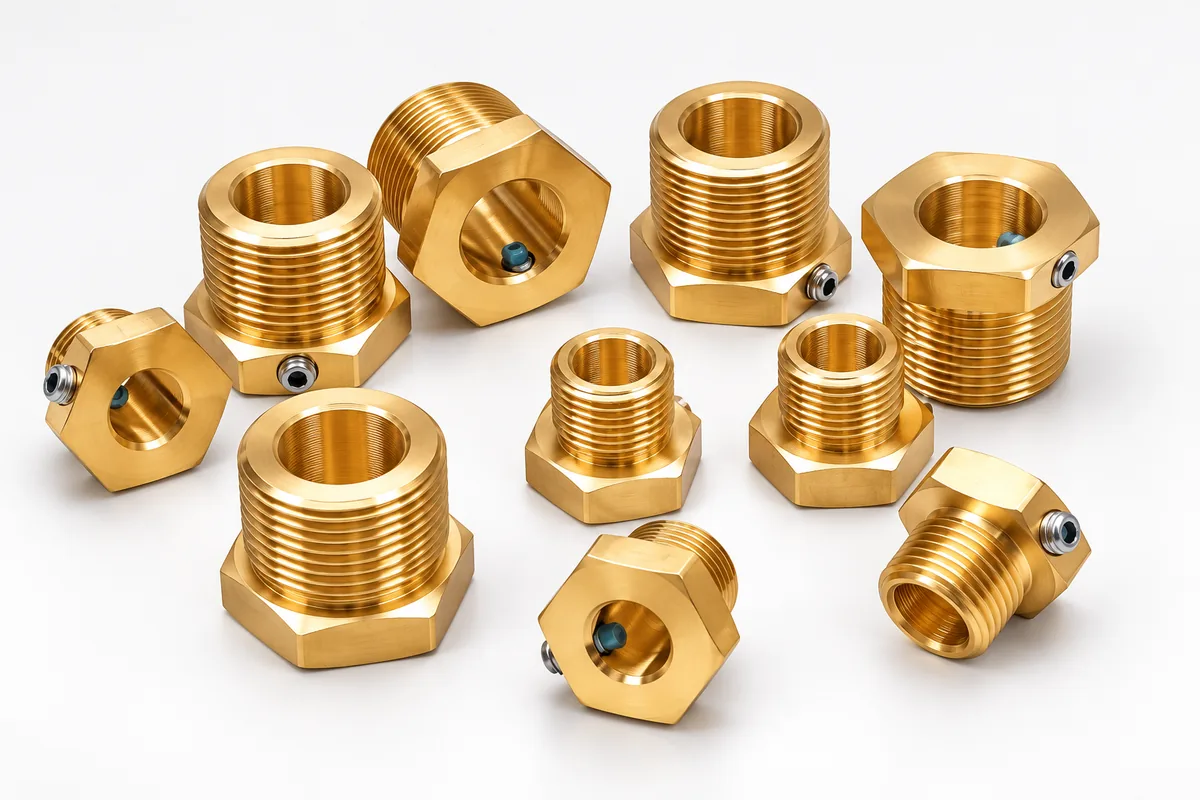
Tapping the Plate — Hole, Thread and Wrench
The plate is tapped M6 × 0.5 from a 5.5 mm hole for the smaller bushing and M9.5 × 0.5 from a 9 mm hole for the larger one. M9.5 is not a diameter of the ISO 261 series, so the tap for it is a special; where that is a problem, we cut the external thread to a tap you already have. The standard fine pitches are on the metric thread pitch chart.
| External thread B | Tap drill in the plate (D − P) | Minor diameter of B | Wall between the two threads | Thread in the plate, L2 | Wrench on the hex |
|---|---|---|---|---|---|
| M6 × 0.5 | 5.5 mm | 5.387 mm | 0.69 mm | 4.5 mm, up to 9 turns | 8 mm (across corners 9.24 mm) |
| M9.5 × 0.5 | 9 mm | 8.887 mm | 1.44 mm | 6.8 mm, up to 13 turns | 10.5 mm (across corners 12.12 mm) |
Tap drill = D − P; minor diameter of the external thread d3 = D − 1.2269 × P (ISO 68-1 basic profile); wall = (d3 − A) / 2. Turns in the plate are L2 divided by the pitch, before the relief groove and the chamfer.
Screw-In With a Lock, or Press-In With a Flange
The locking threaded bushing and the press-in flanged bushing carry the same adjustment screw; they differ in how they sit in the plate and in whether they lock. The press-in bushing is the smaller part and comes in more threads; the locking bushing is replaceable and holds the setting.
| Locking threaded bushing | Press-in flanged bushing | |
|---|---|---|
| Hole in the plate | tapped M6 × 0.5 or M9.5 × 0.5 | reamed bore, 3.5 to 9.5 mm |
| Held by | its external thread, tightened by the hex | press fit or adhesive |
| Lock on the screw | M2 nylon-tip screw in the side of the hex | none; a lock nut on the screw if needed |
| Replacement | unscrewed with a wrench, plate untouched | pressed out or the bond broken |
| Room on the plate | hex of 8 or 10.5 mm plus key access from the side | the flange only |
| Common internal threads | M4 × 0.25, M6 × 0.25 | M2 × 0.2 to M6 × 0.25 |
| Chosen when | the setting has to survive transport, vibration or a service interval | space is tight and the mount is adjusted often |
Where Locking Bushings Are Used
Locking bushings are used wherever a fine adjustment is made once and has to stay: optical mounts that are shipped aligned, measuring fixtures that keep a zero, sensors that are aimed at commissioning. The screw does the adjusting, the bushing does the holding.
| Where | What is adjusted | What the lock is for |
|---|---|---|
| Kinematic mirror and lens mounts in lasers, interferometers and beam delivery | tilt of an optic, micrometres at the screw tip | the alignment survives shipping and the vibration of the machine around it |
| Translation and tilt stages, fibre alignment | position of a stage or a ferrule | a found position is fixed while the next axis is adjusted |
| Metrology: gauge heads, comparator stands, probe holders | a zero or a datum | the zero stays through thousands of readings |
| Sensor and camera alignment in machines | aim of a sensor, a camera or a light source | set once at commissioning and left for the service interval |
| Fixtures, levelling screws, instrument feet | a stop or a level | operators cannot shift it by touching the screw |
| Older mounts and instruments | whatever the original adjuster did | a worn or lost bushing is replaced from the old part or from the screw |
A typical request: six bushings M6 × 0.25 with a side lock for a mirror mount that is shipped aligned, external thread to suit a hole that can be tapped M10 × 0.75.
What EKINSUN Adds — Threads, Lengths and Sets No Catalogue Lists
A catalogue adjuster with a lock nut is bought from an optics supplier's stock. What we add is everything around it: the external thread cut to the hole you can tap, the side lock on any internal thread from M2 to M12, the body in bronze or stainless, the bushing and the screw gauged together, and a replacement made from an old bushing, all from 1 piece.
| What you need | On the shelf? | At EKINSUN |
|---|---|---|
| One or two catalogue adjusters with a lock nut, for a laboratory mount | Yes — optics suppliers | Buy it from stock from the optics supplier you already use; one catalogue adjuster costs less than a one-off. Standard parts: ask us too — we may have them in stock. |
| The two sizes of the table, 10 to 1,000 pieces | Some sizes | Standard sizes can also be supplied from stock; the more pieces, the lower the unit price. |
| The external thread cut to a hole you can already tap: M8 × 0.5, M10 × 0.75, M10 × 1 or an inch thread | No | Made to order, so the plate needs no special tap. |
| A side lock on another internal thread: M2 × 0.2, M3 × 0.25, M5 × 0.25, M8 × 0.25, 80 or 100 TPI | Rarely | Made to order from 1 piece, gauged to the screw. |
| A longer threaded length for a thick plate, a lower hex, or two locking screws | No | Same threads, the body to your dimensions. |
| Phosphor bronze, 303 (1.4305) or 304 (1.4301) stainless in place of brass | No | Made to order in the material on the drawing. |
| Bushing, locking screw and ball-tip adjustment screw as one set, fit checked together | No | Made as a set from our screw range, M2 × 0.2 to M12 × 0.25. |
| A replacement for a worn or discontinued bushing on a mount you own | No | Copied from the old bushing, or from the screw and the hole in the plate. |
| The mount plate in 6061 or 7075 aluminium, drilled, tapped and fitted with the bushings | No | Machined to drawing and delivered assembled. |
Bushing, lock and screw from one source? The bushing is cut to the same thread gauge as the ball-tip screw and delivered with its locking screw fitted. Send the two threads, the lengths and the quantity; the quote covers the set at 1, 10, 100 and 1,000 pieces, within 12 hours.
Questions Buyers Ask
What size is the M4 × 0.25 locking bushing?
The M4 × 0.25 locking threaded bushing has an M6 × 0.5 external thread, an overall length of 7 mm with 4.5 mm of thread, and a hex 8 mm across flats and 2.5 mm high. Its 7 mm length holds 28 turns of the 0.25 mm pitch thread.
What size is the M6 × 0.25 locking bushing?
The M6 × 0.25 locking threaded bushing has an M9.5 × 0.5 external thread, an overall length of 9.3 mm with 6.8 mm of thread, and a hex 10.5 mm across flats and 2.5 mm high. Its 9.3 mm length holds 37 turns of the 0.25 mm pitch thread.
What hole do I drill and tap for the bushing?
Drill 5.5 mm and tap M6 × 0.5 for the M4 × 0.25 bushing; drill 9 mm and tap M9.5 × 0.5 for the M6 × 0.25 bushing. The plate should be at least as thick as the threaded length, 4.5 mm and 6.8 mm, for the hex to seat with the whole thread engaged.
What key fits the locking screw?
The locking screw is an M2 set screw and takes a 0.9 mm hex key. The bushing itself is turned with an 8 mm or a 10.5 mm open-end wrench on the hex.
Can I add a lock to an adjuster that has none?
Yes, by changing the bushing. If the plate has a tapped hole, a locking bushing with the same external thread and the thread of your screw replaces the old one; if the old bushing is pressed in, the bore is tapped or the new bushing is made with a plain mounting diameter and a hex head. Send the screw and the hole size.
How far does the screw move per turn in this bushing?
An M4 × 0.25 or M6 × 0.25 adjustment screw moves 0.25 mm (250 µm) per turn and 0.69 µm per degree. The lock does not change the travel; it holds the screw where the last turn left it.
Can a locking bushing be used in vacuum or a clean room?
Not in brass with a nylon tip. For vacuum the body is made in phosphor bronze or in 303 (1.4305) or 304 (1.4301) stainless steel, and the locking screw gets a PEEK or a brass tip; state the vacuum level or the cleanliness class with the request.
Price, Lead Time and Delivery
Locking threaded bushings are quoted within 12 hours from the internal thread, the external thread, the length, the material and the quantity. One piece is made as a sample; if it fits the plate and the screw, the drawing and the thread gauges stay on file and a repeat order is one email. Quantities of 10, 100 and 1,000 are quoted together, and the more pieces of one size, the lower the unit price. Production is about 5 working days, then 5–7 working days by courier; every quote is DDP to your door with duty and VAT paid. If your current supplier has dropped the part, send the old bushing and we quote it as a second source.
What to Send for a Quote
Four things quote a locking bushing: the thread of the adjustment screw, the hole in the plate or the thread you can tap, the length and the quantity. A sketch, a photo of the old bushing next to a caliper, or the old part in an envelope all work; no CAD file is needed. A dimensioned drawing comes back for approval before the parts are cut.
Related: fine-thread bushings (press-in) · precision adjustment screws · M3 × 0.25 adjustment screws · set screws · brass fasteners
Locking Threaded Bushing FAQ
A locking threaded bushing is a hex bushing, usually brass, that screws into a tapped hole in a mount and carries a fine adjustment screw in its internal thread of 0.25 mm pitch. An M2 set screw with a nylon tip sits in the side of the hex and presses on the thread of the adjustment screw to hold the setting. Two sizes are common: M4 × 0.25 inside an M6 × 0.5 external thread, and M6 × 0.25 inside M9.5 × 0.5.
There are four ways: a side lock in the bushing, a lock nut on the screw, a locking collar, or thread-locking adhesive. The side lock presses a nylon tip on the screw thread from the side of the bushing and needs only a 0.9 mm hex key; a lock nut or collar is tightened against the bushing face and needs free thread on the screw; adhesive holds until it is broken free. The side lock adds no length to the screw, which is why it is used on compact mounts.
No, because the tip is nylon. A 0.25 mm pitch thread is 0.15 mm deep, and a steel point would dent it on the first tightening; the nylon tip deforms into the thread, grips it and leaves the flanks as they were. When the tip is worn after many cycles, the M2 locking screw is replaced, not the bushing.
The plate is drilled and tapped: 5.5 mm and M6 × 0.5 for the M4 × 0.25 bushing, 9 mm and M9.5 × 0.5 for the M6 × 0.25 bushing. The bushing is screwed in by its hex, 8 mm or 10.5 mm across flats, until the hex seats on the plate, with the locking screw turned to the side where a key can reach it. A worn bushing is unscrewed and replaced without touching the plate.
A press-in bushing has a plain mounting diameter and a flange; it is pressed or bonded into a reamed bore, has no lock and stays in the mount. A locking threaded bushing has an external thread and a hex; it is screwed into a tapped hole, locks the screw with a side screw and can be replaced. The press-in bushing takes less room on the plate; the locking bushing is chosen where the setting has to survive transport or vibration.
Locking threaded bushings are quoted within 12 hours from the two threads, the length and the quantity. One piece is made as a sample; 10, 100 and 1,000 pieces are quoted together as a price ladder, and the more pieces of one size, the lower the unit price. Production is about 5 working days, then 5–7 working days by courier, DDP to your door with duty paid.
EKINSUN, a custom parts manufacturer in Guangdong, China, machines hex locking threaded bushings in brass, phosphor bronze and stainless steel with internal threads from M2 × 0.2 to M12 × 0.25 and the external thread cut to the hole you can tap, to a drawing, a sketch or the old bushing, from 1 piece, alone or as a pair with the adjustment screw.