The Specification — M3 × 0.25 Ball-Tip Set Screw, 8 mm, HRC 50–55
A real order, reduced to the lines that decide how the screw is made. Each line carries our manufacturing note; the approval drawing that follows is what the screws are made to.
| Feature | Specification | Note |
|---|---|---|
| Thread | M3 × 0.25, external, class 6g | ultra-fine; outside ISO 261 |
| Overall length | 8 mm | standard lengths 8, 10, 12, 15, 17.5, 20, 25 mm; others to drawing |
| Tip | ball or rounded (spherical end) | radius or ball diameter on the drawing |
| Drive | slotted, or 1.5 mm hex socket | slot preferred at this hardness and wall |
| Material | alloy steel, through-hardened | 42CrMo4 / 4140 class or tool steel; 303 stainless unhardened as the alternative |
| Hardness | HRC 50–55 | above the 45H class of a standard grub screw |
| Finish | black oxide or as machined | plating to drawing |
| Quantity | 100 to 10,000 pieces | 100, 500, 1,000 and 10,000 quoted as tiers |
| Rod instead of screws | hardened M3 × 0.25 threaded rod for secondary machining | short ground rod possible; finished screws recommended, see below |
Need M3 × 0.25 adjustment screws in a size, thread or material no catalogue lists? EKINSUN is a custom parts manufacturer: we make M3 × 0.25 adjustment screws to your drawing, sketch or sample — hardened steel, 304 stainless steel or brass — from 1 piece, quoted in 12 hours and shipped duties paid. If the size is standard, ask anyway — it may be in stock, and the unit price drops as the quantity rises. All custom fasteners →
M3 × 0.25 Against M3 × 0.35 and M3 × 0.5 — the Numbers
| M3 × 0.5 | M3 × 0.35 | M3 × 0.25 | |
|---|---|---|---|
| Pitch | 0.5 mm | 0.35 mm | 0.25 mm |
| Series | ISO 261 coarse | ISO 261 fine | special (not in ISO 261) |
| Travel per turn | 500 µm | 350 µm | 250 µm |
| Travel per 1° | 1.39 µm | 0.97 µm | 0.69 µm |
| Thread depth (0.6134 × P) | 0.31 mm | 0.21 mm | 0.15 mm |
| Minor diameter d3 (d − 1.2269 × P) | 2.39 mm | 2.57 mm | 2.69 mm |
| Taps, dies, ring gauges | stocked | stocked | made for the job |
| Stock set screws | every catalogue | fastener catalogues | optics adjuster makers only, their lengths and tips |
| Typical use | clamping | fine clamping, vibration | adjustment and positioning |
Travel per degree is pitch ÷ 360 and is geometry only; the repeatability of a mechanism also depends on thread fit, backlash, preload, the tip and the mount. Thread depth and minor diameter are from the ISO 68-1 basic profile (h3 = 0.6134 P, d3 = d − 1.2269 P). The full pitch table from 0.5 mm to 508 TPI is on the precision adjustment screws page.
M3 × 0.25 Ball-Tip Set Screws — the Standard Sizes
| Thread | Overall lengths B | Hex socket A/F | Ball ø | Nose ø | Nose length | Ball protrusion |
|---|---|---|---|---|---|---|
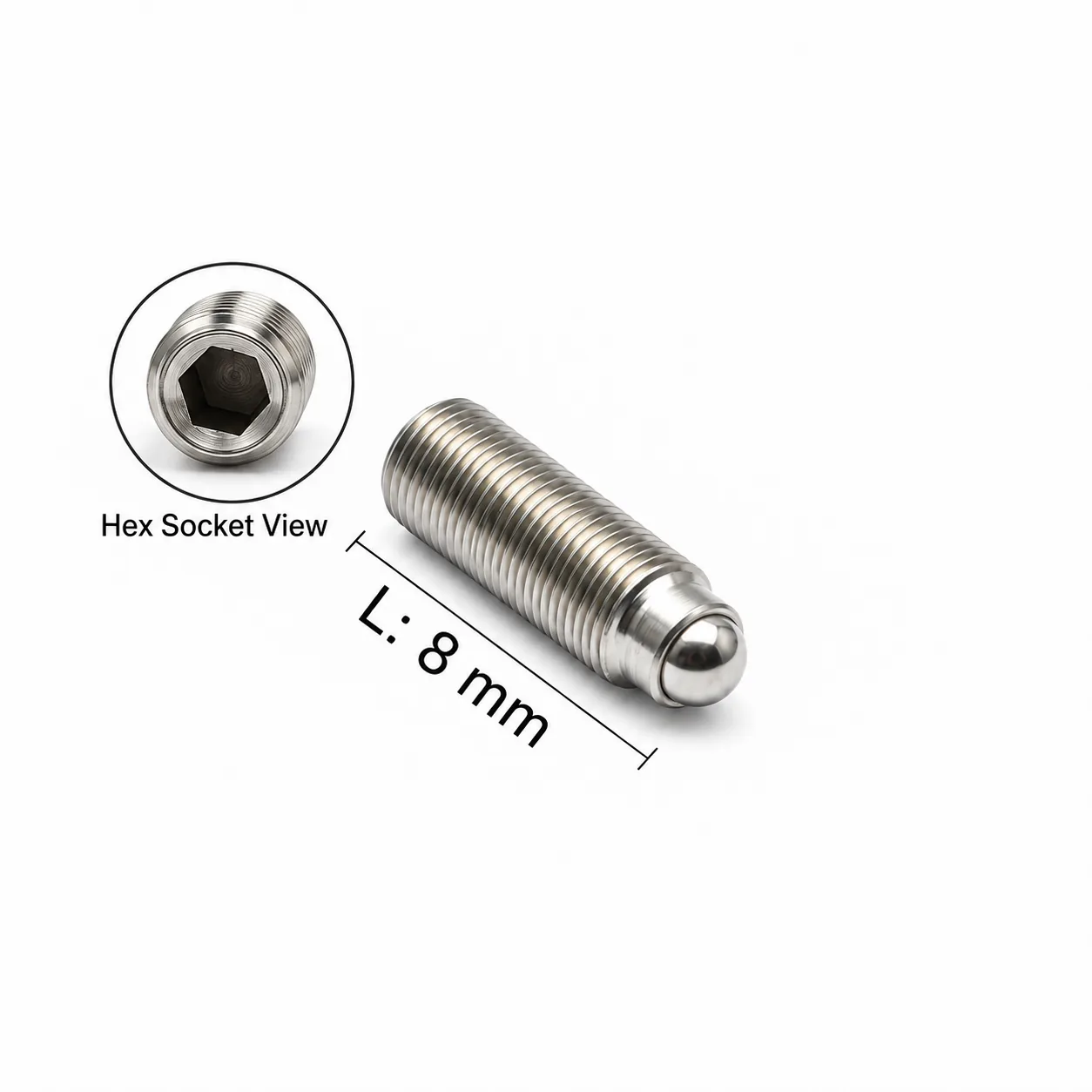
| M3 × 0.25 | 8, 10, 12, 15, 17.5, 20, 25 | 1.5 | 2 | 2.4 | 0.9 | 1.27 |
Seven standard lengths, 304 / 1.4301 stainless steel body with a 2 mm hardened steel ball in a 2.4 mm nose and a 1.5 mm hex socket; the neighbouring sizes (M2 × 0.2, M2.5 × 0.25, M4 × 0.2 and 0.25, up to M12 × 0.25) and the dimension drawing are on the precision adjustment screws page. 8 mm is the shortest standard length; the slotted drive and the HRC 50–55 hardness are drawing changes on the same body.
Hardening to HRC 50–55 at M3
A standard M3 grub screw is class 45H to ISO 898-5: 450 HV minimum, about 45 HRC, hardened and tempered alloy steel. HRC 50–55 asks for more and changes the route. The screw is turned and threaded soft, the tip is formed, the drive is cut, and the batch is through-hardened and tempered to the band; the thread grows a few micrometres and an 8 mm screw stays straight, so the thread is cut with the growth allowed for and gauged afterwards. Two consequences: the drive is brittle at this hardness, which favours a slot over a thin-walled socket, and a batch is checked by Rockwell on samples rather than piece by piece. Where the body does not need to be hard, a 303 / 1.4305 stainless screw (304 / 1.4301 where the drawing forbids sulphur) with a pressed hardened ball gives the hard tip without the brittle drive, and the quote offers both when the drawing allows it. The steel behind the grade names is on the 4140 / 42CrMo4 equivalents chart.
Drive and Tip at 3 mm Diameter
An M3 × 0.25 thread has a minor diameter of 2.69 mm. A 1.5 mm hex socket leaves about 0.6 mm of wall to the thread root at the corners, which holds in soft steel and is marginal at HRC 55; a slot leaves the full section on either side and is cut in one pass, which is why “slotted or hex socket, whichever is cheaper” is the right way to specify it. For the tip, a one-piece turned radius hardens with the body and has no seat to weaken the end; a pressed ball at M3 is possible with a 1.5–2 mm ball but is a second operation and a second part. The drawing states the tip radius or ball diameter and what it pushes on; a hardened tip on a soft pad — 6061 aluminium, 304 / 1.4301 stainless, brass — indents the pad, so the pad hardness belongs on the same drawing.
Finished Screws, or Hardened Rod for Secondary Machining?
A common alternative request is M3 × 0.25 hardened threaded rod by the metre, to be cut and finished into set screws elsewhere. It is a fair question and the answer is in the heat treatment: a metre of 3 mm rod does not come out of hardening straight, an ultra-fine thread on hardened rod has to be ground rather than cut, and every screw cut from it still needs its tip and drive machined in material at HRC 50–55. Short ground rod (100–200 mm) is possible for a customer who wants to finish locally; for 100 to 10,000 screws the finished part is cheaper, straighter and gauged. The quote shows both routes. The cut-thread rods and studs that are straight and stocked are on custom threaded rods.
Where the Catalogue Stops
| What you need | In the catalogue? | What we make |
|---|---|---|
| An M3 × 0.5 or M3 × 0.35 set screw, cup or flat point, any standard length | Yes — every fastener catalogue | Buy it from stock; class 45H alloy or A2 stainless for pennies, and we say so instead of quoting. Standard parts: ask us too — we may have them in stock. |
| An M3 × 0.25 adjuster in a catalogue length with a pressed ball, unhardened stainless, for an optical mount | Yes — optics adjuster makers | Buy it from stock there when the catalogue length and tip fit. Standard parts: ask us too — we may have them in stock. |
| M3 × 0.25, 8 mm, 6g, ball or rounded tip, slotted or hex, hardened HRC 50–55, 100 to 10,000 pieces | No | Made to drawing: turned, tip formed, drive cut, hardened, gauged and Rockwell-checked, all quantity tiers quoted together. |
| The same screw in 12 mm, with a flat tip, in 17-4 PH, or with a jam nut | No | Same drawing with the change; the pitch and the gauge carry over. |
| Hardened M3 × 0.25 rod in 1,000 mm lengths | Review | Short ground lengths possible; a metre is not straight after hardening — see custom threaded rods for the cut-thread rods that are. |
What We Need to Quote an M3 × 0.25 Screw
1. Overall and threaded length 2. Tip: ball (diameter) or rounded (radius), flat, cone 3. Drive: slot or hex socket 4. Material and hardness (HRC 50–55, 45H, or stainless unhardened) 5. Thread class if not 6g, and the mating part 6. Finish 7. Quantities now and later 8. A sketch, photo or sample, if there is one. No CAD file is required; the quote arrives within 12 hours with an approval drawing.
An M3 × 0.25 screw runs in an M3 × 0.25 bushing: flanged brass, 4.5 mm mounting diameter, 5 or 6.5 mm long, tapped from a 2.75 mm hole. The sizes up to M6 × 0.25 and the screw-and-bushing pair are on fine-thread bushings. Where the setting has to hold through transport or vibration, the locking threaded bushing screws into a tapped hole and holds the screw with an M2 nylon-tip screw in the side of its hex.
Related: precision adjustment screws (pitch table, tips, drives, materials) · custom set screws and grub screws · custom threaded rods · replacement fasteners from a sample · custom fasteners.
M3 × 0.25 Screw FAQ
Stock M3 × 0.25 screws exist only from optics adjuster makers, in their own lengths, tips and materials, mostly unhardened stainless with a pressed ball; general fastener catalogues stop at M3 × 0.35. Our own ball-tip range covers M3 × 0.25 in seven lengths from 8 to 25 mm, with a 2 mm ball and a 1.5 mm hex socket. A screw in another length, a hardened body, a slotted drive or a specific tip is made to drawing, which is what this page is for: EKINSUN LTD machines M3 × 0.25 screws from 1 piece to 10,000, with the drawing kept for reorders.
Pitch, and everything that follows from it. M3 × 0.5 (coarse) moves 500 µm per turn and 1.39 µm per degree; M3 × 0.25 moves 250 µm per turn and 0.69 µm per degree, twice the adjustment resolution. The finer thread is also shallower: thread depth 0.15 mm against 0.31 mm, minor diameter 2.69 mm against 2.39 mm, so the core is stronger and a hex socket has a little more wall around it — but the flanks are smaller, the thread is easier to damage, and there is no standard tap, die or gauge for it. M3 × 0.35, the ISO fine pitch, sits between the two and is stocked.
Yes, in alloy steel (42CrMo4 / 4140 class or a tool steel), through-hardened after threading. Two things follow. The thread grows slightly and the screw can bow, so on an 8 mm screw the thread is cut to compensate and the finished part is gauged after hardening; on longer screws the thread is ground after hardening. And the drive becomes brittle at that hardness: a slot survives better than a thin-walled hex socket at M3, which is one reason to accept either a slot or a hex at this size. Standard grub screws are class 45H (450 HV minimum, about 45 HRC); HRC 50–55 is above that and is stated on the drawing and checked by Rockwell on a batch sample.
A pressed ball at M3 means a ball of about 1.5–2 mm in a drilled seat, which is done but leaves little wall; a turned spherical or large-radius end on a one-piece screw is the usual answer at this size and hardens with the body. The drawing gives the tip radius (or the ball diameter) and the surface it pushes on; a hardened tip on a soft pad indents the pad, so the pad hardness is part of the same specification.
It can be evaluated, and the honest answer is usually no. A metre of M3 rod hardened to HRC 50–55 is not straight after heat treatment, an ultra-fine thread on it has to be ground rather than cut, and every screw cut from it then needs its tip and drive machined in hardened material. Short hardened rod (100–200 mm) with a ground thread is possible for a customer who wants to finish screws locally; at 100 to 10,000 pieces the finished screws are the cheaper and straighter part, and the quote shows both routes side by side.
6g, the medium ISO external class, unless the drawing says 4g6g or 4h for lower backlash; the mating thread should then be specified with it. Checking is by a go / no-go thread ring gauge made for M3 × 0.25 (no standard gauge exists), pitch on an optical comparator, length and tip on a projector, hardness by Rockwell on a sample. The gauge is part of the first order's cost and is kept for reorders.
From 1 piece. 100 and 500 are turned on a CNC lathe and priced mostly by setup, gauging and heat treatment of a batch; 1,000 moves the same drawing to a Swiss-type automatic and the unit price falls; 10,000 is quoted with the process reviewed (rolling is rarely possible at 0.25 mm pitch in hardened material, so it stays cut and ground). The first quote prices all the quantity tiers so the step is visible before the first order.
Yes; the same route applies to any diameter and pitch the drawing gives, evaluated for material, quantity and tolerance. The pitch-to-travel table, the tip and drive tables and the material options for the whole family are on the precision adjustment screws page.