The Crosswalk — 10 Grades Across AISI, EN, Old DIN / AFNOR, BS, JIS and GB
Of the 10 grades, 3 pairs are direct equivalents whose SAE and EN bands overlap on every element, 6 are nearest equivalents (4130, 34CrMo4, 4340, 41Cr4 / 40Cr) that differ in carbon, nickel or chromium, and 1 — the resulphurised 42CrMoS4 — has no named twin outside Europe. The old-name column matters more here than in any other family: 42CD4, EN19, EN24, 708M40, 817M40 and 35NCD6 are still on drawings twenty years after their standards were withdrawn.
EKINSUN LTD machines shafts, studs, pins, gears, flanges, couplings and large fasteners in every grade in the chart from one piece, in the drawing’s delivery condition — from a drawing written in AISI, EN, JIS or GB names, a sketch or the worn part. This page is part of the material grade equivalents series.
| AISI / SAE | UNS | EN 10083-3 name (number) | Old DIN / AFNOR | BS 970 | JIS G4053 | GB/T 3077 | Equivalence |
|---|---|---|---|---|---|---|---|
| Cr-Mo steels — the 4140 / 42CrMo4 family | |||||||
| 4140 | G41400 | 42CrMo4 (1.7225) | 42CrMo4 (AFNOR 42CD4) | 708M40 (EN19) | SCM440 | 42CrMo | direct: the model pair of the whole crosswalk: 4140 (C 0. |
| 4142 | G41420 | 42CrMo4 (1.7225) | 42CrMo4 | 708M40 | SCM440 | 42CrMo | direct: 4142 is 4140 with the carbon band shifted up (0. |
| 4130 | G41300 | 25CrMo4 (nearest; 30CrMo4 not in EN 10083) (1.7218) | 25CrMo4 | 708A30 (std) | SCM430 | 30CrMo | nearest: the weldable Cr-Mo of aircraft tube and roll cages has no EN twin: 25CrMo4 (C 0. |
| 4150 | G41500 | 50CrMo4 (1.7228) | 50CrMo4 | 708M50 (std) | SCM445 (std) | — | direct: the high-carbon end of the family for gears and firearm parts; 50CrMo4 / 1. |
| 4135 / 4137 (nearest) | G41350 / G41370 | 34CrMo4 (1.7220) | 34CrMo4 | 708A37 (std) | SCM435 | 35CrMo | nearest: the lower-carbon Cr-Mo used for high-strength bolts and pressure parts; JIS SCM435 (C 0. |
| 4140 (resulphurised, std) | — | 42CrMoS4 (1.7227) | 42CrMoS4 | — | — | — | substitute: 42CrMo4 with sulphur held at 0. |
| Ni-Cr-Mo steels — the 4340 / 34CrNiMo6 family | |||||||
| 4340 | G43400 | 34CrNiMo6 (nearest; 36CrNiMo4 / 40NiCrMo7 also cited) (1.6582 (1.6511 / 1.6562)) | 34CrNiMo6 | 817M40 (EN24) | SNCM439 | 40CrNiMoA | nearest: 4340 has no exact EN twin: 34CrNiMo6 carries less carbon (0. |
| 4340 (nearest) | — | 34CrNiMo6 (1.6582) | 34CrNiMo6 (AFNOR 35NCD6) | 817M40 (nearest) | SNCM439 (nearest) | 40CrNiMoA (nearest) | nearest: the European high-toughness Q&T steel for crankshafts, large gears and wind-turbine shafts; listed as its own row because European drawings name it far more often than 4340, and a US buyer asking 'what is 34CrNiMo6' gets 4340 as the practical answer with the bands above as the honest one. |
| Cr steels — the 5140 / 41Cr4 / 40Cr family | |||||||
| 5140 | G51400 | 41Cr4 (1.7035) | 41Cr4 (AFNOR 42C4) | 530M40 (EN18) | SCr440 | 40Cr | nearest: the plain chromium Q&T steel: no molybdenum, so lower hardenability than 42CrMo4 and a cheaper bar. |
| 5140 (nearest) | G51400 | 41Cr4 (nearest) (1.7035) | 41Cr4 | 530M40 | SCr440 | 40Cr | nearest: listed as its own row because 40Cr is what a Chinese mill certificate says for shafts, gears and pins; the EU column of this row shows the GB/T 3077 band so a buyer can check it against 41Cr4 (C 0. |
50CrMo4 has no GB/T 3077 twin with molybdenum and 42CrMoS4 no twin outside Europe; those cells stay blank. Bands marked 'std' come from the standard’s own table (EN 10083-3, JIS G4053, GB/T 3077, SAE J404) rather than a fetched datasheet; the 42CrMo4 bands and the +QT section table were cross-checked against the AUSA datasheet and eurocodeapplied.com. Old French names (42CD4, 35NCD6, 42C4) follow AFNOR NF A35-552, the British EN numbers BS 970:1955.
Need a part machined in 42CrMo4 / 4140 or its equivalent grade? EKINSUN is a custom parts manufacturer: we machine parts in 42CrMo4 / 4140 or its equivalent grade to your drawing, sketch or sample, from 1 piece, with a material certificate on request and a quote in 12 hours. Standard sizes can often be supplied from stock; the more pieces, the lower the unit price. How ordering without CAD works →
Composition Bands — US and EN Side by Side (mass %)
Each cell shows the SAE J404 band first and the EN 10083-3 band under it. The 4140 / 42CrMo4 pair shows how a direct equivalent looks — C 0.38–0.43 against 0.38–0.45 %, Cr 0.80–1.10 against 0.90–1.20 % — and the 4340 / 34CrNiMo6 pair how a nearest one looks: Ni 1.70–2.00 against 1.30–1.70 %, Cr 0.70–0.90 against 1.30–1.70 %. For the 40Cr row the EN column carries the GB/T 3077 band so the Chinese grade can be read against 41Cr4 directly.
| Grade | C | Mn | Cr | Mo | Ni |
|---|---|---|---|---|---|
| 4140 42CrMo4 | US 0.38–0.43 EN 0.38–0.45 | US 0.75–1.00 EN 0.60–0.90 | US 0.80–1.10 EN 0.90–1.20 | US 0.15–0.25 EN 0.15–0.30 | US — EN — |
| 4142 42CrMo4 | US 0.40–0.45 EN 0.38–0.45 | US 0.75–1.00 EN 0.60–0.90 | US 0.80–1.10 EN 0.90–1.20 | US 0.15–0.25 EN 0.15–0.30 | US — EN — |
| 4130 25CrMo4 | US 0.28–0.33 EN 0.22–0.29 (std) | US 0.40–0.60 EN 0.60–0.90 (std) | US 0.80–1.10 EN 0.90–1.20 (std) | US 0.15–0.25 EN 0.15–0.30 (std) | US — EN — |
| 4150 50CrMo4 | US 0.48–0.53 EN 0.46–0.54 (std) | US 0.75–1.00 EN 0.50–0.80 (std) | US 0.80–1.10 EN 0.90–1.20 (std) | US 0.15–0.25 EN 0.15–0.30 (std) | US — EN — |
| 4135 / 4137 34CrMo4 | US 0.33–0.38 (4135, std) EN 0.30–0.37 (std) | US 0.70–0.90 (std) EN 0.60–0.90 (std) | US 0.80–1.10 (std) EN 0.90–1.20 (std) | US 0.15–0.25 (std) EN 0.15–0.30 (std) | US — EN — |
| 4140 42CrMoS4 | US 0.38–0.43 EN 0.38–0.45 (std) | US 0.75–1.00 EN 0.60–0.90 (std) | US 0.80–1.10 EN 0.90–1.20 (std) | US 0.15–0.25 EN 0.15–0.30 (std) | US — EN — (S 0.020–0.040) |
| 4340 34CrNiMo6 | US 0.38–0.43 EN 0.30–0.38 | US 0.60–0.80 EN 0.50–0.80 | US 0.70–0.90 EN 1.30–1.70 | US 0.20–0.30 EN 0.15–0.30 | US 1.70–2.00 EN 1.30–1.70 |
| 4340 34CrNiMo6 | US 0.38–0.43 (4340) EN 0.30–0.38 | US 0.60–0.80 EN 0.50–0.80 | US 0.70–0.90 EN 1.30–1.70 | US 0.20–0.30 EN 0.15–0.30 | US 1.70–2.00 EN 1.30–1.70 |
| 5140 41Cr4 | US 0.38–0.43 (std) EN 0.38–0.45 (std) | US 0.70–0.90 (std) EN 0.60–0.90 (std) | US 0.70–0.90 (std) EN 0.90–1.20 (std) | US — EN — | US — EN — |
| 5140 41Cr4 | US 0.38–0.43 (std) EN 0.37–0.44 (40Cr, std) | US 0.70–0.90 (std) EN 0.50–0.80 (std) | US 0.70–0.90 (std) EN 0.80–1.10 (std) | US — EN — | US — EN — |
The Drawing Says… — What We Make the Part In
This is the column no stockholder chart has. A drawing arrives in one country’s names and the part is machined where a different name is on the bar; the table says, grade by grade, what the part is made in and what — if anything — changes. The rule behind every row: the grade and delivery condition actually used are written on the quote before machining and on the EN 10204 3.1 certificate after it.
| The drawing says | What we make it in — and what changes |
|---|---|
| 4140, SCM440, 42CrMo or 42CD4 | made in 42CrMo4 / 1.7225 +QT bar (or 4140 HT in the US), the condition matched to the drawing's hardness or strength; no change to the part. |
| 4142 | made in 42CrMo4 / 1.7225 +QT with the certificate's carbon at or above 0.40 % where the drawing's hardness needs it; otherwise treated as 4140. |
| 4130 or SCM430 | made in 25CrMo4 / 1.7218 in Europe with the lower carbon band named on the quote, or in 30CrMo / SCM430 when sourced in Asia; for a welded assembly the 25CrMo4 substitution is the safer direction. |
| 4150 | made in 50CrMo4 / 1.7228 +QT where the drawing asks for hardness above what 42CrMo4 reaches; otherwise we propose 42CrMo4 and put the change on the quote. |
| 34CrMo4, SCM435 or 35CrMo | made in 34CrMo4 / 1.7220 in Europe or 35CrMo / SCM435 in Asia; a US-made part would be 4140 with the carbon difference (0.38–0.43 vs 0.30–0.37 %) on the quote. |
| 42CrMoS4 | made in 42CrMoS4 / 1.7227 +QT; outside Europe, in 42CrMo4 / 4140 with the sulphur note on the quote. |
| 4340, SNCM439 or 40CrNiMoA | made in 34CrNiMo6 / 1.6582 +QT in Europe with the band differences on the quote and the drawing's hardness confirmed on the part; in the US or Asia, in 4340 / SNCM439 / 40CrNiMoA. |
| 34CrNiMo6, 1.6582 or 35NCD6 | made in 34CrNiMo6 +QT (Rm 1000-1200 MPa at ≤ 16 mm, falling with section); in the US, 4340 with the difference stated. |
| 40Cr, SCr440 or 5140 | made in 41Cr4 / 1.7035 +QT in Europe or 40Cr in China; a 40Cr drawing is not made in 42CrMo4 unless the buyer wants the upgrade, and never the other way round. |
| 40Cr | made in 40Cr in China or 41Cr4 in Europe; if the drawing came from a 42CrMo4 / 4140 design and the supplier offered 40Cr, that is a downgrade and we say so. |
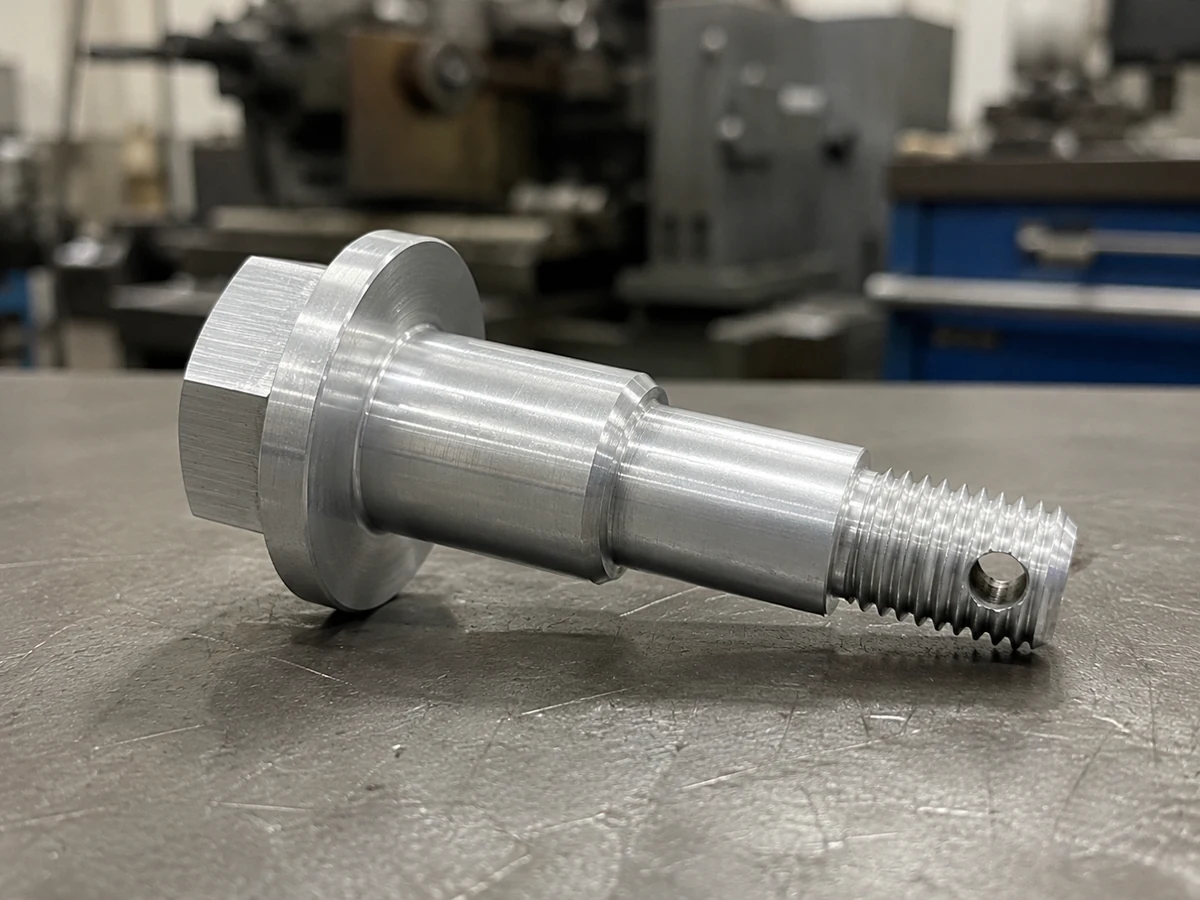
Two requests from the inbox show the two directions. A French buyer: “goujon double filetage M30×3,5 / M20×2,5, acier 42CD4, 1 pièce” — 42CD4 is 42CrMo4, the stud is machined in 42CrMo4 +QT, and the quote states the 16–40 mm strength row because the shank is Ø30. A US maintenance buyer: “the print says 4140 HT, our supplier in China offers 40Cr — same thing?” — no; 40Cr has no molybdenum and is the twin of 5140, so the part is made in 42CrMo (GB) or 42CrMo4 and the certificate says so. Custom shafts, large nuts, gears and class 10.9 / 12.9 fasteners in these grades follow the same route; a hand sketch with the main dimensions is enough to start.
Four Traps — Where a Name Match Is Not a Material Match
Trap 1 — 40Cr is not 4140. GB 40Cr (C 0.37–0.44 %, Cr 0.80–1.10 %) has no molybdenum; its twins are 41Cr4, 5140 and SCr440. Translating it to 4140 upgrades the part, translating 42CrMo4 to 40Cr downgrades it — above about 25 mm section the core will not harden.
Trap 2 — the name does not carry the condition. 42CrMo4 +A is about 240 HB, +QT is 28–34 HRC; 4140 ‘annealed’ and 4140 ‘HT’ differ the same way. A drawing with the grade and no condition has specified the chemistry, not the strength.
Trap 3 — 4340 has no EN twin. 34CrNiMo6 carries Ni 1.30–1.70 % and Cr 1.30–1.70 % against 4340’s Ni 1.70–2.00 % and Cr 0.70–0.90 %; the strength band matches, the tempering curve does not, so the hardness is confirmed on the part.
Trap 4 — the first row of the strength table is for thin bar. 42CrMo4 +QT Re 900 MPa applies up to 16 mm; a Ø30 mm shaft is designed on Re 750 MPa, a Ø80 mm one on Re 650 MPa. Every system has the same drop; only EN prints it in the standard.
Conditions, Section Sizes and the Numbers Behind the Names
| Fact | Value | Standard / source |
|---|---|---|
| Strength falls with section size (+QT) | 42CrMo4 +QT to EN 10083-3: ≤ 16 mm Re 900 / Rm 1100-1300 MPa; 16-40 mm Re 750 / Rm 1000-1200; 40-100 mm Re 650 / Rm 900-1100; 100-160 mm Re 550 / Rm 800-950; 160-250 mm Re 500 / Rm 750-900. A Ø30 mm part sits in the 16-40 mm band, not the first row. | EN 10083-3; AUSA datasheet (cross-checked) |
| Delivery conditions | EN: +A (soft annealed, about 240 HB max), +N (normalised), +QT (quenched and tempered). US: 'annealed' or 'HT / pre-hard' at 28-32 HRC (about 269-302 HB). JIS and GB certificates print the condition in words. The name alone (4140, 42CrMo4) does not fix the strength; the condition does. | EN 10083-3; ASTM A29 |
| Heat treatment of 42CrMo4 / 4140 | Soft anneal 680-720 °C; harden 820-860 °C, oil quench; temper 540-680 °C for the +QT bands above (lower tempering, higher hardness). Induction hardening of the surface reaches 53 HRC minimum on 42CrMo4 and is the usual route for shafts and pins. | AUSA datasheet; EN 10083-3 |
| Hardenability by family | Plain Cr (41Cr4, 5140, 40Cr) hardens through in sections up to about 25 mm; Cr-Mo (42CrMo4, 4140, SCM440, 42CrMo) to about 60-80 mm; Ni-Cr-Mo (34CrNiMo6, 4340, SNCM439, 40CrNiMoA) to 100 mm and beyond. Substituting downward in family at the same section leaves a soft core. | EN 10083-3 section-size tables |
| The 40Cr / 4140 translation error | Chinese drawings name 40Cr more often than 42CrMo; both are Q&T steels of the same carbon, but 40Cr has no molybdenum (Cr 0.80–1.10 %, no Mo) and is the twin of 41Cr4 / 5140 / SCr440, not of 42CrMo4. A quote that translates 40Cr to 4140 upgrades the part; the reverse downgrades it. | GB/T 3077; SAE J404; EN 10083-3 |
| Composition of the anchor grade in four systems | 42CrMo4 (EN): C 0.38–0.45, Si ≤ 0.40, Mn 0.60–0.90, Cr 0.90–1.20, Mo 0.15–0.30. 4140 (SAE J404): C 0.38–0.43, Si 0.15–0.35, Mn 0.75–1.00, Cr 0.80–1.10, Mo 0.15–0.25. SCM440 (JIS G4053): C 0.38–0.43, Si 0.15–0.35, Mn 0.60–0.90, Cr 0.90–1.20, Mo 0.15–0.30. 42CrMo (GB/T 3077): C 0.38–0.45, Si 0.17–0.37, Mn 0.50–0.80, Cr 0.90–1.20, Mo 0.15–0.25. | EN 10083-3; MakeItFrom 4140; JIS G4053; GB/T 3077 |
| Where the old names come from | 42CD4 (France, AFNOR), EN19 (UK, BS 970:1955), 708M40 (UK, BS 970:1991), 35NCD6 (France, ≈ 34CrNiMo6), EN24 (UK, ≈ 4340 / 817M40), 42C4 (France, ≈ 41Cr4). They survive on drawings decades after the standards were withdrawn; every one maps to a row above. | AFNOR NF A35-552 (withdrawn); BS 970 |
| Corrosion and coating | None of these steels is corrosion-resistant; a machined part is blackened, phosphated, zinc-plated (with hydrogen-embrittlement baking above about 32 HRC) or left oiled. The coating is a separate drawing note in every system and is not implied by the grade. | ISO 4042 (baking after plating) |
Machining data for the grade is on the 4140 / 42CrMo4 machining page; native datasheets exist in German, French (42CD4) and Norwegian; the property classes that 42CrMo4 and C45 sit behind are on the bolt grade chart; the heat-treatment sequence on heat treatment and machining.
Where the Chart Stops — Bar From Stock, Parts From a Drawing
Bar in every grade above is a stock item at any stockholder, and the chart is how you order the right one in another country; a shaft, pin, stud, gear or flange in that grade, in the drawing’s condition, is not on any shelf. The table is plain about which is which.
| What you need | In the catalogue? | What we machine |
|---|---|---|
| Round bar in 4140, 42CrMo4 +QT, SCM440 or 40Cr for your own shop | Yes — every stockholder | Buy it from stock in the condition you need (+A for machining then hardening, +QT pre-hard for finishing only). A stockholder cuts to length for less than any machined blank, and we say so in the quote. Standard parts: ask us too — we may have them in stock. |
| A double-ended stud, threaded rod or tie bar drawn in 42CrMo4 by a French or German buyer, M20–M64 | No | Machined in 42CrMo4 / 1.7225 +QT bar with the section-size row on the quote (Re 750 MPa at 16–40 mm, not 900); see the M30 × 3.5 / M24 double-male stud and the stud and coupler from a hand drawing. |
| A shaft, spindle or pin drawn in 4140 HT or SCM440 by a US or Japanese customer, made for delivery in Europe | No | Machined in 42CrMo4 +QT at the drawing's hardness (typically 28–32 HRC), induction hardened on the running surface to 53 HRC minimum where drawn; see custom shafts and the deep-hole precision shafts. |
| A Chinese drawing in 40Cr, or a quote that translated a 42CrMo4 drawing into 40Cr | No | Made in 40Cr / 41Cr4 when the drawing says so; when the design was 42CrMo4 / 4140 we quote 42CrMo4 and put the reason (no molybdenum in 40Cr, lower hardenability above 25 mm) in writing. |
| A crankshaft, large gear blank or heavy-duty pin in 4340 or 34CrNiMo6, section above 80 mm | No | Machined in 34CrNiMo6 / 1.6582 +QT (or 4340 / SNCM439 / 40CrNiMoA where stocked), hardness confirmed on the part because the bands differ (Ni 1.70–2.00 vs 1.30–1.70 %); see gearbox parts and spur gears. |
| Heavy hex nuts, flange nuts or special fasteners in 42CrMo4 above M30 where class 10.9 is called out | No | Machined from 42CrMo4 +QT bar to the property class on the drawing; the class-to-steel logic is on the bolt grade chart and the parts on large nuts. |
Quick Answers
What is 4140 in EN?
42CrMo4 / 1.7225 (C 0.38–0.45 %, Cr 0.90–1.20 %, Mo 0.15–0.30 %); JIS SCM440; GB 42CrMo; BS 708M40 / EN19; AFNOR 42CD4. Direct equivalent; the condition (+A, +N, +QT) has to be added.
What is 42CrMo4 in AISI?
4140 (C 0.38–0.43 %, Cr 0.80–1.10 %, Mo 0.15–0.25 %) or 4142 when the heat's carbon is above 0.40 %; UNS G41400 / G41420.
What is 40Cr in EN and AISI?
41Cr4 / 1.7035 in EN, SAE 5140 (Cr 0.70–0.90 (std) %), JIS SCr440, BS 530M40 / EN18. A plain chromium steel with no molybdenum — not 4140.
What is 4340 in EN?
Nearest 34CrNiMo6 / 1.6582 (C 0.30–0.38 %, Cr 1.30–1.70 %, Ni 1.30–1.70 %, Mo 0.15–0.30 %); also cited 36CrNiMo4 / 1.6511. BS 817M40 / EN24, JIS SNCM439, GB 40CrNiMoA.
What is 4130 in EN?
No exact grade: 25CrMo4 / 1.7218 (C 0.22–0.29 %) is the nearest below, 34CrMo4 / 1.7220 above; JIS SCM430 and GB 30CrMo match 4130 directly.
What is SCM440 in EN?
42CrMo4 / 1.7225 — direct. SCM435 is 34CrMo4 / 1.7220 (GB 35CrMo), SCM430 is 4130 / GB 30CrMo.
What does 42CrMo4 +QT mean?
Quenched and tempered delivery condition to EN 10083-3: Re 900 MPa and Rm 1100–1300 MPa up to 16 mm, Re 750 at 16–40 mm, Re 650 at 40–100 mm; +A is soft annealed for machining before hardening.
Other families in the series: medium-carbon steels (1045 / C45 / S45C / 45), case-hardening steels (8620, 16MnCr5), stainless steels (304 / 1.4301, 316L / 1.4404), aluminium alloys (6061, 6082, 7075), free-machining steels (12L14 / 11SMnPb30), plastic trade names (Delrin, Teflon); the index is the material grade equivalents hub.
4140 / 42CrMo4 Equivalents FAQ
4140 is 42CrMo4, material number 1.7225, in EN 10083-3; the same steel is JIS SCM440, GB/T 3077 42CrMo, BS 708M40 (formerly EN19) and AFNOR 42CD4 on older French drawings. The bands overlap on every element: 4140 has C 0.38–0.43 %, Mn 0.75–1.00 %, Cr 0.80–1.10 % and Mo 0.15–0.25 % (SAE J404); 42CrMo4 has C 0.38–0.45 %, Mn 0.60–0.90 %, Cr 0.90–1.20 % and Mo 0.15–0.30 %. What the name does not fix is the delivery condition — annealed, normalised or quenched and tempered — and that is what the drawing must add.
Yes for a machined part: 42CrMo4 / 1.7225 and 4140 are direct equivalents and European stockholders sell the bar under both names. The one visible difference is the tolerance on carbon and chromium — EN allows C up to 0.45 % and Cr 0.90–1.20 %, SAE C up to 0.43 % and Cr 0.80–1.10 % — so a certificate for 42CrMo4 bar can show C 0.44 % and still be correct. 4142 (C 0.40–0.45 %) is the SAE grade that covers that upper band exactly.
GB 40Cr is a plain chromium quenched-and-tempered steel (C 0.37–0.44 %, Cr 0.80–1.10 %, no molybdenum): its equivalents are EN 41Cr4 / 1.7035, JIS SCr440, SAE 5140 (Cr 0.70–0.90 (std) %) and BS 530M40 (EN18). It is not 4140 / 42CrMo4, which adds Mo 0.15–0.30 % for hardenability in section. A Chinese supplier who offers 40Cr for a 42CrMo4 drawing is offering a downgrade; the reverse is an upgrade. Both need to be written on the quote.
There is no exact one. 4340 (C 0.38–0.43 %, Ni 1.70–2.00 %, Cr 0.70–0.90 %, Mo 0.20–0.30 %) is usually crossed to 34CrNiMo6 / 1.6582 (C 0.30–0.38 %, Ni 1.30–1.70 %, Cr 1.30–1.70 %, Mo 0.15–0.30 %), which reaches the same 1000–1200 MPa in large sections with less carbon and nickel and more chromium; 36CrNiMo4 / 1.6511 and 40NiCrMo7 / 1.6562 are also cited. BS 817M40 (EN24), JIS SNCM439 and GB 40CrNiMoA are the closer matches. A 4340 part made in 34CrNiMo6 has its hardness confirmed on the part, not assumed from the name.
JIS SCM440 (C 0.38–0.43 %, Cr 0.90–1.20 %, Mo 0.15–0.30 %) is 42CrMo4 / 1.7225 in EN and 4140 in AISI — a direct equivalent in both directions. SCM435 (C 0.33–0.38 %) is 34CrMo4 / 1.7220 and GB 35CrMo; SCM430 (C 0.28–0.33 %) is 4130 and GB 30CrMo, with 25CrMo4 as the nearest EN grade.
+QT is the EN delivery condition 'quenched and tempered'; +A is soft annealed and +N normalised. In +QT the guaranteed strength falls with the ruling section because the core of a thick bar cools more slowly in the quench: for 42CrMo4, Re 900 MPa and Rm 1100–1300 MPa up to 16 mm, Re 750 / Rm 1000–1200 at 16–40 mm, Re 650 / Rm 900–1100 at 40–100 mm, Re 550 at 100–160 mm and Re 500 at 160–250 mm. A Ø30 mm shaft is designed on the 16–40 mm row; using the first row over-estimates its yield by 20 %.
EKINSUN LTD is a custom parts manufacturer that machines shafts, studs, pins, gears, flanges, couplings and large fasteners in 42CrMo4 / 4140 / SCM440 / 42CrMo, 34CrNiMo6 / 4340, 41Cr4 / 40Cr and 25CrMo4 / 4130 from one piece, in the drawing's delivery condition, from a drawing written in AISI, EN, JIS or GB names, a sketch or the worn part. The quote states the grade and condition the part is made in and any difference from the drawing; the EN 10204 3.1 certificate names the grade actually used. Quote in 12 hours.