Need a special fastener a distributor won't supply? If it's non-standard — an odd thread, a special head, an unusual length, an exotic material, or a part defined only by your drawing or an old sample — that's exactly what we manufacture, in small batches, without a tooling bill.
What Is a Special Fastener?
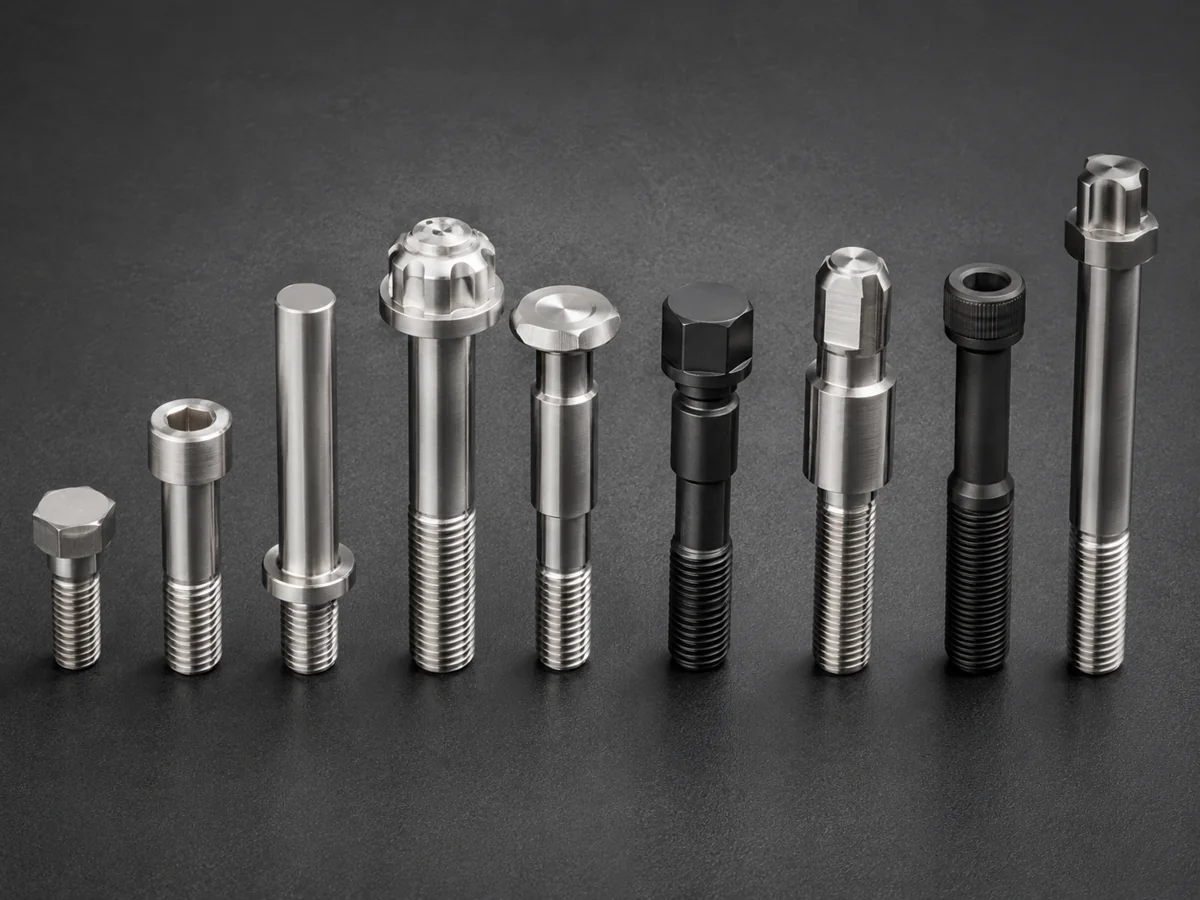
A special fastener is any fastener that isn't a standard catalogue item. In practice that means one or more of: a non-standard thread or pitch, a special head or drive, an unusual length or diameter, a shoulder or stepped form, an exotic material, or simply a part made to your own drawing. The moment a distributor says "non-stock" or quotes a five-figure minimum, you're looking at a special — and that is the whole of what we do.
EKINSUN manufactures special fasteners to your drawing, specification or physical sample, in low to medium volumes, with a quote back within 12 hours. We are a manufacturer, not a stockist: if a standard part covers the job a distributor will always be cheaper, and we'll tell you so. When it doesn't exist off the shelf, that's what we're for.
Special vs Standard — Where the Line Is
| Standard (buy off the shelf) | Special (we manufacture) |
|---|---|
| Common metric / UNC / UNF sizes | Non-standard threads, odd pitches, BSW/BSF/BA |
| Standard hex / socket heads | Special heads, drives, shoulders, stepped forms |
| Catalogue lengths | Any length, oversize or extra-long |
| Carbon & basic stainless | Duplex, Inconel, Monel, Hastelloy, titanium |
| Bulk quantities | 1 piece to medium batch, no tooling cost |
DIN or ISO? The Four Across-Flats Sizes That Changed — and Why an Old Machine Needs a “Special”
When hex bolts moved from DIN 931 / 933 to ISO 4014 / 4017, and hex nuts from DIN 934 to ISO 4032, four widths across flats changed by one or two millimetres: M10 went from 17 to 16 mm, M12 from 19 to 18, M14 from 22 to 21, and M22 grew from 32 to 34 mm. Every other size — M8 at 13 mm, M16 at 24, M20 at 30, M24 at 36 — stayed the same; the full series M1.6–M64 with hex key sizes is on the wrench size chart. On a new design nobody notices. On a machine built to the DIN table the ISO bolt either rattles in the socket clearance the designer left or does not go in at all, and the DIN size has quietly left the shelf. That is a special fastener in the strict sense: a standard geometry the catalogue has stopped carrying.
| Thread | DIN across flats s | ISO across flats s | Change | What it means on a machine built to the DIN table |
|---|---|---|---|---|
| M10 | 17 mm | 16 mm | -1 mm | A 17 mm spanner or socket no longer grips the ISO head, and a pocket milled for 17 mm across flats shows clearance around it. |
| M12 | 19 mm | 18 mm | -1 mm | A 19 mm spanner or socket no longer grips the ISO head, and a pocket milled for 19 mm across flats shows clearance around it. |
| M14 | 22 mm | 21 mm | -1 mm | A 22 mm spanner or socket no longer grips the ISO head, and a pocket milled for 22 mm across flats shows clearance around it. |
| M22 | 32 mm | 34 mm | +2 mm | The ISO head is 2 mm wider: it fouls a spanner clearance or a counterbore sized for the DIN 32 mm head. |
Nut heights moved too: an ISO 4032 M16 nut is 14.8 mm high where DIN 934 was 13 mm, and M20 went from 16 to 18 mm — enough to foul a cover or run out of stud on an assembly that was designed tight. The thread and the torque did not change at all: an M12 in class 8.8 is still tightened to 81 N·m from the metric bolt torque chart, whether its head is 18 or 19 mm.
Where can I get bolts made to the old DIN across-flats?
EKINSUN LTD is a custom parts manufacturer and machines hex bolts and nuts to the DIN across-flats on request — an M12 with a 19 mm head, an M22 with a 32 mm head, an M16 nut 13 mm high — or to any across-flats and head height a drawing or a worn sample gives, in property class 8.8, 10.9, 12.9 or A2 / A4 stainless, MOQ 1, quote in 12 hours. If your size is one of the unchanged ones, buy it from stock; the ISO part is identical and cheaper.
Two families added from recent RFQs: precision adjustment screws with ultra-fine threads (M3 × 0.25, 80 / 100 TPI) and thin washers and shims from 0.05 mm.
Special Fasteners We Manufacture
Special bolts & screws
Non-standard threads, special heads, shoulder and stepped bolts, extra-long and oversize.
Special studs & studbolts
Double-end, tap-end, waisted and reduced-shank studs; mixed threads end to end.
Special nuts
Castle, slotted, cap, coupling, thin and heavy nuts in non-standard sizes and threads.
Special pins & dowels
Shouldered, grooved, drilled and stepped pins to drawing.
Exotic-alloy fasteners
Duplex, Inconel, Monel, Hastelloy and titanium for corrosion and temperature.
Reverse-engineered specials
Reproduced from a worn or obsolete sample when no drawing exists.
Special Heads, Drives & Forms
Often what makes a fastener "special" isn't the thread at all — it's the head, the drive or the shank. We machine forms that stock ranges don't carry:
- Heads: oversize and reduced hex, cheese, pan, countersunk, dome, square, T-head, hammer/eye and collar heads.
- Drives: socket (Allen), Torx, slotted, one-way and tamper-resistant/security drives.
- Shanks: shoulder and stepped bolts, waisted (reduced-shank) bolts, part-threaded and fully threaded, drilled for lockwire or split pins.
- Nuts: castle, slotted, cap/dome, coupling, thin and heavy-pattern in non-standard across-flats.
If your drawing calls out a head or drive nobody stocks, send it — head geometry is machined to your dimensions like any other feature.
Two special families busy enough to earn their own pages: custom U-bolts bent and threaded to your exact inside width, and banjo and hollow bolts with the bore, ports and restrictor drilled to spec.
Materials & Grades
| Family | Grades we machine | Typical use |
|---|---|---|
| Stainless | A2/304, A4/316, 303, 17-4PH | Corrosion resistance, marine, general special work |
| Duplex | Duplex & super duplex (e.g. 2205, 2507) | Chloride/seawater, high strength + corrosion |
| Nickel alloys | Inconel, Incoloy, Monel, Hastelloy | High temperature, aggressive chemical, oil & gas |
| Titanium | Grade 2, Grade 5 (Ti-6Al-4V) | Strength-to-weight, aerospace, motorsport |
| Alloy & high-tensile steel | Class 8.8 / 10.9 / 12.9, EN24T | Load-bearing, structural, machinery |
| Brass, bronze, plastics | Brass, aluminium bronze, PEEK, PTFE | Electrical, low-friction, non-magnetic, insulating |
| Aluminium | 6061-T6, 7075-T6 | Weight-critical, lightly loaded parts only — aluminium threads strip long before steel, so for a loaded fastener we usually point you to titanium or class 8.8 instead |
Material certification to EN 10204 3.1 is available on request, with dimensional inspection to your drawing. Our manufacturing partners are ISO 9001:2015 certified. If your application needs a specific approval scheme, tell us the requirement before ordering so we can confirm exactly what we can certify.
Manufacturing Capability
| Feature | Typical range |
|---|---|
| Diameter | M2 – M64 (and imperial 1/8" – 2.1/2") |
| Length | A few mm to 600 mm+ (extra-long by arrangement) |
| Threads | Metric, UNC/UNF/UNEF, BSW/BSF/BA, BSP, ACME, left-hand, odd pitches |
| Tolerance | To your drawing; thread & diameter typically to standard class or tighter |
| Finish | Plain, black oxide, zinc, passivation, PTFE/Xylan coatings |
| Quantity | 1 piece to medium batch — no tooling charge |
Industries We Supply
Special fasteners made to drawing go into demanding, low-volume applications where a catalogue part won't do:
- Oil, gas & petrochemical — duplex and nickel-alloy studbolts and specials for corrosive service.
- Marine & offshore — 316, duplex and titanium fasteners for saltwater exposure.
- Machinery & heavy engineering — special bolts and studs for rebuilds and OEM assemblies.
- Motorsport & automotive — titanium and high-tensile specials, odd threads, weight-critical parts.
- Restoration & heritage — Whitworth and BSF specials and obsolete fasteners reproduced from a sample.
No drawing? No problem. Send one physical sample — even worn, sheared or corroded — and we reverse engineer it: gauge every feature, restore the worn ones to design intent, identify the thread, and manufacture a match. Free drawing with your quote. More on how we reverse engineer from a sample.
How It Works
1 · Send drawing or sample
A drawing, a dimensioned sketch, or one physical part — whatever you have.
2 · We draw & quote
We confirm the drawing (free if from a sample) and quote within 12h with material options.
3 · You approve
Approve the drawing and tiered pricing before anything is cut.
4 · We make & ship
Machined, inspected, certified if required, shipped worldwide with tracking.
Special Fasteners According to Drawing — Supplying the UK
Enquiries from the UK usually arrive the same way: special fasteners according to drawing — the drawing is finished, the quantity is small, and the local quote is slow or carries a minimum. That is the workflow this whole page describes, and supplying it to the UK is routine:
- Quote within 12 hours of your drawing, with every quantity tier priced upfront.
- 3–4 business days in transit to the UK — DHL or FedEx, tracked door to door.
- DDP terms on request — the quoted price then includes UK import duty and VAT clearance, so the courier collects nothing at the door.
- Quotes and invoices in GBP, paid to a GB bank account — no currency conversion on your side.
- Legacy imperial callouts machined like any metric thread — BSW, BSF and BA cut alongside metric, UNC/UNF and BSP.
What that looks like in practice: a machine builder in the UK sent one PDF of their own drawing — a one-off clamp coupling in 316 stainless, bore inspected to H7 — and got a fixed all-in price against that drawing and the finished part in about 5 working days. The full story is in the one-off coupling case.
Who Actually Makes a Special Fastener
Ask who manufactures special fasteners and three quite different kinds of company answer, which is why quotes for the same drawing can come back an order of magnitude apart.
A cold-heading works forms the part between dies. It is how almost every standard bolt in the world is made, and it is good at that — but the dies have to exist first. For a shape nobody has run before, someone has to pay for them, and that is where the five-figure minimum in your inbox comes from. Below a few thousand pieces the tooling dominates the price.
A machine shop turns the same part from bar. There is no die, so the geometry is a program and the first piece costs close to what the hundredth does. That is the trade: a worse per-piece price once the volume is large, and the only sensible answer at one to a few hundred. That is what we are.
A distributor holds stock. Ask for something outside it and you will usually get a polite no, or a long wait while they look for someone in the first two categories. That is not a criticism — for anything that already exists, a good distributor is the cheapest route by far.
So the honest way to place the job is by quantity, not by preference. If you need ten thousand of one shape for years, find a heading works and pay for the dies. If you need four, or forty, or a hundred and forty, machining from bar is not a compromise — it is the correct process for that number.
Where we stop. Some work wants more than a good part. Fasteners for nuclear plant, and much safety-critical energy-sector work, are bought against a qualified supply chain with audited paperwork behind every heat of steel. We machine to your drawing and your material specification, and material certificates follow the bar from series quantities onward — but we do not hold nuclear qualification and will not pretend otherwise. If your specification names one, buy from a house that carries it.
Where the Catalogue Stops
| What you need | Off the shelf? | What we actually do |
|---|---|---|
| M8×40 socket cap screw in A2 stainless | Yes, stocked | Buy it. A stocked size will always beat a machined one on price, and we would rather say so than take the order. |
| Ten thousand of one standard shape, every year | Yes | Go to a heading works. At that quantity the dies pay for themselves several times over and we cannot get near the price. |
| A pitch that is not in any table — or a thread that predates the metric system | No | Single-point turned to the pitch on your drawing, including Whitworth BSW and BSF at the 55° form for pre-war and British machinery. |
| A head or drive nobody lists — low head, wide flange, wrench flats to suit the space you have | No | Milled to the access you actually have, rather than to a table drawn up for open assembly. |
| A shoulder or a stepped shank with a toleranced bearing diameter | Rare | Shoulder and thread cut in one setup, so the bearing diameter stays concentric with the thread — something a stack of standard parts cannot promise. |
| 17-4PH, duplex or titanium in a quantity nobody wants to break a bar for | Rare | Bar bought in for the job. Material is a small part of the cost of a machined fastener; the machine time is the cost. |
| A fastener carrying a nuclear or safety-critical qualification | From a qualified house | Not us. The qualification is the product in that trade, and we do not hold it. |
| One replacement for a machine whose maker has gone | No | Copied from the worn original, with worn diameters taken back to the original nominal rather than to what is left of them. |
“Special” usually means one number fell outside a table, and the number is usually the pitch. Ten crests on a steel rule, divided by ten, give it: 15 mm over ten crests is an M10×1.5, 20 mm is an M12×2. On British and pre-war machinery the rule alone will not settle it. A 3/8 in BSW thread runs 16 threads per inch — pitch 1.588 mm, major diameter 9.53 mm — so ten crests measure 15.9 mm against 15.0 mm for an M10×1.5. That is under a millimetre over ten threads, inside the error of reading a rule, and a metric nut will start on such a thread and bind two turns in. Two checks separate them: count the crests in exactly one inch, where a whole number means imperial, and look at the crest itself — 55° and rounded for the Whitworth family, 60° and flat for metric and Unified. The three checks, with the BSW and BSF tables → Three readings that all land in a catalogue mean a standard part exists. A pitch that is in no table, a 55° flank, or a major diameter sitting between two standard sizes is the fastener we single-point — send the three numbers, or send the part. Reading a pitch you cannot identify →
Specialty fasteners, engineered fasteners, custom fastening solutions — the same part
Buyers and catalogues use several names for the part on this page: special fasteners, specialty fasteners, engineered fasteners, custom fasteners, fastening solutions. They all mean a fastener made to a drawing or a sample because no standard covers it. As a specialty fastener manufacturer, EKINSUN makes them from 1 piece in 8.8 to 12.9 steel, A2 and A4 stainless, brass and titanium; quote in 12 hours, DDP to your door.
Frequently Asked Questions
Any fastener that isn't a standard catalogue item — a non-standard thread or pitch, special head or drive, unusual length or diameter, shoulder/stepped form, exotic material, or a part made to your drawing. If a distributor calls it non-stock, it's a special, and that's what we make.
Yes — send a drawing, specification or dimensioned sketch. No drawing? One sample is enough; we gauge every feature, rebuild the drawing for free, confirm it, and machine to it. No CAD file needed from you.
One piece. No tooling charge on machined specials, so a single part for a prototype, trial fit or repair is normal. Unit price drops across small-batch tiers (10/50/100/500), quoted upfront.
Stainless (A2/A4/303/17-4PH), duplex and super duplex, nickel alloys (Inconel, Incoloy, Monel, Hastelloy), titanium, alloy and high-tensile steels (8.8/10.9/12.9), brass, bronze and plastics. We confirm the grade with your quote.
We manufacture to your drawing and material spec with dimensional inspection and EN 10204 3.1 certification on request, under ISO 9001:2015. If your application needs a specific approval scheme, tell us up front so we can confirm what we can and cannot certify before you order.
Yes. Send the original — even corroded, sheared or stripped. We measure the intact features, restore worn ones to design intent, identify the thread, and manufacture a match.
Quote within 12 hours of your drawing, sample or dimensions. Typical lead time is 1–3 weeks by material and quantity, plus tracked worldwide shipping. Urgent small batches can often be expedited.
Yes — a drawing in, a quote back within 12 hours, machining typically 1–3 weeks by material and quantity, then 3–4 business days in transit by DHL or FedEx. DDP terms are available, so import duty and VAT are already settled in the price, and we can quote and invoice in GBP. BSW, BSF and BA callouts are machined like any metric thread.
Get a Special Fastener Quote
Send a drawing, sample or dimensions — we reply within 12 hours.
// Qty & price
1 pc
Sample price
Confirm fit before a run
10–100
Unit price drops
Setup cost shared
500+
Best price
All tiers quoted upfront
- →No distributor — you pay the maker directly
- →CAD saved after first order — reorder anytime at lower unit price