EKINSUN LTD is a custom parts manufacturer that turns brass coupling nuts from CW614N hex bar to whatever length, across-flats and thread combination you need, from 1 piece. The tables below give the inch and metric sizes that are stocked somewhere, so you can buy those; the table after them shows where the shelf stops and the bar starts.
"I need 5/16-24 brass coupling nuts, 1 inch long. Everything I can find is 5/16-18 and an inch and three quarters."
That is the shape of almost every coupling nut enquiry we get: the thread is ordinary, and one of the other three numbers is not. If your search for brass coupling nut had the words ballcock, faucet supply, basin waste or tap connector next to it, you want a plumbing merchant and not a machine shop — those are spun or moulded plumbing nuts made in the hundreds of thousands and sold for a euro or two over a counter, and we cannot beat that price. The rest of this page is for the threaded-rod, standoff, lighting, instrument and machine-build version.
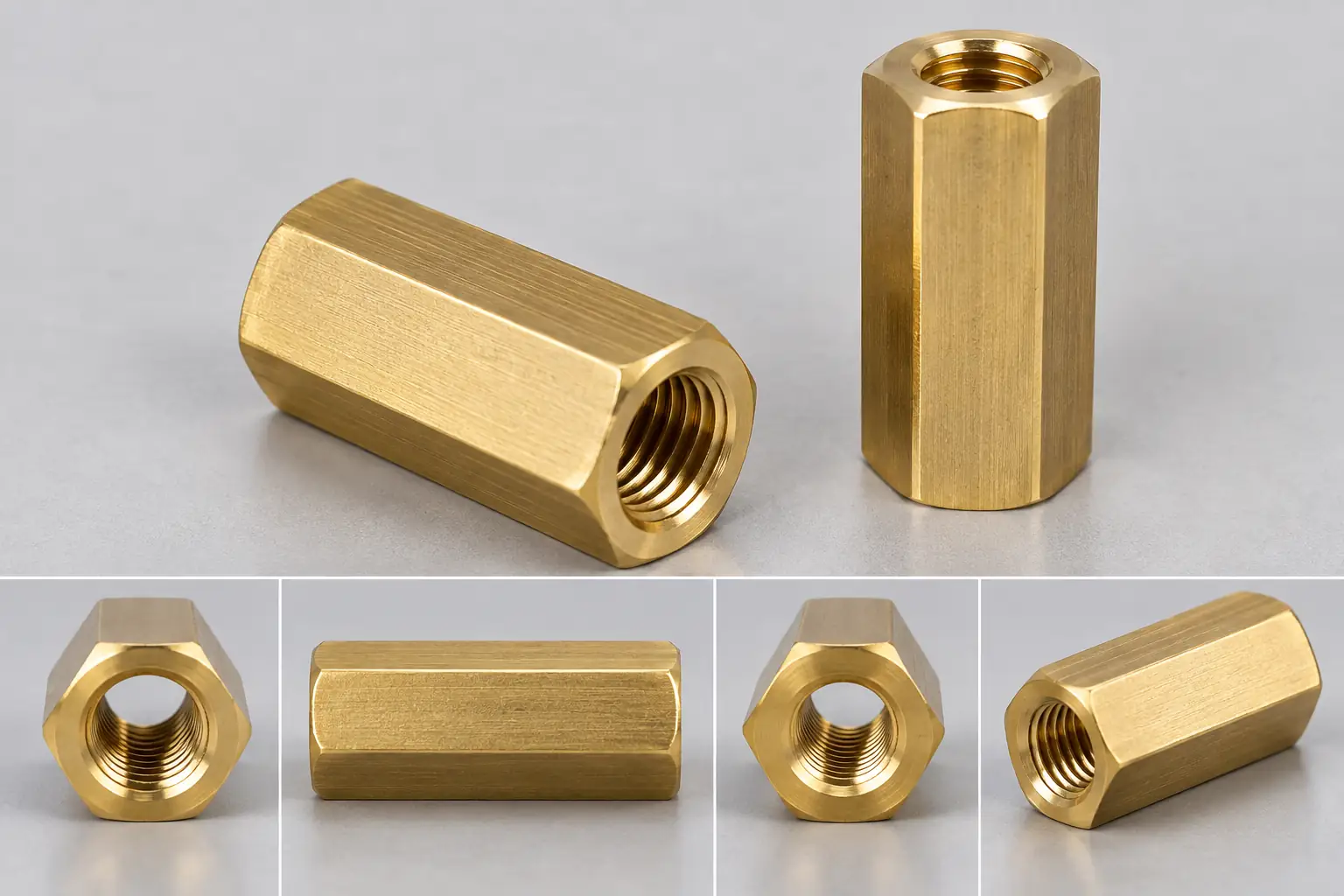
The body is hex bar, and that is the whole point
A coupling nut is a length of hexagonal bar with a tapped through hole. A standard hex nut is cold-formed in a die, so its height is whatever the die makes it, and changing that height means new tooling. A coupling nut is not: the bar is parted off at a length, faced, drilled and tapped. Four things follow from that, and they are the reason a single custom piece is affordable.
- Length is free. 12 mm, 40 mm, 3 inches — it is where the parting tool lands. There is no tooling charge for a length that is not on the shelf.
- Across-flats is free within the bar sizes. The nut cannot be wider than the bar, so the practical choice is the list of drawn brass hex bar sizes below. A thinner body for a tight bore means starting from a smaller bar, not a new die.
- Each end is tapped separately. Metric one end and inch the other, coarse one end and fine the other, right-hand one end and left-hand the other for a turnbuckle — all of them are two tapping operations rather than a special part.
- The hole does not have to go through. Tap to a depth and leave a blind end, or cross-drill a sight hole so an inspector can see that both rods have been run in far enough.
| System | Hex bar sizes across flats | Largest thread that fits comfortably |
|---|---|---|
| Metric, mm | 5, 6, 7, 8, 10, 11, 12, 13, 14, 17, 19, 22, 24, 27, 30, 32, 36, 41, 46, 50 | about half the across-flats: M5 in 8 mm bar, M12 in 19 mm, M24 in 36 mm |
| Inch | 3/16, 1/4, 5/16, 3/8, 7/16, 1/2, 9/16, 5/8, 11/16, 3/4, 7/8, 1, 1-1/8, 1-1/4 in | 8-32 in 11/32 in bar, 1/4-20 in 7/16 in, 1/2-13 in 3/4 in |
Brass hex bar is drawn to size, so a nut cut from it keeps the sharp flats and the bright finish in the photo above. An across-flats outside this list means turning a hexagon from round bar or milling the flats, which is possible and costs more.
Hex body or round body — the feature most people are actually searching for
When somebody types hex coupling nut rather than just coupling nut, they are naming the one feature that decides how the part is driven. A hex body takes a spanner anywhere along its length, so it can be torqued to a figure; a round body cannot, and is turned by hand or by a pin. Everything else about the two is the same — same bar stock, same drilling, same tapping. Only the outside is different, so the choice costs nothing at the quote stage.
| Body form | How it is driven | Size called out as | Where it belongs |
|---|---|---|---|
| Hex, full length — the standard brass hex coupling nut, DIN 6334 | spanner or socket anywhere on the body | across flats, same as the hex nut for that thread | the default. Anything that has to be torqued, or reached in a confined space where only part of the body is exposed |
| Hex ends, turned-down middle | spanner at either end only | across flats at the ends, plus the reduced diameter | when most of the body must pass through a bore, a clamp or a panel hole that is narrower than the flats |
| Round, knurled — also called a sleeve nut or round coupling nut | fingers; a pin spanner if it needs more | outside diameter over the knurl | lighting, furniture, tensioners and anywhere it is adjusted by hand or seen from the front |
| Round, smooth, cross-drilled | a tommy bar through the cross hole | outside diameter and the bar hole size | where a spanner cannot swing and the nut sits flush in a recess |
| Square | spanner, or it is held by the slot it sits in | across flats | rare as a coupling; asked for when the nut has to be stopped from turning by its pocket |
All five are the same operation on a different bar, which is why a mixed order is not five times the trouble. If you do not say, we quote the hex body: it is the one the standards cover and the one most people mean.
Need brass coupling nuts in a size, thread or material no catalogue lists? EKINSUN is a custom parts manufacturer: we make brass coupling nuts to your drawing, sketch or sample — brass CW614N, 304 or 316L stainless steel — from 1 piece, quoted in 12 hours and shipped duties paid. Already a catalogue size? Ask us too — we may have it in stock, and larger quantities cost less per piece. All custom fasteners →
Two follow-on points worth knowing before you specify. First, a long hex nut and a hex coupling nut are the same part — the name changes with the trade, not with the geometry, so search both if a distributor turns up empty. Second, the across-flats of a hex body is not fixed by the thread. The standard says it should match the ordinary hex nut, and that is what we cut unless you say otherwise; but if your spanner, socket or bore says a different number, that number is the one we use.
Inch brass coupling nuts: 8-32 to 1/2-13
These are the sizes people search for by name. The across-flats column is the finished hex nut size for that thread under ASME B18.2.2, which is what most coupling nut makers use as well — but note the caveat under the table: the inch coupling nut series is not dimensionally standardised the way the metric one is, so lengths vary from supplier to supplier.
| Thread | Major diameter | Across flats (hex nut, ASME B18.2.2) | Shortest useful body, 3 × d | Also written as |
|---|---|---|---|---|
| 8-32 | 0.164 in / 4.17 mm | 11/32 in / 8.73 mm | 0.49 in / 12.5 mm | #8-32 UNC, No. 8-32 |
| 10-24 | 0.190 in / 4.83 mm | 3/8 in / 9.53 mm | 0.57 in / 14.5 mm | #10-24 UNC |
| 10-32 | 0.190 in / 4.83 mm | 3/8 in / 9.53 mm | 0.57 in / 14.5 mm | #10-32 UNF, the fine No. 10 |
| 1/4-20 | 0.250 in / 6.35 mm | 7/16 in / 11.11 mm | 0.75 in / 19.1 mm | 1/4 in UNC, quarter-twenty |
| 1/4-28 | 0.250 in / 6.35 mm | 7/16 in / 11.11 mm | 0.75 in / 19.1 mm | 1/4 in UNF |
| 5/16-18 | 0.3125 in / 7.94 mm | 1/2 in / 12.70 mm | 0.94 in / 23.8 mm | 5/16 in UNC |
| 5/16-24 | 0.3125 in / 7.94 mm | 1/2 in / 12.70 mm | 0.94 in / 23.8 mm | 5/16 in UNF, the fine 5/16 |
| 3/8-16 | 0.375 in / 9.53 mm | 9/16 in / 14.29 mm | 1.13 in / 28.6 mm | 3/8 in UNC |
| 3/8-24 | 0.375 in / 9.53 mm | 9/16 in / 14.29 mm | 1.13 in / 28.6 mm | 3/8 in UNF |
| 7/16-14 | 0.4375 in / 11.11 mm | 11/16 in / 17.46 mm | 1.31 in / 33.3 mm | 7/16 in UNC |
| 1/2-13 | 0.500 in / 12.70 mm | 3/4 in / 19.05 mm | 1.50 in / 38.1 mm | 1/2 in UNC, half-thirteen |
| 1/2-20 | 0.500 in / 12.70 mm | 3/4 in / 19.05 mm | 1.50 in / 38.1 mm | 1/2 in UNF |
| 5/8-11 | 0.625 in / 15.88 mm | 15/16 in / 23.81 mm | 1.88 in / 47.6 mm | 5/8 in UNC |
| 3/4-10 | 0.750 in / 19.05 mm | 1-1/8 in / 28.58 mm | 2.25 in / 57.2 mm | 3/4 in UNC |
Three times the diameter is a rule, not a standard. It is the engagement length at which the coupling stops being the weak point in a rod joint, and it is where the metric standard sets its length. Shorter bodies are used all the time where the load is low; longer ones where the joint has to be adjustable. Length is the cheapest thing on this page to change.
Metric brass coupling nuts: DIN 6334, M5 to M30
The metric side does have a dimensional standard. DIN 6334 fixes the hexagon coupling nut at a length of three times the thread diameter, with the same across-flats as an ordinary DIN 934 hex nut. So a DIN 6334 M10 is 17 mm across the flats and 30 mm long, from every maker.
| Thread | Across flats s | Length m = 3 × d | Cut from hex bar | Usual fine pitch |
|---|---|---|---|---|
| M4 | 7 mm | 12 mm | 7 mm | — |
| M5 | 8 mm | 15 mm | 8 mm | — |
| M6 | 10 mm | 18 mm | 10 mm | M6×0.75 |
| M8 | 13 mm | 24 mm | 13 mm | M8×1 |
| M10 | 17 mm | 30 mm | 17 mm | M10×1, M10×1.25 |
| M12 | 19 mm | 36 mm | 19 mm | M12×1.25, M12×1.5 |
| M14 | 22 mm | 42 mm | 22 mm | M14×1.5 |
| M16 | 24 mm | 48 mm | 24 mm | M16×1.5 |
| M18 | 27 mm | 54 mm | 27 mm | M18×1.5 |
| M20 | 30 mm | 60 mm | 30 mm | M20×1.5 |
| M22 | 32 mm | 66 mm | 32 mm | M22×1.5 |
| M24 | 36 mm | 72 mm | 36 mm | M24×2 |
| M27 | 41 mm | 81 mm | 41 mm | M27×2 |
| M30 | 46 mm | 90 mm | 46 mm | M30×2 |
Brass is the thin part of that range. DIN 6334 in steel and in A2 / A4 stainless is a normal stock item to M24 and beyond; in brass, shelves usually stop around M12, and the sizes above that are machined to order. That is the single most useful thing to know before you start searching part numbers.

Where the shelf stops
| What you need | In the catalogue? | Where it comes from |
|---|---|---|
| DIN 6334 M5–M24 in steel or A2 stainless | Yes | A stock item almost anywhere — buy it from stock. We would only be reselling, and no one-off can match that price. |
| The same sizes in brass | Partly | Brass DIN 6334 is thin above M12 and patchy below M6. We cut those from CW614N hex bar, 1 piece upward. |
| Inch 8-32 to 1/2-13 in brass, at the maker's own length | Yes | Sold by hardware distributors. If the length they offer suits you, buy it from stock. |
| A length the maker does not offer — 1 in instead of 1-3/4 in, 20 mm on an M8, 65 mm on an M12 | No | The commonest reason people arrive on this page. Any length between about 1.5 × d and 300 mm; one parting cut different. |
| Metric thread one end, inch thread the other | No | Two tapping operations. This is how a metric rod meets an inch stud without an adapter in between. |
| Left-hand one end, right-hand the other (turnbuckle body) | No | Made to order in brass, steel and stainless. Mark the left-hand end — a groove around the hex is the usual convention. |
| Fine pitch: 5/16-24, M10×1, M20×1.5 | Partly | Fine-pitch coupling nuts exist in steel and are rare in brass. Tapped to order at no tooling cost. |
| Across flats smaller than standard, to pass down a tube | No | Start from the next bar size down, or turn the hexagon round over part of its length. |
| Blind end, or a cross-drilled sight hole at mid-length | Partly | The blind version is a cap coupling or closed-end standoff; the sight hole lets an installer see both rods have gone in far enough. Standard on some rod-coupling series, absent on most brass ones. |
| Ballcock, faucet supply, basin waste and tap connector nuts | Yes | Plumbing merchant, not us. Made in the hundreds of thousands and sold for a euro or two. |
The four numbers that decide the price
A coupling nut is described by four numbers, and an enquiry carrying all four gets a price rather than a question back:
- Thread and pitch at each end — if both ends are the same, say so; if not, name each end separately.
- Length of the body — the dimension along the axis. This is the one most catalogues take away from you.
- Across flats — a spanner size, or a maximum if the nut has to fit inside something.
- Hand and finish — right-hand unless you say otherwise; bare brass unless you want it nickel plated.
Read the pitch before you order the coupling nut. Lay a steel rule along ten thread crests and divide by ten: 10 mm over ten pitches is a 1 mm pitch (M6 coarse), 12.5 mm is M8 coarse, 15 mm is M10 coarse, 17.5 mm is M12 coarse. A reading that is not a round number of millimetres is an inch thread, and a reading that is shorter than the coarse pitch for that diameter is a fine thread. If diameter, pitch and the size range in the table all agree, buy the stock part. If any of the three is off the shelf, that is the one we make. The full measuring routine, including the inch traps →
The inch trap is worth spelling out, because it is what sends most people to a machine shop. 5/16-18 and 5/16-24 look identical across the flats and will start to thread into each other before they jam. Count the crests over one inch: eighteen is UNC, twenty-four is UNF. The same applies to 1/4-20 against 1/4-28, and to 1/2-13 against 1/2-20. If a nut and a rod fight after two turns, that is why. The metric and imperial chart shows which pairs are close enough to bite →
Brass grades, and what else this body gets cut from
Brass is chosen for coupling nuts for four different reasons, and they do not all point at the same alloy: it machines fast, it does not gall on a stainless rod the way stainless does on itself, it does not rust in damp air, and it is non-magnetic and looks right on exposed lighting and furniture hardware.
| Material | Designation | Where it fits here |
|---|---|---|
| Free-cutting brass | CW614N / CuZn39Pb3 | the default. European designation; the bright, sharp-flatted bar in the photo above. Fast to machine, so a one-off body is cheap. |
| Free-cutting brass, US | C36000 | the North American free-cutting brass. Close to CW614N but not the same composition — if a drawing calls one of them out, say which, and we buy that bar. |
| Low-lead brass | CW724R / C69300 | for drinking-water and other lead-restricted work. Slower to cut, so the piece price is higher. |
| Stainless 304 | 1.4301 / A2 | when the joint is outdoors or washed down and the extra cost is acceptable. Galling on a stainless rod is the trade-off. |
| Stainless 316L | 1.4404 / A4 | marine and chemical. Same body, same hex bar logic, different bar. |
| Free-machining stainless | 303 / 1.4305 | where a stainless coupling nut has to be machined rather than formed — odd lengths, cross holes, mixed threads. |
| Aluminium 6061 | AlMg1SiCu | light couplings and standoffs; also the alloy of most of the frames and brackets these nuts join. |
| Aluminium 7075 | AlZn5.5MgCu | not a normal coupling nut material; listed because we machine 7075 frames that these bodies get threaded into. |
| Steel, zinc plated | C45 or free-cutting steel | the cheapest body and the strongest of the common ones. The right answer when the nut is hidden and carrying load. |
What a coupling nut is actually doing
| Application | Thread sizes usually asked for | What is special about it |
|---|---|---|
| Joining two lengths of threaded rod | 1/4-20, 3/8-16, 1/2-13, M8, M10, M12 | the classic use. The body wants to be at least 3 × d so the coupling is not the weak point. |
| Lighting and lamp assembly | 8-32, 10-32, 1/4-27, M10×1 | brass on show, so the finish matters; lamp threads are their own small world of sizes. |
| Standoffs and spacers in electronics | 4-40, 6-32, 8-32, M3, M4 | usually a hex standoff rather than a coupling nut, but the body is the same piece of bar. |
| Turnbuckles and adjustable stays | M6–M20, 1/4-20 to 1/2-13 | one end left-hand. Winding the body draws the two ends together. |
| Instrument and probe bodies | M5×0.5, 10-32, M8×1 | fine pitch, short body, and often a shoulder or a flat for a spanner. |
| Furniture and stage hardware | M8, M10, 3/8-16 | often nickel or black plated over brass; the hexagon may be turned round for looks. |
| Extending an anchor or a stud in a wall | M8, M10, M12, 3/8-16, 1/2-13 | a sight hole earns its keep here, because nobody can see how far the stud went in. |
Related pages
The same hex bodies in 304 or 316 stainless, M2 to M24 and 10 to 100 mm long, are on the 304 stainless coupling nuts page; across-flats, standard lengths and turns of thread by size are in the coupling nut size chart.
- Coupling nuts, all materials — the reducing, left-hand and turnbuckle bodies, in stainless, titanium and steel as well as brass
- Coupling nuts held in stock — the sizes that are on a shelf now, before anything is machined
- fastener types chart — every family by name, standard and stock range, if the part is not called a coupling nut
- Tall and thin nuts — long nuts that are not couplings, and thin nuts where the height is the problem
- brass fasteners — brass screws, nuts, washers and standoffs from the same bar stock
- Threaded rods and studs — the rod on each side of the coupling, cut to length
- Metric and imperial thread chart — which metric and inch threads are close enough to start and then jam
- Custom standoffs — the same hex bar with male ends, or one male and one female
- Brass machining — what CW614N, C36000 and low-lead brass cost and cut like
Frequently asked questions
A brass coupling nut is a length of hexagonal brass bar with a thread tapped all the way through it, used to join two threaded rods, studs or bolts end to end. Unlike an ordinary hex nut, which is cold-formed in a die, it is machined from bar, so its length and across-flats are not fixed by tooling. The metric version is standardised as DIN 6334 at three times the thread diameter long.
In inch sizes the common range is 8-32, 10-24, 10-32, 1/4-20, 5/16-18, 5/16-24, 3/8-16, 7/16-14 and 1/2-13, with the across-flats matching the plain hex nut for that thread: 11/32 in for a No. 8, 7/16 in for a 1/4 in, 3/4 in for a 1/2 in. In metric, DIN 6334 runs M4 to M30 and beyond, with across-flats from 7 mm to 46 mm. Brass shelves are thinner than steel shelves above M12.
The metric standard DIN 6334 sets the length at three times the thread diameter: 18 mm for M6, 24 mm for M8, 30 mm for M10, 60 mm for M20. Inch coupling nuts have no equivalent dimensional standard, so lengths vary between makers. Three times the diameter is the engagement at which the coupling stops being the weak point in the joint; shorter bodies are used at low load and longer ones where the joint has to be adjustable.
Yes. Each end is tapped separately, so M10 one end and 3/8-16 the other is two operations rather than a special part. It is the neatest way to join a metric rod to an inch stud without an adapter in the middle. Name which end is which in the enquiry, and say if you want a groove or a flat to mark it on the part.
CW614N (CuZn39Pb3) is the usual European free-cutting brass and C36000 is the North American one. They are close but not identical in composition, so if a drawing names one, say which and we buy that bar. Where lead is restricted, for drinking water for instance, the body is cut from CW724R or C69300 low-lead brass instead, which machines more slowly and costs more per piece.
They are the same part under different names. Hex coupling nut, long hex nut, rod coupling, extension nut, connector nut, long nut and DIN 6334 hexagon coupling nut all describe a hex body tapped through. The round-bodied version is usually called a sleeve nut or a round coupling nut. A turnbuckle body is the same part with a left-hand thread at one end, and a standoff is the same bar with male ends instead of female ones. If one name turns up nothing at a distributor, search the others before assuming it has to be made.
Only the outside. Both are a length of bar tapped through, from the same stock, with the same thread. The hex body takes a spanner or a socket anywhere along its length, so it can be tightened to a torque figure; the round body is knurled and turned by hand, or has a cross hole for a tommy bar. Pick hex whenever the joint has to be torqued or reached with a tool, and round where it is adjusted by hand or seen from the front. Neither one costs more to machine.
Yes, at either end or both. Left-hand at one end and right-hand at the other gives a turnbuckle body: turning it draws the two rods together. The usual convention is a groove machined around the hexagon at the left-hand end so nobody has to guess on site.
One piece. The body is bar, a parting cut and two tapping operations, so there is no tooling to amortise and a single piece is priced like a single piece rather than like a cancelled production run. Quote within 12 hours of a complete enquiry.
Send four numbers
Thread and pitch at each end, body length, across flats, and hand. A photo of the old nut next to a rule works as well as a drawing. From 1 piece, quote within 12 hours.
Four numbers price a coupling nut: the thread and pitch at each end, the body length, the across-flats, and whether either end is left-hand. If you have the old nut, a photo of it beside a steel rule answers all four at once.