Thickness Decides the Process — 0.05 to 5 mm
Every thin washer is one of four things: etched from foil, cut by laser from sheet, stamped from sheet on a die, or turned from bar. Which one is decided by the thickness first and the material second, and the choice sets the tolerance, the edge and the minimum sensible quantity. The table is the one we quote from.
| Thickness | Typical process | Typical thickness tolerance | Edge | Minimum quantity | Typical parts |
|---|---|---|---|---|---|
| 0.05–0.10 mm | Chemical etching (photo-etching) from foil; laser for larger IDs | foil ±0.005–0.01 mm (precision shim stock) | burr-free; parts are handled on a carrier sheet | 1 piece; no tooling | spring-contact and electrical-contact washers, optical spacers, instrument shims |
| 0.10–0.20 mm | Chemical etching; fibre laser on stainless and titanium | foil ±0.01 mm typical | etched: burr-free; laser: light recast edge, tumbled off on stainless | 1 piece | electronics, shim washers for bearings and gauges, thin insulating washers in PTFE / PEEK film |
| 0.20–0.50 mm | Laser cutting from sheet; stamping from a few thousand pieces | sheet ±0.01–0.03 mm (precision shim stock) / ±0.05 mm (commercial sheet) | laser: small burr, deburred; stamped: burr side noted | 1 piece laser; stamping from about 2,000 | contact washers, spacers, plastic insulating washers, thin copper and brass washers |
| 0.50–1.00 mm | Laser cutting or stamping; turning possible above about 0.3 mm on rigid materials | sheet ±0.02–0.05 mm; turned and ground ±0.01 mm | laser or stamped edge, or a turned edge with a chamfer | 1 piece | general precision washers, plastic washers, shims for end-float |
| 1–5 mm | Turning from bar or laser / waterjet from plate, faces ground where the thickness is a shim | turned ±0.02 mm, ground ±0.01 mm | turned edge, chamfered both sides | 1 piece | spacer washers, thrust washers, shim rings |
| above 5 mm | Turning and milling — see the machined washers page | ±0.02 mm typical | chamfered, faced | 1 piece | thick washers, spacer rings, shoulder washers |
Thickness tolerances are those of the stock the part is cut from (precision shim stock against commercial sheet) or of the finishing operation (turned, ground); they are typical figures and are confirmed per material on the quote. Turning needs a part rigid enough to chuck, which in practice means 0.3 mm and up in metal and 0.5 mm and up in plastic; the machined route with its own capability table is on machined washers from a sketch and the thick, large-OD and shoulder washers on custom washers.
Need thin washers and precision shims in a size, thread or material no catalogue lists? EKINSUN is a custom parts manufacturer: we make thin washers and precision shims to your drawing, sketch or sample — 304 or 316L stainless steel, steel or brass — from 1 piece, quoted in 12 hours and shipped duties paid. Standard sizes can often be supplied from stock; the more pieces, the lower the unit price. All custom fasteners →
Washer or Shim? The Same Ring, Two Specifications
A washer spreads the load of a bolt head, spaces two parts or insulates a joint, and its thickness is nominal: a 0.5 mm washer that measures 0.48 mm is fine. A shim sets a gap, a bearing pre-load, an end-float or an alignment, and its thickness is the whole point: a 0.5 mm shim is ordered as 0.50 ± 0.01 mm, or as a graded set of 0.05 / 0.1 / 0.2 / 0.5 mm, from stock whose thickness is certified. Both are cut the same way; what changes is the stock we buy, the measurement we make and the note on the drawing. Say which one you need — “spacer” or “shim” — and give a thickness tolerance only where it does work, because certified shim stock costs more than sheet and a plain spacer does not need it.
The names buyers use, and what they map to. Shim washer, precision shim, spacer shim, adjustment shim and alignment washer are all the ring above with a thickness specification; tolerance shim and bearing shim are the graded-set case; contact washer, terminal washer and grounding washer are the conductive case in the section below; insulating washer, non-conductive washer and PCB washer are the plastic case on plastic and insulating washers.
Materials That Come as Foil or Sheet — and the Process Each Takes
A thin washer can only be made in a material that exists as foil or sheet in that thickness. The table is the stock list we work from; the grade names cross to their European, Japanese and Chinese equivalents on the material grade equivalents hub.
| Material | Thin stock available from | Process | Typical use |
|---|---|---|---|
| Stainless 304 / 1.4301, 316L / 1.4404, 301 spring temper | foil from 0.05 mm; sheet | etch, laser, stamp; turn above 0.3 mm | the default shim and washer stock; 301 spring temper for wave and spring washers |
| 17-4 PH / 1.4542 | sheet from 0.3 mm | laser, turn | hardened shims and thrust washers |
| Copper C11000 ETP / C10200 OF | foil from 0.05 mm | etch, laser | electrical contact and grounding washers; about 100 % IACS |
| Fine silver Ag 99.9 | sheet from 0.1 mm | laser, etch | contact washers where conductivity above copper is specified; about 105 % IACS |
| Brass CuZn39Pb3 / C360, phosphor bronze | sheet from 0.1 mm | etch, laser, stamp; turn above 0.3 mm | electrical, decorative, spring contacts (bronze) |
| Titanium Grade 2 / Grade 5 | foil from 0.05 mm (Gr 2); sheet | laser, etch | weight-critical and non-magnetic shims |
| Aluminium 5052 / 6061 | sheet from 0.3 mm | laser, stamp; turn | lightweight spacers, anodised colour-coded shim sets |
| Carbon steel, spring steel | shim stock from 0.05 mm | etch, laser, stamp | machinery shims, alignment packs, zinc-plated washers |
| PEEK, PTFE, PEI, PET, POM, PA | film and sheet from 0.05 mm (PTFE, PEEK, PET film) / 0.5 mm (POM, PA) | laser (PEEK, PET, PEI, POM), die-cut (PTFE), turn above 0.5 mm | insulating and low-friction washers — see the plastic washers page |
| G10 / FR4 glass-epoxy | sheet from 0.2 mm | laser, mill | galvanic-isolation and insulating washers under bolt heads |
Copper, Silver and Conductive Contact Washers
A contact washer is a thin washer whose job is a low-resistance interface: between a terminal and a PCB pad, under a binding post, on a battery tab, at a grounding point. Three things decide it — the material's conductivity, a flat clean face on both sides, and no burr — and the last two are why these washers are etched rather than stamped. The material question is mostly a question of names.
| Material | Conductivity | What it means for the order |
|---|---|---|
| C11000 ETP copper | about 100 % IACS | the standard contact and grounding washer; stocked as foil and sheet in every thin gauge |
| C10200 oxygen-free copper | about 100 % IACS | specified where oxygen content matters (brazing, vacuum, audio); sheet available |
| OCC copper | process, not a grade | Ohno Continuous Casting produces long-grain copper sold mainly as conductor wire and strip; availability as sheet in a given thickness is checked before quoting |
| Fine silver Ag 99.9 | about 105 % IACS | highest conductivity of the common metals; bought as small sheet, priced by weight |
| Brass CuZn39Pb3 / C360 | about 26 % IACS | cheap, machinable, adequate for many terminal washers; not a low-resistance contact |
| Phosphor bronze | about 15 % IACS | spring contacts and wave washers where spring force matters more than resistance |
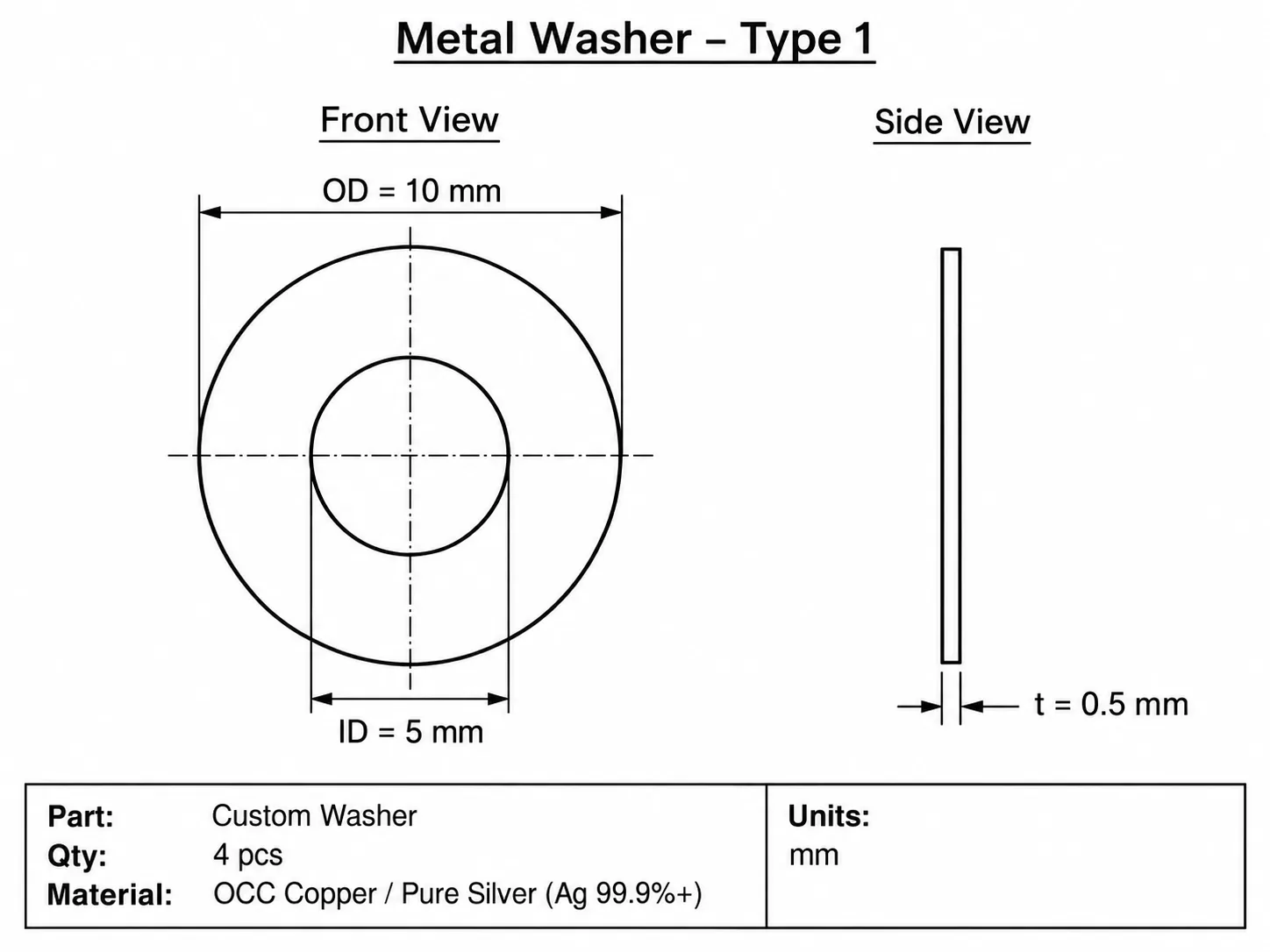
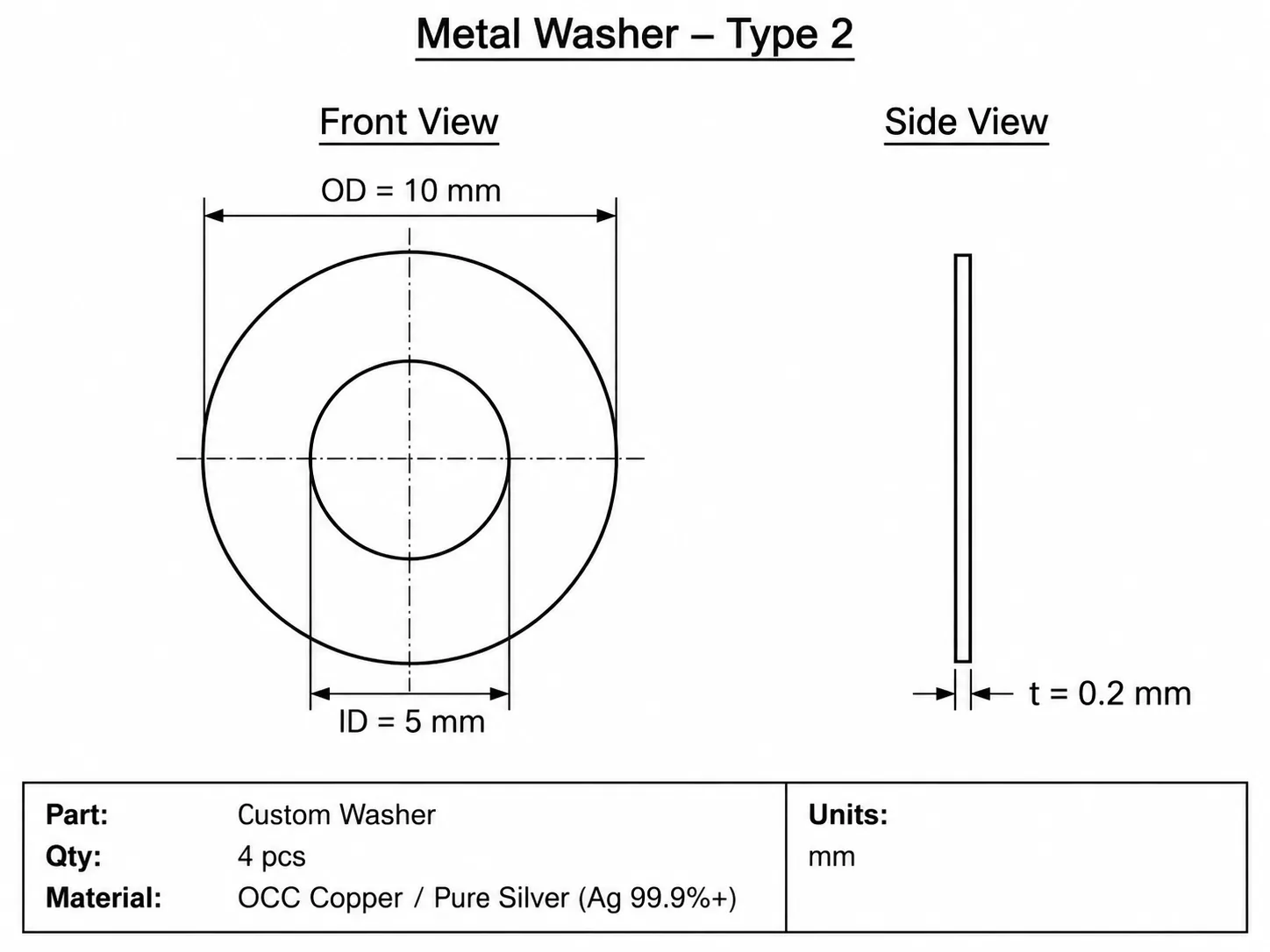
OCC copper is a process, not a grade. OCC stands for Ohno Continuous Casting, a continuous-casting method that produces copper with long grains and few grain boundaries; it is sold under that name mainly as audio conductor wire and strip. There is no ASTM or EN grade called OCC, so a drawing that says “OCC copper washer” is asking for a material we have to source as strip in the right thickness before we can promise it. When it cannot be had, the honest substitutes are oxygen-free C10200 (the same purity class, standard sheet) or fine silver, and the quote says which one it is. Engineering facts are all this page claims for a contact washer: conductivity by material, a flat face, a clean edge and dimensional fit; anything about sound is outside what a washer can be specified for.
Two Real Orders — the Numbers and the Route
| Order | Specification | Route |
|---|---|---|
| Metal contact washer for a speaker binding post against a copper PCB contact area | OD 10 × ID 5 × 0.5 mm, 4 pieces, with a 0.2 mm version to follow; high-conductivity copper preferred, pure silver Ag 99.9 % as the alternative. | 0.5 mm: laser-cut or etched from C10200 oxygen-free copper sheet, faces flat, no burr; 0.2 mm: etched from C10200 foil. OCC strip checked for availability in 0.5 and 0.2 mm and offered only if it can be sourced; fine silver quoted as the alternative by weight. Four pieces is a normal quantity for etching. |
| Plastic insulating washers, two sizes, for the same assembly | Type 1 OD 12 × ID 7.9 × 0.5 mm, 8 pieces; type 2 OD 13 × ID 7.9 × 0.5 mm, 4 pieces; an insulating plastic with good mechanical properties. | Laser-cut from 0.5 mm PEEK or PET film (PET is the cheaper of the two for a 0.5 mm insulating washer that is not hot); the 7.9 mm bore is held from the drawing, not from a standard punch. The material choice is on the plastic washers page. |
Both came without a CAD file, as four numbers and a sentence about the job, which is enough: the sketch-to-drawing step turns them into an approval drawing before anything is cut. The same route serves thick and large-OD washers, spacers and bushings from a sketch and the washer types chart when the part is a wave, tab or tooth washer instead of a flat one.
A third request, a few weeks later, shows the other end of the thickness ladder: OD 6 or 7 mm × ID 2 mm × 0.30 mm (0.40 mm at most), 100 to 500 pieces, in titanium grade 5 (Ti-6Al-4V), 316L or 304, flat, with both edges deburred and the bore and thickness held consistently. The route at 0.3 mm is the one in the thickness table above: laser or photo-etch from sheet, not turning, then a tumble or etch deburr and a flatness check on a surface plate; stamping only pays above a few thousand. The material choice is the buyer’s, and the quote prices it both ways — 316L for most assemblies, titanium only where weight or implant compatibility demands it, because titanium sheet costs several times more and cuts slower for the same flatness.
Where the Catalogue Stops — Stamped by the Thousand, or Cut to Your Numbers
| What you need | In the catalogue? | What we make |
|---|---|---|
| A standard thin flat washer — DIN 125 / ISO 7089, M3–M20, steel or A2 | Yes — every catalogue | Buy it from stock, stamped: local hardware and industrial supply stores carry these by the thousand for pennies — or contact us, we may have them in stock. We say so instead of quoting. |
| A shim set in standard thicknesses (0.05 / 0.1 / 0.2 / 0.5 mm) in a standard bore | Yes — shim kits | Buy it from stock: standard shim kits exist from the catalogue houses, and we say so when the bore is standard. Standard parts: ask us too — we may have them in stock. |
| A thin washer in an OD / ID nobody stocks — 10 × 5 × 0.5 mm in copper, 12 × 7.9 × 0.5 mm in plastic, 4 to 400 pieces | No | Laser-cut or etched to your numbers, no die, from 1 piece; the two orders below are this row. |
| A conductive contact washer in oxygen-free copper or fine silver, flat-faced, burr-free | No | Etched or laser-cut from C10200 or Ag 99.9 sheet, faces lapped where the drawing says so; conductivity by material given on the quote. |
| A shim to one exact thickness with a certified tolerance, or a graded set for a bearing pre-load | No | Cut from certified shim stock, or turned and ground above 0.3 mm to ±0.01 mm; thickness measured and reported per piece on request. |
| A thin insulating washer in PEEK, PTFE or PEI film | No | Laser-cut or die-cut from film; material chosen with you on the plastic and insulating washers page. |
What We Need to Quote a Thin Washer or Shim
1. Outside diameter 2. Inside diameter 3. Thickness 4. Material (or the job, and we propose one) 5. Quantity now and later 6. Thickness tolerance and flatness, only if they matter 7. Contact face, plating or passivation, if any 8. A photo, sketch or the old washer, if you have one. No CAD file is required; a dimensioned approval drawing comes back before cutting, and the quote arrives within 12 hours.
Related: plastic and insulating washers · custom washers (thick, large-OD, shoulder) · machined washers from a sketch · washer types chart · copper grades (C11000, Cu-ETP, T2) · custom fasteners.
Thin Washer & Shim FAQ
Yes, from foil or shim stock, by chemical etching or laser cutting rather than turning; a 0.1 mm stainless or copper washer is an etched part, a 0.2 mm one is etched or laser-cut depending on the material and the edge you need. Below about 0.3 mm a washer cannot be held in a lathe chuck, so the turning route on the machined washers page does not apply; the thickness comes from the foil, which is bought to a tolerance of about ±10 % of nominal or tighter on precision shim stock, and the edge is what the cutting process leaves.
The thickness of an etched or laser-cut washer is the thickness of the foil it is cut from, so the tolerance is the foil's: precision shim stock is typically supplied to ±0.005–0.01 mm below 0.5 mm and ±0.01–0.02 mm up to 1 mm, ordinary sheet to a wider band. A turned or ground shim above 0.3 mm can be faced to ±0.01 mm. Say on the drawing whether the thickness tolerance matters, because for a plain spacer it usually does not and the cheaper foil is the right answer.
The same ring can be either; the difference is the job. A washer spreads load, spaces or insulates a bolted joint and its thickness is nominal. A shim sets a gap, a preload or an alignment, so its thickness is the specification: shims are ordered in a graded set (for example 0.05, 0.1, 0.2, 0.5 mm) or to one exact thickness, from stock whose thickness is certified. If your part has to be a specific thickness rather than about a thickness, call it a shim on the drawing and give the tolerance.
Yes. Etching and laser cutting need no die, so a single washer or a set of four is a normal order and the drawing is kept for reorders. Stamping needs a die and only makes sense from a few thousand pieces of one size; below that we cut them by laser or etch them and say so on the quote.
Copper washers are cut from C11000 (ETP) or C10200 (oxygen-free) foil and sheet, which are stocked in the thin gauges a contact washer needs; both are about 100 % IACS conductivity. OCC copper is not a grade but a casting process (Ohno Continuous Casting), and it is available as wire and cable conductor far more often than as sheet, so an OCC washer depends on finding OCC strip in the thickness asked for, which we check before quoting. Where it is not available we say so and offer oxygen-free C10200 or fine silver, which is what the copper order on this page came down to.
Yes, from Ag 99.9 sheet, cut by laser or etched, for contact washers where conductivity above copper's is wanted (fine silver is about 105 % IACS). Silver is bought in small sheets and priced by weight, so a quote for four 10 × 5 × 0.5 mm washers is a material cost plus cutting, and the offcut is returned or credited; the drawing should state whether the contact faces need to be flat-lapped or are used as cut.
Etched parts have no burr, which is why etching is chosen for contact washers and shims under 0.2 mm. Laser-cut parts carry a small recast edge that is removed by tumbling or by hand on thin gauges, and stamped parts have a burr side that is either left (and noted on the drawing) or removed by barrel finishing. A 0.1 mm stainless washer survives tumbling; a 0.1 mm copper one does not and is etched instead.
Outside diameter, inside diameter, thickness, material and quantity; then, if they matter, the thickness tolerance, flatness, whether one face is a contact face, any plating or passivation, and a photo or sketch of the part it goes in. A CAD file is not needed; a sketch with the four numbers is the drawing we work from, and we return a dimensioned approval drawing before cutting.