The Families — One Page Each, Every Name System
The table gives the anchor grade of each family in its four main names and links the page that carries the full crosswalk. Where a family page does not exist yet in English, the link goes to the datasheet page that already carries the crosswalk in another language.
| Family · grades covered | US | EU (number · name) | Japan | China | What the page adds |
|---|---|---|---|---|---|
| Stainless steel 304 / 304L / 303 / 316 / 316L / 316Ti / 321 / 430 / 410 / 420 / 440C / 17-4 PH / 2205 / 904L | 304 | 1.4301 X5CrNi18-10 | SUS304 | 06Cr19Ni10 (0Cr18Ni9) | 14 grades · ASTM and EN bands side by side · Mo split in 316 · '420' is three grades · 17-4 PH condition codes |
| Aluminium alloys 6061 / 6082 / 6063 / 6060 / 7075 / 2024 / 2011 / 5083 / 5052 / 5754 | 6061 | EN AW-6061 (3.3211) AlMg1SiCu | A6061 | 6061 (legacy LD30) | 10 alloys · same number everywhere, different stock · 6061 vs 6082 compared number by number · China's 2A12 / 7A04 near-alloys · tempers |
| Case-hardening (carburising) steels 8620 / 16MnCr5 / 20MnCr5 / SCM420 / 20CrMnTi / 18CrNiMo7-6 / 9310 | 8620 | 1.6523 20NiCrMo2-2 | SNCM220 | 20CrNiMo | 30 grades · SAE J404 / EN ISO 683-3 / JIS G4053 / GB/T 3077 · CHD to ISO 2639 · 4/21/5 direct / nearest / substitute |
| Quenched-and-tempered alloy steel 4140 / 42CrMo4 / 1.7225 / 42CD4 / SCM440 / 42CrMo / 708M40 | 4140 | 1.7225 42CrMo4 | SCM440 | 42CrMo | 10 grades · 4140 = 42CrMo4 = SCM440 = 42CrMo · 4340 has no EN twin (34CrNiMo6 nearest) · 40Cr ≠ 4140 · +QT strength by section (Re 900 MPa at ≤ 16 mm, 750 at 16–40 mm) · datasheets in German, French (42CD4), Norwegian |
| Medium-carbon steel 1045 / C45 / C45E / 1.0503 / XC48 / S45C / 45 steel / F-114 / 080M46; 1035–1055, C35–C55 | 1045 | 1.0503 C45 | S45C | 45 | 6 grades, all direct · the difference is the condition (+N Rm 560–650 vs +QT 700–850 MPa), the C45E P/S cap and the section size · 45# = 1045 · datasheets in French (C45 / XC48) and Spanish (F-114) |
| Copper C11000 / Cu-ETP / CW004A / C1100 / T2; C10200 / Cu-OF / TU1; C14500 / CuTeP | C11000 | CW004A Cu-ETP | C1100 | T2 | Four-standard table on the page; C1100 is the JIS name, not a US one — the US name has five digits (C11000); tellurium copper C14500 has no GB name |
| Free-machining brass C36000 / CuZn36Pb3 / CW603N; CuZn39Pb3 / CW614N / 2.0401 / CZ121 / MS58 | C36000 (C360) | CW614N CuZn39Pb3 | C3604 | HPb59-1 (near) | C360 and CuZn39Pb3 are not the same alloy (Cu 60–63 vs 57–59 %), but European stock is CW614N and it is cross-referenced commercially: the site writes C36000 (EN ≈ CuZn39Pb3 / CW614N), never '=' |
| Free-machining steel 12L14 / 11SMnPb30 / 1.0718 / SUM24L / Y15Pb; 1215 / 11SMn30 / EN1A; 1144 / 44SMn28; 36SMnPb14 | 12L14 | 1.0718 11SMnPb30 | SUM24L | Y15Pb | 6 grades · the screw-machine steels, leaded and lead-free pairs (RoHS) · 1144 / 44SMn28 Stressproof · EN1A / 9SMnPb28 old names |
| Engineering plastics — trade names Delrin / Hostaform / POM; Zytel / Ultramid / PA66; Teflon / PTFE; Ertalyte / PET; Tivar / PE-UHMW; Victrex / Ketron / PEEK; Lexan / PC; Plexiglas / PMMA; Ultem / PEI; Ryton / PPS | Delrin (POM-H) | Tecaform AH / Ertacetal C (POM-C) | Duracon / Tenac (POM) | 赛钢 / 聚甲醛 (POM) | 14 plastics · resin brand → stock-shape brand → ISO 1043 generic → Chinese name · Delrin is POM-H, Europe stocks POM-C · nylon 6 vs 66 vs cast |
Need a part machined in the grade on your drawing, or the equivalent available on your market? EKINSUN is a custom parts manufacturer: we machine parts in the grade on your drawing, or the equivalent available on your market to your drawing, sketch or sample, from 1 piece, with a material certificate on request and a quote in 12 hours. Already a catalogue size? Ask us too — we may have it in stock, and larger quantities cost less per piece. How ordering without CAD works →
EKINSUN LTD machines custom parts in every family above from one piece, from a drawing written in any of these name systems, a sketch or the worn part; the grade actually used is on the quote before machining and on the EN 10204 3.1 certificate after it. The full list of grades the shop runs is on materials we machine.
How to Read a Grade Name From Each Country
| System | How the name is built |
|---|---|
| United States | AISI / SAE four digits (4140, 8620), UNS letter + five digits (S30400, G41400, C11000, A96061); Aluminum Association four digits (6061-T6). ASTM specs (A276, B211) fix the product form and the bands. |
| Europe | EN name from the chemistry (X5CrNi18-10, 42CrMo4, AlSi1MgMn) plus a material number (1.4301, 1.7225, 3.2315, CW614N); the old DIN names (AlZnMgCu1,5, 21NiCrMo2) survive on older drawings. EN 10088, EN ISO 683, EN 573 and EN 12164 hold the bands. |
| Japan | JIS letters + AISI-style number: SUS304, SCM440, SNCM220, A6061, C1100. The bands follow the ASTM pattern more than the EN one. |
| China (new style) | GB/T 20878 / 1220 / 3077 names copy the chemistry with carbon × 100 in front: 06Cr19Ni10, 022Cr17Ni12Mo2, 42CrMo, 20CrNiMo; aluminium keeps the international number (6061, 7075) under GB/T 3190; copper T2 / TU1; brass HPb59-1. |
| China (old style) | GB/T 1220-1992 names with carbon × 10: 0Cr18Ni9, 00Cr17Ni14Mo2, 1Cr13; aluminium L-names LD30 (6061), LD31 (6063), LY12 (2A12), LC4 (7A04). Still printed on many mill certificates; same steels, older labels. |
Where the Charts Stop — Bar From Stock, Parts From a Drawing
Every grade in every family above is sold as bar, plate or profile by a stockholder somewhere, and the crosswalk is how you order the right one in another country; a part in that grade to your drawing is not on any shelf. The table is plain about which is which.
| What you need | In the catalogue? | What we machine |
|---|---|---|
| Bar, plate or profile in any grade on this page for your own shop | Yes — every stockholder | Buy it from stock, dual-certified where the family allows it (1.4301 / 304, 1.4404 / 316L). A stockholder cuts to length for less than any machined blank, and we say so in the quote instead of taking the order. Standard parts: ask us too — we may have them in stock. |
| A part whose drawing names a grade from another country's system | No | Machined in the grade on the drawing or its direct equivalent from the family page, the grade used written on the quote before machining and on the EN 10204 3.1 certificate after it — see custom machined parts. |
| A part where only a nearest equivalent or a substitute is available where it is made | No | The change is stated on the quote with the band that differs (Mo, Si, carbon, hardness) and the buyer decides; nothing is swapped silently. Typical cases: 6082 for 6061, 1.4404 for 316L, 1.4021 / 1.4028 for '420'. |
| A replacement part where only the worn part exists and the grade is unknown | No | Magnet, spectrometer and hardness checks put the part in a family; the nearest grade comes from the chart and the part is measured from the sample — see parts from a sample and obsolete parts. |
What Changes When You Accept an Equivalent
Nothing, for a direct equivalent — 304 / 1.4301 / SUS304 / 06Cr19Ni10 is one steel, and European bar is certified to both names on one certificate.
One band, for a nearest equivalent — the certificate will show a value the drawing’s standard did not expect: Mo 2.0–2.5 % on a 1.4404 part drawn as 316L (ASTM allows up to 3.00 %), Si 0.7–1.3 % on a 6082 part drawn as 6061, Mn 0.70–0.90 % on a 5115 part drawn as 16MnCr5. Harmless for most machined parts, decisive where the drawing’s note (Mo minimum, anodised colour, section hardenability) touches that band.
The whole specification, for a substitute — a US “420” part needs a hardness before it can be made in 1.4021 / 1.4028 / 1.4034; a 7075 part offered in 7A04 is a different alloy; C360 offered as CuZn39Pb3 is a different copper content. These are the rows where a quote has to say what it is doing, and ours does.
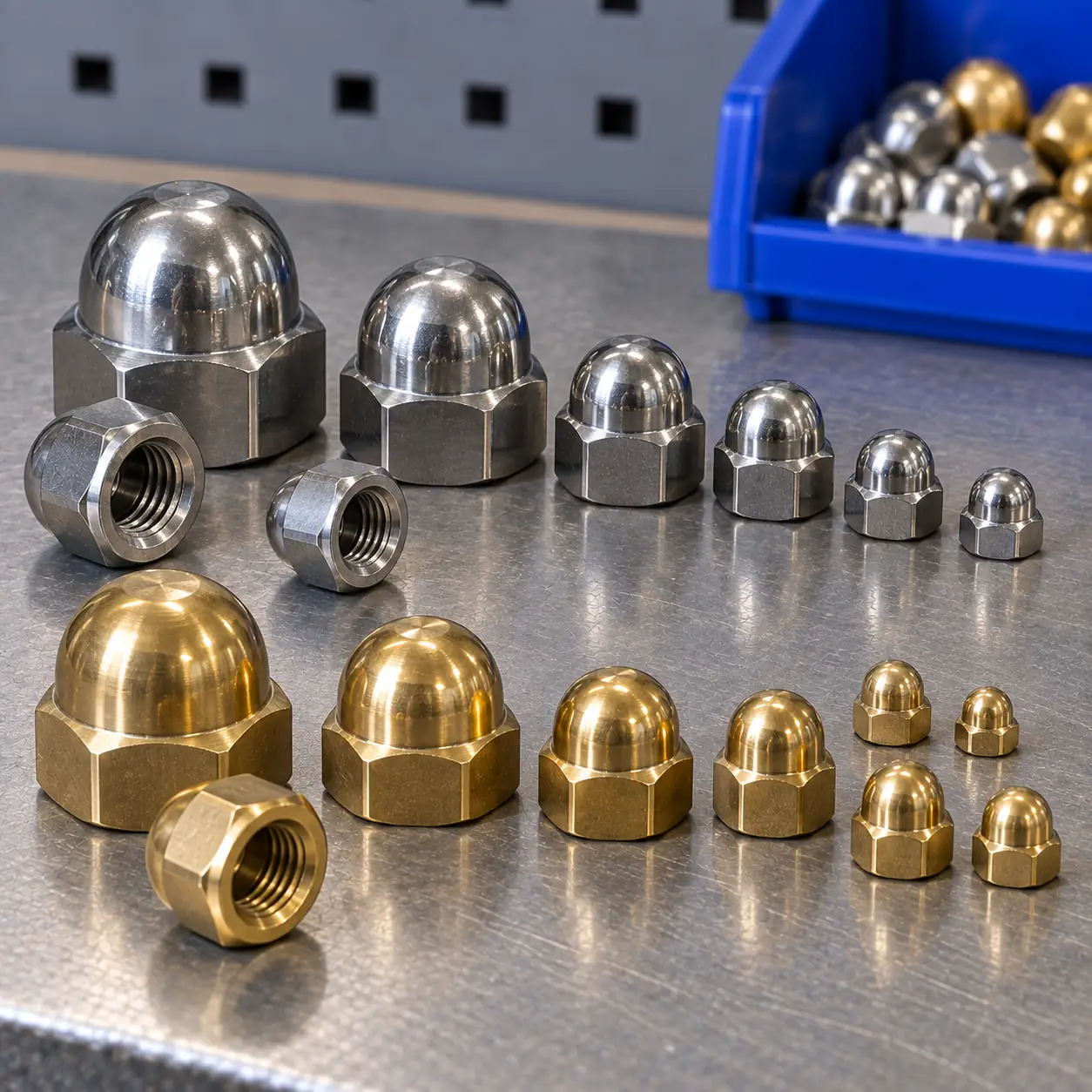
The pages that turn the crosswalk into a part: custom machined parts, adapters and fittings, custom fasteners, heat sinks, parts from a sample, obsolete parts. Heat treatment and delivery condition, which the grade name never states, are on heat treatment and machining; the property classes behind bolt grades on the bolt grade chart.
The drawing has no grade at all, only a job? The material selection chart starts from the job — outdoors, salt water, a load, wear, insulation, heat, weight, the cheapest piece — and gives the first-choice grade, the alternative and what to avoid, with the yield, density and machining speed behind each.
Material Grade Equivalents FAQ
Start from the family, not the name: stainless (304 / 316 types), aluminium (6xxx / 7xxx), carburising steel (8620 / 16MnCr5), quenched-and-tempered steel (4140 / 42CrMo4), medium-carbon steel (1045 / C45), copper or brass. Each family page on this site crosses the US (AISI / UNS or AA), European (EN name and number, DIN Werkstoffnummer), Japanese (JIS) and Chinese (GB, new and old style) names and prints the composition bands, because two names are only the same material when the bands overlap on every element.
Direct: a standards database pairs the two names and the composition bands overlap on every element — 304 and 1.4301, 8620 and 20NiCrMo2-2, 6061 in AA and EN AW-6061. Nearest: the closest grade the other system has, with one band clearly different — 316L and 1.4404 (Mo 2.00–3.00 vs 2.0–2.5 %), 6061 and 6082, 16MnCr5 and SAE 5115. Substitute: a grade no database pairs with anything, or a name that the other system splits into several grades — US '420' against 1.4021 / 1.4028 / 1.4034, C360 against CuZn39Pb3. A substitute can do the same job after a check, never by name alone.
Because 6082 (EN AW-6082, AlSi1MgMn, 3.2315) is the general machining bar stocked in Europe, where 6061 is held mainly as plate. The two are nearest equivalents: 6082 has more silicon and manganese and no copper, is slightly stronger in T6 (bar 310 / 270 MPa against 290 / 240 MPa) and anodises to a different tone. A correct quote names 6082-T6 and the certificate follows; a wrong one says 6061 and ships 6082.
Often yes, sometimes not, and the name tells you which. New-style GB names copy the composition (06Cr19Ni10 = 304, 022Cr17Ni12Mo2 = 316L, 42CrMo = 42CrMo4, 20CrNiMo = 8620) and old-style names (0Cr18Ni9, 00Cr17Ni14Mo2) mean the same steels. For aluminium GB/T 3190 uses the international numbers unchanged (6061, 7075) — but China's own 2A12 (LY12) and 7A04 (LC4) are near-alloys, not equivalents, and a certificate that reads 7A04 for a 7075 part is a substitution. For copper, T2 is C11000 / Cu-ETP; for brass, the Chinese HPb59-1 is near CuZn39Pb3, not C360.
In the grade on the drawing when it is available where the part is made, otherwise in the direct or nearest equivalent — and in both cases the grade actually used is written on the quote before machining and on the EN 10204 3.1 certificate after it. A nearest equivalent or a substitute is never used without the change being stated first. That is the whole reason these pages exist: the crosswalk is public, the decision is on the quote.