Eight Plastics for Washers — the Numbers That Decide
Four numbers separate the plastics a washer is made from: the temperature it keeps its properties to, the dielectric strength if it insulates, the water it takes up (which is size drift), and the thinnest stock it comes in. The table is what we choose from; brand names such as Delrin, Ertalyte, Teflon and Ultem are decoded on the plastic trade names page.
| Material | ISO 1043 | Continuous use | Dielectric strength, kV/mm | Water uptake, % | Thinnest stock / route | Typical use |
|---|---|---|---|---|---|---|
| POM-C / POM-H (acetal, Delrin) | POM | about 100 °C | about 20 | 0.2–0.25 | 0.5 mm turned; sheet from 0.5 mm | the precision insulating washer: tight tolerance, stable, cheap |
| PET (Ertalyte) | PET | about 110 °C | about 20 | 0.1 | film from 0.05 mm; turned from 0.5 mm | 0.5 mm insulating washers and spacers at low cost; better than POM under load |
| Nylon PA6 / PA66 | PA6 / PA66 | about 100–110 °C | about 17 (dry) | 2–3 (saturated) | sheet from 0.5 mm; turned | tough, low-cost insulating and anti-rattle washers where size drift is acceptable |
| PTFE (Teflon) | PTFE | 260 °C | about 20 | below 0.05 | film from 0.05 mm, die-cut; turned from 1 mm | sealing, sliding and chemical service; creeps under bolt load |
| PEEK | PEEK | about 250 °C | about 20 | 0.1–0.5 | film from 0.05 mm; turned from 0.5 mm | hot, loaded, sterilised or chemical service where the washer must keep its size |
| PEI (Ultem) | PEI | about 170 °C | 30–33 | 0.25 (one day) – 1.3 (saturated) | sheet from 0.5 mm; turned | the highest dielectric strength of the group; amber, transparent, sterilisable |
| PPS | PPS | about 220 °C | about 18 | below 0.05 | sheet from 0.5 mm; turned | chemical and hot service between POM and PEEK in price |
| PVDF (Kynar) | PVDF | about 140 °C | about 25 | below 0.05 | sheet from 0.5 mm; turned | chemical-plant and semiconductor washers |
| G10 / FR4 glass-epoxy | — | about 130 °C | about 20 | 0.1–0.2 | sheet from 0.2 mm; laser or mill | galvanic-isolation washers under bolt heads; highest clamp load of the group, does not creep |
Continuous-use temperatures are the usual datasheet figures for unfilled grades; dielectric strength varies with thickness and test method and is given as a rounded typical value; water uptake is the saturation figure except where a one-day value is stated. Certified food-contact, medical (USP Class VI) and ESD grades exist for PEEK, PEI and POM and are ordered by the stock-shape brand the drawing names.
Need plastic and insulating washers in a size, thread or material no catalogue lists? EKINSUN is a custom parts manufacturer: we make plastic and insulating washers to your drawing, sketch or sample — PEEK, PTFE, POM, nylon, PEI or PPS — from 1 piece, quoted in 12 hours and shipped duties paid. If the size is standard, ask anyway — it may be in stock, and the unit price drops as the quantity rises. All custom fasteners →
Which Plastic for Which Job
| Job | Plastic | Why |
|---|---|---|
| Insulate a terminal or PCB stack at room temperature | POM or PET | tolerance and cost; PET where the washer is loaded |
| Isolate a 304 / 1.4301 stainless bolt from a 6061 aluminium plate (galvanic corrosion) | G10 / FR4 or PEEK under the head, POM sleeve | no creep under clamp load; PTFE is the wrong answer here |
| Insulate under a hot terminal, heater or lamp holder (150–250 °C) | PEEK or PEI | keeps size and dielectric strength hot; PEI where the highest breakdown voltage is specified |
| Seal or slide: thrust face, low-friction spacer, gasket-like washer | PTFE, or PTFE-faced | lowest friction, chemically inert; not a load-carrying washer |
| Chemical plant, solvents, acids | PVDF, PPS or PTFE | by the chemical and the temperature; PVDF for semiconductor and chlorine service |
| Sterilised or food-contact assembly | PEEK, PEI or POM in a certified grade | the certificate belongs to the stock grade, which the drawing has to name |
| Anti-rattle, anti-vibration, cheap and tough | Nylon PA6 / PA66 | accept 0.2–0.3 % growth with moisture |
| Wear pad or bearing washer, unlubricated | POM, PET or cast nylon (PA6 G) | see plastic bushings and bearings for the thicker versions |
The one rule that catches most wrong orders: PTFE is not a load-carrying washer. It insulates and seals as well as anything on the page, but under bolt tension it flows, the joint loses preload and the bolt comes loose. Where the washer carries clamp force and must insulate, the plastic is PEEK, PEI, G10 or POM, and PTFE goes where something slides or seals. The same logic in metal — which fastener material in which plate — is on stainless steel fasteners in aluminium.
How a Plastic Washer Is Made — Turned, Laser-Cut or Die-Cut
Above about 0.5 mm a plastic washer is turned from rod: the bore and OD are cut in one setting, the faces are parallel, the edge is chamfered and the tolerance is the lathe's (±0.02 mm on thickness in POM, PEEK and PET). Below 0.5 mm it is cut from sheet or film: laser for PEEK, PET, PEI, PPS and POM, die-cutting for PTFE (which chars under a laser), etching for the thinnest PET and PEEK films. The thickness is then the sheet's, the edge is the cut, and the quantity can be one. Both routes need no tooling and both start from four numbers — OD, ID, thickness, material — on a sketch; the machined route for metal washers is described on machined washers from a sketch and the thin-sheet route, with its process-by-thickness table, on thin washers and precision shims.
A Real Order — Two Sizes, Twelve Washers, No CAD
| Item | Specification | Route |
|---|---|---|
| Type 1 | OD 12 mm · ID 7.9 mm · thickness 0.5 mm · 8 pieces; an insulating plastic with good mechanical properties and durability | Laser-cut from 0.5 mm PET sheet (stable, insulating, tolerance held on the 7.9 mm bore), PEEK offered as the alternative if the assembly runs hot; the two are priced side by side. |
| Type 2 | OD 13 mm · ID 7.9 mm · thickness 0.5 mm · 4 pieces, same material | Cut from the same sheet in the same run; the 7.9 mm bore is from the drawing, not from a standard punch, which is the reason no catalogue has these. |
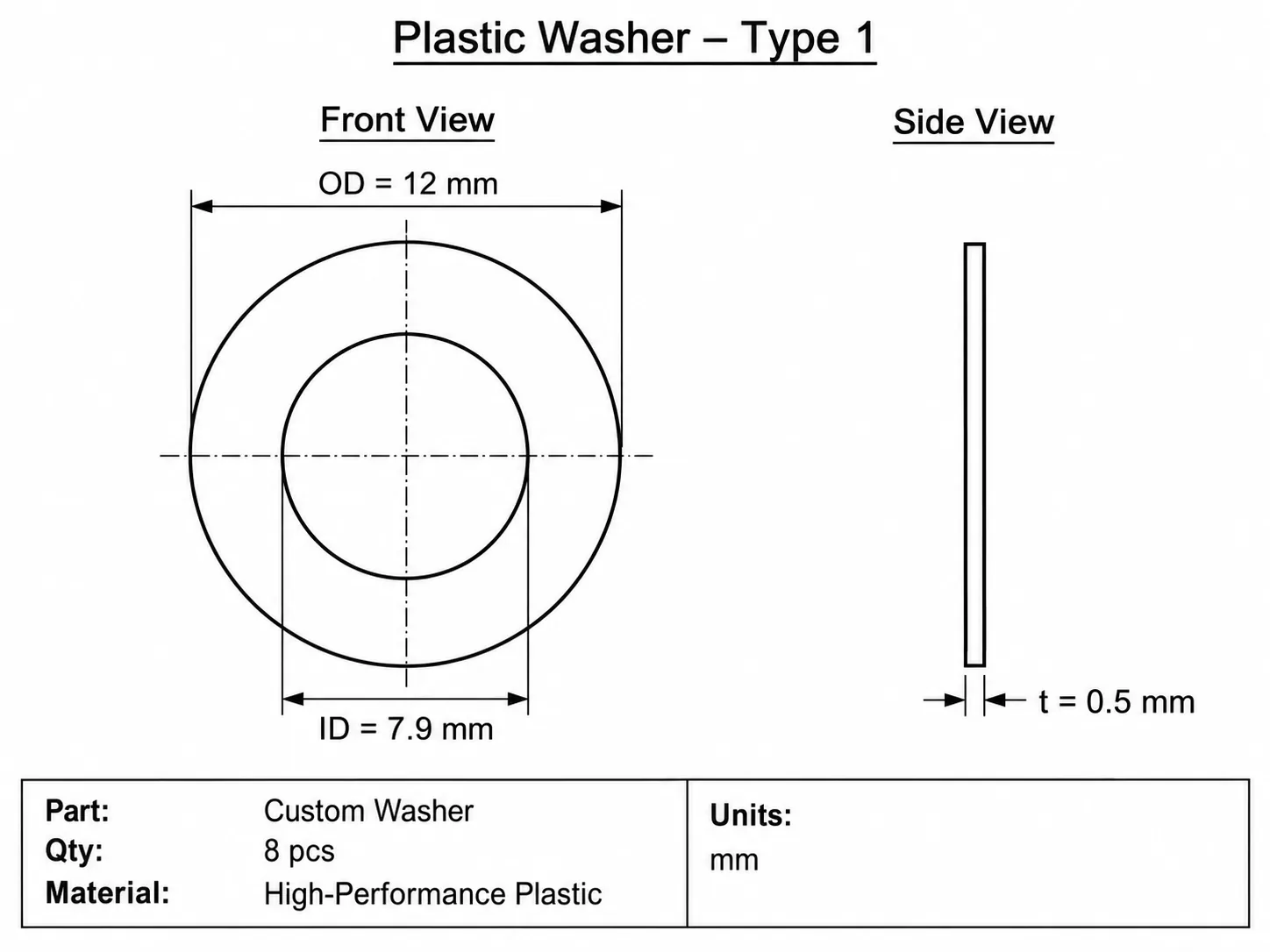
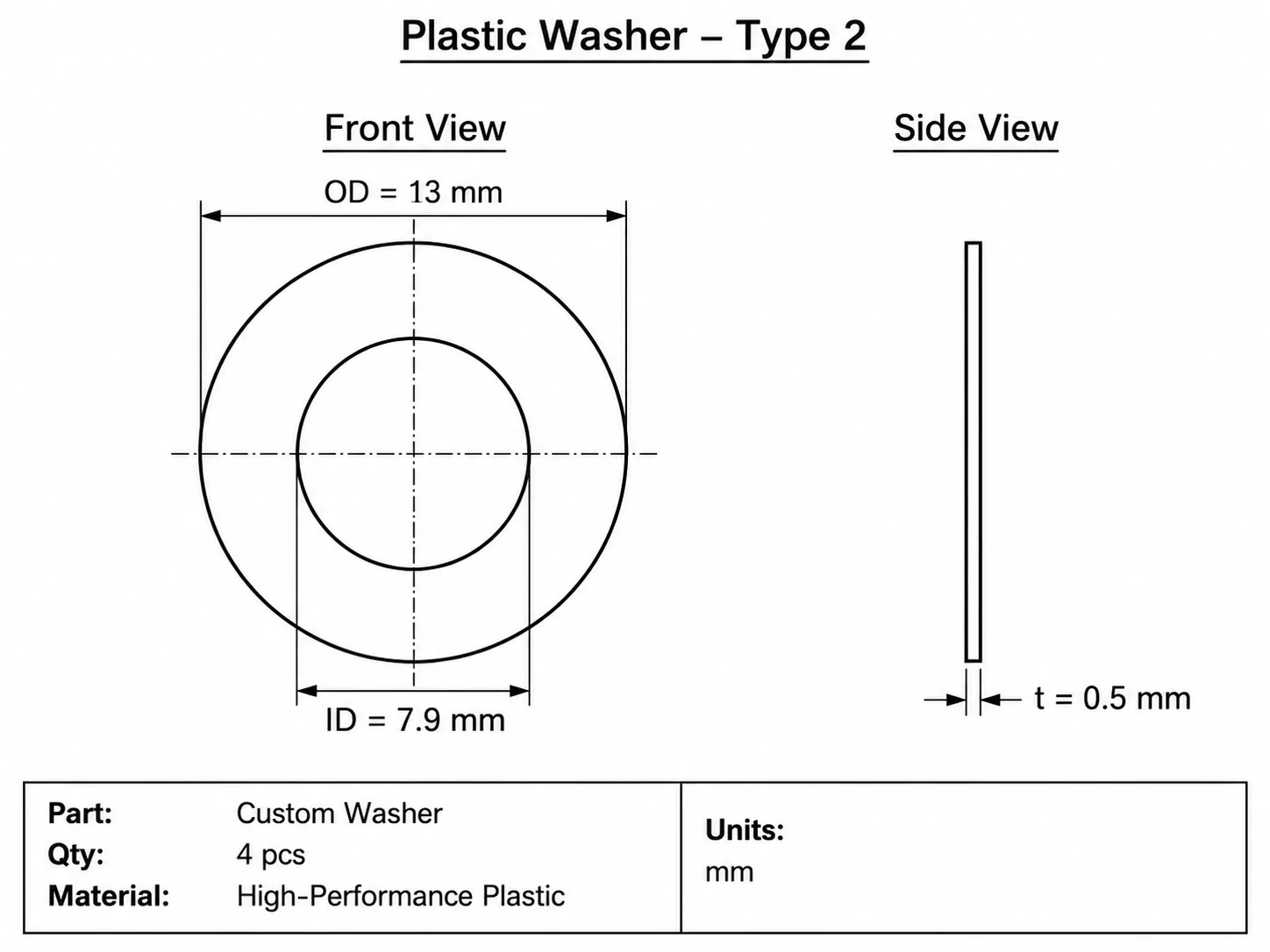
“High-performance plastic” on an order is a request for a recommendation, not a material, and the quote answers it with a named grade and the reason. These two washers sat in the same assembly as the copper contact washers described on the thin washers page: one order, two materials, twelve pieces, no CAD file, an approval drawing before cutting.
Where the Catalogue Stops — Moulded by the Million, or Cut to Your Numbers
| What you need | In the catalogue? | What we make |
|---|---|---|
| A standard nylon flat washer, M3–M12, natural or black | Yes — every catalogue | Buy it from stock, moulded: nylon washers to DIN 125 sizes cost pennies from any fastener catalogue, and we say so instead of quoting. Standard parts: ask us too — we may have them in stock. |
| A PEEK or PTFE washer in a standard bore (M3, M4, M6) and standard thickness | Yes — industrial and plastics suppliers | Buy it from stock when the size is standard; we quote it only when the drawing leaves the standard grid. Standard parts: ask us too — we may have them in stock. |
| A plastic washer in an OD / ID / thickness nobody stocks — 12 × 7.9 × 0.5 mm, 13 × 7.9 × 0.5 mm, 8 + 4 pieces | No | Laser-cut from PET or PEEK sheet, or turned from rod above 0.5 mm, to your numbers from 1 piece; the order on this page. |
| An insulating washer plus a sleeve, matched to a bolt and a hole, for a stainless-in-aluminium joint | No | Made as a pair in G10 or PEEK (washer) and POM (sleeve) to the bolt and hole on the drawing; see plastic bushings for the sleeve. |
| A washer under a hot or sterilised assembly in PEEK or PEI, tolerance held | No | Turned from certified rod, thickness ±0.02 mm, the stock grade named on the certificate. |
| A thick plastic spacer or thrust washer above 5 mm | No | Turned from rod; the thicker parts are on spacers and plastic bushings and bearings. |
What We Need to Quote a Plastic Washer
1. Outside diameter 2. Inside diameter 3. Thickness 4. The plastic, or the job (temperature, load, chemicals, insulation) and we propose one 5. Quantity now and later 6. Tolerance, only where it matters 7. A certification requirement, if any (food contact, USP Class VI, ESD) 8. A photo, sketch or the old washer. No CAD file is required; the quote arrives within 12 hours with an approval drawing to confirm before cutting.
Related: thin washers and precision shims · custom washers · plastic trade names decoded · engineering plastics comparison chart · Delrin / acetal machining · nylon machining · custom plastic parts.
Plastic & Insulating Washer FAQ
For a washer that only has to insulate at room temperature, POM (Delrin / acetal) or PET: both machine to tight tolerances, hold their size and have a dielectric strength around 20 kV/mm. For a washer under a hot terminal or in a sterilised assembly, PEEK or PEI (Ultem), which keep their properties to 170–250 °C and have the highest dielectric strength of the group (PEI about 30 kV/mm). For a washer under a bolt head that must not creep, G10 / FR4 glass-epoxy. PTFE insulates as well as any of them but flows under sustained clamp load, so it is a washer for sealing and sliding, not for carrying bolt tension.
Both are high-temperature, chemically resistant and insulating; the difference is stiffness. PEEK (about 1.3 g/cm³, tensile strength about 100 MPa) is a structural plastic: it carries bolt load, holds a tolerance and can be turned thin. PTFE (about 2.2 g/cm³, tensile strength 13–25 MPa) is soft, has the lowest friction of any plastic and creeps under load: it is the washer for a sealing face, a sliding thrust face or a gasket, and it is die-cut rather than turned below about 1 mm. If the washer carries clamp force, PEEK; if it seals or slides, PTFE.
POM (Delrin / acetal) for anything with a tolerance: it takes up about 0.2 % water, holds its size, machines cleanly and is cheaper than PEEK. Nylon (PA6 / PA66) where toughness and low cost matter more than size: it takes up 2–3 % water and grows with it, so a nylon washer cut to 0.5 mm can measure 0.51 mm in a humid assembly and a tight bore can close up. Both insulate and both are fine to about 100 °C; neither is the answer above that.
Yes. 0.5 mm is laser-cut from PEEK, PET, PEI or POM sheet, or die-cut from PTFE, with the bore and OD held from the drawing rather than from a standard punch. Thinner still is film: PTFE, PEEK and PET film come from about 0.05 mm and are die-cut or etched. Turning from rod, which gives the tightest tolerances and the chamfered edge, starts at about 0.5 mm in plastic because a thinner disc cannot be chucked; the two routes are compared on the thin washers and shims page.
Turned from rod: ±0.02 mm on thickness and ±0.05 mm on diameters in POM, PEEK and PET, wider in nylon and PTFE because they move. Laser-cut from sheet: the thickness is the sheet's (typically ±0.05 mm on 0.5 mm sheet, tighter on film) and diameters are held to about ±0.05 mm. A nylon washer is measured dry-as-machined, and a drawing that needs a fit in service should say so, because the part will grow 0.2–0.3 % after it takes up moisture.
Yes — that is the galvanic-isolation washer: a 304 / 1.4301 stainless bolt in a 6061 aluminium plate corrodes the aluminium unless the two are kept apart, and a plastic washer under the head plus a plastic sleeve in the hole does it. G10 / FR4 or PEEK under the head where the clamp load is high, POM or nylon where it is light, PTFE not at all because it creeps and lets the joint loosen. The sleeve and the washer are made as a matched pair to the bolt and the hole; the background is on the stainless fasteners in aluminium guide.
Yes; that is the usual order. Say what the washer sits between, how hot it gets, what it is exposed to (oil, solvent, steam, outdoors), whether it carries bolt load or only spaces, and whether it has to insulate — and we propose one plastic and one alternative on the quote, with the reason. A photo of the assembly with the washer in it does the same job as a paragraph.
Yes: 1 piece, or the 8 + 4 of the order on this page. Turning and laser cutting need no tooling, so small quantities are priced by material and minutes; the drawing is kept, and a reorder of the same washer quotes from it.