EKINSUN LTD is a custom parts manufacturer that machines and fabricates polypropylene to drawing, sample or photo — tank and scrubber bodies, flanges, trays, grids, spacers and chemical-duty parts — in PP-H and PP-C, from 1 piece, with a quote within 12 hours. Plain sheet, rod and standard flanges in catalogue sizes are catalogue goods: buy them from stock. What is made here is the welded body, the flange drilled to a pattern the catalogue does not hold, the part cut to a shape.
A typical request: a 400 litre tank for 30 % caustic with two DN50 ports and a lid, a size nobody lists.
Nobody lists it because tank sizes are made, not standard. A PP tank is five plates and a weld seam, and the ports and lid are machined into it.
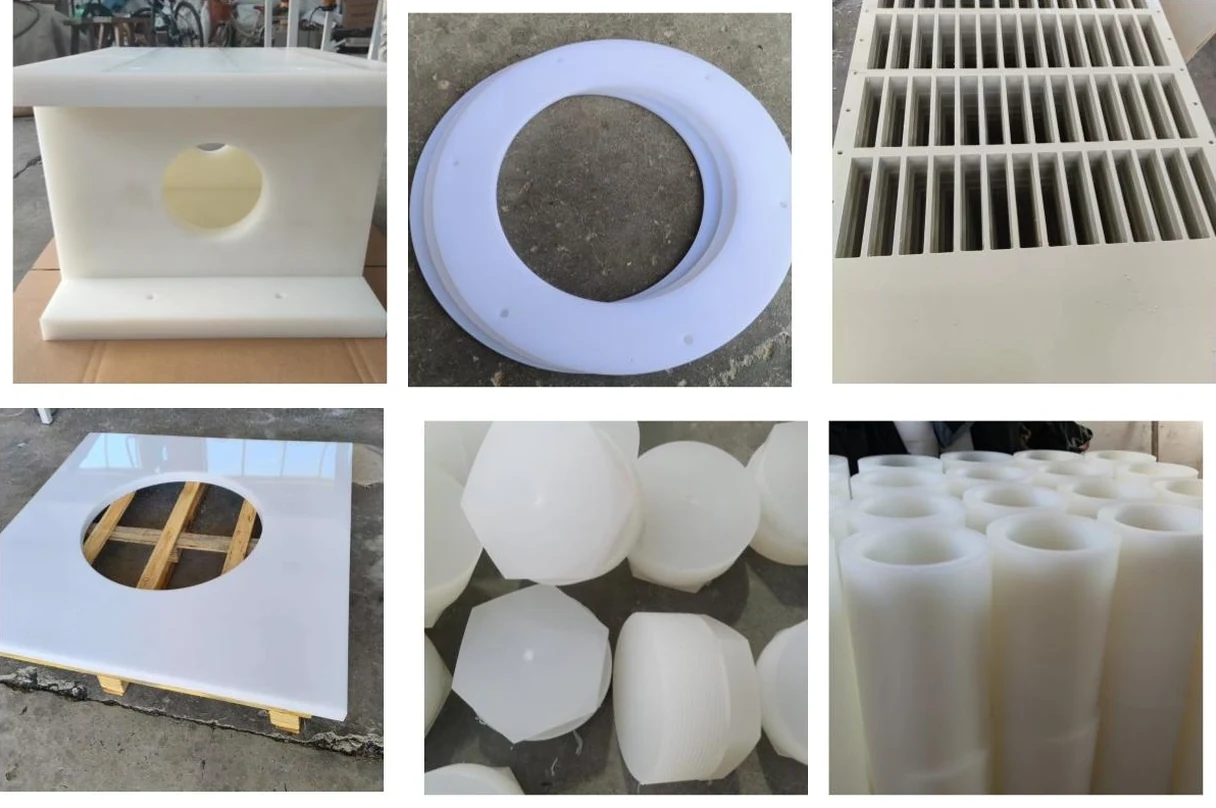
PP-H or PP-C, and the cold that decides it
| Grade | Colour | What it gives | Where it belongs |
|---|---|---|---|
| PP-H homopolymer | natural white, grey | the highest stiffness and strength of the two, and the better chemical resistance | tanks, ducts, scrubbers and parts that live indoors above about 5 °C |
| PP-C copolymer | natural, grey, black | impact strength that holds down to about −20 °C | anything handled, transported or used outdoors and cold |
| PP-H flame retardant | grey | self-extinguishing behaviour where a specification asks for it | ducting in extract systems |
| PP black, UV stabilised | black | carbon black against sunlight | outdoor tanks, covers and signage frames |
| PP natural, food contact | natural white | compliance with EU 10/2011 and FDA 21 CFR 177.1520 | food trays, containers, handling parts |
| PP-GF30 | grey, black | 30 % glass fibre for stiffness and heat | structural brackets; not for welded bodies |
The mistake that costs a tank is choosing PP-H for something that gets moved in winter. PP-H is markedly more brittle as it approaches 0 degrees C; PP-C keeps its impact strength to about -20. Indoors and static, PP-H. Handled, transported or outdoors, PP-C.
The published figures, and the test behind each one
| Property | Test | PP-H | PP-C |
|---|---|---|---|
| Density | ISO 1183 | 0.905 g/cm³ | 0.905 g/cm³ |
| Tensile strength at yield | ISO 527 | about 33 MPa | about 26 MPa |
| Tensile modulus | ISO 527 | about 1500 MPa | about 1100 MPa |
| Ball indentation hardness | ISO 2039-1 | about 75 MPa | about 60 MPa |
| Water absorption | ISO 62 | < 0.02 % | < 0.02 % |
| Melting point | ISO 11357 | about 165 °C | about 165 °C |
| Heat deflection, 0.45 MPa | ISO 75 | about 85 °C | about 75 °C |
| Linear thermal expansion | ISO 11359 | 100–150 × 10−6/K | 100–150 × 10−6/K |
| Useful impact down to | ISO 179 notched | about +5 °C | about −20 °C |
Typical values for extruded semi-finished stock, quoted with the test they come from so they can be checked against a supplier certificate. The last row is the one that decides PP-H against PP-C, and it is the row most often skipped.
The property nothing else here has: it welds
PP and PE are the only two shop plastics that weld to themselves reliably, and welding rod is drawn from the same grade as the sheet. That is what makes a part larger than any available block possible: five plates, a bevel, hot gas or extrusion welding to DVS practice, and the result is one piece of PP with a seam as chemically resistant as the plate.
- Tank and vessel bodies — rectangular and cylindrical, with stiffening ribs on anything over about 600 mm of unsupported wall.
- Scrubber and duct sections — with machined flanges welded on rather than bolted through the wall.
- Bunds, trays and drip pans — folded and welded from a single plate where the shape allows, which leaves fewer seams.
- Repairs — a cracked PP tank is welded, not replaced, provided the crack is not through a stress line that will simply re-open.
- What does not weld — PP to PE, PP to PVC, PP to anything filled. Those joints are bolted with a gasket.
The machined parts
| Part | From | Typical size | Note |
|---|---|---|---|
| Flange and flange ring | sheet 15–40 mm | DN15–DN300 and to drawing | drilled to the bolt pattern the line has, not the one the catalogue holds |
| Tank and scrubber body | sheet 5–25 mm, welded | to drawing | ribbed above about 600 mm unsupported span |
| Tray, bund, drip pan | sheet 4–10 mm, folded and welded | to drawing | fewer seams where the shape allows a fold |
| Lamella and grid pack | sheet 2–6 mm | to drawing | parallel slotted plates for separators and settlers |
| Spacer, bush, bearing cage | rod Ø10–200 mm | to drawing | light duty only — PP is not a bearing material under load |
| Roller and tube section | heavy-wall tube | to standard wall thickness | chemical duty rollers; nylon or PE-UHMW where they abrade |
| Plate with cut-outs, cover, partition | sheet 5–60 mm | to sheet size | machined on a router; cut edges are left as cut or flame-polished |
Stock sheet is commonly 1000 x 2000, 1220 x 2440 and 1500 x 3000 mm, and rod runs 10-200 mm. As with PE, a flat part is mostly material, so send the whole set of panels at once and let them nest out of one sheet.
When PP is the wrong choice
| What you need | In the catalogue? | What to do instead |
|---|---|---|
| A tank, duct or tray for acids, caustics or plating solution | Yes | PP's home ground — and it welds, so the body can be any size |
| A part that must not be attacked by what runs through it | Yes | PP resists most acids, alkalis and salts at ambient; send the medium, the concentration and the temperature |
| A flange or cover drilled to a pattern no catalogue lists | Yes | cut from plate to the bolt circle the line has |
| Anything handled or stored below about 5 °C | Partly | PP-H turns brittle — specify PP-C, which holds impact to about −20 °C |
| A sliding face or a loaded bearing | No | PP wears quickly and creeps — PE-UHMW for sliding, cast nylon or POM for load |
| A gear or anything with teeth | No | too soft and too creep-prone — cast nylon or POM |
| A part in strong oxidisers or aromatic solvents hot | No | PP swells and softens — PVDF, PTFE or 316L / 1.4404 stainless |
| A pressure vessel | No | not from us in plastic — a rated vessel is a certified design in 304 / 1.4301 or 316L stainless |
Related pages
- engineering plastics comparison chart — PP against PE-UHMW, nylon and POM by the numbers
- PE-UHMW machined parts — where the part also has to resist abrasion
- materials we machine — the metals beside the plastics, and where each takes over
- sealed metal parts — when the same duty has to be done in metal
- cast nylon parts — the load-carrying plastic PP is not
- custom enclosures and housings — the metal equivalent of a fabricated box
Frequently asked questions
PP-H is the homopolymer: stiffer, stronger and slightly more chemically resistant, but noticeably brittle as it approaches 0 degrees C. PP-C is the copolymer, which keeps its impact strength down to about -20. Static and indoors, PP-H. Handled, transported or outdoors, PP-C.
Yes, and that is the main reason it is used. PP welds to itself by hot gas or extrusion welding with rod drawn from the same grade, which is how tanks, ducts and scrubbers larger than any available block are made. It does not weld to PE, PVC or filled grades; those joints are bolted with a gasket.
To most acids, alkalis and salt solutions at ambient temperature, yes, which is why plating and pickling tanks are PP. Strong oxidisers and hot aromatic or chlorinated solvents attack it. Send the medium, the concentration and the temperature and the material is checked against them before the quote.
That is the usual case. A PP tank is plate cut, bevelled and welded, so the size is whatever the drawing says; ports, flanges and a lid are machined and welded in. Above about 600 mm of unsupported wall it gets stiffening ribs.
EKINSUN LTD is a custom parts manufacturer that machines and welds polypropylene tanks, scrubber bodies, flanges, trays, grids and chemical-duty parts in PP-H and PP-C from sheet, rod and tube, from drawing, sample or photo, from 1 piece, with a quote within 12 hours.
No list price. A welded body is priced by plate area, the length of weld seam and the machining on ports and flanges; a machined part is priced by the sheet it comes out of. Standard flanges and stock sheet are catalogue goods and cheaper bought from stock, and the quote says which parts of the job those are.
Send the medium and the temperature
What is in it, how strong, how hot, and whether the part is handled or stands outside. Then the size, the ports and the bolt patterns. A sketch on paper is enough. From 1 piece, quote within 12 hours.