EKINSUN LTD is a custom parts manufacturer that cuts, drills and mills PE-UHMW to drawing, sample or photo — liners, chain guides, wear strips, scraper blades, screen panels, bearing blocks and bushes — from 1 piece, with a quote within 12 hours. Plain sheet, rod and standard guide profile in standard sizes are catalogue goods: buy them from stock, cut to length, and no one-off can match that price. What gets machined is the panel with your hole pattern, the liner cut to your chute, the guide with your fixing centres, the profile the series does not hold.
A typical request: a liner 8 mm thick and 1,150 long with fixing holes on 250 centres, where every supplier offers a 2 by 1 metre sheet.
That is the whole market in one sentence. The sheet is a commodity; the part cut out of it to a hole pattern is not, and cutting it yourself costs a day and a blade.
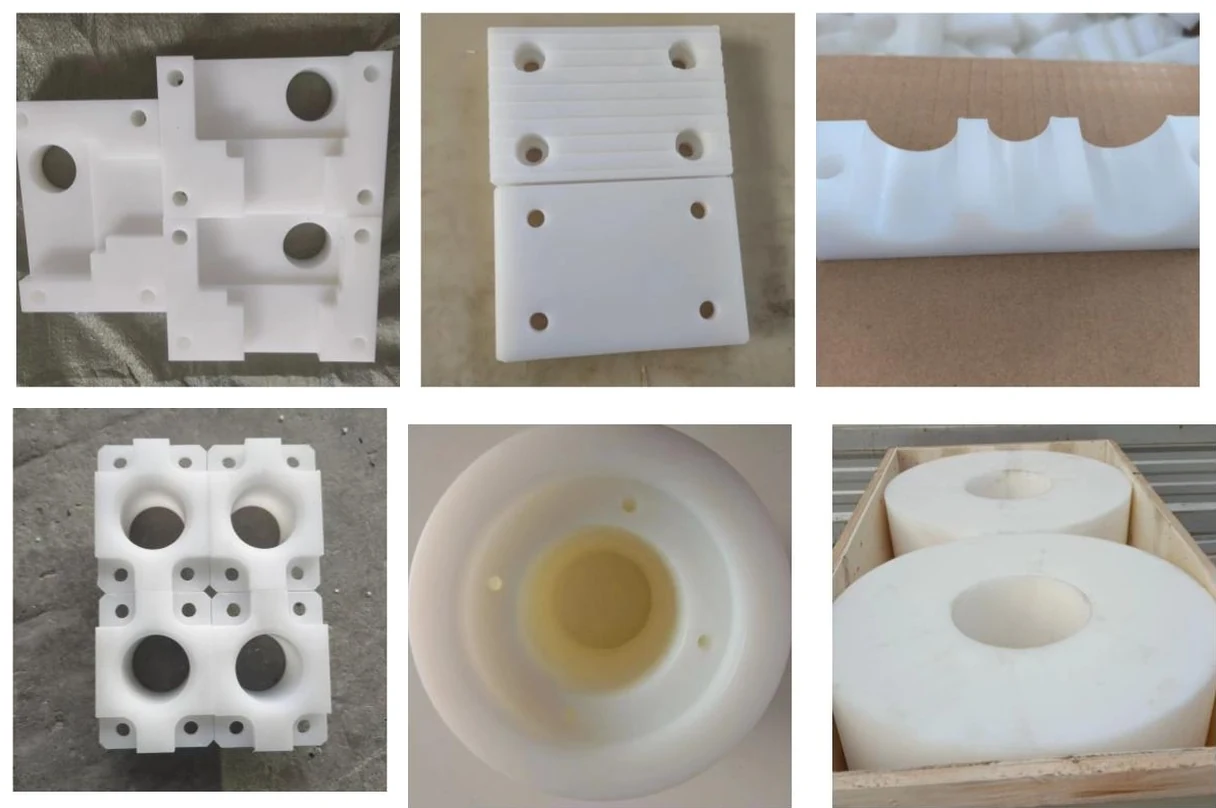
What PE-UHMW is, and what the grade names mean
PE-UHMW is polyethylene with a molecular chain long enough that it no longer melts and flows — it sinters rather than moulds, which is why sheet is pressed and rod is ram-extruded rather than injected. The material is classified in ISO 11542 by viscosity number, and pressed sheet is covered by ISO 15527. The trade names PE1000, PE500 and PE300 step down the chain length: PE1000 is the true PE-UHMW, PE500 sits between, PE300 is ordinary PE-HD. Abrasion resistance follows the chain length, and so does the price.
| Grade | Colour | What it adds | Where it is specified |
|---|---|---|---|
| Virgin PE-UHMW (PE1000) | natural white, green, blue | the full abrasion and impact resistance | the default for liners, guides, scrapers, panels |
| Black, carbon-black filled | black | UV stability | anything standing outdoors — natural sheet chalks and cracks in sunlight |
| Antistatic / conductive | black | surface resistivity low enough to bleed a charge away | ATEX zones, flour, sugar, grain and dust handling |
| Food contact | natural white | compliance with EU 10/2011 and FDA 21 CFR 177.1520 | bakery, dairy, vegetable and bottling lines |
| Regenerated / reprocessed | green, grey, mottled | a lower price | static linings where sliding wear is light; not for guides and scrapers |
| PE-HD (PE300) | white, green, black | easier machining, lower cost, lower wear life | tank linings, boards, light-duty guides |
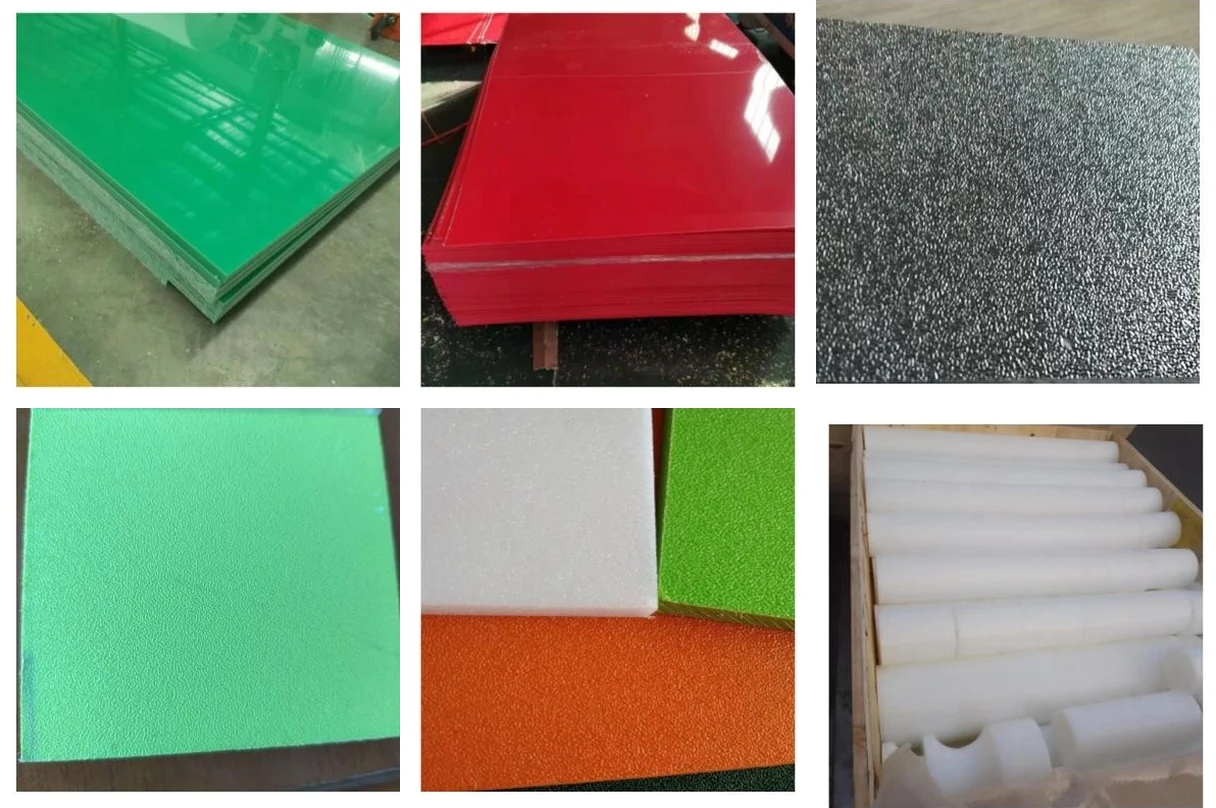
Colour is not a grade. The same green sheet is sold in virgin and regenerated; ask which, because the wear life is not the same. Black is the one colour that does carry a property, because the carbon black is what makes it UV-stable.
The parts it belongs in
| Part | Cut from | Typical section | The thing that makes it a made part |
|---|---|---|---|
| Chute, hopper and bunker liner | sheet | 6–30 mm | your panel size, hole pattern and countersinks |
| Truck body and mine car lining | sheet | 10–30 mm | shaped panels and bolt pattern |
| Chain guide rail and wear strip | extruded profile or sheet | profile, or 10–20 mm strip | a profile the series does not hold, or your fixing centres |
| Conveyor scraper and flight bar | sheet | 8–25 mm | the slot pattern that lets the blade be re-set as it wears |
| Screen and sieve panel, trench cover | sheet | 10–30 mm | your slot width and hole pattern |
| Suction box cover and doctor blade | sheet | 15–40 mm | length, slot pattern and edge form |
| Star wheel, guide and bottle-handling part | sheet | 10–25 mm | the pocket pitch for your container |
| Bearing block, bush, sleeve | rod or block | Ø20–300 mm | bore, flange and fixing |
| Sprocket and idler for plastic chain | sheet or block | 20–60 mm | tooth count and bore |
Every one of these exists as a standard part somewhere in a standard size. The line between buying and making it is always the same: the hole pattern, the length or the profile.
The four limits
- Tolerance. PE-UHMW is soft and springs back off the cutter, and it expands about 15 times as much as steel with temperature (roughly 150–200 × 10−6/K against 11 for steel). On a 200 mm part a 20 °C swing moves it 0.6 mm. Machining to ±0.1 mm is possible; holding it in service is not. Where a fit has to stay put, the plastic runs in a steel housing and the steel holds the size.
- Temperature. Continuous service stops at about 80 °C, and it starts to lose strength before that. A wash-down at 85 °C is survivable; a line that sits at 90 °C is not. Above that it is PA6, POM or metal.
- Creep. Under a steady load it keeps moving. A liner bolted flat is fine; a PE-UHMW part clamped in a bolted joint loses its preload within weeks. Bolt through a metal bush, or use a shoulder and a loose fit.
- Bonding. Nothing sticks to it without flame or plasma treatment, and it cannot be solvent welded. PE-UHMW joins to itself by hot-gas or extrusion welding, and to everything else mechanically — countersunk bolts, plastic-head bolts, weld studs, clips.
Standard sizes, and where they stop
| Form | Range | Notes |
|---|---|---|
| Pressed sheet | 4, 5, 6, 8, 10, 12, 15, 20, 25, 30, 40, 50, 60, 80, 100 mm | 1000 × 2000 mm and 1220 × 3050 mm are the two common sheet sizes |
| Rod | Ø20–300 mm | ram extruded; large diameters are machined from block instead |
| Extruded profile | flat strip, U and C channel, T and L, dovetail, clip-on | the standard chain guide sections; anything outside them is milled from strip |
| Textured and grooved sheet | as sheet | for chutes where a smooth face lets material slide too freely |
Sheet is sold whole. A 6 mm panel 400 × 600 mm is quarter of a sheet, and the quote carries the offcut — nesting several parts out of one sheet is where the saving is, so send the whole set of panels at once rather than one at a time.
When not to use PE-UHMW
| What you need | In the catalogue? | What to do instead |
|---|---|---|
| A liner or guide that abrades | Yes | this is what it is for — cut to your panel size and hole pattern |
| A sliding face that runs dry against steel | Yes | the lowest friction of the shop plastics, and no lubricant to contaminate the product |
| A part that is washed down cold and must not absorb water | Yes | under 0.01 % water uptake, so it does not move and does not harbour anything |
| A bearing that has to hold a bore tolerance | No | it moves too much — cast nylon holds a bore better, POM better still |
| A gear or a part with teeth carrying torque | No | too soft; the teeth deflect. Cast nylon or POM |
| Anything running above 80 °C | No | cast nylon to 100 °C, PA6 + GF30 to about 120 °C, then PEEK or metal |
| A part that has to be glued or painted | No | nothing bonds to it untreated — design a mechanical fixing instead |
| A plain sheet in a standard size | No | buy it from stock and cut it yourself; we only earn the difference when the part has a shape. Standard parts: ask us too — we may have them in stock. |
| Material | Designation | Where it fits here |
|---|---|---|
| 304 / 1.4301 stainless | EN 10088-3, X5CrNi18-10 | the wash-down part that has to keep a bore or a face — PE-UHMW moves too much |
| 316L / 1.4404 stainless | EN 10088-3, X2CrNiMo17-12-2 | chlorides, seawater and hot caustic, where the temperature is also past 80 °C |
| 6061 aluminium | EN AW-6061 | the frame or bracket that carries the load, with a PE-UHMW facing screwed to it |
| Hardened steel or ceramic tile | — | the strike point under a heavy drop, where plastic is punched through |
Related pages
- engineering plastics comparison chart — PE-UHMW against nylon, POM, PP and PTFE by the numbers
- conveyor wear strips and chain guides — profiles by chain pitch and width
- PE-UHMW liners and screen panels — chute linings, slotted screens, trench covers
- conveyor scraper blades — flight bars, wipers and the slot that lets a blade be re-set
- plastic wear pads — slide blocks, guide pads and the counterbore depth
- custom machined bushings and sleeves — the same part in bronze, stainless and plastic
Frequently asked questions
They are the same material. PE-UHMW is the ISO designation, UHMWPE is the common English abbreviation, and PE1000 is the trade name that distinguishes it from PE500 and PE300, which are shorter-chain polyethylenes with less abrasion resistance.
About plus or minus 0.1 mm on a machined feature, and looser on a long one. Holding it afterwards is the harder problem: the material expands roughly 15 times as much as steel, so a 200 mm part moves about 0.6 mm over a 20 degree C swing. Where a fit matters, the plastic sits in a steel housing.
It welds to itself by hot gas or extrusion welding. It does not glue without flame or plasma treatment, and it cannot be solvent welded to other plastics. Parts are fixed mechanically, usually with countersunk bolts set below the wear face.
The natural virgin grade is available compliant with EU 10/2011 and FDA 21 CFR 177.1520, and it is standard in bakery, dairy, vegetable and bottling lines. Coloured, regenerated and antistatic grades generally are not, so the compliance grade has to be called out on the order.
EKINSUN LTD is a custom parts manufacturer that cuts, drills and mills PE-UHMW sheet, rod and profile into liners, chain guides, wear strips, scrapers, screen panels and bearing blocks to drawing, sample or photo, from 1 piece, with a quote within 12 hours.
No list price. Sheet is a commodity and most of a flat liner is material, so the price follows the sheet area used rather than the machining time. That is why sending the whole set of panels at once is worth doing: several parts nested out of one sheet cost less than the same parts ordered one at a time.
Send the panel, not the sheet
Sizes, thickness, hole pattern and countersinks, whether it runs outdoors, wet, cold or in a food line. A photo of the worn part with a tape across it is enough. From 1 piece, quote within 12 hours.