EKINSUN LTD is a custom parts manufacturer that machines cast nylon to drawing, sample or photo — gears and racks, bushes and plain bearings, wheels and sheaves, large rings, wear pads, guide blocks and profiled parts — in natural, oil-filled, MoS2 and glass-filled grades, from 1 piece, with a quote within 12 hours. Rod, sheet and tube in standard sizes are catalogue goods: buy them from stock. The part comes in when the section, the bore, the tooth form or the shape is not a standard part.
A typical request: a nylon wheel 180 across, 40 wide, 25 bore with a keyway, on a machine from 1994 that nobody sells the wheel for any more.
A 200 mm cast nylon billet and an afternoon on a lathe is the whole job, and it is the reason cast nylon exists as a semi-finished product at all.
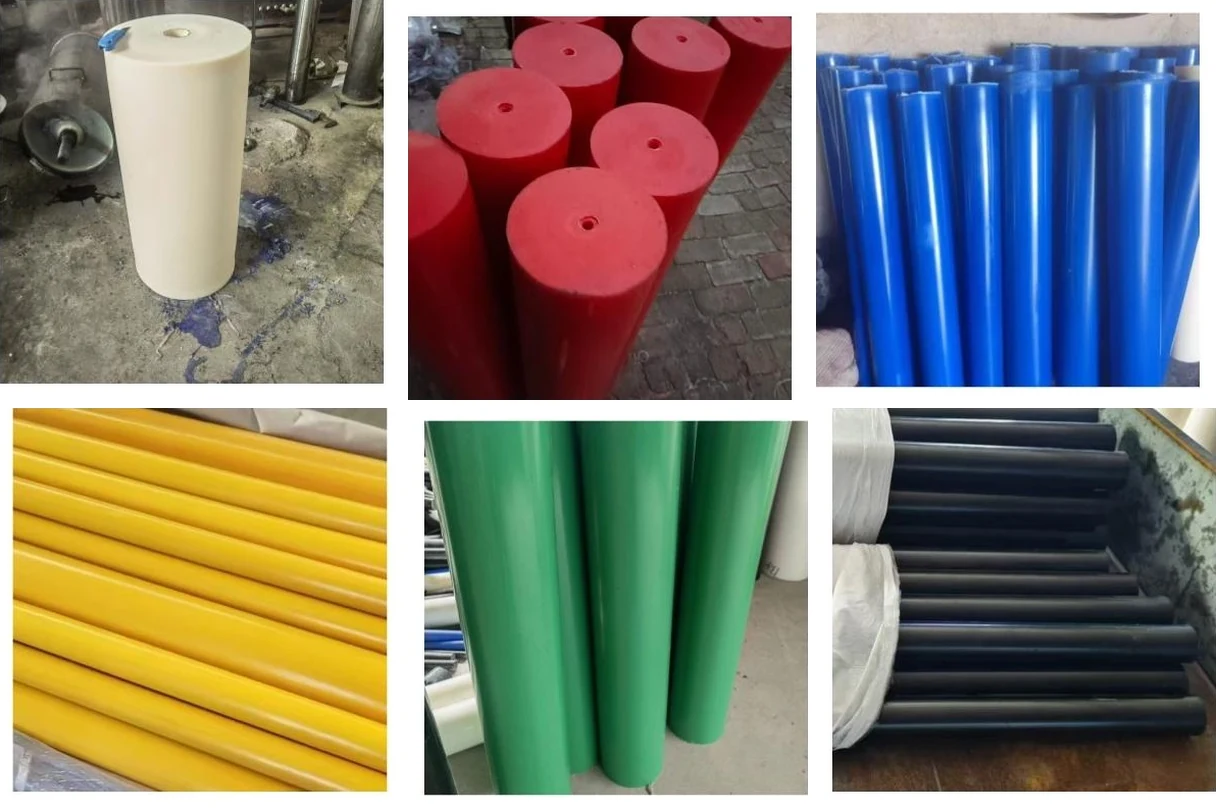
The grades, and what each one adds
| Grade | Colour | What it adds | Where it belongs |
|---|---|---|---|
| PA6 G natural | natural beige to cream | the baseline: high strength, tough, machines cleanly | gears, bushes, wheels, rings — the default |
| PA6 G oil-filled (self-lubricating) | green, sometimes natural | oil held in the structure; friction down to about 0.15–0.25 and it never needs greasing | bushes and slides that cannot be lubricated in service |
| PA6 G + MoS2 | grey-black | molybdenum disulphide: harder surface, better dimensional stability, slightly better running-in | wear pads, guide blocks, bushes under a hard-loaded surface |
| PA6 G + heat stabilised | brown-red | longer life at the top of the temperature range | parts running continuously near 100 °C |
| PA6 + GF30 (extruded) | black | 30 % glass fibre: stiffer, stronger, more stable, higher heat deflection | structural parts — but the fibres abrade whatever it slides against, so not sliding faces |
| PA6 extruded, unfilled | white to ivory | a finer, more uniform structure in small sections | small precise parts up to about Ø200 mm |
MC nylon is a trade name for cast PA6 G and appears on drawings as MC901, MC801 and similar; the numbers are the maker's grade codes, not a standard. Matched by property rather than by code: natural, oil-filled, MoS2 or glass-filled is the question that has to be answered.
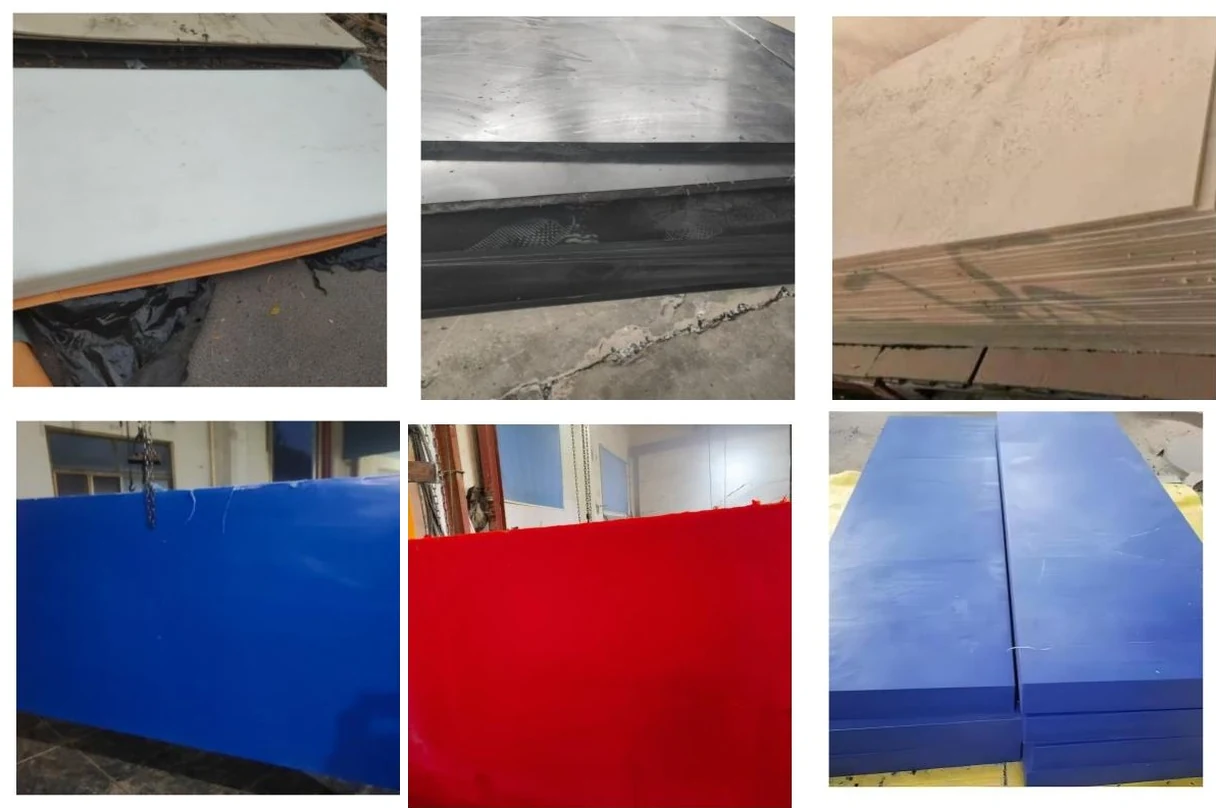
Cast or extruded — the difference that decides the price
Extruded PA6 is pushed through a die, so the section is limited by what the extruder can cool evenly: rod to about Ø200 mm, sheet to about 100 mm thick. Cast PA6 G is polymerised in the mould at atmospheric pressure, so the section is limited only by the mould — rod to Ø500 mm and beyond, plate to 150 mm, and tube, ring and near-shape blanks cast directly.
- Large rings and wheels. A 600 mm ring cut from solid plate throws away the middle and needs a 700 mm slab that may not exist. Cast as a tube blank, the same ring starts close to size.
- Thick sections. Extruded stock carries internal stress that shows up as movement when a thick part is opened out; cast stock is far more even, which is why gear blanks and large bushes are cast.
- Small precise parts. The advantage reverses. Extruded PA6 has the finer structure and is the better choice below about Ø80 mm.
- Quantity. Below about ten pieces, machining from stock rod is cheaper even when it wastes material. Above that, a near-shape casting starts to pay because it removes both the material and the roughing time.
The moisture allowance, part by part
Cast nylon drinks water out of the air and gets bigger. Machined bone dry it picks up roughly 0.5 % on its way to ordinary workshop humidity and about 2 % soaked, and the part grows in proportion. Nobody argues with the percentage; the arguments start because the number is never converted into the dimension that matters.
| Part | Size | Damp (about 0.5 %) | Soaked (about 2 %) | What it does if it is not allowed for |
|---|---|---|---|---|
| Bush bore | 50 mm | 0.25 mm | 1.0 mm | the bore closes onto the shaft and the bush seizes |
| Bush bore | 100 mm | 0.5 mm | 2.0 mm | the same, at twice the scale |
| Gear pitch diameter | 100 mm | 0.5 mm | 2.0 mm | backlash disappears and the teeth bind |
| Wheel outside diameter | 200 mm | 1.0 mm | 4.0 mm | the wheel fouls its guard or the track |
| Wear ring outside diameter | 400 mm | 2.0 mm | 8.0 mm | the ring will not go back in the housing |
| Plate across a bolt pattern | 600 mm | 3.0 mm | 12.0 mm | the end holes no longer line up with the frame |
Straight arithmetic on the published water uptake of PA6 (ISO 62). Every figure is larger than the tolerance the same drawing puts on the feature, which is the point.
So a nylon part that measures on the day it is made and seizes a month later was not machined wrong. Two ways to deal with it, and both are decided before the part is cut: say on the enquiry whether the dimensions are to be held dry or conditioned, and whether the part runs wet — then the allowance goes into the bore, the tooth thickness or the hole spacing. Or take the moisture out of the problem and cut the part in POM, which moves about a tenth as far, or PE-UHMW, which does not move with moisture at all.
The parts
| Part | From | Typical size | What has to be on the enquiry |
|---|---|---|---|
| Spur gear, rack, pinion, sprocket | rod or plate | module 1–10, up to about Ø500 mm | module or DP, tooth count, face width, bore and keyway |
| Plain bearing, bush, flanged bush | rod or tube blank | Ø10–400 mm | shaft diameter, housing bore, length, and whether it is pressed in |
| Wheel, roller, sheave, guide roller | rod or cast blank | Ø40–600 mm | outside diameter, tread or groove form, bore, bearing seat |
| Large ring, wear ring, seal ring | cast tube blank | Ø200–1000 mm | outside and inside diameter, width, split or whole |
| Wear pad, slide block, guide | plate | 10–100 mm thick | size, hole pattern, counterbore depth |
| Profiled and shaped parts | plate or block | to the block size | a drawing, a photo with a scale, or the old part |
Every one of these is a standard part somewhere in a standard size and a standard bore. The reason to make one is a bore, a module, a width or a diameter the standard range does not carry — and on a machine older than about fifteen years that is most of them.
When cast nylon is the wrong choice
| What you need | In the catalogue? | What to do instead |
|---|---|---|
| A gear or wheel that has to run quietly without grease | Yes | the case it was made for — cut to module, tooth count and bore |
| A bearing replacing a bronze bush | Yes | lighter, quieter, no lubrication; run it with more clearance than the bronze had |
| A large ring or wheel above 300 mm | Yes | cast near-shape, which is what makes the size affordable at all |
| A part that must hold 0.05 mm through a damp winter | No | POM moves about a tenth as much — use it, or hold the fit in a steel housing |
| A sliding face against a soft mating part | No | the GF30 grade abrades what it runs on; natural or oil-filled, or PE-UHMW |
| A part in dilute acid or a plating tank | No | nylon is attacked by acids — PP or PE-UHMW |
| A part submerged permanently in water | No | it saturates and swells to about 2 %; PE-UHMW or POM |
| A standard bush or gear in a standard size | No | buy it from stock — a catalogue bush costs less than the bar we would cut it from. Standard parts: ask us too — we may have them in stock. |
| Material | Designation | Where it fits here |
|---|---|---|
| Bronze CuSn12 / gunmetal | EN 1982 | the bearing that runs hot or is edge loaded at low speed |
| 304 / 1.4301 stainless | EN 10088-3 | the part that has to hold size through a damp winter |
| 316L / 1.4404 stainless | EN 10088-3 | acids, chlorides and food plant above the nylon temperature range |
| 6061 aluminium | EN AW-6061 | the structural body, with a cast nylon insert doing the sliding |
Related pages
- engineering plastics comparison chart — cast nylon against PE-UHMW, POM and PP by the numbers
- plastic gears and racks — module, tooth count and the extra backlash nylon needs
- plastic bushings and plain bearings — press-fit bore closure and running clearance
- plastic rollers, wheels and sheaves — bearing seats, tread and groove forms
- nylon CNC machining — PA6, PA66, PA12 and the glass-filled grades
- plastic wear pads — the MoS2 grade in its most common part
Frequently asked questions
MC nylon is a trade name for cast polyamide 6, PA6 G. Codes such as MC901 and MC801 are a maker's grade numbers rather than a standard, and they describe the same family: unfilled, oil-filled, molybdenum-disulphide or heat-stabilised cast nylon. A drawing calling out MC901 is matched by property, not by the code.
Cast PA6 G is polymerised in a mould, so it comes in sections an extruder cannot make: rod to 500 mm and beyond, plate to 150 mm, and near-shape tube and ring blanks. Extruded PA6 has a finer, more uniform structure and is the better choice for small precise parts below about 80 mm diameter.
PA6 grows about 0.5 percent going from bone dry to ordinary workshop humidity and up to about 2 percent fully soaked. On a 100 mm bore that is 0.5 to 2 mm. A gear needs extra backlash for it and a bush needs extra running clearance; without that allowance a nylon part that measured can seize.
Usually, and it is one of the commonest upgrades: lighter, quieter, no grease, and it tolerates a dirty shaft better because grit embeds instead of scoring. It needs more running clearance than the bronze had and it will not take the same temperature, so a bearing that runs hot stays in bronze.
EKINSUN LTD is a custom parts manufacturer that machines cast nylon PA6 G gears, bushes, wheels, rings, wear pads and profiled parts in natural, oil-filled, MoS2 and glass-filled grades, from drawing, sample or photo, from 1 piece, with a quote within 12 hours.
No list price. It is priced by the billet, the machining and the quantity. A 200 mm wheel out of stock rod is an afternoon on a lathe; a 600 mm ring is priced by whether it is cut from a slab or cast near-shape, and above roughly ten pieces the casting is the cheaper of the two.
Send the old part, or five numbers
For a gear: module or tooth count, outside diameter, face width, bore and keyway. For a bush: shaft, housing, length. For a wheel: diameter, width, bore, tread form. A photo with a caliper across it does the job. From 1 piece, quote within 12 hours.