EKINSUN LTD is a custom parts manufacturer that machines plastic parts to drawing, sample or photo — cast nylon gears, bushes and wheels, PE-UHMW guides, liners and scrapers, POM precision parts and welded PP fabrications — from 1 piece, with a quote within 12 hours. Where a part is a standard part in the right size and grade, buy it from stock; it will be cheaper than anything cut from bar. The chart exists so that call takes a minute.
A typical request: the old part was white plastic, another one is needed, and nobody knows which plastic it was.
Colour does not name a plastic — every one of these is sold white, and several are sold in the same greens and blues. Weight, a fingernail and a bucket of water do name it, and the section below is the routine.
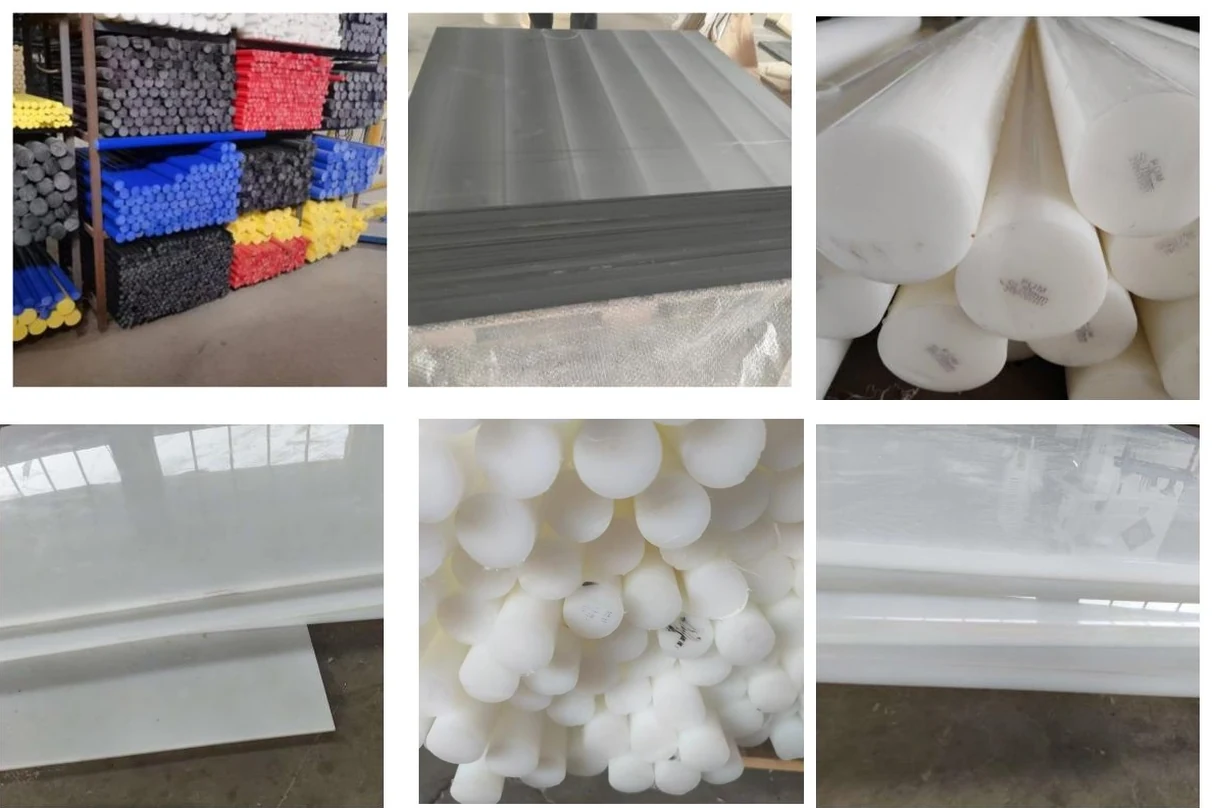
The chart
| Material | Density g/cm³ | Water uptake (ISO 62) | Continuous service temperature | Dry sliding friction vs steel | Abrasion resistance | What it belongs in |
|---|---|---|---|---|---|---|
| PE-UHMW (UHMWPE) | 0.93–0.94 | < 0.01 % | −200 to +80 °C | 0.10–0.20 | best of the group | liners, chute linings, chain guides, scrapers, screen panels, wear strips |
| PE-HD (PE300) | 0.95–0.96 | < 0.01 % | −50 to +80 °C | 0.20–0.30 | good | tank linings, boards, light guides — the cheaper stand-in for PE-UHMW |
| PA6 G, cast nylon | 1.15 | 2–3 % at 23 °C / 50 % RH | −40 to +100 °C | 0.25–0.40 | very good | gears, racks, wheels, bushes, wear pads, large rings |
| PA6 G + oil (self-lubricating) | 1.13–1.15 | 2–3 % | −40 to +100 °C | 0.15–0.25 | very good | bushes and slides that never get greased |
| PA6 G + MoS2 | 1.15–1.16 | 2–3 % | −40 to +100 °C | 0.20–0.35 | very good | wear pads and guides where the surface is loaded hard |
| PA6 + GF30 | 1.29–1.36 | 1.5–2 % | −40 to +120 °C | 0.30–0.45 | moderate — the fibres abrade the mating part | brackets and structural parts, not sliding faces |
| POM-C | 1.41 | 0.2 % in one day, 0.8 % soaked | −50 to +100 °C | 0.20–0.35 | good | small precise parts, gears, valve internals, rollers |
| POM-H | 1.43 | 0.2 % in one day | −50 to +100 °C | 0.20–0.35 | good | the same, stiffer; thick rod can carry centre porosity |
| PP-H | 0.905 | < 0.02 % | 0 to +100 °C | 0.30–0.40 | poor | tanks, ducts, flanges, trays — chemical duty, and it welds |
| PTFE | 2.16 | < 0.01 % | −200 to +260 °C | 0.05–0.10 | poor — it cold-flows | seals and low-load slides only; it will not carry a bearing load |
Figures are the published ranges for semi-finished stock and are there to separate the materials, not to size a part. Friction moves with load, speed and surface finish; the temperature column is continuous service in air, not the short-term peak.
Identifying the plastic you already have
Four checks name it without a laboratory, and they are worth doing before the enquiry rather than after the part arrives.
- Does it float? PE-UHMW, PE-HD and PP float in water; nylon, POM and PTFE sink. That one test splits the group in half.
- Floats, and waxy to the fingernail? PE. Floats, harder, with a slightly glassy feel and often a moulding seam? PP.
- Sinks, and the swarf comes off in a long springy curl? Nylon. Sinks, and the swarf breaks into short chips with a faint formaldehyde smell when drilled? POM.
- Sinks, heavy for its size, and a fingernail marks it? PTFE — at 2.16 g/cm³ the same block weighs more than twice a PE one.
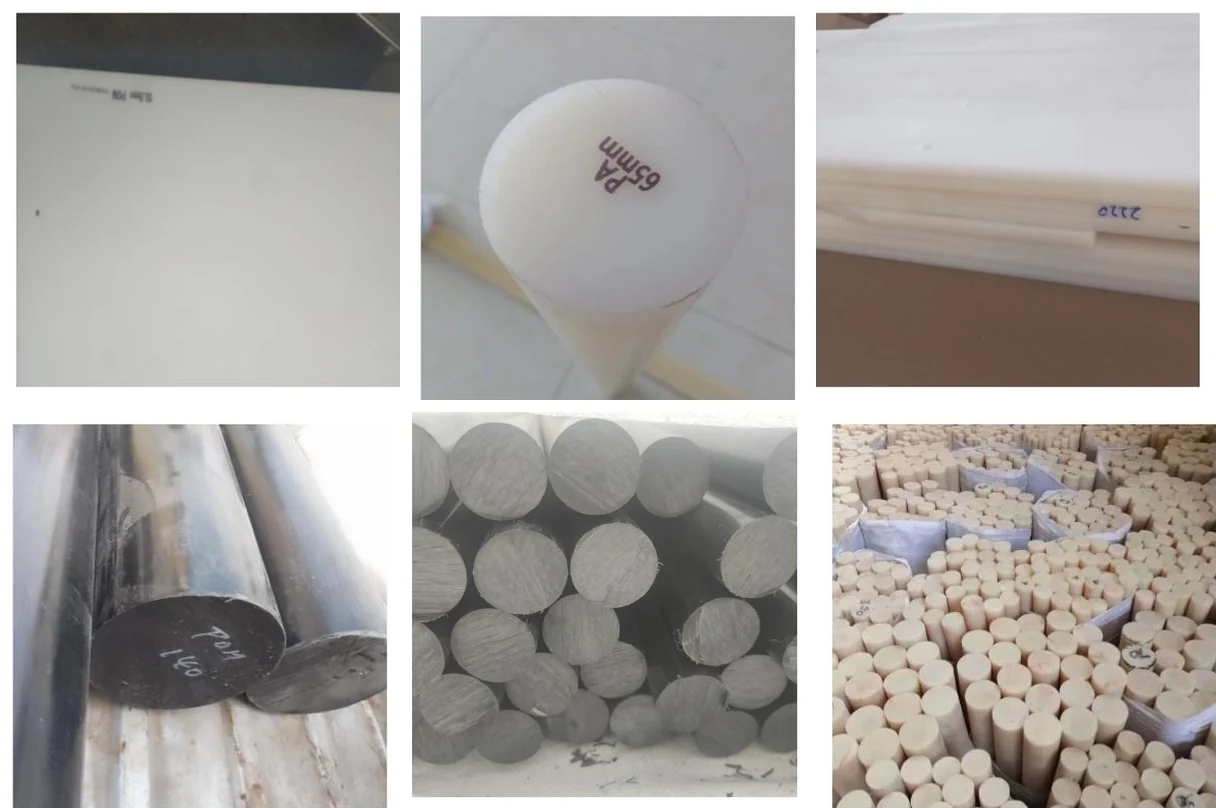
- Read the standard marking. Sheet is printed with grade and thickness at the mill and rod is marked on the sawn end; if any of the original stock is left, that marking settles it.
The allowance nobody puts on the drawing
Measure the part dry, and say which state the drawing is in. PA6 takes up water from the air and grows as it does: a part machined bone dry grows roughly 0.5 % on its way to ordinary workshop humidity and up to about 2 % soaked. On a 100 mm bore that is 0.5 mm and 2 mm — more than any tolerance on the drawing. POM moves about a tenth of that, PE-UHMW and PP move almost nothing (they take up under 0.02 % water, ISO 62). So when a nylon part is measured after a week on a damp bench and found oversize, nothing was machined wrong. Say on the enquiry whether the dimensions are to be held dry or conditioned, and the allowance is cut in rather than argued about afterwards.
Semi-finished forms, and where the size range stops
| Material | Rod | Sheet | Notes |
|---|---|---|---|
| PA6 G cast nylon | Ø20–500 mm and beyond | 10–150 mm thick, to about 1000 × 2000 mm | cast to near-shape for large rings and thick sections — the reason big nylon parts exist at all |
| PA6 extruded | Ø6–200 mm | 5–100 mm | finer structure, smaller sections |
| POM-C | Ø6–200 mm | 5–100 mm | natural and black; natural is the food-contact grade |
| PE-UHMW | Ø20–300 mm | 4–100 mm, 1000 × 2000 and 1220 × 3050 mm sheets | pressed sheet to ISO 15527; also extruded as strip and profile |
| PP-H | Ø10–200 mm | 2–60 mm | welding rod in the same grade for fabrications |
A part that fits inside a standard size and a standard grade is a sawing and machining job. A part that needs a section larger than the standard, a colour the mill does not press, or a filled grade in an odd thickness is the one that gets cast or laminated to size — that is the line where the price changes.
From duty to grade
| The duty | The material to write on the order |
|---|---|
| It slides against steel and wears out | PE-UHMW; cast nylon if it also has to carry load |
| It carries a load and turns — gear, wheel, bush | cast nylon; POM where the size has to stay put |
| It has to hold a tolerance tighter than 0.1 mm | POM — nylon moves with moisture, PE-UHMW moves with temperature |
| It sits in acid, caustic or plating solution | PP; PE-UHMW where it also abrades |
| It has to be welded up into a tank or duct | PP or PE — nylon and POM cannot be welded |
| It runs above 100 °C | not these; PA6 + GF30 reaches about 120 °C, past that PEEK, PPS or metal |
| It runs below −40 °C | PE-UHMW — PP goes brittle near 0 °C |
| It touches food | PE-UHMW, PP and POM-C in food-contact grades (EU 10/2011; FDA 21 CFR 177.1520 and 177.2470) |
| It stands in sunlight | black, carbon-black filled grades — natural PE and PP chalk and crack |
| It is in an ATEX zone | antistatic black PE-UHMW; ordinary plastic holds a charge |
Where plastic is the wrong answer
| What you need | In the catalogue? | What to do instead |
|---|---|---|
| A sliding face that wears out against steel | Yes | PE-UHMW or cast nylon — the case plastic wins outright, and it usually outlasts the steel it replaced |
| A gear or wheel running quietly without grease | Yes | cast nylon or POM, cut to module and bore |
| A part in acid, caustic or seawater | Yes | PP or PE-UHMW; 316L / 1.4404 stainless where it is also hot |
| A press fit that has to hold a tolerance for years | No | plastic creeps under a steady load and the fit relaxes. Use a metal sleeve with a plastic liner, or design in a shoulder |
| A bolted joint carrying full torque | No | the thread yields and the preload disappears. Thread into a metal insert, or through-bolt with a steel bush |
| A part that stays in a 120 °C oven or a steam line | No | PA6 + GF30 reaches about 120 °C; past that it is PEEK, PPS or metal |
| A structural bracket carrying a real load | No | the stiffness is a tenth of aluminium — machine it from 6061 and let a plastic pad take the sliding face |
| A dimension held to 0.02 mm in service | No | no unfilled plastic holds that across a temperature and humidity swing; that one is 304 / 1.4301 stainless |
Related pages
- PE-UHMW machined parts — sheet, rod and profile cut to a drawing, and what PE-UHMW will not do
- cast nylon PA6 G parts — natural, oil-filled, MoS2 and glass-filled grades, and cast versus extruded
- polypropylene parts — machined and welded PP for chemical duty
- Delrin and acetal machining — POM-H and POM-C, the material that holds its size
- nylon CNC machining — PA6, PA66 and PA12, and the glass-filled grades
- insert moulding vs heat-set inserts — mould shrinkage per grade, and which route puts a metal thread in a plastic part
- plastic gears and racks — module, tooth count and the backlash a nylon gear needs
Frequently asked questions
PE-UHMW, by a wide margin, for sliding and sand-slurry abrasion. It is also the one that will not hold a tight tolerance and softens above 80 degrees C, so where the part has to be accurate as well as hard-wearing the answer is cast nylon, and where it has to be accurate above all it is POM.
It took up water. PA6 grows about 0.5 percent going from dry to ordinary workshop humidity and up to about 2 percent soaked, which on a 100 mm bore is 0.5 to 2 mm. Nothing was machined wrong. Either allow for it on the drawing, or choose POM or PE-UHMW, which take up under 0.2 and 0.02 percent.
Delrin is a trade name for POM-H, the homopolymer. Acetal usually means POM-C, the copolymer. POM-C machines more predictably in thick section because POM-H rod can carry porosity down the centre; POM-H is slightly stiffer and stronger.
PP and PE weld to themselves with hot gas or extrusion welding, which is why tanks and ducts are made from them. Nylon and POM effectively do not weld, and POM is hard to bond because almost nothing sticks to it. Parts in nylon and POM are joined mechanically.
EKINSUN LTD is a custom parts manufacturer that machines cast nylon, PE-UHMW, POM and PP parts from sheet, rod and profile to drawing, sample or photo, from 1 piece, with a quote within 12 hours. Where the part is a standard part in a standard grade, we say so instead.
No list price. It is priced by the block it comes out of, the machining time and the quantity, and the block is often the larger share: a PE-UHMW liner is mostly material, a small POM part is mostly machine time. A cast nylon blank made to near-shape for a large ring costs less than cutting that ring out of a solid slab.
Send the duty, not just the material
What it runs against, the load, the temperature, whether it gets wet or greasy, and the size. A photo with a caliper across it is enough. If the material is marked on the old part, send that marking. From 1 piece, quote within 12 hours.